
Florida Non Disclosure Agreement (NDA) [Free Printable, PDF]
A Florida non disclosure agreement that’s written too broadly may be modified rather than simply rejected when the confidentiality provision is being enforced as a restrictive covenant under Fla. Stat. § 542.335, and that distinction matters when a business is relying on a generic template to protect something valuable. When a Florida confidentiality provision is enforced as a restrictive covenant, Fla. Stat. § 542.335(1)(c) requires a court to modify a restraint that is overbroad, overlong, or otherwise not reasonably necessary to protect an established legitimate business interest. That rule does not mean every NDA is automatically governed by § 542.335, so the agreement’s actual restrictions and the interest being protected matter.
I’ve reviewed Florida NDA template language that defined confidential information so broadly it covered everything the employee ever learned on the job, which is exactly the kind of provision Florida courts treat as an unreasonably broad restraint and rewrite down to something narrow enough to survive a challenge. If a Florida confidentiality provision is being enforced as a restrictive covenant under §542.335, identifying the legitimate business interest being protected matters: the statute expressly includes trade secrets and valuable confidential business or professional information. The template and discussion below should therefore be tailored to the information actually being protected.
Candice Hayden, Legal Writer
Carly Johansson, Florida Contract Attorney Last updated: September 24, 2026
Florida Non Disclosure Agreement (PDF, Printable, Fillable)
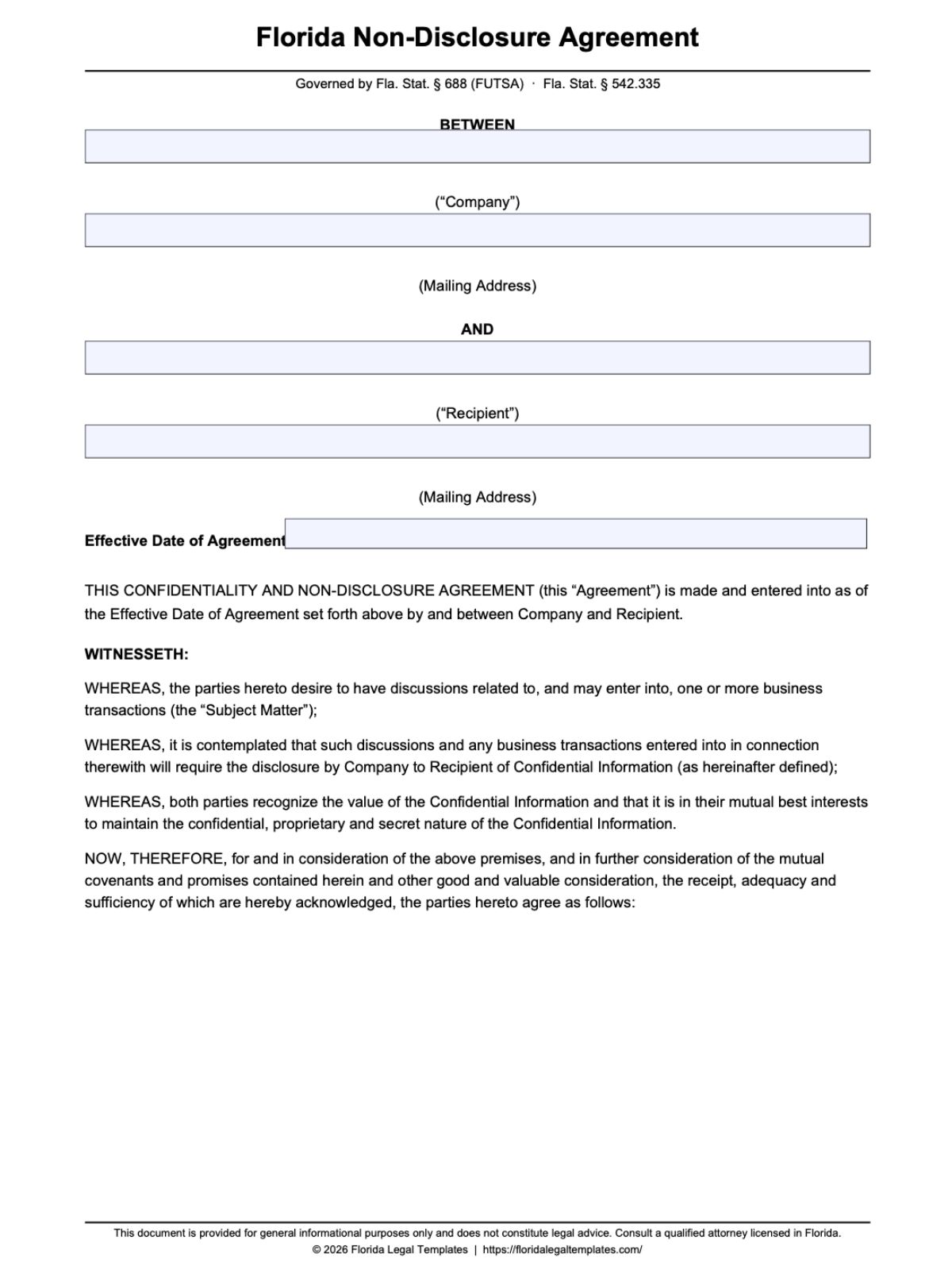
A florida non disclosure agreement template provides a structured, ready-to-use format that ensures all key legal elements are included.
What the document includes:
- Identification of both parties (disclosing and receiving)
- Clear definition of “Confidential Information”
- Obligations of the receiving party (non-use and non-disclosure)
- Duration of confidentiality obligations
- Permitted disclosures, including legally required disclosures and the federal trade-secret immunity notice required by 18 U.S.C. § 1833(b) for agreements with employees, contractors, and consultants covered by that provision.
- Remedies in case of breach
Who should use this:
- Businesses protecting trade secrets or proprietary data
- Employers onboarding employees or independent contractors
- Startups sharing sensitive ideas with investors
- Individuals entering confidential negotiations
When this template may NOT be sufficient:
- Agreements involving non-compete or non-solicit clauses (must comply with Chapter 542)
- Multi-state or international NDAs
- High-value intellectual property transactions requiring custom drafting
A florida nda template works well for standard use cases but should be tailored for complex legal scenarios.
What Is a Florida Non Disclosure Agreement?
A non disclosure agreement florida is a private contract that legally restricts how confidential information can be used or shared.
Legal framework:
- Trade-secret claims may be governed by the Florida Uniform Trade Secrets Act (FUTSA), while the NDA itself is also governed by applicable contract law
- General Florida contract law applies, with Chapter 725 relevant to certain Statute of Frauds issues
- May intersect with restrictive covenant laws under Chapter 542
Legal nuance:
An NDA does not automatically create trade secret protection. Under Florida law, protection depends on whether the disclosing party took “reasonable efforts” to maintain secrecy.
Critical distinction:
- Confidential information: Broad category defined in the agreement
- Trade secrets: Legally protected information meeting statutory criteria
Execution validity:
- Florida law does not generally require witnesses or notarization for an ordinary NDA
- A signed writing is important where a restrictive-covenant or Statute of Frauds issue applies
- Execution requirements can depend on the agreement and the legal theory being used to enforce it
Practical implication:
A vague NDA can also make the trade-secret question harder because §688.002(4) asks whether the owner took efforts that were reasonable under the circumstances to maintain secrecy. The agreement is one part of that record; the company’s actual handling of the information matters too.
Many Florida businesses use NDAs alongside broader operational contracts to protect confidential workflows, pricing structures, and client relationships. When sensitive information is shared during ongoing professional services, pairing confidentiality provisions with a detailed business services contract or a structured consulting engagement agreement can help clarify both disclosure limits and performance obligations.
Key Florida Laws That Affect Florida non disclosure agreement
Summary of Applicable Laws
| Topic / Issue | Florida Legal Rule | Governing Statute |
|---|---|---|
| Governing Law | Trade secrets governed under FUTSA | Fla. Stat. Ch. 688 |
| Statute of Limitations | 3 years from discovery of misappropriation | Fla. Stat. § 688.007 |
| Statute of Frauds | A signed writing is required for an agreement that falls within § 725.01, including an agreement that cannot be performed within one year | Fla. Stat. § 725.01 |
| Age / Capacity | Florida generally removes the disability of nonage at age 18, but contracts involving minors can depend on the circumstances | Fla. Stat. § 743.07 |
| Reasonable Efforts Requirement | Must take steps to protect secrecy | Fla. Stat. § 688.002(4) |
Florida’s CHOICE Act (§§542.41–542.45), effective July 1, 2025, provides a separate framework for qualifying covered noncompete and garden-leave agreements, while §542.335 continues to govern other restrictive-covenant disputes.
Florida restrictive covenant rules frequently overlap with confidentiality disputes, especially in employee and contractor relationships. Businesses using NDAs to protect trade secrets should also understand how related employment agreement provisions and independent contractor terms interact with enforceability standards under Chapter 542.
Practical Impact & Document Clauses
These statutes directly determine whether your florida non disclosure agreement will actually hold up in court.
First, under Fla. Stat. § 688.002(4), information qualifies as a trade secret only if it derives independent economic value from not being generally known or readily ascertainable and is subject to efforts that are reasonable under the circumstances to maintain its secrecy.
- Access restrictions
- Confidential handling obligations
- Return or destruction of materials
Under FUTSA (§ 688.002), trade-secret protection depends on whether the owner took reasonable steps under the circumstances to maintain secrecy. A signed NDA can help document those efforts, but the company’s actual handling of the information also matters.
Second, timing matters. Under Fla. Stat. § 688.007, an action for misappropriation must be brought within three years after the misappropriation is discovered or, through reasonable diligence, should have been discovered.
Third Fla. Stat. § 725.01 requires a signed writing for an agreement that cannot be performed within one year from the date it is made. That rule should not be reduced to a blanket statement that every NDA with a confidentiality period longer than one year is unenforceable if oral.
Finally, contractual capacity matters Fla. Stat. § 743.07, which generally removes the disability of nonage at age 18; agreements involving minors can still require a closer look at the circumstances.
In real-world terms, these rules mean:
- A poorly drafted NDA may be unenforceable in whole or in part, depending on the provision and the legal theory being used to enforce it
- Oral agreements are unreliable for long-term protection
- Missing confidentiality protections can make it harder to show the reasonable secrecy efforts required for trade-secret protection
When to Use Florida non disclosure agreement
A florida nda should be used whenever confidential information is being shared and legal protection is needed.
Common use cases:
- Sharing business plans or proprietary strategies
- Hiring employees or independent contractors
- Discussing partnerships or investments
Practical scenarios:
- Startup pitching to investors
- Vendor or supplier agreements
- Handling sensitive customer or client data
When NOT to use:
- To conceal illegal activity or fraud
- When dealing with government entities subject to public records laws
- As a substitute for broader employment or intellectual property agreements
A Florida NDA works best when its confidentiality obligations match the information being protected and do not attempt to restrict conduct beyond what the parties actually need.
NDAs Do Not Automatically Keep Records Confidential in Government Contracts
One situation that surprises businesses is when they submit proprietary pricing, formulas, or technical proposals to a Florida state or local agency. Signing an NDA with a Florida government agency does not by itself create a blanket public-records exemption; the applicable statutory exemption must be satisfied.
Florida’s Public Records Act generally makes government records available for inspection unless a specific statutory exemption applies. If you are submitting trade-secret material to a Florida agency, confirm the applicable statutory exemption and follow the agency’s submission procedures; §119.0715 expressly protects a trade secret held by an agency when the statutory definition is satisfied. Simply stamping every page “Confidential” or relying on the NDA is usually not enough if the material does not meet the statutory definition. See Fla. Stat. § 119.0715 and Fla. Stat. § 688.002 for the applicable trade secret framework.
This comes up frequently in government bids, procurement responses, and public university research agreements. Before sharing proprietary information with a Florida public agency, verify whether a specific public records exemption applies and whether your submission procedures require separate identification of trade secret material. An NDA can support your position, but it does not replace Florida’s statutory public records rules.
Confidentiality agreements are especially common during early-stage business negotiations where financial projections, client lists, or proprietary systems are being discussed. In partnership discussions or joint ventures, businesses often combine NDAs with more detailed business ownership arrangements to define responsibilities, profit allocation, and confidentiality expectations at the same time.
How to Create or Fill Out the Florida Non Disclosure Agreement
Creating a florida non disclosure agreement template requires more than filling blanks—it requires legal clarity.
Step-by-step process:
- Identify the parties
- Include full legal names and roles (disclosing vs receiving)
- Define confidential information
- Specify categories such as trade secrets, business data, or client lists
- Set obligations
- Clearly state non-use and non-disclosure requirements
- Include “reasonable efforts” language
- Limit access to authorized individuals
- Require secure handling
- Include return or destruction clause
- Define duration
- Specify how long confidentiality obligations last
- Include legal exceptions
- Allow disclosure for:
- Court orders
- Subpoenas
- Government requests
- Allow disclosure for:
- Add remedies clause
- Include injunctive relief and damages
- Execute agreement
- Signed by both parties
Practical tips:
- Avoid vague definitions of confidential information
- Keep obligations clear and enforceable
- Adjust duration based on the sensitivity of the information
If the NDA relates to a product sale, intellectual property transfer, or staged business acquisition, parties may also need separate written purchase and sale terms outlining payment obligations, deliverables, and transfer conditions beyond confidentiality alone.
Limitations and Legal Considerations
A florida non disclosure agreement is powerful but not unlimited.
Key limitations:
- Cannot override subpoenas or court orders
- Cannot be used to conceal illegal conduct
Florida-specific constraints:
- NDAs cannot override public records laws for government entities
- Must comply with FUTSA requirements to protect trade secrets
High-risk scenarios:
- Using NDA to suppress evidence of wrongdoing
- Drafting overly broad or vague confidentiality definitions
Edge cases:
- Government contracts subject to public disclosure laws
- Employee agreements requiring federal whistleblower protections
- Multi-state agreements with conflicting legal requirements
Understanding these limits can help a business separate ordinary confidentiality obligations from trade-secret protection, public-records issues, and restrictive-covenant requirements under Florida law.
The De Facto Non-Compete Truncation Trap
While a properly structured non-disclosure agreement in Florida can protect proprietary technical data or trade secrets for an appropriate period, an aggressive drafting error can create a separate restrictive-covenant issue. A Florida confidentiality provision can be analyzed under Fla. Stat. § 542.335 when it functions as a restrictive covenant, including in some employment and business disputes; whether that framework applies depends on the provision and the interests being protected.
If a business defines confidential information so broadly that it encompasses general industry knowledge, routine job functions, or public skills, the provision may face an enforceability challenge under § 542.335. For a post-employment restrictive covenant that is not predicated on trade-secret protection, Fla. Stat. § 542.335(1)(d)1 creates a rebuttable presumption that a restraint lasting more than two years is unreasonable. That is a presumption about the restraint’s reasonableness, not an automatic expiration of the confidentiality obligation. Trade-secret restraints have a separate rebuttable presumption under § 542.335(1)(e), with five years or less presumed reasonable and more than ten years presumed unreasonable.
An NDA should not be used as a substitute for broader legal authority or financial control documents. For example, businesses handling sensitive financial or operational decisions may require separate instruments such as a Florida power of attorney form when authorization rights—not confidentiality obligations—are the primary legal concern.
Common Mistakes to Avoid
Failing to include reasonable secrecy protections
Consequence: A signed NDA alone does not establish trade-secret status. Under Fla. Stat. § 688.002(4), the owner must take efforts that are reasonable under the circumstances to maintain the information’s secrecy.
Assuming every long-term NDA falls under the one-year rule
Consequence: Fla. Stat. § 725.01 applies when an agreement cannot be performed within one year from the date it is made. It should not be reduced to a rule that every NDA lasting more than one year is unenforceable unless written.
Drafting vague confidentiality definitions
Consequence: A definition that reaches general knowledge, publicly available information, or information outside a legitimate business interest can create enforceability problems, particularly if the provision is being enforced as a restrictive covenant under Fla. Stat. § 542.335.
Ignoring restrictive covenant laws
Consequence: If an NDA also contains a non-compete, non-solicit, or other restrictive provision, the applicable requirements of Chapter 542 should be reviewed separately.
Using NDA to conceal unlawful activity
Consequence: Confidentiality language cannot be relied on as a substitute for compliance with applicable law, and certain disclosures may be protected or required by law.
Frequently Asked Questions (FAQ)
Is a Florida NDA enforceable without notarization?
Yes. Florida law does not require notarization for an NDA to be legally binding.
How long can a non disclosure agreement last in Florida?
An NDA can last for a reasonable duration, but Fla. Stat. § 725.01 may require a signed writing when the agreement cannot be performed within one year from the date it is made.
What qualifies as a trade secret under Florida law?
Information must have economic value and be protected through reasonable efforts under Fla. Stat. § 688.002.
Can an NDA override a subpoena or court order?
No. An NDA cannot prevent disclosure required by law, but it can require notice before disclosure.
The strongest Florida NDA is not necessarily the longest one. It identifies the information being protected, limits use and disclosure to what the parties actually need, and—where trade-secret protection is important—works alongside reasonable operational safeguards under Fla. Stat. § 688.002.
Legal Disclaimer: This Florida non-disclosure agreement template and the information on this article are provided for general informational purposes only and do not constitute legal advice. Laws and circumstances vary, and you should consult a qualified Florida attorney before relying on or using this document for your specific situation.