
Florida Last Will and Testament [Free PDF & Word Template]
A Florida last will and testament law recognizes as valid requires two witnesses who sign in the presence of the testator and each other — but validity and practicality are two different things, and the distinction matters most to the family you leave behind. Under F.S. § 732.502, a notary is not required to make a will legally valid in Florida, A self-proving affidavit under § 732.503 is optional, but it can make probate easier by avoiding the need for additional proof of execution. of execution.
I’ve seen families navigate an otherwise straightforward estate get delayed for weeks because a florida last will and testament form they found online didn’t include the self-proving affidavit section, and one of the witnesses had moved out of state. The florida last will and testament template below includes the self-proving affidavit language so the people you’re protecting don’t have to solve an administrative problem while they’re grieving.
Candice Hayden, Legal Writer
Maria Rosso, Florida Probate, Guardianship and Estate Planning Attorney
Free Florida Last Will and Testament Template (PDF & Printable)
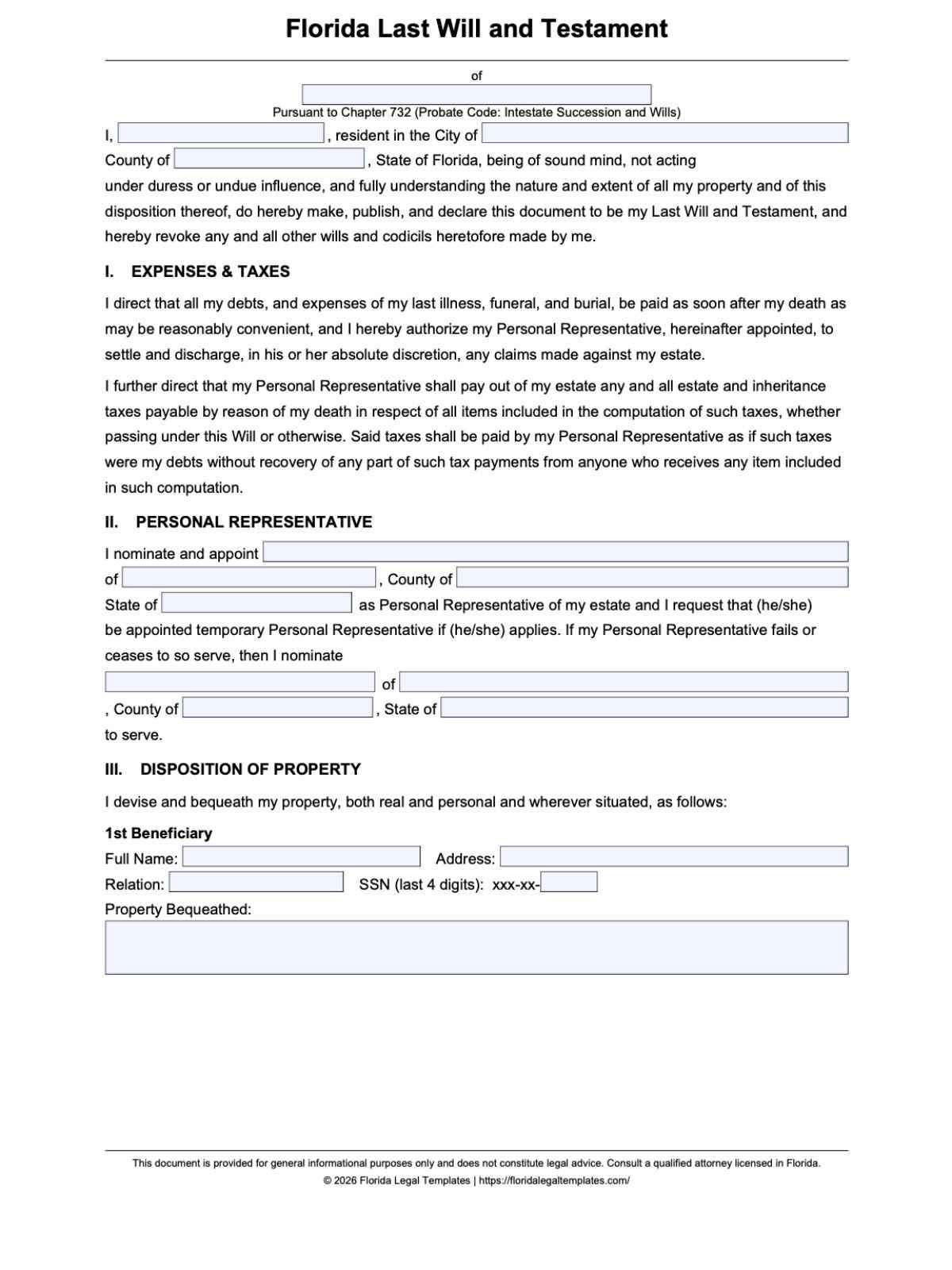
A Florida last will and testament template should do more than provide blank spaces for beneficiaries. It should give the testator a clear place to name a personal representative, address the residuary estate, nominate guardians when appropriate, and complete the witness and self-proving language required for Florida probate.
- Identifying the testator
- Naming beneficiaries
- Appointing a personal representative (executor)
- Naming guardians for minor children
- Distributing personal and residual property
- Witness attestation language
- A self-proving affidavit
A free Florida last will and testament template may work well for someone with a relatively straightforward estate. For example, a married couple with adult children and standard assets may only need a simple last will Florida form to organize probate instructions.
However, a downloadable Florida last will and testament PDF is not always enough for more complicated situations. Extra caution is usually necessary when dealing with:
- Blended families
- Significant business ownership
- Special needs beneficiaries
- Complex tax planning
- Florida homestead property
- Potential family disputes
Florida homestead rules alone can create serious legal problems if the will attempts to transfer a primary residence in violation of state law. A generic form may not account for those restrictions.
Many people also search for:
- Free printable Florida last will and testament form
- Last will and testament Florida PDF
- Sample last will and testament Florida documents
- While the Florida Bar provides educational brochures, they do not provide a “free official template” to the public. High-quality templates generally follow Florida’s statutory execution requirements and include the provisions needed to address the testator’s intended estate plan.
Using a sample can help you understand structure and formatting, but the document still needs to comply with Florida probate requirements to be enforceable.
What Is a Florida Last Will and Testament?
A Florida last will and testament is the document a person uses to state how qualifying probate property should pass after death. Florida law calls the person making the will the ‘testator,’ and § 732.501 requires the testator to be at least 18 or an emancipated minor and of sound mind.
The will can:
- Name beneficiaries
- Appoint a personal representative
- Nominate guardians for minor children
- Specify how probate assets should be distributed
A personal representative is the individual responsible for administering the estate during probate. This includes collecting assets, paying debts, and distributing property according to the will.
A Florida will only controls probate assets. It generally does not override:
- Joint tenancy property
- Beneficiary-designated retirement accounts
- Life insurance proceeds
- Payable-on-death accounts
- Trust assets
This distinction matters because many people mistakenly assume their will controls every asset they own. In practice, beneficiary designations and ownership structure often determine what bypasses probate entirely.
A Florida last will and testament also remains private during the testator’s lifetime. It is not filed with the court while the person is alive.
Many people preparing a will also create supporting incapacity planning documents at the same time. For example, a durable financial authority document can allow someone to manage finances during incapacity, while a Florida advance healthcare directive addresses end-of-life medical decisions that a standard will does not cover.
Key Florida Laws That Affect This Document
Summary of Applicable Laws
| Topic / Issue | Florida Legal Rule | Governing Statute |
|---|---|---|
| Testamentary Capacity | Testator must be at least 18 and of sound mind | Fla. Stat. § 732.501 |
| Witness Requirements | Will must be signed before two attesting witnesses | Fla. Stat. § 732.502(1) |
| Self-Proving Affidavit | Not required for validity but requires notarization | Fla. Stat. § 732.503 |
| Filing Deadline After Death | Original will must be deposited within 10 days after learning of death | Fla. Stat. § 732.901 |
| Elective Share Rights | Surviving spouse may claim 30% elective share | Fla. Stat. §§ 732.201 & 732.2065 |
| Homestead Restrictions | Homestead cannot be devised improperly if survived by spouse or minor child | Fla. Stat. § 732.4015 |
| Holographic & Oral Wills | Unwitnessed handwritten and oral wills are invalid | Fla. Stat. § 732.502(2) |
Florida probate courts strictly enforce these requirements. A will that fails execution formalities can be rejected entirely, which may cause the estate to pass through intestate succession instead of following the testator’s wishes.
A defective will can create problems during probate, especially when execution is disputed or the document contains unclear provisions. Florida’s execution rules under § 732.502 are therefore worth checking before the will is signed.
You can review the governing Florida probate laws directly through the Florida Legislature website:
Florida Witness Requirements for a Valid Will
Under Florida law, the testator must:
- Be at least 18 years old or an emancipated minor
- Be of sound mind
- Sign the will at the end of the document
Pursuant to Florida Statutes § 732.502(1), the signing must occur in the presence of at least two witnesses. The witnesses must also sign in the presence of the testator and in the presence of each other.
This is where many DIY wills fail. A will signed casually at home without all parties present at the same time may later become vulnerable to probate challenges.
If the will is invalidated, Florida intestate succession laws could determine who inherits instead.
Self-Proving Affidavit Requirements
A Florida will does not need to be notarized to be legally valid. However, A self-proving affidavit is optional, but many people include one because it can simplify proof of the will during probate.
Under Fla. Stat. § 732.503, the testator’s acknowledgment and the witnesses’ affidavits must be made before an officer authorized to administer oaths, with the officer’s certificate attached to or following the will.
The statute includes required wording beginning with:
“I, [Testator], declare to the officer taking my acknowledgment of this instrument…”
A properly executed self-proving affidavit can:
- Eliminate the need to locate witnesses later
- Speed up probate administration
- Reduce court complications
Without it, witnesses may need to testify regarding the authenticity of the will years after signing.
Florida Homestead Restrictions
Florida homestead law creates unique estate planning restrictions that many generic will templates ignore.
If the testator is survived by:
- A spouse, or
- A minor child
Florida law generally prohibits the homestead property from being devised to someone else. Under Fla. Stat. § 732.4015, protected homestead generally is not subject to devise when the owner is survived by a spouse or minor child, subject to the statutory exceptions.
This commonly affects:
- Second marriages
- Blended families
- Unequal inheritance plans involving the family home
A will that ignores homestead restrictions can create probate litigation even when the rest of the document is properly drafted.
Homestead disputes often become more complicated when family members continue occupying inherited property after death. In situations involving rental income, shared occupancy, or inherited residential property, related documents such as a Florida room rental arrangement or residential leasing documentation may become relevant during estate administration.
Spousal Rights and Elective Share Rules
Florida generally does not allow a spouse to be completely disinherited through a will alone.
Under Florida Statutes §§ 732.201 and 732.2065, a surviving spouse may claim a 30% elective share of the “Elective Estate.” The elective estate is broader than the probate estate and can include specified non-probate property interests, including certain survivorship accounts, revocable transfers, insurance interests, and retirement benefits, subject to statutory exclusions.
This issue frequently appears in:
- Second marriages
- Late-life remarriages
- Blended family estate plans
Someone may leave most property to children from a prior relationship in the will, only to discover later that the surviving spouse still has statutory inheritance rights.
Holographic and Oral Wills and Florida Execution Requirements
For an ordinary Florida will, the document must satisfy the execution requirements in § 732.502. Florida law also contains a separate rule for certain wills executed by nonresidents.
- Oral wills
- Unwitnessed handwritten wills
A handwritten document intended as a Florida will must still satisfy Florida’s applicable will-execution requirements; simply writing and signing a document by hand does not substitute for the formalities required by § 732.502.
This creates problems for people who:
- Write informal “backup wills”
- Make handwritten edits after execution
- Assume a signed handwritten document automatically becomes valid
A handwritten change made after execution does not become an effective Florida testamentary amendment simply because the testator signed it. Any replacement will or codicil still has to satisfy Florida’s execution requirements.
Practical Impact & Document Clauses
The clauses worth checking most carefully are the ones tied to Florida’s execution rules:
The witness attestation, personal-representative appointment, revocation language, and self-proving affidavit. For a Florida homestead, the will should also be reviewed against § 732.4015 rather than assuming a generic devise clause will control.
Common probate disputes often involve:
- Improper execution
- Conflicting beneficiary designations
- Missing signatures
- Ambiguous residual estate clauses
Even a small execution mistake can become a probate problem if the court cannot determine that the will was signed with the formalities required by Fla. Stat. § 732.502.
When to Use a Florida Last Will and Testament
A Florida last will and testament is commonly used by:
- Parents with minor children
- Married couples
- Florida property owners
- Individuals wanting to avoid intestate succession
- People updating older out-of-state wills
The document is especially important for parents because it allows them to nominate guardians for minor children.
However, a will alone may not fully address:
- Medicaid planning
- Probate avoidance
- Asset privacy concerns
- Large taxable estates
In those situations, additional estate planning tools like trusts may also be necessary.
July 2026 Update: Effective July 1, 2026, Florida’s summary-administration threshold increases from $75,000 to $150,000, measured after excluding property exempt from creditor claims. Summary administration provides a simplified probate procedure for qualifying estates.
A will is only one part of a broader estate planning strategy. Families with smaller estates may also benefit from reviewing Florida’s simplified probate transfer options, including the small estate affidavit process, which can sometimes reduce the complexity of formal probate administration.
How to Create or Fill Out the Florida Last Will and Testament
Identify the Testator
Use the testator’s full legal name and Florida residency information. The document should clearly establish testamentary intent and capacity.
Revoke Prior Wills
Most wills contain a revocation clause stating that all prior wills and codicils are revoked. This helps avoid conflicts between multiple estate planning documents.
Name Beneficiaries
Clearly identify:
- Primary beneficiaries
- Alternate beneficiaries
- Residual beneficiaries
Clear beneficiary descriptions matter in Florida probate because the personal representative and court may have to determine exactly who is entitled to receive a particular devise under the will.
Appoint a Personal Representative
The personal representative manages probate administration. Naming a backup representative is also recommended in case the primary choice cannot serve.
Nominate Guardians for Minor Children
Parents commonly use wills to nominate guardians for minor children. Courts still retain final authority, but the nomination carries substantial weight.
Address Florida Homestead Property Carefully
Florida homestead restrictions can override portions of a will. Families with complex ownership structures or blended family issues should proceed carefully.
Execute the Will Properly
Florida execution requirements are strict:
- Two witnesses are required
- Arrange the signing so the testator and both witnesses are present as required by Florida law
- The testator must sign at the end
Failure to follow the proper signing sequence may invalidate the document.
Add a Self-Proving Affidavit
A notarized self-proving affidavit simplifies probate and reduces evidentiary problems later.
Store the Original Will Safely
The original signed will should be stored securely. Under Fla. Stat. § 732.901, the custodian must deposit it with the clerk of the court having venue of the estate within 10 days after receiving information that the testator is dead.
Estate plans often work best when financial authority and probate instructions are coordinated together. While the will controls post-death asset distribution, a Florida power of attorney document can help manage financial and legal matters during the testator’s lifetime if incapacity occurs before death.
Limitations and Legal Considerations
A Florida last will and testament generally directs how probate assets should be distributed, but the will itself does not eliminate the probate process. Whether probate is required and which procedure applies depends on the assets and circumstances of the estate.
The document also does not control:
- Trust assets
- Joint property
- Retirement accounts
- Life insurance with named beneficiaries
Florida-specific legal limitations include:
- Elective share rights
- Homestead restrictions
- Strict witness requirements
Electronic wills also follow separate rules under Florida law. Under Florida Statutes § 732.522, additional procedural safeguards apply during remote online execution sessions.
Because a will does not automatically avoid probate, some families later need supplemental probate documentation depending on the estate structure and tax issues involved. In more complex administrations, documents such as an affidavit confirming no Florida estate tax is due may become relevant during court filings and asset transfers.
The Electronic Wills “Vulnerable Adult” Remote Witnessing Trap
Under Florida’s Electronic Wills Act (Fla. Stat. §§ 732.521–732.526), an electronic will may be executed using electronic signatures and audio-video communication technology when the statutory online-notarization requirements are satisfied. Current Florida law does impose additional safeguards for remote witnessing of an electronic will. Under Fla. Stat. § 117.285, remote witnessing is not effective for a principal who is a vulnerable adult, and an affirmative answer to certain required questions requires the witnesses to be physically present.
For an electronic will, the testator and witnesses may use audio-video communication technology when the requirements of Fla. Stat. § 732.522 and the applicable online-notarization rules are satisfied. Remote witnessing is subject to additional safeguards under Fla. Stat. § 117.285, including a rule making remote witnessing ineffective when the principal is a vulnerable adult.
Because a will does not automatically avoid probate, some families later need supplemental probate documentation depending on the estate structure and tax issues involved. In more complex administrations, documents such as an affidavit confirming no Florida estate tax is due may become relevant during court filings and asset transfers.
Common Mistakes to Avoid
One of the most common mistakes is using an unwitnessed handwritten will. Florida courts generally will not enforce it.
Other major mistakes include:
- Improper witness execution
- Forgetting to revoke prior wills
- Naming unavailable executors
- Ignoring homestead restrictions
- Attempting to disinherit a spouse improperly
Review a Florida will after a marriage, divorce, birth or adoption, or major change in assets. Those events can affect beneficiary designations, personal-representative choices, guardianship nominations, and the way the residuary estate should be handled.
Another practical problem is storing only a digital copy. Florida law requires the custodian of a will to deposit the will with the appropriate clerk within 10 days after learning of the testator’s death, and § 732.901 requires the original to be preserved.
Don’t “Edit” Your Will With Pen Marks or Sticky Notes
One issue that appears in real probate files is a will covered with handwritten changes made years after it was signed. In Florida, crossing out a beneficiary, writing a new gift in the margin, or attaching handwritten instructions does not substitute for a properly executed amendment or codicil. A codicil must satisfy the same execution formalities as a will under Fla. Stat. § 732.502(5), while notarization is not required for the will itself. (Statutory authority: Fla. Stat. § 732.502).
Florida law does not permit a testator to use an informal physical alteration as a substitute for the statutory requirements governing revocation. Under Fla. Stat. § 732.506, a testator can revoke a will by intentionally burning, tearing, canceling, defacing, obliterating, or destroying the entire document (or directing another person to do so in their presence). However, partially crossing out only a few lines or names does not legally delete those provisions. In fact, Florida courts will generally ignore the strike-throughs and probate the willas originally written (Cioeta v. Estate of Linet, 850 So. 2d 562).
If your wishes have changed, executing a properly witnessed new will that expressly revokes all prior wills or executing a formal codicil is the only legally effective way to ensure your updated intentions are honored.
Frequently Asked Questions (FAQ)
Does a Florida last will and testament need to be notarized?
No. Florida law does not require notarization for the will itself to be valid. However, a notarized self-proving affidavit can simplify probate administration.
What happens if a Florida will is not signed correctly?
A probate court may reject the will entirely. If that happens, the estate could pass under Florida intestate succession laws instead of following the document’s instructions.
Can I write my own handwritten will in Florida?
Florida does not recognize an unwitnessed holographic will for a Florida resident. A handwritten will must still comply with Florida’s execution requirements under Fla. Stat. § 732.502(1).
How long after death must a will be filed in Florida probate court?
Under Fla. Stat. § 732.901, the custodian of the original will must deposit it with the appropriate probate court within 10 days after learning of the testator’s death.
Can a spouse contest a Florida last will and testament?
A surviving spouse may have elective-share rights under Florida law even if the will attempts to leave them little or nothing.
Does a Florida last will avoid probate?
No. A will generally directs how probate assets should be distributed, but it does not eliminate probate itself.
Legal Disclaimer: This article provides general information about Florida wills and is not legal advice. Laws and individual circumstances vary, so consult a qualified Florida attorney for advice about your specific estate plan or situation.