
Florida Bill of Sale Template (Free Printable PDF)
A Florida bill of sale is one of those documents people tend to skip until something goes wrong, and by then the absence of it becomes the entire problem. Under Florida’s Uniform Commercial Code framework, Fla. Stat. § 672.201 generally requires a record sufficient to indicate a contract for the sale of goods priced at $500 or more, signed by the party against whom enforcement is sought, for the contract to be enforceable under the Statute of Frauds. A handshake transaction can create proof problems, but payment or acceptance may still matter because Florida law recognizes an exception when payment for the goods has been made and accepted, or when the goods have been received and accepted.
I’ve seen situations where someone sold a boat motor, a trailer, or a piece of equipment for a few thousand dollars with nothing but a text message as proof, and when the buyer came back claiming it never transferred or the seller claimed it was never paid for, there was no document for either side to stand on. Whether you need a free Florida bill of sale for a one-time personal property transfer or a Florida bill of sale PDF you can reuse for future transactions, the template below covers what Florida law expects that a generic receipt form typically doesn’t.
Candice Hayden, Legal Writer
Carly Johansson, Florida Contract Attorney Last updated: September 23, 2026
Florida Bill of Sale (PDF, Printable, Fillable)
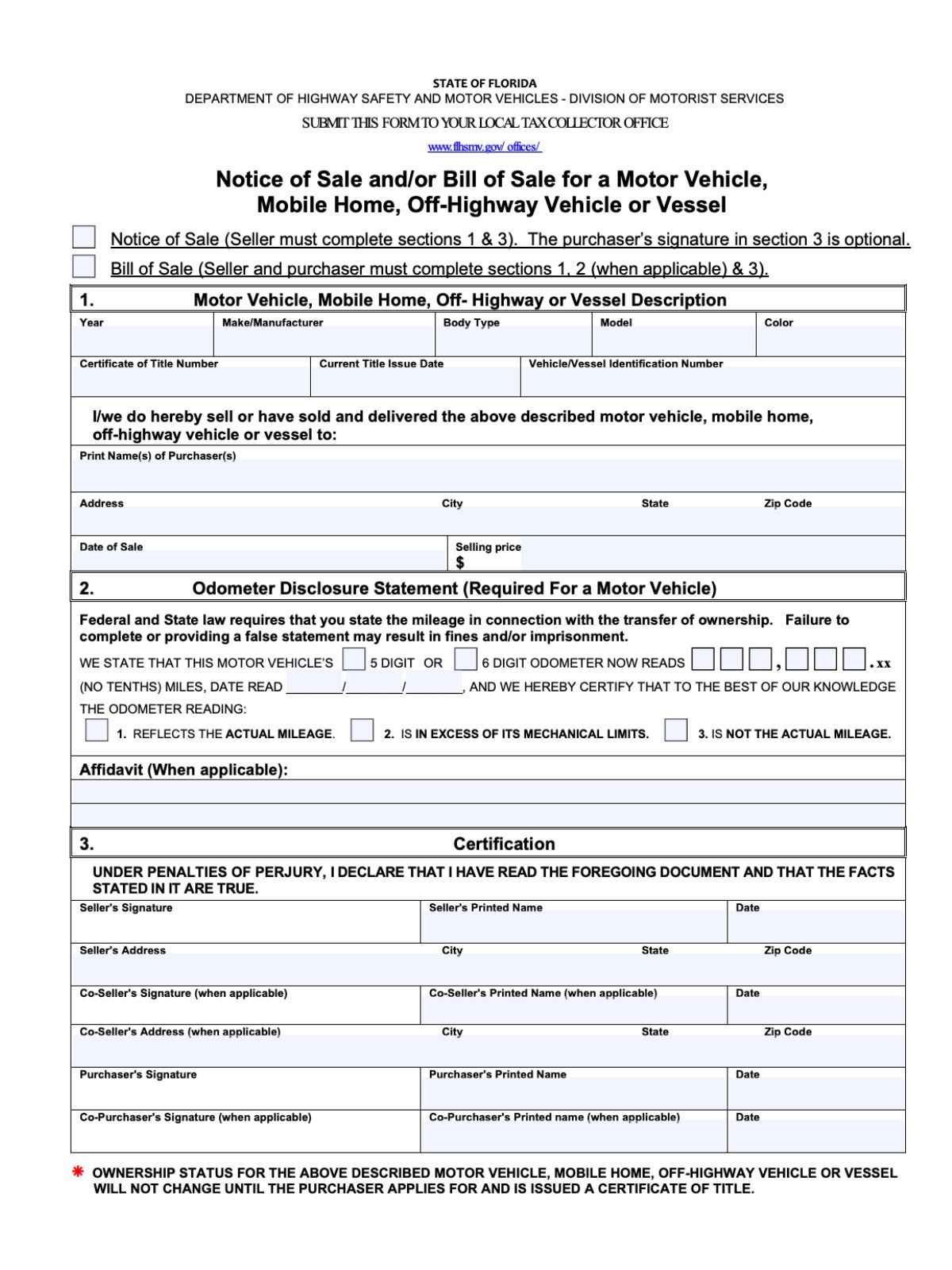
A Florida bill of sale template provides a standardized way to document a transaction clearly and legally.
What the document includes:
- Buyer and seller full legal information
- Description of the item (vehicle, goods, or vessel)
- Purchase price and payment method
- Warranty terms (including “as-is” language if applicable)
- Signatures of both parties
Who should use this:
- Private individuals selling personal property
- Buyers needing proof of purchase
- Sellers documenting vehicle or boat transactions
When this template may NOT be sufficient:
- Motor vehicle sales without proper title transfer
- Complex commercial agreements requiring detailed contracts
- Situations requiring notarization for added fraud protection
A printable Florida bill of sale works best for straightforward transactions, but legal compliance still depends on the type of property involved.
What Is a Florida Bill of Sale?
A Florida bill of sale is a written record of a sale that identifies the property, the parties, the price, and the agreed terms. Its legal effect depends on what is being sold: a general item may be documented by the bill of sale, while a titled motor vehicle or vessel may require separate title or registration steps under Florida law.
Legal framework:
- Governed by:
- Uniform Commercial Code (Fla. Stat. Chapter 672) for sales of goods
- Motor vehicle laws (Fla. Stat. Chapter 319)
- Vessel laws (Fla. Stat. Chapter 328)
Key legal nuance:
The document proves that a transaction occurred, but it does not always transfer ownership.
- General goods: A bill of sale can document the transaction, but additional contract terms or requirements may apply depending on the sale.
- Motor vehicles: A bill of sale does not replace the required title transfer.
Execution validity:
- Not generally required for an ordinary bill of sale
- Separate execution or documentation requirements may apply to certain property transactions
Practical implication:
The biggest mistake is treating the bill of sale as a substitute for the vehicle title. Under Fla. Stat. § 319.22, a purchaser of a motor vehicle generally does not acquire marketable title until the certificate-of-title requirements are satisfied.
While a standard bill of sale covers most personal property transfers, the legal requirements shift significantly based on what’s being sold. If you’re transferring a vehicle, the Florida car bill of sale includes the mandatory odometer and title assignment language that a general form omits — and for watercraft, the Florida boat bill of sale should account for the Hull Identification Number and other information required for vessel registration under Chapter 328
Key Florida Laws That Affect Florida Bill of Sale
Summary of Applicable Laws
| Topic / Issue | Florida Legal Rule | Governing Statute |
|---|---|---|
| Statute of Frauds | Written contract required for goods ≥ $500 | Fla. Stat. § 672.201 |
| Notice of Sale (Vehicles) | Seller must notify the department within 30 days after a bona fide sale or transfer, subject to statutory exceptions | Fla. Stat. § 319.22(2) |
| Odometer Disclosure | Required for covered used motor vehicles, subject to statutory exemptions based on vehicle type and model year | Fla. Stat. § 319.225 |
| Rebuilt Vehicle Requirements | Florida law requires applicable rebuilt, salvage, flood, and other title-brand designations to be properly reflected on the certificate of title before the vehicle is offered for sale | Fla. Stat. § 319.14 |
| Age and Contracting Capacity | Florida generally removes the disability of nonage at age 18, but Fla. Stat. § 743.07 is not a universal rule that every contract requires both parties to be 18 or older | Fla. Stat. § 743.07 |
For sellers moving goods as part of a recurring or business arrangement, a standalone bill of sale may not provide enough legal protection. A Florida sales agreement offers more detailed terms around delivery, payment schedules, and breach remedies — making it a stronger fit when the transaction involves ongoing obligations rather than a simple one-time exchange.
Practical Impact & Document Clauses
These rules directly shape how a Florida bill of sale pdf or form should be drafted and used.
For sales of goods priced at $500 or more, Fla. Stat. § 672.201 generally requires a signed record sufficient to indicate that a contract was made. A bill of sale can satisfy that role when it contains the required information and is signed by the party against whom enforcement is sought.
For motor vehicles, the legal requirements are stricter. A seller who makes a bona fide sale and delivers possession should notify the department within 30 days as provided by Fla. Stat. § 319.22; that notice can satisfy the statutory notice requirement used to limit the seller’s potential civil liability. Without this step, the seller could remain responsible for parking tickets, toll violations, or even accidents involving the buyer.
For applicable vehicle transactions, the title and transfer paperwork must also comply with Florida’s vehicle-specific requirements, including the odometer disclosure requirements of Fla. Stat. § 319.225 and applicable title-brand requirements under Fla. Stat. § 319.14.
Another important clause is the warranty disclaimer. For transactions governed by Chapter 672, Florida law recognizes expressions such as “as is” or “with all faults” as language that can exclude implied warranties unless the circumstances indicate otherwise.
Failure to follow these rules can lead to:
- Unenforceable agreements
- Continued liability after sale
- Fraud allegations (especially in odometer disclosures)
When to Use Florida Bill of Sale
A Florida bill of sale form should be used whenever personal property is transferred between parties.
Common use cases:
- Selling personal property when you want a clear written record
- Private vehicle sales where the bill of sale supplements the title documents
- Vessel transactions where the bill of sale may also serve a registration purpose during the statutory temporary period
Practical scenarios:
- Cash sales where the parties need a written record of payment and delivery
- Vehicle or vessel sales where additional title or registration paperwork is required
- Transactions where the parties want a clear record of the item’s condition and agreed price
When NOT to use:
- Transferring vehicle ownership without title
- Informal agreements without documentation
- Complex commercial transactions
Using a simple bill of sale Florida helps protect both parties by clearly documenting the transaction.
How to Create or Fill Out the Florida Bill of Sale
Creating a blank bill of sale Florida requires attention to both detail and legal compliance.
Step-by-step process:
- Identify the parties
- Full legal names and contact details
- Describe the property
- Include detailed description
- For vehicles: VIN, Make, Model, Year, Body Type, and Color. For vessels: Hull Identification Number (HIN), Length, and Propulsion type.
- State the purchase price
- Include amount and payment method
- Include warranty terms
- “As-is” or specific warranties
- Add required disclosures (if applicable)
- Odometer reading for vehicles
- Rebuilt/salvage disclosure
- Sign the document
- Both parties must sign
- File Notice of Sale (vehicles only)
- Notify the department within 30 days after the sale or transfer, as required by Fla. Stat. § 319.22
Practical tips:
- Keep copies for both buyer and seller
- Use clear, specific descriptions to avoid disputes
- Never rely solely on verbal agreements
Limitations and Legal Considerations
For ordinary sales of goods, the bill of sale is usually retained by the buyer and seller rather than filed with the state. The important exception is specialized property: Florida’s motor-vehicle and vessel laws impose separate title and registration requirements, so the bill of sale should be treated as supporting documentation rather than a substitute for those procedures.
Key limitations:
- Cannot replace title transfer for motor vehicles
- Does not guarantee ownership without proper title
Legal constraints:
- Must comply with odometer disclosure requirements
- Must include valid warranty disclaimers
High-risk scenarios:
- Selling a vehicle without transferring title
- Failing to file Notice of Sale
Edge cases:
- Cash transactions without documentation
- Disputes over item condition
The practical takeaway is simple: use the bill of sale to document the transaction, but do not treat it as a substitute for a vehicle title, vessel registration paperwork, or another property-specific requirement.
Your Bill of Sale Does Not Automatically Determine Vehicle Sales Tax
One issue that catches buyers off guard is assuming the amount written on the bill of sale is automatically the amount Florida will use to calculate sales tax. It often is not. When a privately purchased vehicle is titled, the county tax collector or license plate agency can question a purchase price that appears substantially below market value. For an occasional or isolated vehicle sale, Florida’s sales-tax statute uses a recognized reference price for covered vehicles. If the reported price is less than 80% of the applicable average loan price, the tax is generally computed using that average loan price unless the parties provide an affidavit or other substantial proof establishing the actual sales price.
This usually comes up in family sales, project cars, or vehicles sold with mechanical problems. If you legitimately paid less because the vehicle needed major repairs or had accident damage, keep evidence such as repair estimates, photographs, maintenance records, or messages discussing the defects before the sale. Those documents can help explain why the purchase price was lower than expected.
The bill of sale should always state the actual purchase price. Listing a lower amount to reduce taxes can create far more expensive problems later if the transaction is audited or investigated. A few extra minutes documenting the real condition of the vehicle at the time of sale can save both parties significant time and money during registration.
Common Mistakes to Avoid in Florida Bill of Sale
Using bill of sale as substitute for vehicle title
For titled motor vehicles, a bill of sale alone does not replace the certificate-of-title transfer required by Florida law.
Consequence: A bill of sale alone does not complete the title-transfer process for a titled motor vehicle.
Failing to include odometer disclosure
Required for most vehicle sales.
Consequence: Failing to complete the applicable title-transfer and statutory notice steps can leave the seller exposed to ownership and civil-liability disputes. Failing to satisfy the statutory title-transfer and notice requirements can leave the seller exposed to disputes over ownership and potential civil liability under Fla. Stat. § 319.22.
Not filing Notice of Sale within 30 days
Required to protect the seller.
Consequence: Continued liability for the vehicle.
Omitting “as-is” warranty language
Leaves seller exposed to implied warranties.
Consequence: Buyer may claim defects after sale.
Using vague descriptions
Unclear item details create disputes.
Consequence: Difficulty enforcing agreement.
Relying on verbal agreements
No written proof of transaction.
Consequence: Contract may be unenforceable.
A vehicle sale can create another problem when the seller overlooks the notice and title requirements or when the property is still subject to a lien. Before completing the transaction, check the title and make sure any recorded security interest is properly addressed. If a buyer later faces a repossession situation tied to unpaid debt on personal property, a Florida affidavit of repossession may be required to formally document the recovery. Sellers dealing in trailers or towed equipment should also review the Florida trailer bill of sale, which handles the specific disclosure requirements that apply to non-motorized towed vehicles.
Frequently Asked Questions (FAQ)
Is a bill of sale required to sell a car in Florida?
It is commonly used but not sufficient alone. A properly assigned title must also be transferred.
Does a Florida bill of sale transfer ownership of a vehicle?
No. Ownership transfers only when the title is properly assigned under Florida law.
What happens if I don’t file a Notice of Sale in Florida?
You may remain legally responsible for the vehicle, including tickets or accidents, under Fla. Stat. § 319.22.
Do I need to notarize a bill of sale in Florida?
Generally no. Florida law does not impose a general notarization requirement on an ordinary bill of sale, although particular transactions or documents may have separate execution requirements. For a vessel, make sure the bill of sale and other ownership documents satisfy the applicable title and registration requirements.
A properly prepared Florida bill of sale gives the buyer and seller a clearer record of what was sold, for how much, and on what terms. For vehicles and vessels, it should be used alongside the applicable title, registration, and disclosure requirements rather than as a substitute for them.
Disclaimer: This article is for general informational purposes only and does not constitute legal advice. Florida laws may change, and the requirements for a bill of sale can vary depending on the property involved and the circumstances of the transaction. Consider consulting a qualified Florida attorney for advice about your specific situation.