
Florida Car Bill of Sale (Free Template PDF & Word)
A Florida car bill of sale does more than document the sale price and signatures — for the seller, it’s also the instrument that ends your legal connection to the vehicle, and most private sellers don’t realize those are two separate functions until something goes wrong after the sale. Florida’s HSMV Form 82050 is a dual-purpose document by design, combining the florida vehicle bill of sale the buyer needs for title transfer with a Notice of Sale section the seller must file with the tax collector’s office under F.S. §319.22(2) to cut off civil liability.
I’ve worked with sellers who used a generic auto bill of sale florida template they found online, handed it over at the driveway, and then received a toll invoice or an accident notice weeks later because their name was still in the DHSMV database as the registered owner. The template and instructions below are built around the official HSMV 82050 so both sides of the transaction are covered, not just the buyer’s half.
Candice Hayden, Legal Writer
Carly Johansson, Florida Contract Attorney
Florida Car Bill of Sale (PDF, Printable, Fillable)
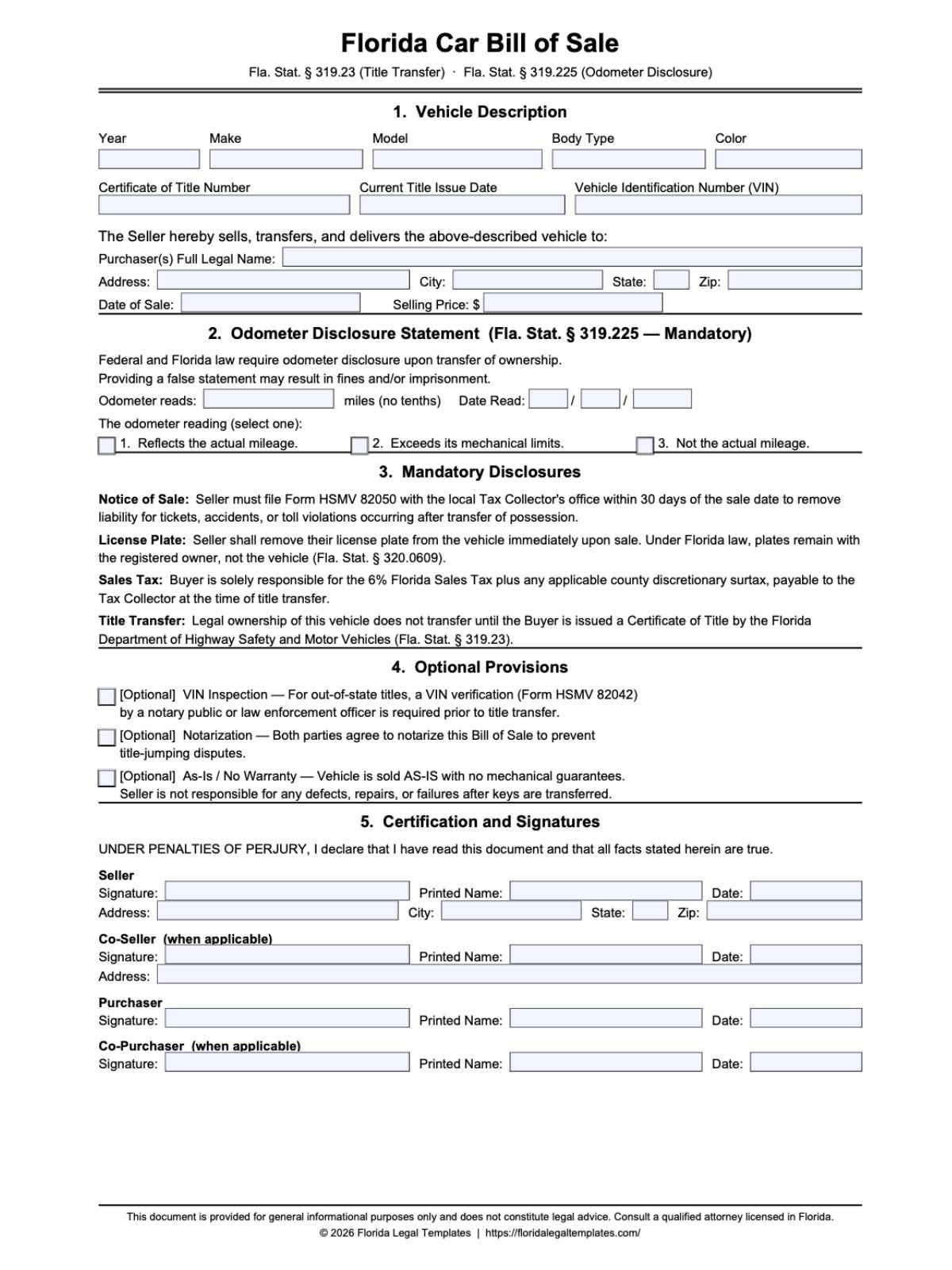
A Florida vehicle bill of sale pdf or fillable template provides a clear and standardized way to document a private car sale.
What the document includes:
- Buyer and seller identification
- Vehicle details (VIN, make, model, year)
- Purchase price and payment method
- Odometer disclosure section
- Warranty disclaimer (“AS IS” or similar language)
- Signatures of both parties
- Confirmation of Title Status (Paper vs. Electronic). If the title is electronic, the seller must print a paper copy or visit a tax collector’s office with the buyer to finalize the transfer.
Who should use this:
- Private individuals selling or buying used vehicles
- Sellers needing proof of transaction
- Buyers documenting purchase details
When this template may NOT be sufficient:
- When the vehicle title is not properly transferred
- Dealer-regulated transactions
- Complex financing or lien arrangements
Even a well-drafted auto bill of sale Florida cannot replace the legal requirement of transferring the vehicle title.
What Is a Florida Car Bill of Sale?
A Florida car bill of sale is a legally recognized contract that documents the terms of a motor vehicle transaction.
Legal framework:
- Governed by:
- Florida motor vehicle laws (Chapters 319 and 320)
- Uniform Commercial Code (Chapter 672)
Key legal nuance:
This document establishes the agreement between the parties, but it does not finalize ownership transfer.
- Bill of sale: Evidence of sale
- Title: Legal proof of ownership
Execution validity:
- No notarization required under Florida law
- No witness requirement
Practical implication:
If the buyer does not complete the title transfer, they cannot legally register or operate the vehicle—even if they have a signed bill of sale.
A car bill of sale sits within a broader category of personal property transfer documents under Florida law. If you’re also selling a vehicle that doesn’t require a Florida title — such as a towed unit — the trailer sale documentation process follows slightly different rules worth reviewing separately. For all other private property sales not involving motor vehicles, the general Florida bill of sale covers the baseline legal requirements under the UCC and Statute of Frauds.
How to Create or Fill Out the Florida Car Bill of Sale
Completing a Florida car bill of sale requires accuracy and attention to legal requirements.
Step-by-step process:
- Identify the parties
- Full legal names and contact information
- Describe the vehicle
- VIN, make, model, year, and condition
- State the purchase price
- Include payment method (cash, transfer, etc.)
- Add odometer disclosure
- Select the correct certification category (Actual, Excess, or Inaccurate). Note: Under Florida’s rolling 20-year framework (Fla. Stat. § 319.225(4)), model year 2011 and newer vehicles strictly require a completed odometer disclosure in 2026, while all model year 2010 and older vehicles are permanently exempt.
- Include warranty clause
- Use “AS IS” or clearly defined warranties
- Sign the document
- Both buyer and seller must sign
- Complete title transfer
- Properly assign the certificate of title
- File Notice of Sale (seller)
- Submit within 30 days
- Apply for new title (buyer)
- Submit within 30 days
Practical tips:
- Double-check VIN accuracy to avoid registration issues
- Keep copies for both parties
- Never rely on verbal agreements
Key Florida Laws That Affect This Document
Summary of Applicable Laws
| Topic / Issue | Florida Legal Rule | Governing Statute |
|---|---|---|
| Title Transfer Deadline (Buyer) | Must apply for new title within 30 days | Fla. Stat. § 319.23(6)(a) |
| Notice of Sale (Seller) | Must notify the state within 30 days to comply with motor vehicle codes; however, civil liability under the Dangerous Instrumentality Doctrine is only terminated upon actual filing or mailing of the notice. | Fla. Stat. § 319.22(2) |
| Odometer Disclosure | Mandatory mileage disclosure with certification | Fla. Stat. § 319.225 |
| Warranty Disclaimer | “AS IS” required to exclude implied warranties | Fla. Stat. § 672.316(3)(a) |
| Title Jumping Prohibited | Cannot sell without title in seller’s name | Fla. Stat. § 319.21 |
When a vehicle is sold with an outstanding lien, the transaction becomes considerably more complex than a standard private sale. In those situations, a Florida loan agreement may need to be executed separately to document any seller-financed arrangement, and the lien must be formally released before or at the time of title transfer — a step that a bill of sale alone cannot accomplish.
Practical Impact & Document Clauses
These legal requirements directly shape how a Florida car bill of sale must be completed and used.
First, the buyer must apply for a new title within 30 days under Fla. Stat. § 319.23. Missing this deadline can delay registration and lead to penalties.
Second, while the seller has a 30-day statutory window to file a Notice of Sale under Fla. Stat. § 319.22, waiting to do so leaves a dangerous liability exposure gap. Under Florida common law, the seller’s primary shield against vicarious liability for the buyer’s actions remains inactive until Form HSMV 82050 is physically delivered or mailed to the department.
The document must also include a compliant odometer disclosure under Fla. Stat. § 319.225. The seller must certify whether the mileage is:
- Actual
- In excess of mechanical limits
- Not actual (odometer discrepancy)
Additionally, to avoid future disputes over vehicle condition, the agreement should include a conspicuous warranty disclaimer such as “AS IS,” as required under Fla. Stat. § 672.316.
Failure to comply with these laws can result in:
- Continued liability for the seller
- Registration issues for the buyer
- Fraud claims or legal penalties
Why You Should Always Remove Your License Plate Before the Buyer Drives Away
One mistake that causes a surprising number of headaches has nothing to do with the bill of sale itself. In Florida, the license plate belongs to the registered owner, not to the vehicle. When you sell a car privately, you should remove the plate before handing over the keys and either transfer it to another vehicle you own or return it to your local tax collector if you no longer need it. Allowing the buyer to leave with your plate creates an entirely separate problem from ownership records. Even if you’ve signed the title, you may continue receiving registration renewal notices tied to that plate, and the buyer may be driving with a registration that is no longer valid for their ownership situation.
Filing the Notice of Sale protects you from future ownership-related liability, but it does not replace the requirement to remove your plate. Experienced Florida sellers treat these as two different closing steps: (1) complete and promptly file Form HSMV 82050, and (2) take possession of the license plate before the vehicle leaves. That simple habit eliminates a large percentage of post-sale disputes that arise after otherwise legitimate private vehicle transactions. (Florida plate ownership procedure: Fla. Stat. §§ 320.0609 and 320.131.)
When to Use This Document
A Florida vehicle bill of sale should be used whenever a car is sold privately.
Common use cases:
- Private sale of a used vehicle
- Cash transactions between individuals
- Documenting vehicle condition at time of sale
Practical scenarios:
- Selling a car without dealer involvement
- Recording payment terms and vehicle details
- Protecting against future disputes
When NOT to use:
- Without proper title transfer
- Dealer-regulated transactions
- Lease buyouts without formal title assignment
Using this document correctly helps establish a clear record of the transaction.
Limitations and Legal Considerations
A Florida car bill of sale is a private contract and is not filed independently with the state.
Key limitations:
- Does not transfer ownership without title
- Cannot override Florida motor vehicle laws
Legal constraints:
- Must include odometer disclosure
- Must comply with FLHSMV procedures
High-risk scenarios:
- Selling a vehicle without holding title (illegal)
- Failing to file Notice of Sale
Edge cases:
- Vehicles with liens
- Joint ownership transfers
Understanding these limits helps prevent serious legal complications.
Common Mistakes to Avoid
Using bill of sale without transferring title
A bill of sale alone is not sufficient.
Consequence: Buyer cannot legally register the vehicle.
Skipping odometer disclosure
Required under Florida law.
Consequence: Risk of fraud claims under Fla. Stat. § 319.35.
Not filing Notice of Sale within 30 days
This step protects the seller.
Consequence: Continued liability for vehicle use.
Omitting “AS IS” clause
Leaves seller exposed to warranty claims.
Consequence: Buyer may demand repairs or compensation.
Providing incorrect vehicle details
Errors in VIN or description.
Consequence: Registration delays or disputes.
Participating in title jumping
Selling without title in your name.
Consequence: Criminal violation under Florida law.
Title jumping — selling a vehicle before the title is in your name — is one of the most serious errors in private vehicle sales and carries criminal exposure under Florida law. Sellers dealing in motorized recreational vehicles should also be aware that the same title-in-hand requirement applies to those transactions; the RV bill of sale requirements in Florida and the motorcycle ownership transfer documentation each carry their own DHSMV procedures that a generic auto form won’t address.
Frequently Asked Questions (FAQ)
Is a bill of sale enough to transfer car ownership in Florida?
No. Ownership transfers only when the title is properly assigned and filed with the state.
How long do I have to transfer a car title in Florida?
The buyer must apply for a new title within 30 days of purchase under Florida law.
What happens if I don’t file a Notice of Sale?
You remain the “owner of record” and are civilly liable for any damages caused by the buyer under Florida’s Dangerous Instrumentality Doctrine under Fla. Stat. § 319.22. Filing HSMV 82050 immediately after the sale is your only statutory shield against the buyer’s future crashes, tolls, and tickets.
Do I need to notarize a Florida car bill of sale?
No. Florida law does not require notarization for a car bill of sale to be valid.
If you’re dealing with a repossession situation — whether the vehicle was reclaimed by a lienholder or a private seller after a failed payment agreement — a bill of sale is not the correct instrument. A Florida affidavit of repossession is the document used to formally establish the legal basis for reclaiming the vehicle before any retitling can occur.
A properly prepared Florida car bill of sale ensures the transaction is clearly documented and legally supported. When combined with proper title transfer and required disclosures, it provides strong protection for both buyers and sellers.