
Florida Trailer Bill of Sale | Free PDF Template
A Florida trailer bill of sale needs to answer one question before anything else — does this trailer require a certificate of title or not — and the answer depends entirely on the net weight of the trailer, a detail most bills of sale don’t bother to include. Under Fla. Stat. § 319.20 and § 320.08, trailers with a net weight of exactly 2,000 pounds or more require a formal certificate of title, whereas units weighing 1,999 pounds or less are registration-only. Florida county tax collectors strictly mandate a certified physical weight slip whenever this net empty weight metric is omitted from the bill of sale or the accompanying historical registration records.
I’ve watched buyers get turned away from the tax collector’s window and sent to a weigh station because nobody wrote the trailer’s net weight on the trailer bill of sale florida template they used, turning a straightforward registration into a half-day errand. The template below includes a dedicated field for net weight precisely because of that, along with the other details Florida requires depending on which side of the 2,000 pound line your trailer falls on.
Candice Hayden, Legal Writer
Carly Johansson, Florida Contract Attorney
Florida Trailer Bill of Sale (PDF, Printable, Fillable)
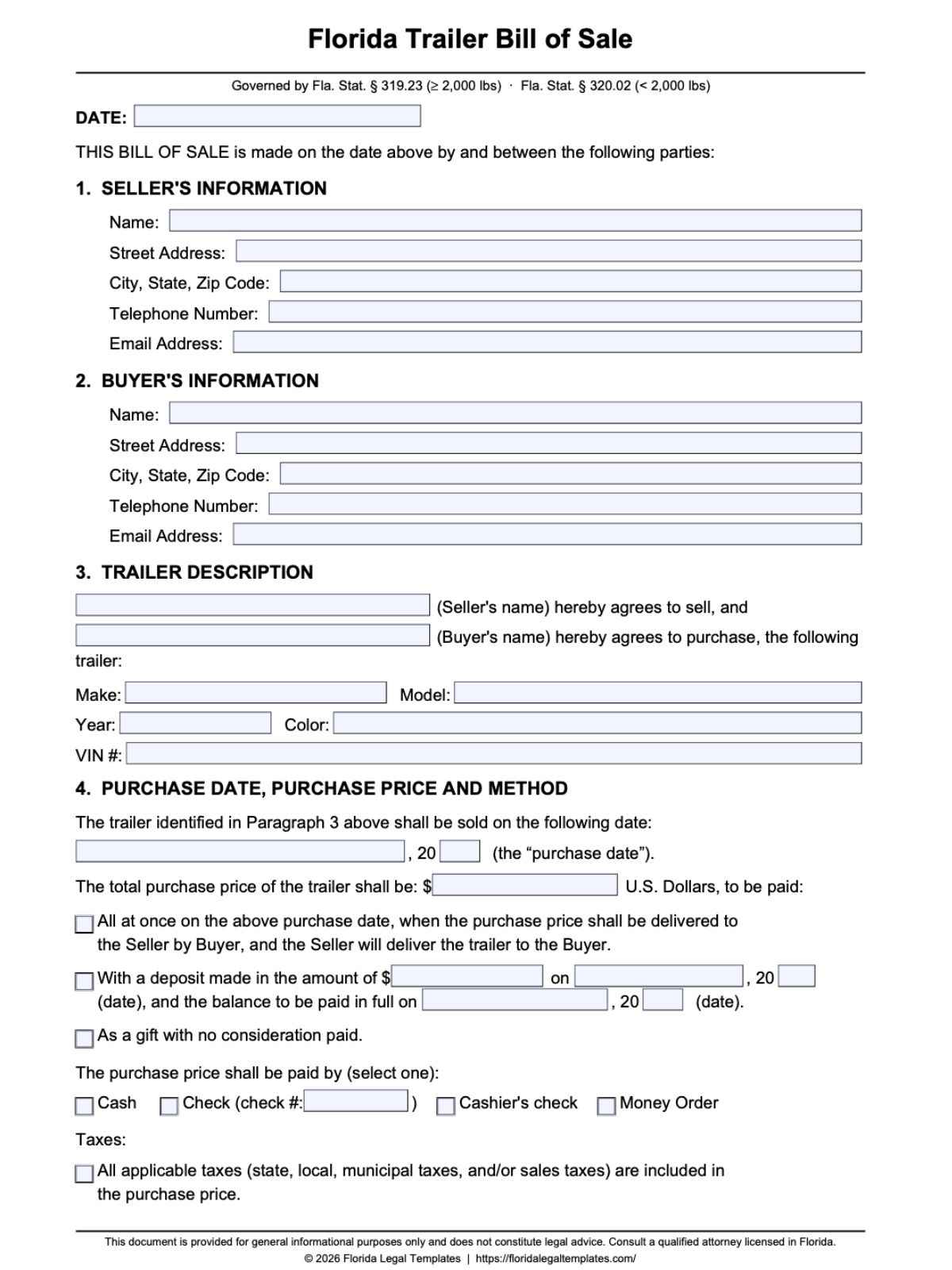
A Florida trailer bill of sale template provides a structured format for documenting trailer sales clearly and in compliance with state requirements.
What the document includes:
- Buyer and seller full legal information
- Trailer identification:
- VIN or serial number
- Year, make, body type, and Net Weight (Empty Weight). Including the net weight is essential for the Tax Collector to determine if a title is required or if it is a registration-only transaction.
- Purchase price and payment terms
- Sales tax acknowledgment
- Signatures (seller required; buyer recommended)
Who should use this:
- Private individuals selling or buying trailers
- Buyers needing proof of purchase for registration
- Sellers documenting ownership transfer
When this template may NOT be sufficient:
- Trailers 2,000 lbs or more without proper title transfer
- Homemade trailers without inspection and VIN assignment
- Transactions involving missing or invalid ownership documents
Even a well-prepared Florida trailer bill of sale pdf cannot replace the title when one is legally required.
What Is a Florida Trailer Bill of Sale?
A Florida trailer bill of sale is a transaction document that records the transfer of a trailer, which Florida law classifies as a motor vehicle.
Legal framework:
- Governed by:
- Florida Statutes Chapter 319 (Title Certificates)
- Florida Statutes Chapter 320 (Motor Vehicle Licensing)
Legal nuance:
Under Fla. Stat. § 320.01, trailers are treated as motor vehicles. This means they are subject to the same regulatory framework as cars when it comes to ownership and registration.
Critical distinction:
- Bill of sale: Evidence that a transaction occurred
- Title (if required): Legal proof of ownership
Weight-based rule:
- 1,999 lbs or less: Explicitly registration-only; exempt from certificate of title mandates
- 2,000 lbs or more: Full certificate of title and vehicle registration concurrently required
Execution validity:
- Seller signature is required
- Notarization is generally not required, except in special cases such as homemade trailers
Practical implication:
Many disputes occur when buyers rely on a bill of sale alone for a titled trailer. Without proper title transfer, ownership is not legally recognized.
If the Buyer Loses the Signed Title Before Registration
One situation catches people off guard. The seller signs over the title, the buyer takes it home, and then the original title is lost before it ever reaches the Tax Collector. At that point, the bill of sale does not solve the problem. Florida requires the ownership application to be supported by the actual certificate of title when one is required under Chapter 319.
In practice, the buyer usually cannot register the trailer until a replacement title is issued. Because the title was never successfully transferred into the buyer’s name, the seller often has to cooperate by applying for a duplicate title or signing whatever FLHSMV paperwork is required to complete the transfer. A buyer who assumes they can simply present the bill of sale instead is often turned away after waiting in line.
For that reason, many experienced sellers do not hand over possession until both parties have confirmed that the signed title has been completed correctly and placed somewhere secure. Taking clear photos or scans of the signed title before leaving the sale can also make it much easier to resolve later disputes over how the document was completed, even though the copies cannot replace the original certificate for registration purposes. (Replacement title procedure: FLHSMV duplicate title process under Fla. Stat. § 319.)
Because Florida treats trailers as motor vehicles under state law, buyers often benefit from understanding how broader ownership transfer documentation works through a general Florida proof of purchase form. Similar registration and title rules also apply in many highway vehicle transactions involving a motor vehicle transfer document.
When to Use Florida Trailer Bill of Sale
A Florida trailer bill of sale form should be used whenever a trailer is sold or transferred between private parties.
Common use cases:
- Selling utility or cargo trailers
- Transferring ownership of boat trailers
- Documenting private sales
Practical scenarios:
- Cash transactions between individuals
- Proof of purchase for registration
- Recordkeeping for legal or tax purposes
When NOT to use:
- As a substitute for title transfer (for trailers ≥ 2,000 lbs)
- For homemade trailers without inspection
- Without complete trailer identification details
Using the correct document ensures the transaction is properly documented and legally recognized.
Trailer ownership documents are commonly used alongside other recreational and transport-related transfers. For example, campers and towable recreational units frequently require a recreational vehicle ownership form, while boat trailer transactions are often connected to a separate vessel transfer record when both items are sold together.
Key Florida Laws That Affect Florida Trailer Bill of Sale
Summary of Applicable Laws
| Topic / Issue | Florida Legal Rule | Governing Statute |
|---|---|---|
| Classification | Trailers treated as motor vehicles | Fla. Stat. § 320.01(1)(a) |
| Title Requirement | Required if trailer ≥ 2,000 lbs | Fla. Stat. § 319.20 |
| Registration Requirement | Required for all trailers | Fla. Stat. § 320.08 |
| Title Transfer Deadline | Must apply within 30 days | Fla. Stat. § 319.23(6) |
| Notice of Sale | Seller must file within 30 days | Fla. Stat. § 319.22 |
Practical Impact & Document Clauses
These laws directly determine whether a Florida trailer bill of sale is legally effective.
First, the title priority rule is critical. If the trailer weighs 2,000 lbs or more and has a title, that title must be properly transferred. A bill of sale alone will not be accepted by the Tax Collector. This is a common mistake that leads to rejected registrations and ownership disputes.
Second, statutory timing metrics are absolute. Under Fla. Stat. § 319.23(6), the buyer must submit the title application to the tax collector within 30 days of vehicle delivery. Missing this critical window triggers a mandatory $20.00 administrative late penalty fee alongside baseline processing complications.
Third, filing a Notice of Sale (Form HSMV 82050) under Fla. Stat. § 319.22 applies exclusively to titled trailers weighing 2,000 lbs or more. Because trailers under 2,000 lbs are registration-only and do not possess a state title record, a Notice of Sale cannot be electronically processed or tracked against them. For these lighter units, a retention copy of the executed bill of sale serves as the seller’s sole defense against subsequent toll or civil claims.
Additionally, the bill of sale must include accurate identification details—VIN or serial number, year, make, and body type. Missing or incorrect information can lead to rejection during registration.
Finally, Florida law requires acknowledgment of sales tax under Fla. Stat. § 212.05. The document should clearly state whether the buyer or seller is responsible for paying the tax.
Failure to comply with these rules can result in:
- Invalid ownership transfer
- Registration denial
- Continued liability for the seller
- Financial penalties
Private trailer sales involving installment payments or seller financing should clearly document repayment obligations in writing. In higher-value transactions, parties sometimes pair the sale paperwork with a formal payment arrangement contract to reduce disputes after possession of the trailer changes hands.
How to Create or Fill Out the Florida Trailer Bill of Sale
Completing a trailer bill of sale Florida requires accuracy and compliance with Florida law.
Step-by-step process:
- Identify the parties
- Full legal names and contact information
- Describe the trailer
- VIN or serial number
- Year, make, body type
- Weight classification
- State the purchase price
- Include payment method
- Include tax acknowledgment
- Clarify whether the buyer or seller will pay sales tax
- Sign the document
- Seller signature required
- Buyer signature recommended
- Transfer title (if applicable)
- Required for trailers ≥ 2,000 lbs
- Register the trailer
- File with County Tax Collector
- File Notice of Sale (seller)
- Submit within 30 days
Practical tips:
- Always verify VIN accuracy before signing
- Confirm whether the trailer requires a title based on weight
- Keep copies of the document for both parties
- If you are buying a used trailer and the weight is not on the registration, require the seller to provide a certified weight slip before the sale. This prevents surprises at the Tax Collector’s office if the trailer turns out to be over the 2,000 lbs titling threshold.
Accurate VIN and ownership information is essential because Florida tax collectors routinely reject incomplete transfer paperwork. Sellers correcting clerical mistakes or registration errors may also need a document correction affidavit before the trailer registration can be finalized.
Limitations and Legal Considerations
A Florida trailer bill of sale is not a standalone ownership document in many cases.
Key limitations:
- Cannot replace title transfer for trailers ≥ 2,000 lbs
- Not valid without proper trailer identification
Legal constraints:
- Must comply with FLHSMV requirements
- Must follow weight-based classification rules
High-risk scenarios:
- Selling a trailer without a valid title
- Allowing the buyer to use the seller’s license plate
Under Fla. Stat. § 320.0606, the license plate belongs to the seller—not the trailer. It must be removed before transfer.
Edge cases:
- Homemade trailers requiring inspection and VIN assignment
- Non-titled trailers under 2,000 lbs
- Out-of-state trailer purchases
Understanding these limitations helps avoid costly legal errors.
Homemade or improperly documented trailers often create ownership disputes when inspection records, identification numbers, or prior registrations are missing. In situations involving disputed possession or lender recovery rights, parties sometimes rely on a repossession ownership affidavit to support related title or recovery procedures.
Common Mistakes to Avoid
Using a bill of sale without transferring title
A bill of sale alone is insufficient for titled trailers.
Consequence: Buyer cannot legally register the trailer.
Not identifying trailer weight category
Weight determines whether a title is required.
Consequence: Incorrect documentation and rejected registration.
Missing VIN or serial number
Required for identification.
Consequence: Application rejection by the Tax Collector.
Failing to file Notice of Sale
Seller does not notify the state.
Consequence: Continued liability for fines, tolls, or accidents.
Allowing buyer to keep license plate
Illegal under Florida law.
Consequence: Legal violations and liability exposure.
Creating bill of sale for homemade trailer without inspection
Improper process.
Consequence: Cannot register or title the trailer.
Frequently Asked Questions (FAQ)
Do I need a title for a trailer in Florida?
It depends on weight. Trailers 2,000 lbs or more require a title, while lighter trailers require registration only.
Is a bill of sale enough for a trailer under 2,000 lbs?
Yes, in most cases, it can serve as proof of ownership for registration since a title is not required.
What happens if I don’t file a Notice of Sale?
You may remain legally responsible for the trailer, including fines or accidents, under Fla. Stat. § 319.22.
Can I sell a homemade trailer with just a bill of sale?
No. Under Florida law, homemade trailers must be weighed at a certified scale and inspected by the FLHSMV to be assigned a Trailer Identification Number (TIN). If the trailer is 2,000 lbs or more, a full VIN and Title will be issued after a more rigorous safety inspection.
A properly prepared Florida trailer bill of sale ensures the transaction is documented, supports compliance with state law, and protects both buyer and seller. When used alongside proper title transfer and registration procedures, it helps avoid legal disputes and liability.