
Florida RV Bill of Sale Template (Free PDF & Word)
A Florida RV bill of sale has to get the vehicle classification right before anything else, because Florida law treats a self-propelled motorhome and a towable travel trailer as two entirely different types of property with different title processes, different forms, and in some cases different odometer disclosure requirements. Self-propelled RVs fall within Florida’s motor-vehicle and recreational-vehicle title framework, while Chapter 319 also applies its title provisions to recreational vehicle-type units, which means sellers of a 2014 motorhome need to know that Florida’s current odometer disclosure rule under F.S. §319.225 applies for 20 years to model years 2011 and newer, so a 2014 motorhome remains subject to the disclosure requirement in 2026.
I’ve seen RV transactions stall at the tax collector’s office because the camper bill of sale florida the seller prepared treated a motorhome like a trailer, or because nobody included the odometer reading on a self-propelled unit that clearly required it. The template below accounts for both RV types so the paperwork matches what the DHSMV actually needs depending on what you’re selling.
Candice Hayden, Legal Writer
Carly Johansson, Florida Contract Attorney
Florida RV Bill of Sale (PDF, Printable, Fillable)
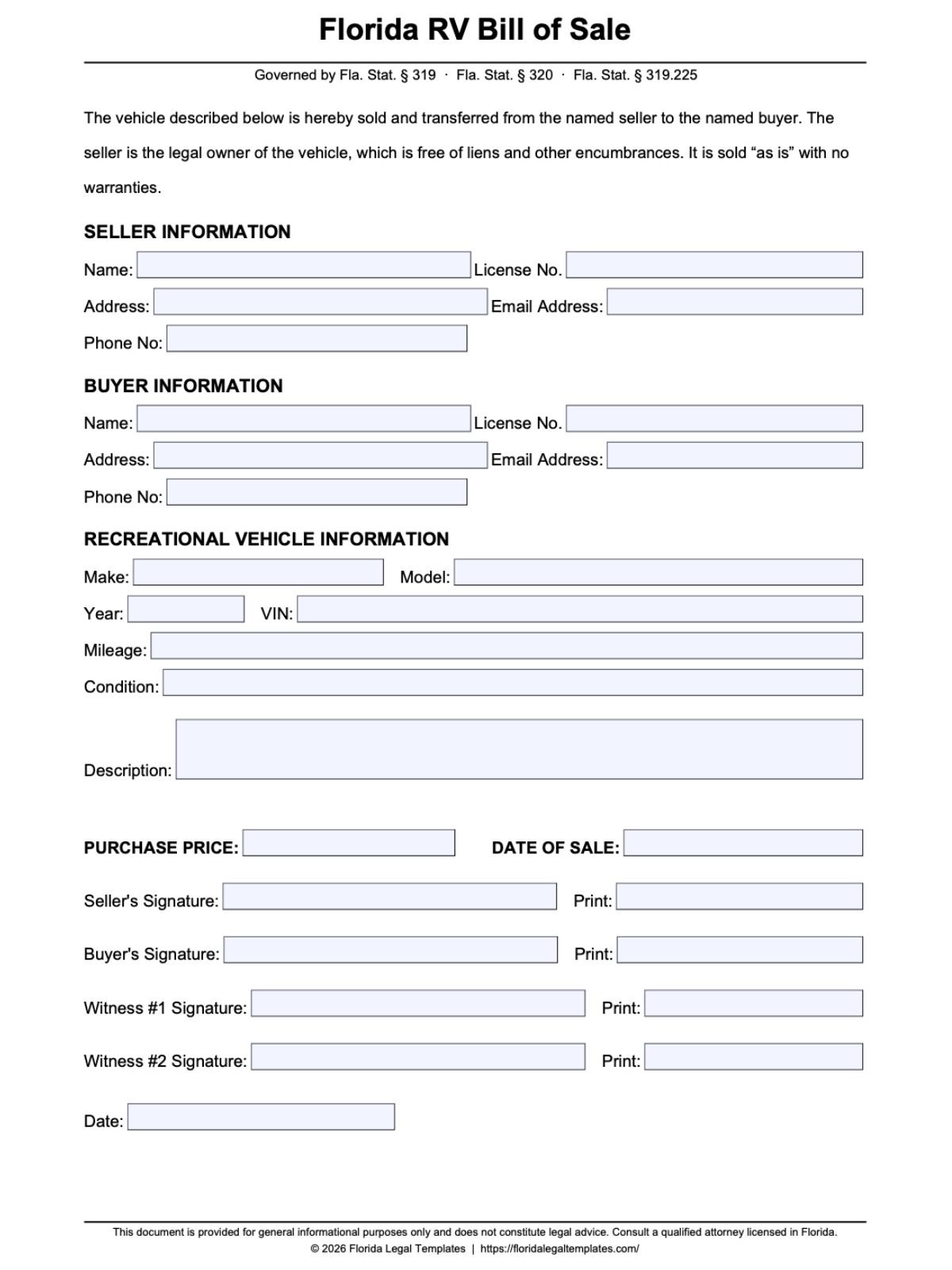
A Florida RV bill of sale template provides a standardized format that includes all necessary details for a compliant transaction.
What the document includes:
- Buyer and seller full legal names and addresses
- RV details:
- Vehicle Identification Number (VIN)
- Make, model, and year
- Type (motorhome vs travel trailer/camper)
- Purchase price and payment terms
- Odometer disclosure (required for motorized RVs)
- Sales tax acknowledgment
- Signatures of both parties
Who should use this:
- Private sellers of motorhomes, campers, and travel trailers
- Buyers purchasing used recreational vehicles
- Individuals documenting private RV transactions
When this template may NOT be sufficient:
- If the RV has an active lien that has not been satisfied
- If the seller does not have a valid certificate of title
- If an out-of-state RV requires VIN verification under Fla. Stat. § 319.23, use the applicable HSMV 82042 process; Florida law exempts certain recreational trailers and other listed vehicles from VIN verification.
- Dealer or financed transactions requiring additional documentation
Even a complete bill of sale does not by itself complete the Florida title process when a certificate of title is required.
What Is a Florida RV Bill of Sale?
A Florida RV bill of sale documents the sale of a recreational vehicle and serves as supporting documentation for the required title transfer process.
Legal framework:
- Governed by Florida Statutes Chapter 319 (Title Certificates)
- Florida title procedures are implemented through FLHSMV rules, including Florida Administrative Code Chapter 15C-21, which governs certificates of title.
- Registration requirements governed under Chapter 320
Legal nuance:
RVs are categorized differently depending on type:
- Motorhomes: Treated as motor vehicles and subject to odometer disclosure laws
- Travel trailers and other recreational vehicle-type units are subject to Florida’s title framework, although § 319.20 excludes trailers and semitrailers having a net weight of less than 2,000 pounds from Chapter 319.
Critical distinction:
- Bill of sale: Evidence of transaction
- Title: Legal proof of ownership
Execution validity:
- Must be signed by both buyer and seller under Fla. Stat. § 319.22.
- Must align with the title assignment section on the certificate
Practical implication:
Because Florida’s title records control the ownership transfer, the buyer should complete the required title application even when the parties have already signed a bill of sale.
Because RV ownership transfers in Florida still depend on title compliance, many buyers and sellers also review the broader Florida bill of sale requirements to understand how vehicle transactions are documented across different property types. If the RV being sold is a towable camper or utility-style unit, the rules often overlap with Florida’s trailer transfer documentation process for registration and title purposes.
Key Florida Laws That Affect Florida RV Bill of Sale
Summary of Applicable Laws
| Topic / Issue | Florida Legal Rule | Governing Statute |
|---|---|---|
| Execution Formalities | The bill of sale should be completed and signed by the parties, and the seller must properly complete the title assignment required for the transfer. | Fla. Stat. § 319.22 |
| Title Transfer Deadline | The purchaser must apply for the title transfer within 30 days after delivery of the motor vehicle; a late application carries an additional $20.00 fee. | Fla. Stat. § 319.23(6) |
| Notice of Sale | The seller should submit the required Notice of Sale to the department within 30 days; FLHSMV directs sellers to use Form HSMV 82050 through a local tax collector office or license plate agency. | Fla. Stat. § 319.22(2) |
| Odometer Disclosure | For a motorized RV subject to the odometer requirement, the transferor must complete the odometer disclosure and the transferee must acknowledge it; the disclosure states whether the mileage is actual, exceeds the mechanical limits, or is not the actual mileage. | Fla. Stat. § 319.225 |
| Title Possession Rule | Must have title before selling | Fla. Stat. § 319.21 |
The title transfer obligations discussed in this section are similar to those that apply in private automobile transactions, especially where odometer disclosures and title assignments are required. Sellers dealing with self-propelled motorhomes may benefit from reviewing Florida’s motor vehicle bill of sale guidance for additional compliance considerations involving VIN records and ownership transfer procedures.
Practical Impact & Document Clauses
These statutes directly control how a Florida RV bill of sale must be prepared and used.
First, under Fla. Stat. § 319.21, the seller must have a valid certificate of title at the time of sale. Florida generally requires the seller to deliver the certificate of title with the required assignment; a bill of sale alone does not replace the title-transfer requirements.
Second, the buyer must apply for a new title within 30 days under Fla. Stat. § 319.23. Missing this deadline results in a statutory late fee and delays ownership recognition.
At the same time, the seller should file a Notice of Sale within 30 days under Fla. Stat. § 319.22(2). Note that this statutory liability shield applies to motorhomes and travel trailers weighing 2,000 lbs or more. If you are selling a lightweight towable camper under 2,000 lbs, it is registration-only and lacks a state title record; therefore, a Notice of Sale cannot be electronically filed, making a signed copy of the bill of sale your primary proof of transfer.
For motorhomes, an odometer disclosure is mandatory under Fla. Stat. § 319.225. The document must include certification that the mileage is:
- Actual
- In excess of mechanical limits
- Not actual
Failure to include this disclosure can expose the seller to fraud claims.
Finally, any existing lien must be properly addressed in the title records before the transfer is completed; an active lien does not automatically prevent a title from being issued, but the lien remains enforceable until it is properly satisfied or otherwise resolved.
In practice, these rules mean the bill of sale must be accurate, complete, and aligned with statutory requirements to support a valid transfer and avoid legal exposure.
Lost Title Before the Sale? Fix It Before You Meet the Buyer
A surprising number of private RV sales fall apart for one simple reason: the seller can’t find the original Florida title. Florida does not let a bill of sale substitute for a missing certificate of title, even if both parties agree on the sale. If the seller cannot hand over a properly assigned title, the tax collector will reject the buyer’s title application.
The practical solution is to replace the title before advertising the RV or arranging pickup. The registered owner can apply for a duplicate certificate of title using Form HSMV 82101 through an authorized tax collector or FLHSMV channel, subject to the applicable title procedures, provided the ownership record is otherwise clear. Once the duplicate title is issued, the seller completes the assignment exactly as they would with the original document, allowing the buyer to transfer ownership without interruption.
This is an agency procedure used every day, but many private sellers only discover it after a buyer is already waiting to complete the transaction. Completing the duplicate-title process first usually avoids a failed closing and an unnecessary second trip to the tax collector. (FLHSMV duplicate title procedure: Fla. Stat. § 319.29; physical title requirement: Fla. Stat. § 319.23(1)).
Limitations and Legal Considerations
A Florida RV bill of sale is not a standalone ownership document.
Key limitations:
- Cannot replace the certificate of title
- Not valid without VIN and title details
Legal constraints:
- Must comply with FLHSMV filing procedures
- Must include odometer disclosure for motorhomes
High-risk scenarios:
- Selling an RV without title
- Allowing the buyer to use the seller’s license plate
Under Fla. Stat. § 320.0609, the owner must remove the registration license plate from the vehicle upon its sale, trade, transfer, or other disposition.
Edge cases:
- Out-of-state RV requiring VIN verification (Form HSMV 82042)
- Non-titling state vehicles where notarization may be needed
- Differences between motorhomes and non-motorized campers
Checking the title, lien status, VIN, and applicable RV classification before the sale can prevent avoidable problems when the buyer applies for title or registration.
Certain RV transactions involve supporting ownership affidavits, especially when correcting title records, handling inherited vehicles, or resolving documentation inconsistencies. In those situations, Florida residents sometimes need additional affidavit forms and sworn statement templates to support the title correction or transfer process with the tax collector’s office.
When to Use Florida RV Bill of Sale
A Florida RV bill of sale should be used whenever a recreational vehicle is sold in a private transaction.
Common use cases:
- Selling a motorhome, camper, or travel trailer
- Documenting cash transactions between individuals
- Recording purchase terms and RV condition
Practical scenarios:
- Buying a used RV from a private seller
- Completing paperwork required for title transfer
- Providing proof of purchase for tax and registration purposes
When NOT to use:
- Without a valid certificate of title
- When the RV has an active lien
- For dealer or financed sales
- Without VIN verification for out-of-state RVs
Using this document correctly helps ensure the transaction is legally recognized and properly documented.
How to Create or Fill Out the Florida RV Bill of Sale
Completing a Florida RV bill of sale requires accuracy and compliance with Florida law.
Step-by-step process:
- Identify the parties
- Include full legal names and addresses
- Describe the RV
- VIN
- Make, model, and year
- RV type (motorhome or camper/trailer)
- State the purchase price
- Include payment method and terms
- Insert odometer disclosure (motorhomes only)
- Use the exact statutory certification wording. Note: Under Florida’s rolling 20-year disclosure rule (Fla. Stat. § 319.225(4)), model year 2011 and newer motorized RVs strictly require odometer documentation in 2026, whereas model year 2010 and older motorhomes are permanently exempt.
- Include sales tax acknowledgment
- Buyer should account for any Florida sales or use tax due at the time of title transfer, subject to any applicable exemption.
- Sign the document
- Both buyer and seller must sign
- Complete title transfer
- Fill out the “Transfer of Title by Seller” section
- File Notice of Sale (seller)
- Submit Form HSMV 82050 within 30 days
- Apply for new title (buyer)
- Submit Form HSMV 82040 within 30 days
Practical tips:
- Verify VIN accuracy to avoid delays
- Ensure any lien is cleared before completing the sale
- Keep signed copies for both parties
If the RV purchase involves installment payments, delayed possession, or seller financing, the parties should consider documenting repayment obligations separately through a written Florida loan agreement. This can help clarify payment schedules, default terms, and financial responsibilities beyond the basic bill of sale itself.
Common Mistakes to Avoid
Selling without a valid title
This violates Florida law.
Consequence: Transaction is invalid and cannot be completed.
Not clearing lien before transfer
Active lien remains on vehicle.
Consequence: Title transfer will be rejected.
Skipping odometer disclosure (motorhomes)
Required by statute.
Consequence: Risk of fraud claims and legal penalties.
Not filing Notice of Sale
Seller does not notify state.
Consequence: Severe liability. Under Florida’s Dangerous Instrumentality Doctrine, if the buyer crashes and you haven’t filed HSMV 82050, you can be held financially responsible for the victim’s injuries as the “owner of record.”
Allowing buyer to keep license plate
Illegal under Florida law.
Consequence: Seller remains liable for vehicle use.
Using incorrect VIN
Errors in identification.
Consequence: Registration and title rejection.
Allowing the buyer to leave with an improperly documented towable camper can create the same registration and liability problems commonly seen in boat and recreational trailer sales. Sellers handling recreational equipment transactions may also want to review Florida-specific watercraft ownership transfer requirements to better understand how Florida treats private title transfers involving titled recreational property.
Frequently Asked Questions (FAQ)
Is a Florida RV bill of sale enough to transfer ownership?
No. Ownership transfers only when the title is properly assigned and filed with the state.
Do I need an odometer disclosure for a camper or travel trailer?
No. Odometer disclosure is required only for motorized RVs (motorhomes).
What happens if I don’t file a Notice of Sale after selling an RV?
You may remain legally responsible for the RV, including fines or accidents, under Fla. Stat. § 319.22.
Can I sell an RV in Florida if there is an active lien?
No. The lien must be satisfied before ownership can be legally transferred under Florida law.
Do I need to notarize an RV bill of sale in Florida?
Generally no. For an out-of-state vehicle being titled in Florida for the first time, § 319.23 may require VIN verification, but the law permits several verification methods and expressly exempts certain recreational trailers and other listed vehicles. For private Florida-to-Florida sales, notarization is not required but remains a recommended safeguard.
A properly prepared Florida RV bill of sale gives the buyer and seller a clear record of the transaction, while the required title and FLHSMV filings complete the ownership-transfer process.
Legal Disclaimer:This article provides general information about Florida RV bill of sale and title-transfer requirements and is not legal advice. Florida requirements can vary based on the RV type, title status, lien status, and transaction circumstances. For a specific transaction, confirm current requirements with FLHSMV or a Florida attorney.