
Florida Durable Power of Attorney Template | Free PDF
A Florida durable power of attorney is built to remain effective if you lose the ability to make decisions — but the document must contain the statutory durability language, or similar words showing your intent that the authority remain exercisable despite your subsequent incapacity.
Under F.S. §709.2104, a Florida power of attorney is durable when it contains the statutory durability language, or similar words showing the principal’s intent that the authority remain exercisable despite subsequent incapacity.
A common problem is a signed and notarized Florida power of attorney that does not provide durable authority because it lacks the required durability language. The template below includes the statutory durability language and authority provisions commonly used in Florida financial POAs, but whether a particular document is accepted still depends on its terms and the circumstances.
Candice Hayden, Legal Writer
Maria Rosso, Florida Probate, Guardianship and Estate Planning Attorney
Free Florida Durable Power of Attorney Form (PDF & Printable)
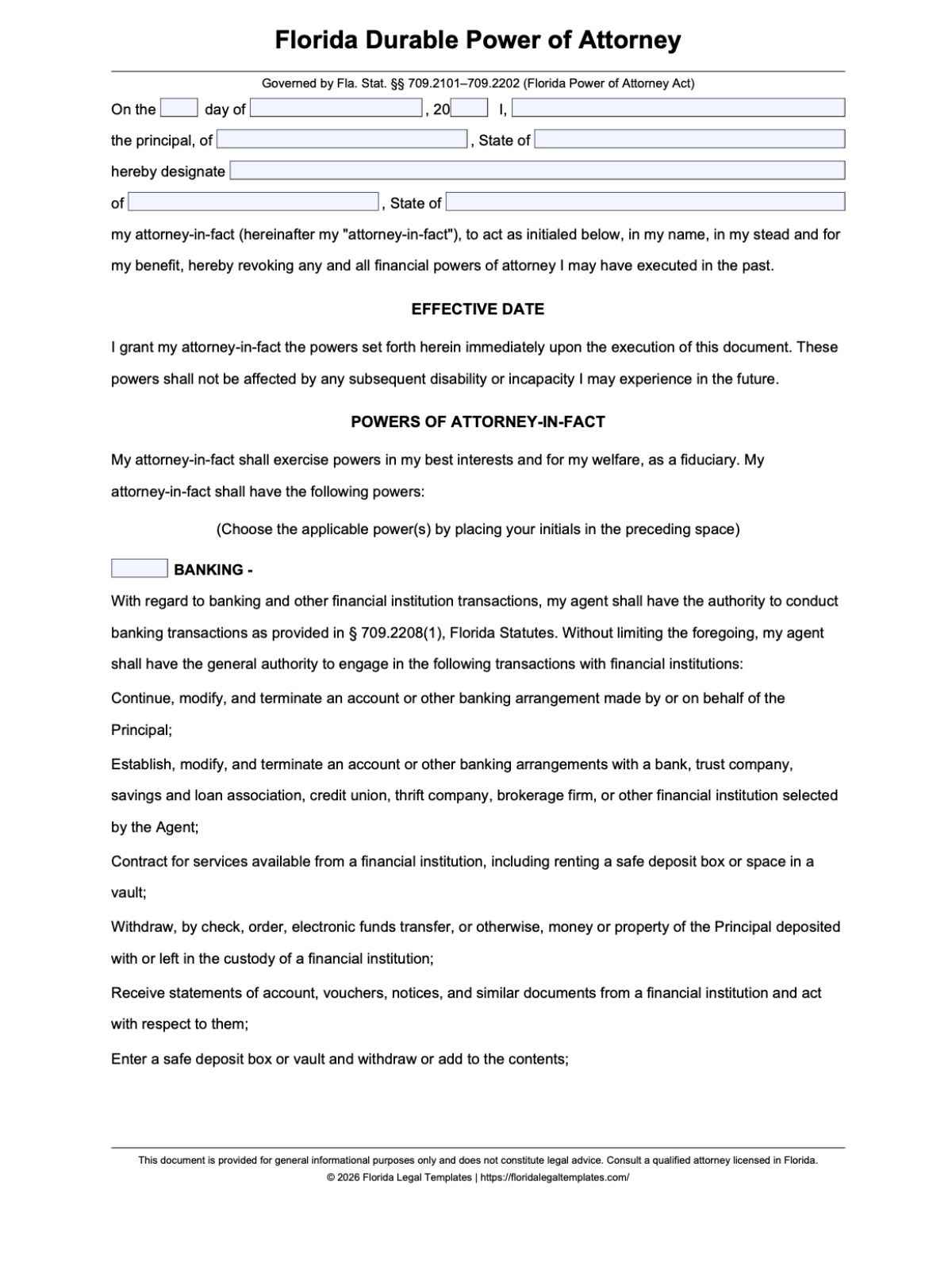
A Florida durable power of attorney form typically authorizes an agent to continue managing financial and legal matters on behalf of the principal even after incapacity.
Most printable and fillable forms include:
- Principal identification
- Agent appointment provisions
- Durable authority language
- Banking and financial powers
- Investment authority
- Real estate powers
- “Superpowers” sections requiring initials
- Witness and notary acknowledgment sections
A durable power of attorney Florida template may work well for:
- Adults planning for future incapacity
- Seniors organizing long-term financial management
- Individuals with medical concerns
- Families assisting aging parents
However, a standard Florida durable power of attorney PDF may not fully address:
- Complex trust planning
- Medicaid asset protection strategies
- Multi-state property ownership
- High-net-worth financial structures
- Family conflict concerns
Many people also search for:
- Durable power of attorney Florida PDF
- Florida durable power of attorney form
- Printable durable power of attorney Florida forms
- Florida durable power of attorney template examples
Using a sample document can help explain structure and authority provisions, but Florida statutory compliance still determines whether the document will actually work when presented to banks, title companies, or financial institutions.
What Is a Florida Durable Power of Attorney?
A Florida durable power of attorney is a written legal instrument governed by the Florida Power of Attorney Act that authorizes an agent to act on behalf of the principal even after the principal becomes incapacitated.
The durability feature is what separates this document from a standard non-durable power of attorney.
Common powers granted through a durable POA may include:
- Banking authority
- Property management
- Investment management
- Tax matters
- Real estate transactions
- Contract authority
A durable power of attorney is different from:
- A general power of attorney
- A health care surrogate designation
- Court-appointed guardianship
- A last will and testament
Under Florida law, durable powers of attorney generally become effective immediately upon execution.Florida generally makes a power of attorney exercisable when executed and makes a POA ineffective if it provides for effectiveness upon a future date or event, subject to limited statutory exceptions.
A durable financial authority document is only one part of a complete incapacity and estate planning strategy. Many Florida residents also prepare a medical treatment directive for end-of-life decisions and a Florida will for probate asset distribution to address separate legal and family responsibilities.
Key Florida Laws That Affect This Document
Summary of Applicable Laws
| Topic / Issue | Florida Legal Rule | Governing Statute |
|---|---|---|
| Witness Requirements | Durable POA requires two subscribing witnesses | Fla. Stat. § 709.2105(2) |
| Notary Requirement | Principal must acknowledge signature before notary | Fla. Stat. § 709.2105(2) |
| Agent Eligibility | Agent generally must be an adult natural person or a qualifying financial institution | Fla. Stat. § 709.2105(1) |
| Springing POA Restriction | Springing POAs created after Oct. 1, 2011 are generally invalid | Fla. Stat. § 709.2108(3) |
| Durability Language | Durable authority requires the statutory wording or similar language showing that the authority remains exercisable despite the principal’s subsequent incapacity | Fla. Stat. § 709.2104 |
| “Superpowers” Initials Rule | Certain powers require separate initials or signatures | Fla. Stat. § 709.2202(1) |
| Real Estate Recording | Recording protects a power of attorney used in a real estate transaction against creditors and subsequent purchasers without notice when the statutory recording requirements apply | Fla. Stat. § 695.01 |
| Non-Delegable Duties | Certain personal acts (voting, wills, personal service contracts) cannot be delegated | Fla. Stat. § 709.2114(1) |
Florida Witness and Notary Requirements
Under Florida law, a durable florida power of attorney must be signed by the principal and two subscribing witnesses and acknowledged by the principal before a notary public, subject to the alternative procedure in Fla. Stat. §695.03
Pursuant to Fla. Stat. § 709.2105(2), the principal must also acknowledge the document before a notary public. Notarization is mandatory for validity.
Improper execution can create major operational issues, including:
- Bank refusal
- Delayed transactions
- Real estate title complications
- Litigation regarding agent authority
Even small signing mistakes may cause third parties to reject the document entirely.
Florida’s Durability Clause Requirement
For a Florida power of attorney to remain effective after incapacity, it must contain statutory durability language.
Under Florida law, the document should state:
“This durable power of attorney is not terminated by subsequent incapacity of the principal except as provided in chapter 709, Florida Statutes.” (Per Fla. Stat. § 709.2104)”
Florida permits substantially similar wording, but the intent to create durable authority must be explicit.
Without proper durability language, the authority may terminate upon incapacity — exactly when the document is most needed.
Florida’s Immediate Effectiveness Rule
Florida durable powers of attorney become effective immediately upon execution.
Under Fla. Stat. § 709.2108(3), a power of attorney that provides for effectiveness at a future date or upon a future event is generally ineffective, subject to the statutory exceptions in § 709.2108(2) and § 709.2106(4), including certain military-related powers of attorney.
This immediate effectiveness rule creates important practical implications:
- Agents may immediately access financial authority
- Principals must choose agents carefully
- Fraud and misuse risks become more significant
Florida’s prohibition on springing powers was largely designed to reduce disputes over incapacity determinations.
Florida “Superpowers” Requirements
Florida imposes heightened requirements for certain high-risk financial powers often referred to as “superpowers.”
Under Fla. Stat. § 709.2202, powers involving the following actions generally require separate initials or signatures:
- Creating or amending trusts
- Making gifts
- Changing beneficiary designations
- Waiving survivorship rights
General authority language is insufficient for these powers.
Missing initials can invalidate only those specific powers even if the rest of the document remains effective.
Real Estate Recording Rules
Most Florida durable powers of attorney remain private documents.
However, if the agent will:
- Sell property
- Mortgage property
- Transfer real estate interests
the power of attorney should be recorded in the county’s official records when it is used for an instrument affecting title to real property because § 695.01 requires recording to protect the instrument against creditors or subsequent purchasers without notice.
Under Fla. Stat. § 695.01, title companies and closing agents often require recorded authority before accepting property transactions.
When an agent is authorized to manage investment or rental property, related occupancy and leasing documents may also become important during administration. Property owners frequently coordinate authority documents with a Florida residential tenancy agreement or similar housing contracts when managing tenant obligations through an appointed agent.
What If a Bank or Financial Institution Refuses to Honor the Power of Attorney?
Many people assume that once a durable power of attorney is properly signed, every bank or brokerage must accept it immediately. In practice, that is not always what happens. Florida law requires third parties to act within a reasonable time, with four days excluding Saturdays, Sundays, and legal holidays presumed reasonable for certain banking and investment transactions.
Under Fla. Stat. § 709.2120, a person or institution presented with an acknowledged Florida power of attorney generally must either accept it, request a permissible item such as an agent’s affidavit or an opinion of counsel, or provide a written basis for refusing it within the statutory timeframes. For covered banking and investment transactions, Florida law provides a four-business-day presumption of reasonableness, although the statute does not impose that same four-day presumption on every type of POA review. If a third party makes a permissible request for additional documentation, the applicable statutory requirements and response periods must be considered again after the requested material is supplied.
This becomes especially relevant after a principal loses capacity. Families often believe the document is defective when the real issue is that the institution is completing its legal review. Keeping a certified copy of the POA, a government-issued ID for the agent, and being prepared to sign an affidavit confirming that the power of attorney has not been revoked can significantly reduce delays. If a refusal appears inconsistent with Chapter 709, an estate planning or probate attorney may be able to resolve the issue without the expense of opening a guardianship proceeding.
Non-Delegable Duties and Self-Dealing Restrictions
Florida law prohibits agents from performing certain inherently personal acts.
Under Florida law, an agent generally cannot:
- Execute or revoke a will
- Vote in public elections
- Make any affidavit as to the personal knowledge of the principal
- Perform contracts requiring personal services
Florida also restricts self-dealing authority.
Florida imposes fiduciary duties and special rules on conflicts of interest. If an agent’s exercise of authority benefits the agent or an affiliate, the applicable authorization and conflict-of-interest rules under Fla. Stat. §§709.2114, 709.2116, and 709.2202 must be followed.
These restrictions are designed to reduce financial exploitation and abuse risks.
Practical Impact & Document Clauses
The most important drafting issues usually involve the authority actually granted and the way the document is executed. Under §709.2201, an agent generally may exercise only the authority specifically granted in the power of attorney, while §709.2202 requires separate signing or initialing for certain powers.
A Florida POA can create problems when the principal grants authority too broadly or incompletely, misses required initials for §709.2202 powers, fails to follow the execution requirements in §709.2105, or chooses an agent without considering the fiduciary duties imposed by §709.2114.
That timing matters because Florida generally makes a POA exercisable when executed under §709.2108. If the document is being prepared for future incapacity, the authority should therefore be checked while the principal can still understand and execute the document.
When to Use a Florida Durable Power of Attorney
A Florida durable power of attorney is commonly used by:
- Adults planning for future incapacity
- Seniors organizing long-term finances
- Individuals with progressive medical conditions
- Families assisting aging relatives
- People wanting to avoid guardianship proceedings
The document can also help individuals who:
- Travel extensively
- Live part-time outside Florida
- Need ongoing property management assistance
However, a durable POA alone may not fully address:
- Medical decision-making
- Estate distribution planning
- Complex trust administration
- Business succession issues
Additional estate planning documents are often necessary.
A durable power of attorney is especially useful for families preparing for long-term incapacity or cognitive decline. Individuals comparing authority structures may also benefit from reviewing a standard Florida power of attorney arrangement to better understand how durability provisions change the document’s legal effect after incapacity.
How to Create or Fill Out the Florida Durable Power of Attorney
Identify the Principal
Use the principal’s full legal name and identifying information. The principal must possess mental capacity at signing.
Select a Trustworthy Agent
Choose an agent who can handle the specific authority being granted and who understands that Florida treats an agent as a fiduciary under §709.2114. A successor agent can also be useful if the first agent later dies, resigns, becomes incapacitated, or otherwise cannot serve.
Naming successor agents may also reduce future operational problems.
Define the Scope of Authority
Clearly define powers involving:
- Banking
- Real estate
- Investments
- Taxes
- Financial management
Overly vague language frequently creates disputes with financial institutions.
Include Proper Durability Language
The document must contain statutory durability wording or substantially similar language demonstrating intent for authority to survive incapacity.
Address Florida “Superpowers” Carefully
Florida requires separate initials or signatures for certain high-risk powers.
Missing initials is one of the most common drafting mistakes in Florida durable powers of attorney.
Execute the Document Properly
Florida generally requires:
- Two witnesses
- Mandatory notarization
- Proper signing procedures
Improper execution may invalidate the document.
Record the Document if Real Estate Authority Will Be Used
Recording becomes important when agents will conduct real estate transactions on behalf of the principal.
Distribute Copies Securely
Keeping copies available to the agent and relevant financial institutions can make the document easier to locate when authority is needed, although the institution may still require the original or other documentation in circumstances covered by Florida law.
Review and Update the Document Periodically
Review the document after:
- Divorce
- Agent incapacity or death
- Major financial changes
- Relocation to another state
Because financial institutions often scrutinize authority documents closely, some families also organize supporting financial disclosures and sworn records together with the durable POA. Related materials such as Florida financial affidavit forms may help organize income, debts, and financial obligations during legal or administrative proceedings.
Limitations and Legal Considerations
A Florida durable power of attorney does not:
- Replace a will
- Continue after death
- Authorize prohibited personal acts
- Override Florida statutory limitations
Florida-specific legal limitations include:
- No valid springing POAs in most situations
- Mandatory durability language
- “Superpowers” initials requirements
Operational risks may also involve:
- Bank refusal
- Elder exploitation concerns
- Third-party verification demands
- Agent misuse
Proper revocation procedures and secure document storage help reduce abuse risks.
The Capacity Petition Suspension Trap (§ 709.2109(3))
A critical statutory nuance occurs when a family member or third party files a judicial petition to determine the principal’s incapacity under Chapter 744. Under Fla. Stat. § 709.2109(3), Under Fla. Stat. §709.2109(3), initiating judicial proceedings to determine the principal’s incapacity generally suspends authority under the power of attorney, subject to statutory exceptions for certain close-family agents and health care decisions.
However, Florida law creates a vital statutory exception: if the named agent is the principal’s parent, spouse, child, or grandchild, authority is not automatically suspended merely because a petition is filed. For agents who are not the principal’s parent, spouse, child, or grandchild, the suspension generally applies when the judicial proceeding is initiated, subject to the court’s authority to permit specified powers and the statutory emergency procedures, leaving the agent unable to pay bills or manage accounts unless a judge enters an emergency interim order or dismisses the guardianship petition.
A durable power of attorney does not transfer authority after death or replace probate administration. Once the principal dies, estate-related responsibilities generally shift to probate documents such as a Florida estate planning will and other court-recognized inheritance procedures.
Common Mistakes to Avoid
One important Florida drafting issue is durability. Section 709.2104 requires language showing that the authority remains exercisable despite the principal’s subsequent incapacity; the statute provides specific wording as well as an option for substantially similar language.
Other common problems include:
- Using a non-notarized document
- Failing to obtain two witnesses
- Forgetting initials for “superpowers”
- Choosing an unreliable agent
- Assuming authority activates only after incapacity
People also frequently fail to:
- Record the document for real estate use
- Update outdated agents
- Understand self-dealing restrictions
Another serious misunderstanding is believing a durable power of attorney survives death. Under Florida law, the authority terminates immediately upon the principal’s death.
Frequently Asked Questions (FAQ)
Does a Florida durable power of attorney need to be notarized?
Yes. Florida law requires a durable power of attorney to be acknowledged before a notary public to be legally valid. Under Florida’s execution requirements, the document must also be signed in the presence of two subscribing witnesses. Financial institutions and title companies commonly reject improperly notarized documents, even if the principal’s intent is otherwise clear.
Are springing durable powers of attorney valid in Florida?
Generally no. Florida largely eliminated springing powers of attorney for documents executed on or after October 1, 2011. This means a Florida durable power of attorney usually becomes effective immediately after signing rather than waiting for a future incapacity determination. For most Florida POAs executed under the current statutory framework, the practical rule is simpler: §709.2108 generally makes the POA exercisable when executed rather than waiting for a later incapacity event.
What makes a power of attorney “durable” in Florida?
A power of attorney becomes “durable” when it contains language showing that the agent’s authority continues even if the principal later becomes incapacitated. Florida law requires specific durability wording or substantially similar language demonstrating that intent. Without a valid durability clause, the authority may terminate once the principal loses mental capacity.
Does a Florida durable power of attorney remain valid after death?
No. A Florida durable power of attorney immediately terminates upon the principal’s death. A Florida power of attorney terminates when the principal dies under Fla. Stat. §709.2109(1)(a); estate administration then proceeds under applicable probate and estate-administration rules. Estate administration responsibilities generally shift to the personal representative named in the will or appointed by the probate court.
What powers require separate initials under Florida law?
Florida imposes stricter requirements for certain high-risk financial powers sometimes called “superpowers.” Actions involving trusts, gifts, beneficiary designations, survivorship rights, and similar authority generally require the principal to separately sign or initial next to each specific grant of authority. A broad statement giving the agent general authority is not enough for these powers under Florida law.