
Durable vs. Medical Power of Attorney in Florida
Choosing between a durable vs medical power of attorney isn’t about picking one document over the other. In Florida, they serve completely different purposes, and relying on only one can leave your family without the legal authority they need during an emergency.
A Florida Durable Power of Attorney generally allows someone you trust to manage your finances, property, taxes, and other legal matters, and it can also specifically grant authority to make certain health care decisions. A Medical Power of Attorney, legally called a Designation of Health Care Surrogate in Florida, is designed for health care decisions and health information. The authority granted depends on the language of the document and the powers specifically provided under Florida law.
For example, if you’re hospitalized after a serious stroke, your Health Care Surrogate can discuss treatment with your doctors, but they can’t access your bank account to pay your bills. Likewise, your financial agent can manage your mortgage and insurance claims but cannot approve surgery or make end-of-life decisions. That’s why most Florida estate plans include both documents—they work together to protect different parts of your life.
Candice Hayden, Legal Writer
Maria Rosso, Florida Probate, Guardianship and Estate Planning Attorney
The Florida Probate Process at a Glance
Florida probate is separate from the authority created by a Durable Power of Attorney or Health Care Surrogate designation. A Durable Power of Attorney generally ends when the principal dies, while probate or another estate-administration process handles the person’s assets after death.
Durable Power of Attorney vs. Medical Power of Attorney in Florida
The easiest way to understand the difference is to look at the authority actually granted. In Florida, a Durable Power of Attorney can cover financial matters and can also specifically authorize health care decisions, while a Health Care Surrogate designation is governed by Chapter 765.
A Florida Durable Power of Attorney (DPOA) gives an Attorney-in-Fact the authority to manage financial and property matters. Depending on the powers granted in the document, the agent may handle banking transactions, real estate, tax filings, investment accounts, business operations, debt management, and applications for government benefits. The authority remains effective even if the principal later loses mental capacity.
A Florida Medical Power of Attorney, which Florida law formally calls a Designation of Health Care Surrogate, serves an entirely different purpose. Instead of handling money or property, it authorizes a Health Care Surrogate to communicate with healthcare providers, consent to or refuse medical treatment, choose physicians or care facilities, and carry out the principal’s healthcare wishes when the principal is no longer capable of making informed medical decisions.
One of the biggest misconceptions is that signing a general Florida power of attorney automatically gives an agent authority over both financial and healthcare matters. It does not. Florida separates these powers into different legal documents governed by different statutes, different signing requirements, and different activation rules under Chapter 709, Florida Statutes and Chapter 765, Florida Statutes.
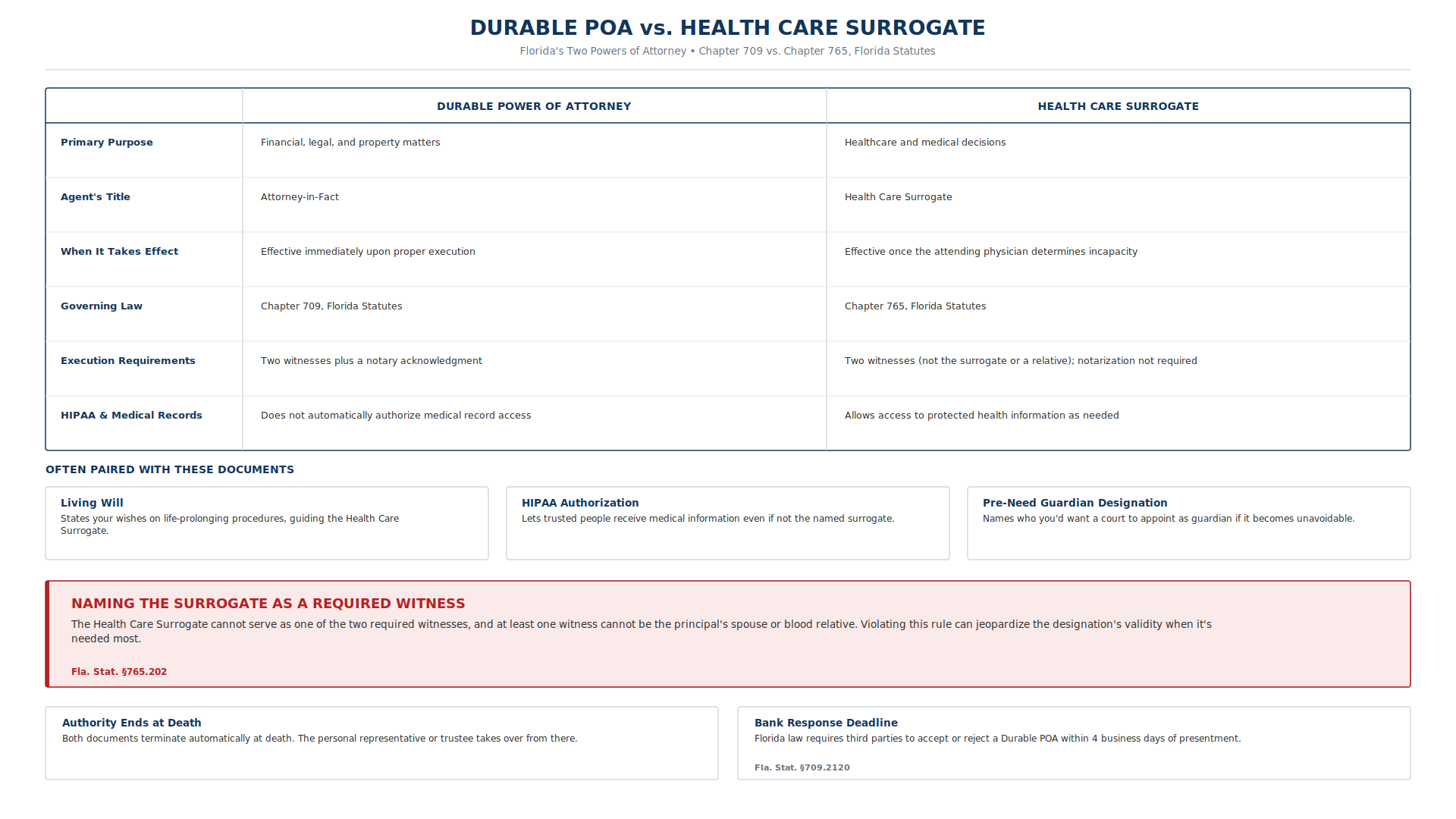
Side-by-Side Comparison: Durable vs. Medical Power of Attorney
| Feature | Durable Financial Power of Attorney | Medical Power of Attorney (Health Care Surrogate) |
|---|---|---|
| Primary Purpose | Financial, legal, and property matters | Healthcare and medical decisions |
| Agent’s Title | Attorney-in-Fact | Health Care Surrogate |
| When It Takes Effect | Effective immediately after proper execution under Florida law | Generally becomes effective when the principal lacks decision-making capacity, unless the designation provides that the surrogate’s authority to receive health information or make health care decisions is effective immediately. |
| Governing Florida Law | Chapter 709, Florida Statutes | Chapter 765, Florida Statutes |
| Execution Requirements | Two witnesses and a notary acknowledgment | Two witnesses (one cannot be the surrogate or a relative); notarization is not required |
| HIPAA & Medical Records | Does not automatically authorize healthcare decisions or full medical record access | Allows the surrogate to access protected health information as needed to carry out healthcare decisions |
Understanding this distinction before creating your estate plan can prevent costly delays later. If you’re hospitalized after a serious accident, your Health Care Surrogate can discuss treatment options with your doctors, but that person cannot access your bank account to pay medical bills unless they are also your financial agent. Likewise, an Attorney-in-Fact may have authority to manage your finances but cannot authorize surgery or decide whether life-sustaining treatment should continue. These responsibilities operate side by side rather than overlapping.
What Is a Durable Power of Attorney in Florida?
A Florida Durable Power of Attorney is a legal document that authorizes another person—known as your Attorney-in-Fact—to manage financial and legal matters on your behalf. It is governed by Chapter 709 of the Florida Statutes and is designed to remain effective even if you later become mentally incapacitated.
Unlike many people expect, Florida no longer recognizes traditional springing financial powers of attorney. Under Fla. Stat. § 709.2108, a durable power of attorney generally becomes effective as soon as it is properly executed, not after a doctor determines that you’ve become incapacitated. This immediate effectiveness often surprises people who assume the document stays dormant until it’s needed.
The authority granted can be broad or limited, depending on how the document is drafted. A properly prepared durable power of attorney may allow the Attorney-in-Fact to:
- Manage bank and investment accounts.
- Buy, sell, or refinance real estate.
- File state and federal tax returns.
- Handle business operations.
- Apply for Medicaid or other government benefits.
- Manage debts, insurance matters, and other financial obligations.
Although a Durable Power of Attorney is commonly used for financial and property matters, Florida law allows the document to specifically grant an agent authority to make health care decisions as well.
A Durable Power of Attorney is commonly used for financial and legal matters, but Florida law also permits a Durable Power of Attorney to specifically authorize an agent to make health care decisions. If the document does not grant that authority, the agent’s financial powers do not by themselves create health care decision-making authority.
This distinction matters in practice. Banks require a valid Durable Power of Attorney for financial transactions, while hospitals rely on a Health Care Surrogate for medical decisions. Using the wrong document can cause unnecessary delays when quick decisions are needed.
What Is a Medical Power of Attorney (Designation of Health Care Surrogate) in Florida?
Although many people search for a Florida Medical Power of Attorney, Florida law uses a different legal term: Designation of Health Care Surrogate. This document is governed by Chapter 765 of the Florida Statutes and appoints a trusted person to make healthcare decisions if you lose the ability to make or communicate those decisions yourself.
Your appointed representative is called a Health Care Surrogate, not an Attorney-in-Fact. The distinction matters because the surrogate’s authority is limited exclusively to medical and healthcare matters.
By default, a surrogate’s authority begins only after an attending physician documents that you lack decision-making capacity (Fla. Stat. § 765.202(6)). Alternatively, you can elect immediate authority, allowing your surrogate to review medical records and consult physicians right away, though your instructions always override the surrogate’s as long as you remain capable.
A Health Care Surrogate may be authorized to:
- Consent to or refuse medical treatment.
- Discuss your condition with physicians and healthcare providers.
- Choose hospitals, rehabilitation centers, nursing homes, or hospice care.
- Access protected health information necessary to make informed decisions.
- Carry out your Living Will or other advance directives regarding end-of-life care.
The authority is intentionally limited. The Health Care Surrogate does not have general authority to sell your home, manage investments, pay your mortgage, or handle your finances. However, Florida law permits a surrogate to access certain income, asset, and banking information when reasonably necessary to apply for public benefits such as Medicare or Medicaid.
In practice, this distinction becomes especially important during extended illnesses. While the Health Care Surrogate focuses on treatment decisions and communication with healthcare providers, the Attorney-in-Fact can continue managing the financial responsibilities that arise from long-term care, ensuring both your personal and financial interests remain protected.
Key Florida Laws That Govern Durable And Medical Power of Attorney
Understanding which Florida statute governs each document is more than a legal technicality—it affects when the document becomes effective, including Florida execution requirements, how it must be signed, and whether a bank or healthcare provider is likely to accept it. Financial powers of attorney and healthcare surrogate designations follow different statutory rules, so using the wrong form or overlooking an execution requirement can delay critical decisions when they’re needed most.
Where Financial and Medical Authority Diverge Under Florida Statute
| Topic / Issue | Florida Legal Rule | Governing Statute |
|---|---|---|
| Immediate effectiveness of a Durable Power of Attorney | A Florida Durable Power of Attorney must generally become effective when executed; traditional springing financial POAs are not permitted. | Fla. Stat. § 709.2108 |
| Execution requirements for a Durable Power of Attorney | Must be signed by the principal before two witnesses and acknowledged before a notary public. | Chapter 709, Florida Statutes |
| Execution requirements for a Health Care Surrogate | Must be signed before two adult witnesses. The surrogate cannot serve as a witness, and at least one witness cannot be the principal’s spouse or blood relative. Notarization is not required. | Fla. Stat. § 765.202 |
| When the Health Care Surrogate may act | Authority generally begins after the attending physician determines the principal lacks decision-making capacity and documents that determination. | Chapter 765, Florida Statutes |
| HIPAA and medical records | A Health Care Surrogate may receive protected health information needed to make healthcare decisions. A financial agent does not automatically receive this authority. | Chapter 765, Florida Statutes |
The biggest difference is when each document takes effect. In Florida, a Durable Power of Attorney is generally effective as soon as it’s signed, so it’s important to choose someone you trust completely. A Health Care Surrogate, on the other hand, can only act after a doctor determines you’re unable to make your own medical decisions.
Following the signing requirements also matters. A bank may reject a Durable Power of Attorney that wasn’t properly notarized, while a healthcare surrogate designation with incorrect witnesses could cause delays during a medical emergency. Taking the time to execute both documents correctly helps avoid problems when they’re needed most.
Practical Impact & Document Clauses
Florida’s prohibition on traditional springing Durable Powers of Attorney changes how many estate plans are drafted. Instead of delaying the document’s legal effectiveness, many people rely on personal instructions or an understanding with their Attorney-in-Fact about when the authority should actually be exercised. Legally, however, the authority already exists once the document is signed.
The different execution requirements also affect how these documents are used in practice. A Durable Power of Attorney that is missing a proper notary acknowledgment is likely to encounter resistance from banks, title companies, and county recording offices because those institutions routinely verify statutory compliance before accepting the document. By comparison, a Designation of Health Care Surrogate does not require notarization, but mistakenly naming the surrogate as one of the required witnesses can jeopardize the document’s validity under Chapter 765.
Well-drafted Florida estate planning documents also include provisions that help avoid future problems. A durability clause ensures the financial authority survives the principal’s incapacity, successor agent and successor surrogate provisions provide continuity if the first choice cannot serve, and appropriate healthcare authorization language allows medical providers to share the information necessary for informed treatment decisions. These provisions rarely receive much attention when signing the documents, but they often determine how smoothly the documents function years later during a medical or financial crisis.
When Each Document Actually Gets Used
Understanding the legal distinction is one thing—knowing how these documents work during a real-life emergency is another. In most situations, a Durable Power of Attorney and a Designation of Health Care Surrogate operate at the same time, but each person has authority over a different set of decisions.
Sudden Stroke or Serious Accident
Imagine someone suffers a severe stroke and is no longer able to communicate.
The Health Care Surrogate works directly with physicians, reviews treatment options, consents to surgery if necessary, selects a rehabilitation facility, and ensures the person’s healthcare wishes are followed.
At the same time, the Attorney-in-Fact uses the Durable Power of Attorney to pay hospital bills, manage insurance claims, access bank accounts, keep mortgage payments current, and handle ongoing financial obligations.
Unless the Durable Power of Attorney also specifically grants health care decision-making authority, the Attorney-in-Fact cannot authorize medical treatment merely because the agent controls the principal’s finances. Likewise, a Health Care Surrogate does not have general authority over the principal’s finances.
Elective Surgery With Temporary Incapacity
These documents can also matter during a short period of incapacity, such as when a patient temporarily cannot make or communicate health care decisions after surgery.
Suppose you’re scheduled for major surgery. While you’re under anesthesia or recovering from complications, you may temporarily lose the ability to make informed medical decisions. During that period, your Health Care Surrogate can communicate with physicians and approve treatment if unexpected medical decisions arise.
If the surrogate’s authority began because you lacked decision-making capacity, it generally ceases when capacity returns. However, a designation that gives the surrogate immediate authority over health information or health care decisions can remain effective until revoked.
Managing Property During Long-Term Care
Now consider a different scenario.
A person moves into a memory care facility after being diagnosed with advanced dementia. Their home needs to be maintained, property taxes must be paid, investments require management, and financial accounts still need regular attention.
These responsibilities belong to the Attorney-in-Fact under the Durable Power of Attorney. The Health Care Surrogate has no authority to sell the home, refinance property, sign tax documents, or manage investment accounts simply because the principal is receiving medical care.
When Neither Document Should Be Relied Upon
Some situations fall outside the ordinary authority granted by these documents. For example, if no designated Health Care Surrogate or alternate is available, Florida’s proxy statute in § 765.401 may provide the next available decision-maker without automatically requiring a guardianship proceeding.
For example, emergency physicians generally do not delay life-saving treatment while waiting for a Durable Power of Attorney. Likewise, a Health Care Surrogate cannot attend a real estate closing or sign documents transferring ownership of property.
Each document has a clearly defined legal purpose. Trying to use one outside its intended scope often results in delays while the appropriate authority is confirmed.
Naming Agents and Executing Both Documents as Part of One Florida Estate Plan
Many people choose the same trusted individual to serve as both their Attorney-in-Fact and their Health Care Surrogate. Doing so can simplify communication because one person understands both the medical situation and the family’s financial responsibilities.
That approach is not always the best choice.
Some families intentionally divide these responsibilities. One child may have experience managing finances, investments, and property, while another has a healthcare background or lives nearby and can communicate regularly with physicians. Separating the roles can also reduce stress during emotionally difficult situations by allowing each person to focus on specific responsibilities.
Whichever approach you choose, every Florida estate plan should include at least one successor agent and one successor surrogate. If your first choice dies, resigns, becomes incapacitated, or simply cannot be reached during an emergency, the backup can immediately assume responsibility without requiring court intervention.
From a practical standpoint, many estate planning attorneys recommend signing both documents during the same appointment. Completing them together helps ensure the documents reflect the same intentions, identify consistent decision-makers, and satisfy Florida’s execution requirements without overlooking witness or notarization rules.
If your Durable Power of Attorney may later be used to buy, sell, or mortgage real estate, recording it in the appropriate county records may become necessary for that specific transaction. A Designation of Health Care Surrogate, by contrast, is not recorded. Instead, copies should be provided to your surrogate, primary care physician, hospital system, and anyone else likely to need the document during a medical emergency.
For the most comprehensive planning, these documents should also coordinate with your Living Will and any separate HIPAA authorization so your surrogate can carry out your healthcare preferences without confusion or conflicting instructions.
Limitations and Legal Considerations
A Durable Power of Attorney terminates when the principal dies. A health care surrogate’s decision-making authority is focused on the principal’s health care, but Florida law gives a designated surrogate certain limited responsibilities and authority that can continue to matter after death, including in connection with anatomical gifts. Once the principal dies, the authority granted under both documents automatically ends, and responsibility for managing the estate passes to the personal representative named in the Last Will and Testament or to the trustee of a Revocable Living Trust, if applicable.
A Durable Power of Attorney also has important legal limits. Even if it grants broad financial authority, it does not permit the Attorney-in-Fact to consent to surgery, withdraw life-sustaining treatment, or make other healthcare decisions reserved for a Health Care Surrogate.
The reverse is equally true.
A Health Care Surrogate cannot access investment accounts, write checks, sell property, or manage financial assets solely because medical bills need to be paid. Those decisions remain outside the surrogate’s legal authority.
Failing to execute one of these documents often creates an administrative gap. If no valid financial agent exists, family members may need to seek court-appointed guardianship before managing assets. Likewise, If no designated surrogate or available alternate surrogate exists, Florida law provides a statutory order of priority for a health care proxy under § 765.401, although particular disputes or circumstances may still require court involvement. These proceedings are typically more expensive, more time-consuming, and far less flexible than executing the appropriate documents in advance.
Documents Often Paired With These Two
A Durable Power of Attorney and Health Care Surrogate designation are often coordinated with other Florida advance-planning documents, including a Living Will and, where appropriate, a separate HIPAA authorization.
These commonly include:
- Living Will – States your wishes regarding life-prolonging procedures and end-of-life care, providing instructions that help guide your Health Care Surrogate when making decisions under Florida law.
- HIPAA Authorization – Allows designated family members or trusted individuals to receive medical information even if they are not your named Health Care Surrogate.
- Pre-Need Guardian Designation – Identifies the person you would prefer a court to appoint as your guardian if guardianship later becomes unavoidable.
Using these documents together creates a more complete plan and reduces uncertainty for both family members and healthcare providers during periods of incapacity.
Common Mistakes That Undermine These Documents in Florida
Even well-intentioned estate planning can fail if these documents are prepared or executed incorrectly. Many of the problems families encounter during a medical emergency or financial crisis stem from avoidable mistakes rather than complex legal issues.
Using Generic Power of Attorney Forms
A common mistake is downloading a generic power of attorney template that is not designed for Florida law. Some generic forms may not reflect Florida’s durability and execution requirements, so a form should be checked against the current requirements of Chapter 709 before it is signed.
The problem often isn’t discovered until the document is presented to a bank, title company, or other institution. At that point, correcting the issue may require the principal to sign a new document—which may no longer be possible if they have already become incapacitated.
Naming the Health Care Surrogate as a Required Witness
Florida’s witness requirements for a Designation of Health Care Surrogate are specific. Naming the person who will serve as the Health Care Surrogate as one of the required witnesses can jeopardize the validity of the designation.
Because this mistake occurs during execution rather than drafting, many people never realize there’s a problem until the document must be relied upon during a medical emergency. Reviewing witness eligibility before signing is a simple step that can prevent unnecessary disputes later.
Assuming a Durable Power of Attorney Covers Medical Decisions
Many families arrive at a hospital believing their Durable Power of Attorney gives them authority to approve surgery or make treatment decisions.
It doesn’t.
A Durable Power of Attorney generally addresses financial and legal matters, but Florida law permits it to specifically delegate health care decision-making authority. If neither a health care surrogate nor an agent with applicable health care authority is available, Florida’s statutory rules for health care decision-making may apply. That misunderstanding can delay important medical decisions during a time when prompt action is critical.
Failing to Name a Successor Agent or Successor Surrogate
Life circumstances change. The person you appoint today may later become unavailable because of illness, relocation, death, or a personal decision not to serve.
If no successor is named, family members may need to seek court involvement simply because there is no one with legal authority to step into the vacant role. Naming at least one alternate agent and one alternate surrogate provides valuable continuity without requiring additional legal proceedings.
Never Reviewing an Older Durable Power of Attorney
Florida law does not impose an expiration date on a properly executed Durable Power of Attorney. However, financial institutions sometimes apply internal policies when reviewing older documents, particularly if they are many years old or have never been used.
Although the document may remain legally valid, an outdated power of attorney can lead to additional verification requests or delays before it is accepted. Reviewing your estate planning documents every few years—and after major life events such as marriage, divorce, relocation, or the death of a named agent—helps ensure the information remains accurate and practical for future use.
Frequently Asked Questions (FAQ)
Can the same person serve as both my financial agent and my Health Care Surrogate in Florida?
Yes. Florida law allows you to appoint the same trusted individual to serve in both roles. Many people do so for simplicity and consistency. Others choose different individuals based on their experience or availability—for example, naming one person to manage finances and another with healthcare knowledge to make medical decisions.
Does my Durable Power of Attorney allow my agent to make medical decisions if I’m hospitalized and can’t speak for myself?
Not necessarily. A Durable Power of Attorney generally covers the powers specifically granted in the document, and Florida law permits a Durable Power of Attorney to specifically authorize an Attorney-in-Fact to make health care decisions. If that authority is not granted, the agent’s financial powers do not by themselves authorize medical decision-making.
What happens if my named Health Care Surrogate and my family disagree about my treatment?
If your Designation of Health Care Surrogate is valid and effective, healthcare providers will generally follow your appointed surrogate’s decisions. The surrogate must follow your wishes, including any instructions in your Living Will or other advance directives. Family members cannot override those instructions simply because they disagree.
Will a Florida bank or title company still honor my Durable Power of Attorney if it’s several years old?
Yes. Florida law does not establish an expiration date for a properly executed DPOA, but the four-day rule in Fla. Stat. § 709.2120 is a presumed reasonable period for a financial institution or broker-dealer to accept or reject a power of attorney for specified banking or investment transactions. A third party may still reject a power of attorney for reasons permitted by the statute. While banks may request an agent’s affidavit of validity under § 709.2119, the underlying document remains fully enforceable.
Disclaimer:This article provides general information about Florida Durable Powers of Attorney and Health Care Surrogate designations and is not legal advice. Florida laws may change, and individual circumstances vary. Consider consulting a qualified Florida attorney for advice about your specific situation.