Understanding the Florida Probate Process (Step by Step)
Losing a loved one is difficult enough without trying to navigate the legal process that follows. If the deceased owned assets in their sole name, those assets often cannot be transferred until the appropriate probate procedure is completed. Understanding the Florida probate process early can help families avoid unnecessary delays, unexpected costs, and procedural mistakes that may complicate estate administration.
Florida offers more than one probate pathway. Some estates qualify for a simplified procedure known as Summary Administration, while others require Formal Administration through the probate court. Which option applies depends on factors such as the value of the probate estate, the date of death, the nature of the assets, and whether ongoing estate management is necessary.
Recent legislative changes also make timing especially important. The 2026 increase to Summary Administration’s eligibility limit makes timing especially important. Families relying on outdated information may assume an estate requires formal probate when a simplified option is now available or choose the wrong procedure altogether.
This article explains how probate works in Florida, the steps involved, the updated 2026 eligibility rules, and the practical issues that commonly delay or derail probate proceedings.
Candice Hayden, Legal Writer
Maria Rosso, Florida Probate, Guardianship and Estate Planning Attorney
The Florida Probate Process at a Glance
Although every estate presents its own challenges, most follow the same overall sequence.
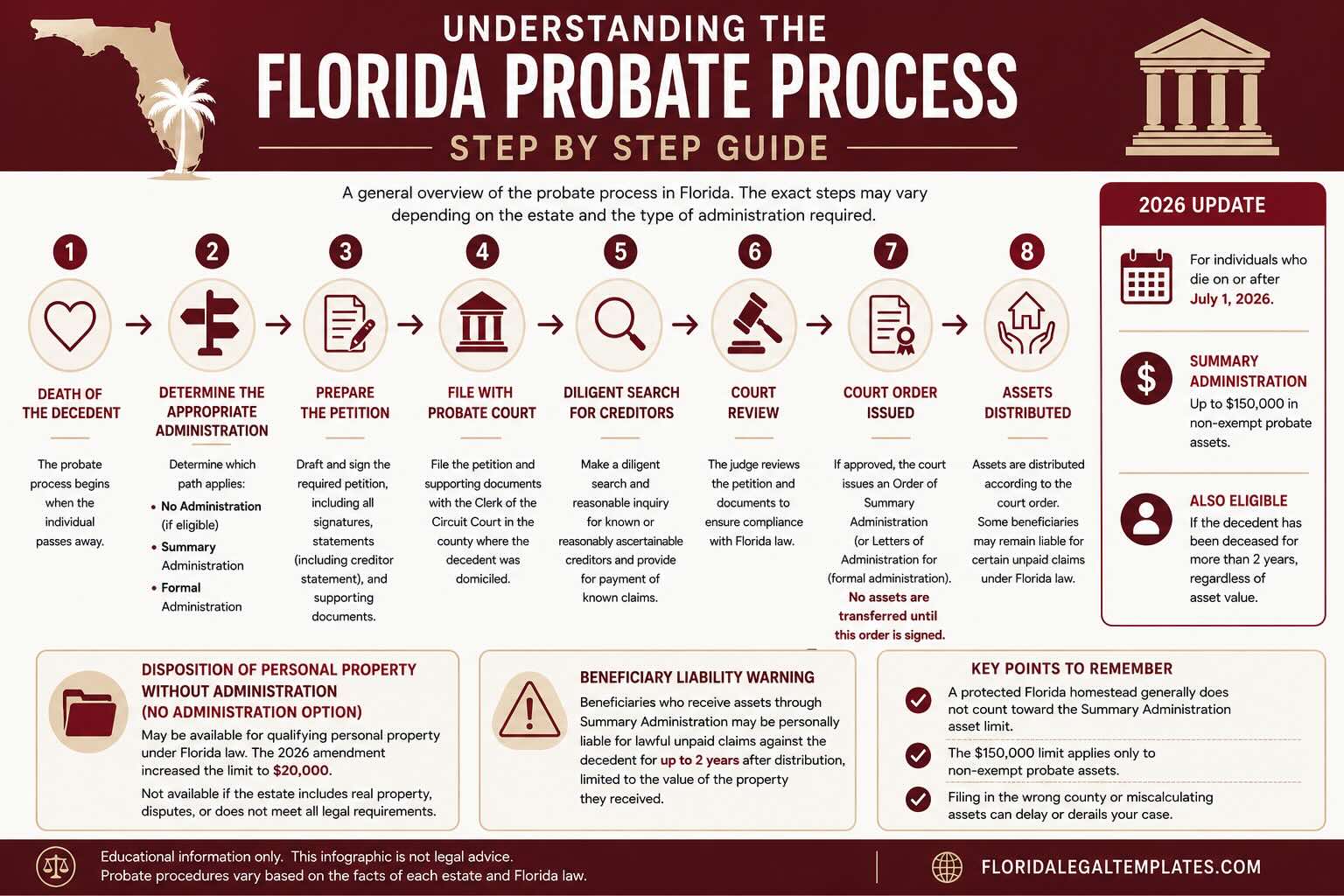
- Death of the property owner.
- Determine whether Summary Administration or Formal Administration applies.
- Prepare and verify the required probate petition.
- File the petition with the appropriate Florida probate court.
- Identify creditors and satisfy statutory notice requirements.
- Court reviews the filing.
- Judge signs the appropriate probate order.
- Assets are distributed to beneficiaries.
Many families first ask two questions:
- How long does probate take?
- Which probate procedure applies to my situation?
The answer depends largely on the type of administration.
| Administration Type | Generally Used When | Court Involvement |
|---|---|---|
| Summary Administration | Eligible estates meeting Florida’s statutory requirements | Simplified judicial proceeding |
| Formal Administration | Larger or more complex estates requiring ongoing administration | Formal case with a personal representative and court involvement as required by law |
Summary Administration usually involves fewer procedural steps because no ongoing estate administration occurs after the court issues its order. Formal Administration, by contrast, often requires appointment of a personal representative, continuing estate administration, creditor administration, and additional filings before assets can be distributed.
The correct procedure should be identified before preparing any probate documents. Filing under the wrong process often results in delays, additional court costs, or conversion into Formal Administration.
Step 1 — Determine Which Type of Administration Applies
Selecting the correct probate procedure is the single most important decision at the beginning of estate administration. Florida law provides different requirements depending on the estate’s circumstances, and choosing the wrong path can delay distributions or require the entire filing to be redone.
Summary Administration Eligibility (Updated for 2026)
Florida law now permits Summary Administration in two primary situations. For a testate estate, the will must not direct administration under chapter 733.
First, effective July 1, 2026, Summary Administration is available when the value of the entire estate subject to administration in Florida, less property exempt from creditor claims, does not exceed $150,000. This threshold was increased from the previous $75,000 limit under CS/HB 1337, expanding access to the simplified probate process. Fla. Stat. § 735.2055 permits a petition at any stage if it appears the estate qualifies at the time of filing.
Second, Summary Administration remains available regardless of estate value if the decedent has been deceased for more than two years.
One detail frequently causes confusion: not every asset is included when calculating the statutory limit.
For example, a properly protected Florida homestead generally qualifies as an exempt asset and does not count toward the $150,000 eligibility threshold. Non-exempt probate assets, however, are included when determining whether the estate qualifies.
Statutory Reference Matrix
| Topic / Issue | Florida Legal Rule | Governing Statute |
|---|---|---|
| Summary Administration eligibility | Available when the estate meets the statutory value test or the decedent has been dead for more than two years | Fla. Stat. § 735.201 |
| Petition execution | Petition must be signed and verified by the surviving spouse (if any) and all beneficiaries, subject to the statutory exception | Fla. Stat. § 735.203 |
| Unsworn verification | Petition may use an unsworn declaration containing the statutory verification language under penalty of perjury | Fla. Stat. § 92.525 |
The higher threshold means many estates that previously required Formal Administration may now qualify for Summary Administration. However, eligibility is determined by applying the statutory rules exactly as written. Incorrectly excluding assets or misunderstanding which property is exempt can cause the court to reject the petition.
Families should also remember that Summary Administration is still a formal court proceeding. The increased asset limit did not eliminate filing requirements or judicial review—it simply expanded who may use the simplified process.
Formal Administration Trigger Points
Not every estate can proceed through Summary Administration.
Formal Administration is generally used when the estate does not qualify for Summary Administration or when the circumstances of the estate call for the broader administration procedures provided by Florida law.
Common situations include:
- The estate does not meet the statutory requirements for Summary Administration.
- Litigation involving the estate.
Since July 1, 2026, a personal representative may petition to enforce statutory authority under Fla. Stat. § 733.6125 and, if successful, recover taxable costs including reasonable attorney fees. The proceeding is adversarial under Florida Probate Rule 5.025(a)(14) unless the court directs otherwise.
- Ongoing business interests requiring management.
- Asset investigations or title issues.
- Circumstances requiring appointment of a personal representative to administer the estate.
Effective July 1, 2026, a Florida-appointed personal representative must be granted access to a decedent’s safe-deposit box upon presenting certified letters of authority. The representative or the representative’s attorney may also pay accumulated charges and terminate the lease.
In Formal Administration, the personal representative handles estate affairs under Florida law, with court involvement when required by the code or a court order. Although it typically involves more filings and a longer administration period, it is designed for estates where simplified procedures would not adequately protect creditors, beneficiaries, or the estate itself.
In practice, families sometimes focus only on the estate’s approximate value without considering whether administration activities will continue after filing. Even an estate that appears straightforward can require Formal Administration if unresolved legal or financial issues demand ongoing management.
The Retroactivity Trap (Critical 2026 Nuance)
Florida’s Summary Administration procedure also covers a nonresident decedent’s Florida estate when the statutory requirements are met.
The $150,000 Summary Administration limit took effect July 1, 2026, and the current statutes should be reviewed based on whether the estate qualifies when the petition is filed.
The statute contains no separate cutoff based on the decedent’s date of death.
Consider this example.
A Florida resident who died before July 1, 2026, leaving $120,000 in non-exempt probate assets may meet the current value test if the petition is filed on or after July 1 and the other eligibility requirements are met. If a petition was filed or an order entered before July 1, 2026, have counsel review the transition question.
This distinction has practical consequences. Filing under the wrong administration type because the law was misunderstood can lead to dismissal of the petition, additional filing costs, and delays while the estate is converted into the proper probate proceeding.
Step 2 — Prepare the Petition and Required Statements
Once you’ve confirmed the correct type of probate administration, the next step is preparing the court filings. This stage is more than paperwork—it establishes the legal foundation for the probate case. Even a minor omission can delay court review or require amended filings.
For Summary Administration, the petition must contain specific information required by Florida law. It identifies the decedent, lists the beneficiaries, describes the probate assets, explains why the estate qualifies for Summary Administration, and tells the court how the assets should be distributed.
Unlike informal estate settlements, this is a verified court pleading. Every statement made to the court carries legal significance, so accuracy matters from the outset.
Statutory Reference Matrix
| Topic / Issue | Florida Legal Rule | Governing Statute |
|---|---|---|
| Petition requirements | Petition must include all statutory information required for Summary Administration | Fla. Stat. § 735.203 |
| Probate filing format | Summary Administration petitions must comply with Florida Probate Rules | Florida Probate Rules of Court Procedure (Rules 5.010–5.530) |
| Unsworn verification | Petition may be verified through an unsworn declaration under penalty of perjury | Fla. Stat. § 92.525 |
Preparing the petition is often where probate delays begin. Courts frequently require corrections when beneficiary information is incomplete, asset descriptions are inaccurate, or statutory language is omitted. Taking time to prepare a complete petition usually saves far more time than correcting deficiencies after filing.
The Mandatory Creditor Statement
Since October 1, 2026, Florida Probate Rule 5.530(a)(9) requires a Summary Administration petition to state either that all creditor claims are barred or that a diligent search and reasonable inquiry was made, followed by a statement that the estate is not indebted or the required creditor and payment information.
This creditor language reflects the requirements of Florida Probate Rule 5.530, while § 735.206(2) separately requires a diligent search and reasonable inquiry for known or reasonably ascertainable creditors before the order of summary administration is entered. Before the court authorizes distribution of estate assets, it expects petitioners to determine whether legitimate debts exist and explain how those obligations will be handled.
Skipping this requirement or replacing it with informal wording may result in the court requiring an amended petition before moving the case forward.
Who Must Sign the Petition?
Florida law also specifies who must join the petition.
For Summary Administration, the petition must generally be signed and verified by:
- the surviving spouse, if one exists; and
- all beneficiaries.
The only statutory exception applies when a beneficiary will receive their entire distributive share under the proposed order. In that limited circumstance, formal joinder may not be required.
Getting the signatures and required joinder issues settled before filing can prevent a petition from being returned for correction. Under § 735.203, a beneficiary receiving a full distributive share under the proposed distribution does not have to join, but formal notice must still be served on a beneficiary who does not join.
Notarization or an Unsworn Declaration
Many people assume every probate petition must be notarized.
Florida provides another option.
Instead of appearing before a Notary Public or Deputy Clerk, petitioners may use an unsworn written declaration, provided it contains the exact statutory verification language required by Fla. Stat. § 92.525(2).
The written declaration uses the verification wording shown in the linked required affidavit:
“Under penalties of perjury, I declare that I have read the foregoing document and that the facts stated in it are true.”
The wording should not be paraphrased. Courts expect the statutory language to appear exactly as required because it substitutes for a sworn oath.
Cross-Border Signatures via Remote Online Notarization (RON)
In many Florida probate matters, beneficiaries reside out of state or even out of the country, complicating the collection of physical signatures for joint petitions. If an estate uses a traditional notarized verification rather than an unsworn declaration under § 92.525, Florida’s Remote Online Notarization laws may permit a principal located outside Florida to appear before a Florida online notary through compliant audio-video technology.
To be valid, the Florida online notary must record a two-way audio-video session, confirm an out-of-state principal’s consent to a Florida notary and Florida law, and verify identity by personal knowledge or, if the principal is not personally known, remote ID presentation, credential analysis, and identity proofing. While the unsworn declaration remains the standard shortcut, utilizing a formal RON framework is legally robust and fully accepted by Florida circuit courts when a traditional sworn oath is requested by a specific local judicial division.
Don’t Forget the Homestead Filing
If the estate includes Florida real property claimed as protected homestead, another filing is commonly required.
If protected homestead is an issue, a Petition to Determine Homestead Status may be filed under Florida Probate Rule 5.405 so the court can determine whether the property qualifies as protected homestead and identify the interests of the persons entitled to it.
Failing to address homestead issues early often delays title transfers because financial institutions and title companies rely on the court’s determination before recognizing ownership changes.
Step 3 — File With the Correct Circuit Court
After the petition has been completed and properly verified, it must be filed in the correct Florida probate court.
Florida probate cases are filed with the Clerk of the Circuit Court (Probate Division) serving the county of the decedent’s Florida domicile at death or, if the decedent had no Florida domicile, a county where the decedent’s Florida property is located or, if there was no Florida property, where a debtor resides.
Probate filings may be submitted electronically where required or permitted by the applicable Florida court and clerk procedures.
Practical Filing Workflow
The filing package commonly includes:
- Verified probate petition.
- Death certificate, where required.
Beginning January 1, 2027, amended Florida Probate Rule 5.205 will require evidence of death no later than three months after the first creditor notice in Formal or Ancillary Administration, before the order in Summary Administration, and with the application for Disposition Without Administration. The rule will also bar early demands for an official death record unless reasonable cause exists to believe the decedent is alive.
- Petition to Determine Homestead Status, if applicable.
- Supporting schedules identifying estate assets.
- Any additional documents required by the local probate division.
Filing a complete petition matters because the clerk and probate court still have to process the required pleadings and supporting documents. Missing information can mean another filing before the judge can act on the request.
Why Venue Matters
Venue is not based simply on where the beneficiaries live or where the largest asset is located. Under Fla. Stat. § 733.101, probate venue is generally the county where the decedent was domiciled, with separate rules when the decedent had no Florida domicile.
If the case is filed in an improper county, the court may transfer it to a county of proper venue under Fla. Stat. § 733.101. That means additional filing costs, administrative delays, and extra work for everyone involved.
A quick review of domicile before filing often prevents weeks of avoidable delay.
Step 4 — Creditor Notice and Claims Handling
One of probate’s primary purposes is ensuring that legitimate creditors receive the protections provided by Florida law before estate assets are distributed.
That responsibility begins well before the judge signs a probate order.
What Does “Diligent Search” Actually Mean?
Florida requires petitioners to make a diligent search and reasonable inquiry for known or reasonably ascertainable creditors.
In practice, this involves reviewing the decedent’s financial records rather than relying solely on memory.
Common sources include:
- bank statements;
- credit card accounts;
- medical invoices;
- mortgage records;
- personal loan documents;
- tax records; and
- other financial correspondence.
The goal is not to discover every possible debt but to make a reasonable, good-faith effort to identify creditors who can be found through ordinary investigation.
Summary Administration vs. Formal Administration
Both probate procedures address creditor rights, but they do so differently.
Summary Administration is designed for qualifying estates and generally involves a streamlined process. Even so, creditors cannot simply be ignored. The petition must explain that provision has been made for payment of known debts to the extent estate assets are available.
Formal Administration typically involves a more extensive creditor administration process because estate management continues under court supervision.
For an attorney intending to charge the statutory schedule under Fla. Stat. § 733.6171(3), written disclosures must explain that no statutory attorney fee is mandatory, fees need not be based on estate size and are negotiable, and the personal representative chooses counsel. The personal representative must sign an acknowledgment of these disclosures.
The distinction matters because many families mistakenly believe Summary Administration eliminates creditor issues. It does not—it simply handles them under a different procedural framework.
Proposed Distribution Must Address Known Debts
Florida law also requires the proposed distribution plan to account for known obligations.
If creditors have been identified, the petition should explain how those claims will be satisfied before beneficiaries receive estate property.
After a Summary Administration order, a person who obtained the order may publish a creditor notice under Fla. Stat. § 735.2063. If proof of publication is filed, claims of creditors who are unknown or not reasonably ascertainable are barred unless filed within three months after first publication.
Ignoring known debts may create problems long after probate appears complete. As discussed in the next section, beneficiaries who receive distributions may remain personally responsible for certain unpaid claims for a limited period under Florida law.
Step 5 — Court Review and the Order of Summary/Formal Administration
After the petition is filed, the probate case moves from document preparation to judicial review. At this stage, the court examines whether the filing complies with Florida law before authorizing any transfer of estate assets.
Filing the petition does not itself authorize the transfer of probate assets. In a Summary Administration proceeding, the court may enter an order allowing distribution, and § 735.206(4) authorizes holders of estate property to comply with that order.
Until the court enters the appropriate probate order, estate assets generally remain subject to the probate process.
What the Judge Reviews
In a Summary Administration proceeding, the Circuit Judge reviews the petition against the statutory requirements and considers matters such as:
- Whether the estate qualifies for the requested probate procedure.
- Whether required beneficiaries have properly joined the petition.
- Whether the petition contains the mandatory statutory statements.
- Whether creditor-related obligations have been addressed.
- Whether the proposed distribution complies with Florida law.
If the court identifies deficiencies, it may require amendments or additional documentation before entering an order.
This is why probate delays often stem from incomplete filings rather than court backlog. Missing signatures, omitted creditor disclosures, or incorrect asset valuations frequently result in avoidable requests for correction.
Why the Court Order Matters
Once the judge is satisfied that the statutory requirements have been met, the court issues the appropriate probate order.
For Summary Administration, this is the Order of Summary Administration.
Under Fla. Stat. § 735.206, the signed order authorizes holders of estate property to transfer to beneficiaries the assets assigned to them by the order.
Without that judicial order, third parties generally have no legal obligation to release probate assets.
This distinction is especially important for families attempting to close bank accounts or transfer real estate. Even if everyone agrees on who should inherit, institutions typically require the court order before recognizing the change in ownership.
Since January 1, 2025, the clerk must record specified probate records in Official Records, including orders admitting wills to probate and orders determining beneficiaries. Check the applicable clerk and title requirements for the specific property transfer.
Practical Example
Suppose an estate consists of a bank account, an investment account, and a vehicle titled solely in the decedent’s name.
Even if every beneficiary agrees on the distribution, the bank cannot simply divide the funds because a probate petition has been filed.
The legal authority arises only after the Circuit Judge signs the Order of Summary Administration. That order instructs the institution to release the assets according to the court-approved distribution.
Step 6 — Distribution and Lingering Heir Liability
After an Order of Summary Administration, assets may be distributed as the order directs; in Formal Administration, the personal representative handles distribution under Florida law.
For beneficiaries, this often feels like the end of the probate process. Legally, however, one important risk may continue after the distributions have been made.
How Assets Are Distributed
Under Summary Administration, once the court enters the distribution order:
- Banks release account funds.
- Financial institutions transfer investment assets.
- Title companies process approved real estate transfers.
- Other custodians distribute property according to the court’s order.
Because the court has already approved the proposed distribution, beneficiaries generally receive assets directly rather than through prolonged estate administration.
Probate May End—Potential Liability May Not
Receiving an inheritance does not always eliminate future financial exposure.
Under Fla. Stat. § 735.206(4), recipients of property under a Summary Administration order may be personally liable for their pro rata share of lawful estate claims.
That liability is limited in two important ways:
- The two-year period runs from the decedent’s death; after that, the estate and recipients are not liable unless enforcement proceedings were taken.
- Each recipient’s liability is limited to the value of estate property actually received, excluding property exempt from creditor claims.
This rule surprises many families because they assume the judge’s order permanently closes every issue relating to the estate.
Instead, Summary Administration balances efficiency with creditor protection. Qualified creditors may still pursue lawful claims within the statutory framework even after distributions have occurred.
Why This Matters in Practice
Imagine an estate is distributed shortly after probate because no outstanding debts are apparent.
Months later, a previously unknown medical provider establishes a lawful claim that should have been paid from estate assets.
If the statutory conditions are met, beneficiaries may be responsible up to the value of what they inherited.
That does not mean every late invoice creates liability, nor does it guarantee creditors will prevail. It does mean beneficiaries should avoid assuming that receiving inherited property automatically eliminates every potential estate obligation.
When Florida Probate Is Not Enough for Out-of-State Real Estate
A completed Florida probate case does not always mean every asset can be transferred. If the decedent owned real estate in another state, beneficiaries may discover that the Florida probate order is only part of the process.
For example, if the decedent lived in Florida but also owned a cabin in North Carolina or vacant land in Georgia titled solely in their name, the Florida Order of Summary Administration usually will not allow that county’s land records office to transfer ownership by itself. Instead, a separate probate proceeding, commonly called ancillary administration, may be required in the state where the real property is located. The exact procedure depends on that state’s probate laws.
This distinction matters when planning the estate timeline. Beneficiaries may receive Florida bank accounts and other assets quickly, only to discover months later that they still cannot sell or refinance the out-of-state property because an additional court process is required elsewhere. Florida probate can therefore be completed while title issues remain unresolved in another jurisdiction.
Florida law recognizes that administration of property located outside Florida may involve separate proceedings, but the requirements are governed primarily by the law of the state where the real estate sits.
Since June 13, 2024, Florida’s Community Property Rights at Death Act has also applied to qualifying property acquired as or traceable to community property under another jurisdiction. For covered property, one half belongs to the surviving spouse and is not part of the decedent’s probate estate; the decedent’s half is subject to probate. A declaratory-relief action to resolve a dispute must be filed within two years after death.
The No-Administration Alternative for Small Estates
Not every estate requires Summary Administration or Formal Administration.
Florida law provides another option for certain very small estates through the Disposition of Personal Property Without Administration procedure.
Section 735.301 is a separate expense-only route, limited to qualifying nonexempt personal property no greater than preferred funeral expenses plus reasonable and necessary medical and hospital expenses from the last 60 days of the last illness. The intestate small-estate route described below is separately governed by section 735.304.
Unlike probate administration, this process is designed for limited circumstances where qualifying personal property can be transferred without opening a traditional probate case.
Two other narrow routes may also avoid formal administration in qualifying cases. Effective July 1, 2026, a federal income-tax overpayment of up to $5,000 may be refunded to a surviving spouse or, if there is no surviving spouse, a designated child when debts are handled and no administration is pending or planned. Since the same date, a Florida financial institution may pay up to $2,000 in combined qualifying sole-name accounts without a survivor designation to an eligible family member no earlier than six months after death, subject to the statutory aggregate, affidavit, and no-pending-proceeding requirements.
Updated $20,000 Limit
Effective July 1, 2026, Fla. Stat. § 735.304 raised the nonexempt personal-property limit for this intestate small-estate procedure from $10,000 to $20,000, plus preferred funeral expenses and reasonable, necessary medical and hospital expenses from the last 60 days of the last illness.
When This Option May Apply
This alternative applies only in the specific circumstances described in Fla. Stat. § 735.304, including an intestate estate consisting of qualifying personal property and the statute’s other requirements.
The decedent must have been dead more than one year, and no Florida administration may be pending. Before filing, the heir must make a diligent search and reasonable inquiry for known or reasonably ascertainable creditors and provide for payment from available assets or obtain creditor consent. The affidavit must be served on nonjoining heirs, those creditors, and the Agency for Health Care Administration if the decedent was over 55; the court may authorize transfer by letter or other writing under seal.
In the right circumstances, it can eliminate many of the procedural steps discussed earlier, including:
- filing a Summary Administration petition;
- obtaining an Order of Summary Administration; and
- completing a formal court administration.
When It Is Not Enough
Despite its convenience, this procedure has clear limits.
It generally is not appropriate when:
- the estate includes real property;
- heirs dispute ownership;
- significant probate assets are involved; or
- the estate exceeds the statutory requirements.
Families sometimes assume every “small estate” avoids probate, but that is not how Florida law operates. The availability of this alternative depends on satisfying the specific statutory requirements rather than the family’s preference for a simpler process.
Homestead and Asset-Counting Mistakes That Derail a Petition
One of the most common reasons Summary Administration petitions encounter problems is incorrect asset valuation.
The issue is rarely intentional. More often, families misunderstand which assets count toward the statutory eligibility limit.
Protected Homestead vs. Non-Exempt Real Estate
Florida’s protected homestead generally does not count toward the Summary Administration asset threshold.
However, not every property qualifies for that protection.
For example, a commercial building or a multi-unit property where portions of the property do not qualify as protected homestead may contain non-exempt value that must be included when determining eligibility.
Leaving those values out can dramatically change whether the estate qualifies for Summary Administration.
Consequences of Incorrect Asset Calculations
If non-exempt property is omitted from the asset calculation, the court may determine that the estate never qualified for Summary Administration.
That can result in:
- dismissal of the petition;
- additional filing expenses;
- delays in estate distribution; or
- conversion into Formal Administration.
Correct classification of estate assets before filing is usually far less expensive than correcting an improperly filed probate case later.
Other Common Filing Mistakes
Other issues that frequently delay probate include:
- relying on estimated asset values instead of documentation;
- overlooking partial ownership interests;
- failing to identify all probate assets;
- incomplete beneficiary information;
- missing required signatures; and
- omitting mandatory statutory statements from the petition.
Many of these problems are preventable through careful preparation before filing.
Frequently Asked Questions (FAQ)
If my loved one died in June 2026, can I still use the new $150,000 threshold now that it’s in effect?
Potentially. A June 2026 date of death does not by itself bar Summary Administration under Florida’s $150,000 limit. For a petition filed on or after July 1, 2026, eligibility is assessed at filing using the value of the estate subject to administration in Florida, less exempt property, under Fla. Stat. §§ 735.201 and 735.2055. Have an attorney review any petition filed or order entered before July 1, 2026, for the transition issue.
Can I use an unsworn declaration instead of a notary for the Summary Administration petition?
Yes, provided the declaration complies with Fla. Stat. § 92.525 and includes the exact statutory verification language required under Florida law:
Under Fla. Stat. § 92.525(2), a Florida probate petitioner using an unsworn declaration must include this verification: “Under penalties of perjury, I declare that I have read the foregoing document and that the facts stated in it are true.”
If I already received my inheritance through Summary Administration, can a creditor still come after me later?
Potentially. Under Fla. Stat. § 735.206(4), recipients may be personally liable pro rata for lawful estate claims. Each recipient’s liability is capped at the value of estate property actually received, excluding exempt property. After two years from the decedent’s death, the estate and recipients are not liable unless enforcement proceedings have been taken.
What happens if I forget to include a rental property or partial-interest asset when calculating the $150,000 limit?
If omitted property should have been included as a non-exempt probate asset, the estate may no longer qualify for Summary Administration. The court may require correction of the filing, dismiss the petition, or require the estate to proceed through Formal Administration instead.
This article is intended for educational purposes only and provides general information about the Florida probate process. It is not legal advice and does not create an attorney-client relationship.