
Florida Promissory Note Template | Free PDF & Requirements
A Florida promissory note puts the loan in writing: who is borrowing, how much is being advanced, and when and how it will be repaid. For a private loan between relatives or a one-time business advance, that usually means settling the interest rate, payment dates, how payments are credited, and what happens if a payment is late.
The form below is for a loan with a defined repayment plan. The debt may be unsecured or backed by property, but a repayment promise alone won’t create a lien. A real estate mortgage or personal property security agreement needs its own filing or recording steps. Future advances, several guarantors, or a lender relying on special statutory authority to charge interest may call for a fuller loan agreement or transaction-specific drafting.
Candice Hayden, Legal Writer
Carly Johansson, Florida Contract Attorney Last Updated: November 11, 2026
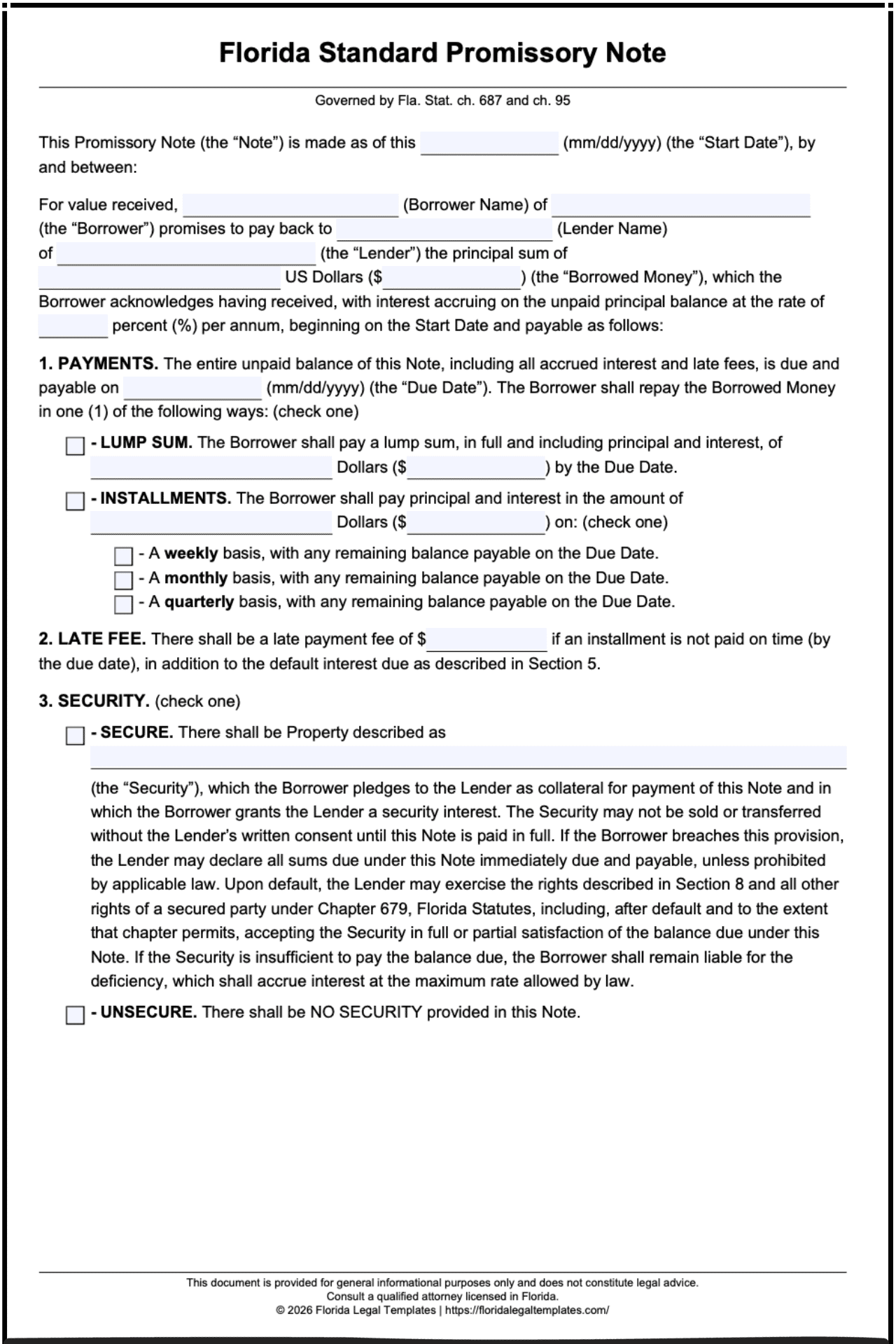
Free Florida Promissory Note Template (PDF)
Get PDF
Use the fillable, printable PDF to record the parties, principal, interest, payment schedule, maturity date, default terms, and signatures. It should make the secured or unsecured choice clear.
For example, if a friend lends a contractor $12,000 to be repaid in monthly installments, the note can state the payment amount and due dates. If the friend also expects repayment to be backed by a work van, that collateral arrangement needs its own documentation and title-lien step. Checking “secured” on a note doesn’t do that work.
Choose a Note, Loan Agreement, or Collateral Document
A Florida promissory note records the borrower’s promise to repay. It answers practical questions: what amount was advanced, when payments are due, and what happens if one is missed.
A loan agreement can cover more of the business deal, such as conditions for funding, how the borrower may use the money, or additional lender protections. A mortgage or security agreement gives the lender rights in specified collateral. A guaranty is a separate promise by another person or entity to pay if the borrower does not.
These documents work together, but they do different jobs. A lender who wants repayment backed by real estate needs a mortgage; a sentence in the note saying “secured by the borrower’s home” is not a substitute. Likewise, naming equipment as collateral in the note does not replace a security agreement or the steps required to perfect the security interest.
A short Florida loan promissory note may work for a one-time loan with a fixed amount and uncomplicated payment plan. If the deal has several funding stages, multiple guarantors, conditions that must be met before funding, or a lender charging a rate under statutory authority, a broader loan agreement and tailored collateral documents may be needed.
Set the Repayment Terms Before Anyone Signs
Identify the parties and amount
Use the borrower’s and lender’s full legal names. If a company is the borrower, name the entity—not only the person who arranged the loan. The person signing for an entity should sign with their title or representative capacity, so the document shows who owes the money.
State the principal amount and when the borrower receives the funds. If the money will be advanced in stages, say so and specify how each advance changes the balance. For co-borrowers, identify each one as a borrower. A guarantor should have a separate guaranty and signature line; otherwise, the parties may later disagree about whether that person borrowed the money or merely guaranteed it.
Make the payment promise measurable
The note should let either party work out the balance without guessing. State the interest rate and how it accrues, the amount and due date of each installment, and the date when any remaining balance becomes due. Specify where payments go and how the lender will credit them between interest and principal.
Deal with prepayment, late charges, default interest, notice and cure periods, and acceleration in distinct terms. These provisions answer different questions. A cure period tells the borrower how long they have to fix a missed payment after notice. An acceleration clause tells both sides when the lender may demand the remaining balance early. If the clause is vague, the parties may dispute whether the entire debt is due—or whether the lender gave the notice required to make it due.
Before signing, fill in every amount and date. A blank interest rate or maturity date can turn a straightforward repayment plan into a dispute about what the borrower agreed to pay.
Decide whether Chapter 673 negotiability matters
A note is negotiable under Fla. Stat. § 673.1041 only if it meets the statute’s conditions: it must be an unconditional promise to pay a fixed amount, payable to bearer or order, due on demand or at a definite time, and not require an unauthorized act beyond paying money.
A conspicuous statement such as “not negotiable” can exclude the note from Chapter 673. That can be appropriate when the parties want a direct contract between the original borrower and lender. Negotiability is a drafting choice, not a universal requirement for an enforceable loan. Authorized collateral or acceleration terms do not necessarily make an instrument nonnegotiable.
Since July 1, 2025, a note may also require disputes about its payment promise to be resolved in a specified forum without, by itself, making the note nonnegotiable.
Florida Rules That Change What a Note Can Do
| Topic / Issue | Florida Legal Rule | Governing Statute |
|---|---|---|
| Signatures and capacity | A person generally must sign to be liable on a negotiable note. A credit agreement must be written, state consideration and relevant terms, and be signed by creditor and debtor. At 18, the disability of nonage is removed, subject to exceptions in § 743.07. | §§ 673.4011, 687.0304(2), 743.07(1) |
| Interest and receipts | For obligations of $500,000 or less, the baseline civil usury limit is 18% simple annual interest, subject to statutory exceptions. Larger obligations are subject to separate criminal usury rules. Lenders covered by § 687.12 must state the specific statutory chapter authorizing a rate that would otherwise be unauthorized. Receipt rules apply to loans made upon security. | § 687.02; §§ 687.03, 687.04, 687.071, 687.08, 687.12(4) |
| Documentary stamp tax | Notes made, executed, delivered, sold, transferred, or assigned in Florida are generally taxed at $0.35 per $100 or fraction, capped at $2,450, unless exempt. Tax on a recorded mortgage or security agreement is uncapped. Unrecorded-note tax is remitted through the Department of Revenue. | § 201.08; § 201.133; Fla. Admin. Code rr. 12B-4.001, 12B-4.054(18) |
| Collateral and recording | A real estate mortgage must be recorded to protect against later creditors or qualifying purchasers. Personal property and titled assets have distinct perfection processes. | §§ 319.27, 328.15, 679.2031, 679.3101, 679.3111, 679.3141, 695.01, 695.03, 695.26 |
| Enforcement limits | Five years generally applies to actions on written instruments and mortgage foreclosures. Advance powers to confess judgment are void. | §§ 95.11(2)(b)–(c); 55.05 |
The rules affect several separate decisions: who must sign, how interest is set, whether collateral documents are needed, and whether the note is negotiable. A standalone note generally does not need a witness or notary. A mortgage or other instrument submitted for recording has separate signing and acknowledgment requirements.
Taxes and liens also need to be handled separately from the repayment promise. An unsecured note may stay private between the parties, but it can still be subject to documentary stamp tax. A mortgage or security instrument securing future advances may not be enforceable in court as to a future advance until the required tax on that advance is paid.
Finally, a five-year limitation period is not always measured from one simple date. For installment debt, each missed payment may have its own accrual date; acceleration can affect the remaining balance. The note’s wording and the lender’s actions matter.
For a note secured by a mortgage on a one- to four-family residential property, a deficiency claim has a one-year deadline under § 95.11(6)(g), starting the day after the clerk issues the certificate or the day after the mortgagee accepts a deed in lieu of foreclosure.
Complete the Form, Sign, and Handle Collateral and Tax
- Before funding: Confirm the borrower and lender names, principal, interest calculation, payment dates, maturity, and default terms. Decide whether the loan is secured. If so, identify the property precisely and prepare the separate collateral document.
- At signing: Have each borrower sign the final version. An authorized representative should sign for an entity in a representative capacity. The borrower’s signature is essential to liability on a negotiable note; having both sides sign also helps document their agreement and may be necessary if the arrangement is a statutory credit agreement. Keep the signed original and give each party a copy.
- For an unsecured note: Public recording is not generally needed to establish the private obligation between borrower and lender. Do not confuse that with the separate tax obligation: an unrecorded note may still be taxable.
- For a secured note: Match the collateral document and filing route to the property. Real estate calls for a separate mortgage recorded in the county where the property is located. Non-titled personal property generally requires a security agreement and a UCC-1 filing with Florida’s Secured Transaction Registry. Since July 1, 2025, a security interest in a controllable electronic record may also be perfected by control under § 679.3141, so a UCC-1 may not be the only route. For a vehicle, vessel, or mobile home, check the title-lien process; a UCC-1 filing generally is not the way to perfect that lien. A filing with the wrong debtor name or an incomplete collateral description can leave the lender without the expected protection against third parties.
- For documentary stamp tax: Unrecorded notes generally use Form DR-228 for nonregistered taxpayers or Form DR-225 for registered taxpayers averaging five or more taxable transactions per month. The usual deadline is the 20th day of the month after the reporting month. Registered taxpayers must place the required tax statement, or similar language, and registration number on each taxable note. The statutory wording begins: “Florida documentary stamp tax required by law in the amount of $___ has been paid or will be paid directly to the Department of Revenue. Certificate of Registration #___.” When tax is paid on a recorded mortgage or security agreement, the note needs a notation saying so. Since January 25, 2026, a UCC-1 notation must state that stamp tax has been paid on the promissory instruments and will be paid on any additional promissory instrument, or that no tax is due.
During repayment, keep a payment ledger along with the original note, notices, signed amendments to the note, and any transfer records. For loans made upon security, Florida requires signed receipts for payments or permits a qualifying annual statement instead. A receipt is still required for a cash payment or when the borrower requests one in writing. The record matters: if the balance is challenged years later, the parties need to show how each payment was applied.
Mistakes That Can Complicate Collection
- Leaving key terms open to interpretation. If the note does not say how interest accrues, when installments are due, or when the balance matures, borrower and lender may calculate different amounts. A clear schedule is easier to follow and easier to prove.
- Treating the note as the collateral document. The note proves the debt; it does not, on its own, create a mortgage or perfect a security interest in equipment. If the lender expected collateral, a missing mortgage, security agreement, or title notation can leave that expectation unprotected.
- Skipping a filing or tax notation. A note can be signed while the collateral process is still incomplete. If the lender does not record or file in the right place, or omits the required tax notation, the lien may not be effective against third parties or a filing may be rejected.
- Using an interest rate without checking the transaction. The 18% simple-interest benchmark is not a complete answer for every loan. Loan amount, lender status, statutory exceptions, and the way fees affect the effective rate can change the analysis. Consequences can range from forfeiture of interest to criminal penalties; certain unlawful extensions of credit are not enforceable debts.
- Assuming every claim has the same limitations date. A missed installment, a final maturity date, and an acceleration can each matter. Waiting too long can bar collection of some or all of the debt.
- Including a confession-of-judgment clause. It does not give the lender a shortcut to judgment. A clause authorizing judgment in advance is void under § 55.05.
Florida Promissory Note FAQs
Does a Florida promissory note need both signatures, witnesses, or notarization?
The borrower, or an authorized agent, must sign to be liable on a negotiable note. A credit agreement has additional writing and signature requirements, so signatures from both creditor and debtor can be important when the note documents that broader agreement. A standalone note generally needs no witnesses or notarization. A mortgage or other document submitted for recording has its own formalities.
Does signing a secured promissory note automatically create a lien on a Florida home, vehicle, or business equipment?
No. The note records the repayment promise. A mortgage, security agreement, or title-lien notation is needed to create or perfect rights in the property. The right route depends on the collateral: a home requires a recorded mortgage, while titled vehicles and vessels use a title process.
How is documentary stamp tax paid on an unrecorded Florida promissory note?
Tax is generally remitted to the Florida Department of Revenue using Form DR-228 or DR-225, depending on the taxpayer’s registration status and transaction volume. The usual deadline is the 20th of the month after the reporting month. Registered taxpayers must also put the required tax notation and registration number on each taxable note.
For an installment note, does the five-year enforcement period run from each missed payment or from maturity or acceleration?
It depends on the note and what the lender does. Each missed installment may start its own five-year period. If the note allows optional acceleration, a missed payment alone may not make the entire balance due; the lender generally must clearly exercise that option. The final maturity date and the terms of any acceleration notice can therefore change the analysis. Keep notices and payment records, and do not assume one date governs every installment.
This article provides general educational information, not individualized legal advice, and does not create an attorney-client relationship. The note’s terms and the details of the transaction can affect the result.