Florida Marital Settlement Agreement (Free Template & PDF)
A Florida marital settlement agreement is a written contract between spouses that sets out how they will resolve financial and family-related matters during a divorce. It allows both parties to agree on property division, debts, alimony, child support, parenting arrangements, and other responsibilities before the court enters a final judgment of dissolution of marriage.
If you and your spouse have already agreed on the terms of your separation, you can use a Florida marital settlement agreement template to document those decisions. However, the agreement must address more than who receives which assets. Financial disclosure, child support guidelines, real estate transfers, and provisions that remain subject to court review can all affect whether the settlement works as intended.
Below, you can access the Florida marital settlement agreement form, understand which version applies to your situation, and learn how to complete and file it under Florida law.
Candice Hayden, Legal Writer
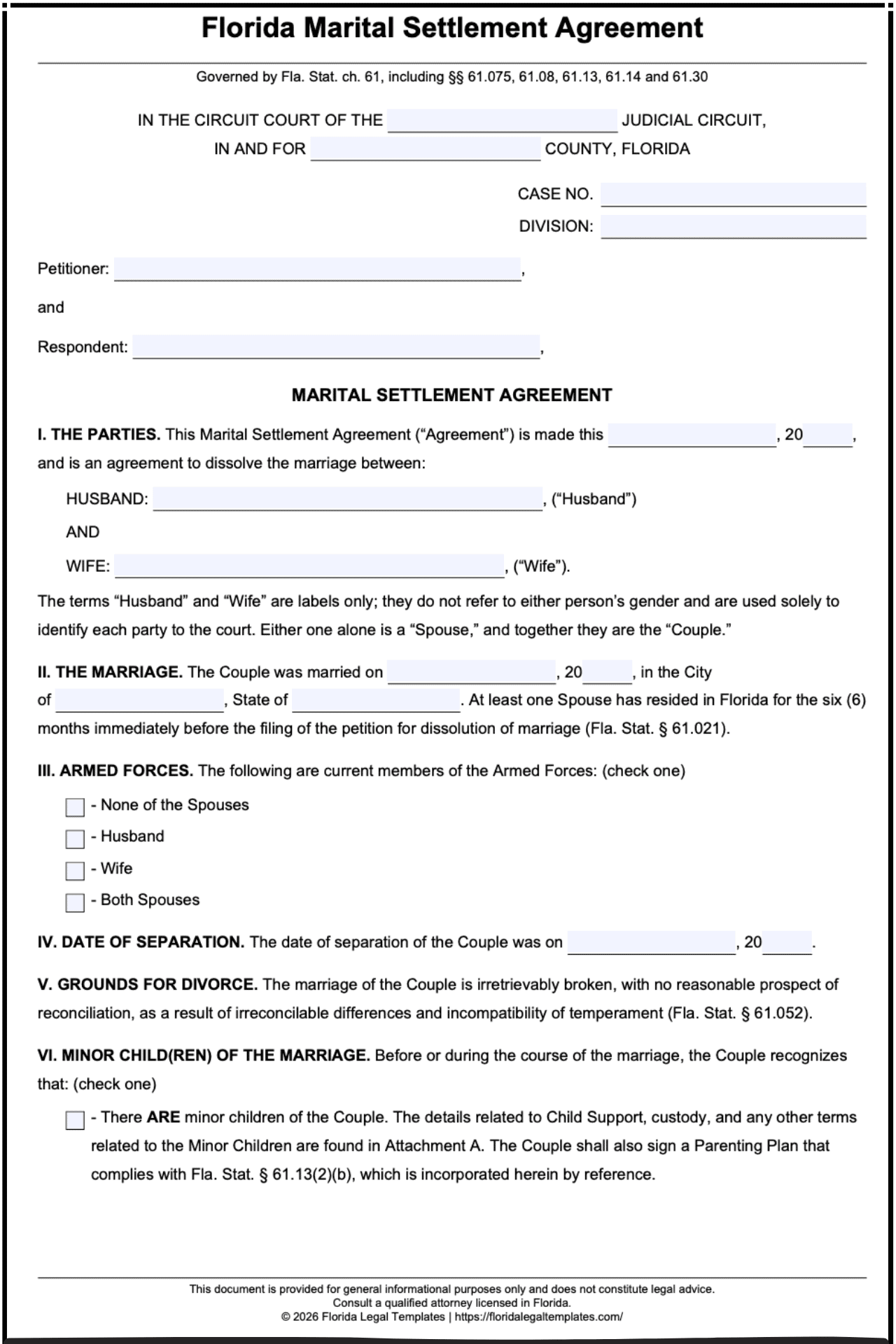
Florida Marital Settlement Agreement Template (PDF)
Get PDF
This Florida marital settlement agreement template is intended for spouses who have reached an agreement on the terms of their divorce. It provides a written record of their financial obligations, property arrangements, and, where applicable, parenting and child-related responsibilities.
Depending on your circumstances, the agreement may cover:
- Property division: Allocation of the marital home, vehicles, retirement accounts, investments, bank accounts, and personal belongings.
- Debts and liabilities: Responsibility for mortgages, credit cards, loans, and other outstanding obligations.
- Alimony: The agreed type, amount, duration, payment schedule, and whether the obligation can be modified.
- Parenting and time-sharing: Parenting responsibilities, residential schedules, and arrangements for the children.
- Child support: Payment amounts, health insurance, uncovered medical expenses, childcare, and other child-related costs.
- Insurance and tax matters: Agreed responsibilities for insurance coverage and relevant financial or tax arrangements.
- Signatures and acknowledgment: Signature spaces for both spouses, witness lines, and notarial acknowledgment.
Which Florida Marital Settlement Agreement Form Should You Use?
The Florida Supreme Court Approved Family Law Forms include different marital settlement agreement forms depending on whether children are involved and which dissolution procedure the spouses are using.
| Situation | Florida Supreme Court Approved Form |
|---|---|
| Divorce involving dependent or minor children | Form 12.902(f)(1) |
| Property division without minor children | Form 12.902(f)(2) |
| Simplified dissolution of marriage | Form 12.902(f)(3) |
Choose the form that matches your circumstances. A simplified dissolution form is not interchangeable with the regular dissolution forms. To qualify, the spouses must meet Florida’s simplified dissolution requirements, including having no qualifying minor or dependent children, agreeing on the division of their assets and liabilities, and neither spouse seeking alimony.
Who Should Use This Template?
The agreement is suitable for spouses who have resolved their disagreements and want to document their settlement before or during divorce proceedings.
It may not be sufficient when:
- One spouse suspects that the other has hidden assets or debts.
- The marital estate includes complicated business ownership or substantial investments.
- The agreement directly transfers ownership of real estate rather than relying on the final judgment.
- The proposed child support amount differs from the statutory guidelines.
- Either spouse does not have a clear understanding of the other’s financial circumstances.
In these situations, professional legal review can help prevent an agreement from creating additional disputes or transfer problems.
What a Marital Settlement Agreement Does in a Florida Divorce
A marital settlement agreement establishes the terms both spouses have accepted for resolving their divorce-related responsibilities. Its legal effect depends partly on whether it remains a private contract or becomes part of the court’s final judgment.
Private Agreement vs. Court-Incorporated Agreement
When both spouses sign a marital settlement agreement, it can become an enforceable private contract without being filed with a government agency, provided it satisfies applicable contract requirements.
However, a privately signed agreement has limitations. It cannot:
- Legally dissolve the marriage.
- By itself, create a court-entered child support order or a court-approved parenting plan and time-sharing order.
- Give either spouse access to the court’s contempt powers for enforcing its provisions.
For those additional protections, the agreement must be submitted in the dissolution proceeding and incorporated into the Final Judgment of Dissolution of Marriage.
The court may incorporate the agreement by reference or merge its terms into the judgment. Once incorporated, the court can use enforcement mechanisms such as contempt proceedings, income deduction orders, and writs of garnishment, as applicable.
Relationship With a Parenting Plan
When minor children are involved, the marital settlement agreement should address the financial and parental arrangements without treating itself as a substitute for a parenting plan.
The parenting plan addresses parental responsibilities and time-sharing. Any agreed arrangements remain subject to judicial review and the court’s authority to protect the child’s best interests.
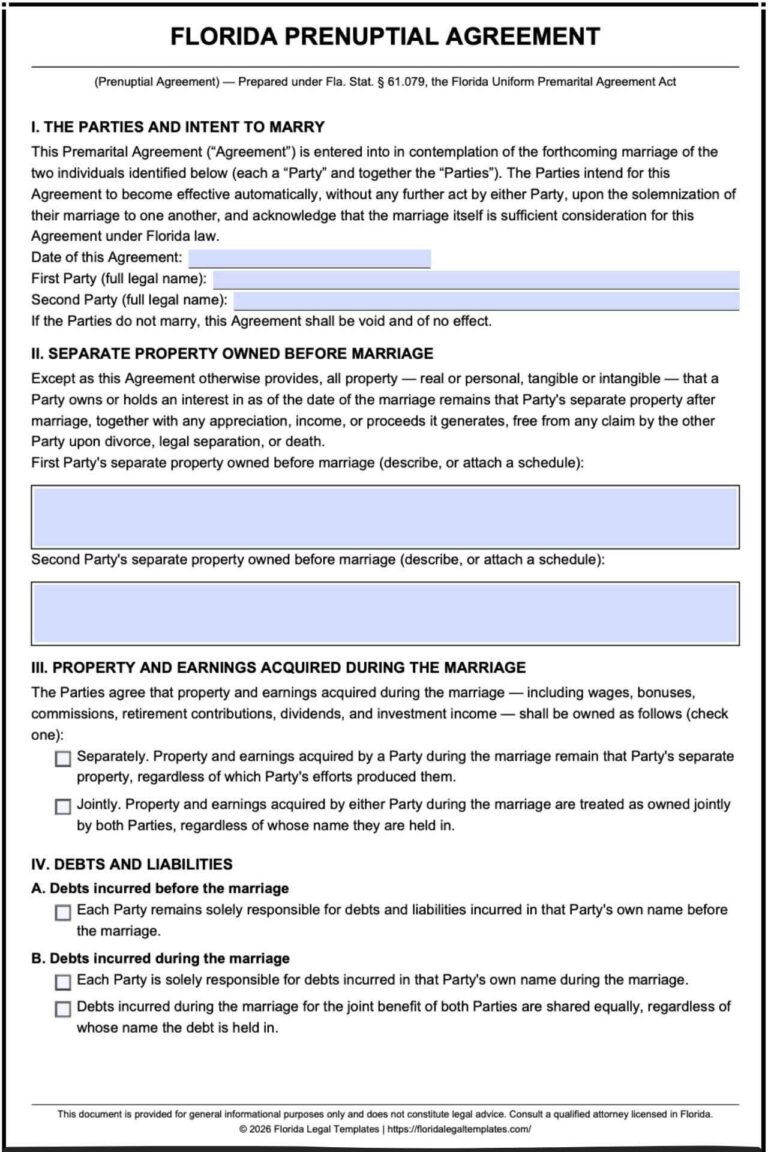
A divorce settlement agreement or Florida divorce agreement may refer to the same general settlement document. However, a marital settlement agreement used during divorce proceedings is different from a prenuptial or postnuptial agreement, which addresses financial arrangements outside the divorce settlement process.
Florida Law That Shapes Your Agreement
Florida marital settlement agreements must account for the state’s dissolution procedures, financial disclosure requirements, and rules governing children and property transfers.
Requirements at a Glance
| Topic / Issue | Florida Legal Rule | Governing Statute |
|---|---|---|
| Witnesses | No Chapter 61 witness requirement for ordinary agreements; two subscribing witnesses are required for direct real estate conveyances. | Fla. Stat. § 689.01 |
| Notarization | Not generally required for the validity of an ordinary private marital settlement agreement. Notarial certificates are governed by Fla. Stat. § 117.05, while acknowledgment or proof requirements for recording real estate instruments are governed by Fla. Stat. § 695.03. | Fla. Stat. §§ 117.05 and 695.03 |
| Residency | At least one spouse must reside in Florida for six months immediately before filing. | Fla. Stat. § 61.021 |
| Financial disclosure | Sworn financial affidavits must be exchanged within 45 days of service in non-simplified proceedings. | Fla. Fam. L. R. P. 12.285 |
| Child support deviation | A deviation exceeding 5% from the guideline amount requires specific written findings. | Fla. Stat. § 61.30(1)(a) |
| Alimony | Permanent periodic alimony has been abolished for dissolution proceedings under the amended statutory framework. | Fla. Stat. § 61.08(1)(a) |
How these requirements affect your Florida marital settlement agreement
A common mistake is treating the signed settlement as the final step. For example, spouses may agree that one party will keep the marital home but fail to address how ownership will actually be transferred. Under Fla. Stat. § 61.075(4), a final judgment distributing assets can operate as a duly executed instrument of conveyance when properly recorded in the county’s official records. A separate deed, however, must satisfy Florida’s execution requirements, including the two-subscribing-witness requirement under Fla. Stat. § 689.01, and the acknowledgment or proof requirements for recording under Fla. Stat. § 695.03.
Support provisions also require careful drafting. If the spouses agree to child support that differs by more than 5% from the guideline amount, the proposed arrangement must identify the presumptive guideline amount and provide the specific reasons and factual findings supporting the deviation.
How These Rules Show Up in Your Agreement’s Clauses
Real property: If one spouse receives the marital home, clearly identify the property and the agreed transfer obligations. A recorded final judgment may accomplish the transfer under Fla. Stat. § 61.075(4). If the parties instead use a separate quitclaim or warranty deed, the deed must satisfy the requirements of Fla. Stat. §§ 689.01 and 695.03.
Alimony: Specify the type of support, payment obligations, duration, and modification terms. Under Fla. Stat. § 61.14(1)(a), an obligation may remain subject to judicial modification unless the agreement explicitly, clearly, and unambiguously waives the applicable right to seek modification.
Child support: Include the guideline calculation and explain any proposed deviation exceeding 5%. Parents cannot permanently eliminate a minor child’s right to support through a private agreement.
Time-sharing: Florida law establishes a rebuttable presumption that equal time-sharing is in the child’s best interests. An unequal arrangement must address the applicable statutory requirements and remains subject to court review under Fla. Stat. § 61.13.
Financial disclosure: Both spouses should complete and exchange the appropriate sworn financial affidavits before finalizing their financial settlement. A recital that both parties have disclosed their finances does not replace the required exchange.
Ignoring these requirements can result in rejected filings, unenforceable provisions, defective property transfers, or additional court proceedings.
Clauses That Make or Break a Florida marital settlement agreement
A well-prepared agreement should identify each obligation clearly enough that neither spouse has to interpret what was intended months or years later.
Equitable Distribution of Assets and Debts
Start by identifying marital and nonmarital property. Then specify who receives each asset and who becomes responsible for each liability.
Consider addressing:
- The marital home and any other real estate.
- Bank accounts, investments, and retirement accounts.
- Vehicles and personal property.
- Business interests and ownership shares.
- Mortgages, loans, and credit card balances.
Avoid broad statements such as each spouse keeps their own property without identifying what that includes. Specific descriptions reduce disagreements about ownership and responsibility.
Alimony and Financial Support
Florida recognizes temporary, bridge-the-gap, rehabilitative, and durational alimony. Permanent periodic alimony is no longer available under the amended statutory framework effective July 1, 2023.
If the parties agree to support payments, specify the amount, payment frequency, duration, and modification provisions. Leaving these matters ambiguous can create disputes over whether payments should continue after a change in circumstances.
Parenting and Time-Sharing
Where minor children are involved, the agreement should coordinate with the parenting plan.
Address parental responsibilities, time-sharing arrangements, and the practical arrangements needed to implement the agreed schedule. Remember that the court retains authority over matters affecting the children’s welfare.
Child Support and Related Expenses
Child support should be calculated using Florida’s Child Support Guidelines Schedule.
In addition to the monthly payment, address:
- Health insurance premiums for the children.
- Uncovered medical and dental expenses.
- Childcare expenses.
- Other agreed child-related costs.
Do not exchange child support for a larger share of property or more time-sharing. Under Florida law, child support belongs to the child, and parents cannot contractually waive that right.
Vehicles and Business Interests
If one spouse receives a vehicle, specify the vehicle’s identifying information and responsibility for completing the ownership transfer. The transfer generally requires the applicable HSMV 82040 title application and a copy of the Florida court order awarding the vehicle, submitted through the local county tax collector’s office. For motor vehicles, use Form HSMV 82040 MV.
Business interests require similar attention. A settlement agreement does not replace separate corporate filings with the Florida Division of Corporations (Sunbiz) when ownership or managerial interests must be updated, or when authority to act under a power of attorney is involved.
Dispute-Prevention Clauses
Include clear deadlines and responsibilities for completing agreed actions. For example, identify when a spouse must sign a deed, transfer a vehicle, make a payment, or provide required documentation.
The more specific these obligations are, the less room there is for disagreement about whether either party has complied.
How to Complete and File Your Florida Marital Settlement Agreement
Preparing the document should begin only after both spouses have a reasonably complete understanding of their financial circumstances and have resolved the issues covered by the settlement.
Before You Draft: How Couples Reach Agreement
Spouses may negotiate directly, use mediation, or work through a collaborative process.
Regardless of the method, resolve the major issues before preparing the final agreement. Drafting while important financial or parenting matters remain unsettled can lead to repeated revisions and inconsistent provisions.
Documents to Gather
Before completing the Florida marital settlement agreement form, collect:
- Proof of Florida residency, such as a driver’s license, identification card, voter registration, or qualifying affidavit.
- Marriage information and identification documents.
- Recent tax returns and pay stubs.
- Bank statements and debt records.
- Property deeds and available appraisals.
- Vehicle ownership records.
- Relevant insurance policies and financial account statements.
These documents help both spouses understand the financial position being divided.
Step-by-Step Completion and Filing
- Confirm Florida residency. At least one spouse must satisfy the six-month residency requirement immediately before filing the dissolution petition.
- Complete financial affidavits. In non-simplified proceedings, each party must prepare and exchange the appropriate sworn Florida Family Law Financial Affidavit. Form 12.902(b) applies when a party’s gross annual income is less than $50,000, while Form 12.902(c) applies when gross annual income is $50,000 or more.
- Choose the correct agreement form. Select Form 12.902(f)(1), (f)(2), or (f)(3), depending on the circumstances.
- Complete the settlement terms. Identify the property, debts, support obligations, and parenting arrangements. Include clear payment amounts, deadlines, and transfer responsibilities.
- Review signatures and acknowledgment. Follow the applicable form’s execution instructions. Although Chapter 61 does not independently require witnesses for an ordinary marital settlement agreement, two subscribing witnesses are necessary when the agreement itself directly conveys real estate. Notarial acknowledgment is also relevant to filing and authentication.
- File the agreement with the court. Submit the completed document to the Clerk of the Circuit Court in the county where the dissolution proceeding is pending.
- Complete post-judgment transfers. Record the final judgment or applicable deed in the county where the property is located. Submit vehicle transfer paperwork through the county tax collector and coordinate child support payments through the Florida State Disbursement Unit, where applicable.
Financial affidavit privacy: Under Florida Family Law Rule 12.285(c)(2), spouses may jointly waive the public filing of their financial affidavits through a Florida Supreme Court Approved Family Law Form 12.902(k) – Notice of Joint Verified Waiver of Filing Financial Affidavits. However, they cannot waive the actual exchange of sworn affidavits. The notice must contain five required acknowledgments, including confirmation that the affidavits were exchanged, responsibility for retaining copies, and the limited scope and revocability of the waiver.
Enforcing the Agreement After Judgment
Once incorporated into the Final Judgment of Dissolution of Marriage, the settlement provisions become part of the court’s judgment and can be enforced through appropriate judicial procedures.
For example, if one spouse fails to make an agreed support payment, the other may seek enforcement through the available court mechanisms. Depending on the obligation, these can include contempt proceedings, income deduction orders, and writs of garnishment.
Property-related obligations also need follow-through. If the judgment awards real estate to one spouse, recording the judgment in the county’s official records helps implement the transfer.
An agreement that remains a private contract may still be enforceable between the spouses under ordinary contract principles. However, it does not independently provide access to the court’s contempt powers or establish judicially enforceable parenting and child support arrangements.
Changing or Challenging the Agreement After Judgment
Not every provision in a Florida marital settlement agreement is treated the same way after the final judgment.
Alimony: Support obligations may remain subject to modification under Fla. Stat. § 61.14(1)(a), unless the applicable right to modification has been expressly and unambiguously waived.
Child support: Child support remains subject to judicial review and modification. Parents cannot permanently prevent future support modifications through contractual language.
Time-sharing: Parenting arrangements remain subject to the court’s authority and may be modified when the applicable legal requirements are satisfied and modification serves the child’s best interests.
Property division: Property distribution is generally treated as final. Do not assume that a later disagreement about fairness automatically permits the court to redistribute assets.
Can a Signed Agreement Be Challenged as Unfair?
The timing of the agreement matters.
In Macar v. Macar, 803 So. 2d 707 (Fla. 2001), the Florida Supreme Court distinguished marital settlement agreements entered after dissolution litigation begins from prenuptial and pre-litigation postnuptial agreements.
A settlement reached after litigation begins cannot ordinarily be set aside simply because one spouse later considers its terms unfair or unreasonable. The availability of mandatory financial discovery under Florida Family Law Rule 12.285 is relevant to this distinction.
Once a settlement agreement has been incorporated into a final judgment, a challenge generally must satisfy the grounds for relief under Florida Family Law Rule 12.540, including mistake, newly discovered evidence, fraud, misrepresentation, or other misconduct of an adverse party, as applicable.
This is why financial disclosure and careful review before signing matter so much. Discovering an unfavorable term later is not necessarily enough to undo a settlement.
Limitations and When You Need More Than a Template
A Florida marital settlement agreement template provides a starting point, not permission to include provisions that conflict with Florida law.
Certain arrangements cannot be enforced as written:
- Child support waivers: Parents cannot permanently waive or extinguish a child’s right to support.
- Permanent periodic alimony: This form of alimony has been abolished under Florida’s amended statutory framework.
- Removal of court authority over children: Parents cannot contractually prevent the court from protecting a minor child’s best interests.
- Residency agreements: The spouses cannot use a private agreement to overcome the statutory six-month Florida residency requirement.
An attorney is not legally required simply to prepare a marital settlement agreement. However, professional review is advisable when the settlement involves business ownership, unequal time-sharing, child support deviations, real estate conveyances, or uncertainty about financial disclosure.
Depending on the settlement, you may also need separate documents, including a parenting plan, financial affidavits, a deed, or vehicle transfer paperwork.
Costly Mistakes in Florida Settlement Agreements
Several drafting and procedural mistakes can create problems even when both spouses initially agree on every term.
| Common Mistake | Potential Consequence |
|---|---|
| Awarding a vehicle without identifying its VIN or title information | The county tax collector may have difficulty matching the vehicle to the divorce judgment. |
| Transferring a property without checking existing mortgage obligations | The spouse receiving the property may remain exposed to unresolved loan obligations, even after ownership is transferred. |
| Dividing retirement accounts without addressing the required plan documents | A settlement provision alone may not complete the transfer of retirement benefits. A qualified domestic relations order (QDRO) or other plan-specific documentation may be necessary. |
| Assigning a business interest without addressing existing ownership restrictions | The transfer may conflict with corporate documents, partnership agreements, or third-party consent requirements. |
| Setting payment deadlines without specifying the payment method | The spouses may later disagree about when payment was due or whether the obligation was satisfied. |
| Assigning responsibility for a joint debt without addressing the creditor’s rights | The creditor may continue pursuing either borrower even when the settlement assigns responsibility to only one spouse. |
One particularly costly mistake is treating the agreement as complete once both spouses have signed it. A property transfer may still require recording, a vehicle transfer may require separate paperwork, and support obligations may need to be coordinated through the appropriate payment system.
A carefully drafted agreement should account for these steps before the document is signed.
Frequently Asked Questions (FAQ)
Does our Florida settlement agreement need two witnesses or a notary to be valid?
Not necessarily. Florida Statutes Chapter 61 does not impose a general witness or notarization requirement for the validity of an ordinary private marital settlement agreement between spouses.
However, a direct real estate conveyance requires two subscribing witnesses under Fla. Stat. § 689.01. Notarial acknowledgment is not generally required for an ordinary private marital settlement agreement. However, if the agreement includes a real estate instrument intended for recording, the execution must satisfy the applicable requirements of Fla. Stat. §§ 689.01 and 695.03. The Florida Supreme Court-approved forms include witness and notarial sections that should be completed according to their instructions.
Can we skip the financial affidavits to save time or keep finances private?
No. In non-simplified dissolution proceedings, spouses must exchange their sworn financial affidavits under Florida Family Law Rule 12.285.
They may jointly waive public filing of those affidavits by submitting a Notice of Joint Verified Waiver containing the required acknowledgments. This does not eliminate the obligation to exchange the documents privately.
Can we put in our agreement that child support is waived or alimony is permanent?
No. Parents cannot permanently waive a minor child’s right to child support, even if both spouses agree.
Permanent periodic alimony has also been abolished under Florida’s amended statutory framework. Agreements involving alimony should instead address the available statutory classifications and clearly establish the intended payment and modification terms.
If we signed after filing, can either of us later claim the agreement was unfair?
Ordinarily, unfairness alone is not sufficient to set aside a marital settlement agreement reached after dissolution litigation has commenced.
Under Macar v. Macar, 803 So. 2d 707 (Fla. 2001), such agreements are treated differently from prenuptial and pre-litigation postnuptial agreements. Challenges may remain available on narrower grounds, including extrinsic fraud, deceit, coercion, or lack of capacity under Florida Family Law Rule 12.540.
Legal disclaimer: This article and the Florida marital settlement agreement template are provided for general informational purposes only and do not constitute legal advice. Florida divorce proceedings involve individual financial, property and family circumstances. The information provided here does not create an attorney-client relationship. Consider consulting a qualified Florida family law attorney before signing or filing a marital settlement agreement.