
Florida Living Will Form (Free PDF & Guide)
A florida living will residents rely on to guide their medical care in a crisis only works if two things are true — it was executed correctly, and the right people know it exists. Under Fla. Stat. § 765.302(1), a Florida living will must be signed in the presence of two subscribing witnesses, one of whom is neither the principal’s spouse nor a blood relative, If both witnesses are the principal’s spouse or blood relatives, the execution does not satisfy the witness requirement in Fla. Stat. § 765.302(1), regardless of how clearly the living will states the principal’s wishes.
Families sometimes discover a living will in a parent’s files after a medical emergency, only to find that two siblings witnessed it—leaving the hospital without a legally valid directive when the family needs one most. The Florida living will form and breakdown below explain the witness requirements, the notification responsibility Florida law places on the principal, and why both steps matter as much as the document itself.
Candice Hayden, Legal Writer
Maria Rosso, Florida Probate, Guardianship and Estate Planning Attorney
Free Florida Living Will Form (PDF & Printable)
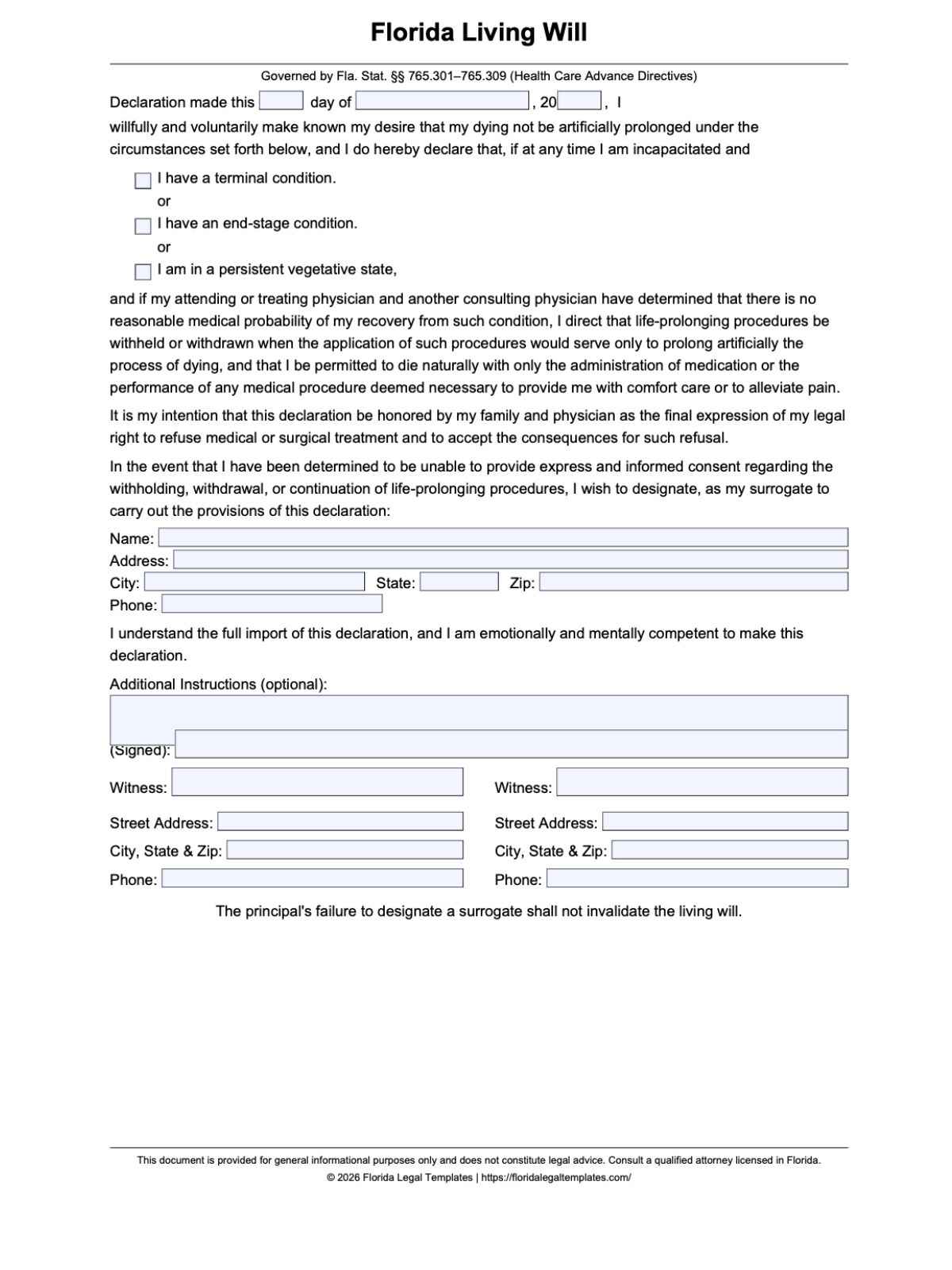
A Florida living will gives a competent adult a way to put instructions about life-prolonging procedures in writing before a medical crisis occurs.
Most printable and fillable forms include:
- End-of-life treatment preferences
- Instructions regarding life-prolonging procedures
- Directions concerning artificial nutrition and hydration
- Statements addressing terminal conditions
- Persistent vegetative state provisions
- End-stage condition instructions
- Witness signature sections
A free Florida living will form may work well for:
- Adults creating basic advance directives
- Seniors planning for future incapacity
- Individuals with chronic medical conditions
- Patients preparing for surgery or ongoing treatment
However, a basic form can cover the core directive, but it may leave more complicated planning questions unanswered, such as:
- Complex ethical or religious medical preferences
- Long-term incapacity planning
- Family disagreements involving treatment decisions
- Coordination with broader estate planning documents
Many people also search for:
- Free printable Florida living will
- Florida living will PDF
- Sample living will Florida documents
- State of Florida living will form examples
Using a sample Florida living will declaration can help you understand the structure, but the document still needs to comply with Florida statutory requirements to function properly in a medical setting.
What Is a Florida Living Will?
A Florida living will is an advance directive authorized under Florida law that allows a competent adult to provide instructions regarding the withholding or withdrawal of life-prolonging procedures.
The person creating the document is called the principal.
Under Florida law, a living will takes effect only after the statutory medical conditions have been satisfied, including the required determination of the principal’s capacity and qualifying medical condition.
- The principal is determined to be incapacitated, and
- The required physician certifications are made
A living will is different from:
- A health care surrogate designation, which appoints someone to make medical decisions
- A do-not-resuscitate order (DNR), which addresses resuscitation specifically
- A last will and testament, which distributes property after death
A Florida living will can communicate treatment preferences, but it does not:
- Transfer assets
- Appoint guardians for children
- Replace broader incapacity planning documents
The document also remains private. It is not filed with the court or recorded with a government agency during the principal’s lifetime.
Under Fla. Stat. § 765.101(12), “life-prolonging procedures” specifically excludes the administration of medication or the performance of any medical procedure deemed necessary to provide comfort care or to alleviate pain.
Many Florida residents mistakenly assume a living will covers all incapacity planning needs. In practice, broader planning documents such as a durable financial authority form and a Florida estate distribution document often work alongside a living will to address financial management and probate issues separately.
Key Florida Laws That Affect This Document
Summary of Applicable Laws
| Topic / Issue | Florida Legal Rule | Governing Statute |
|---|---|---|
| Witness Requirements | Living will must be signed before exactly two witnesses | Fla. Stat. § 765.302(1) |
| Witness Restrictions | One witness must not be spouse or blood relative | Fla. Stat. § 765.302(1) |
| Competency Requirement | Principal must be a competent adult | Fla. Stat. § 765.302(1) |
| Physician Certification | The primary physician and at least one consulting physician must separately examine the patient, and each physician’s findings must be documented and signed in the medical record before life-prolonging procedures may be withheld or withdrawn. | Fla. Stat. § 765.306 |
| Suggested Form Guidance | Florida provides statutory suggested form language | Fla. Stat. § 765.303 |
| Pregnancy Exception | Unless the statutory exceptions apply, a surrogate or proxy may not consent to withholding or withdrawing life-prolonging procedures from a pregnant patient before viability under Fla. Stat. § 765.113(2). | Fla. Stat. § 765.113(2) |
| Euthanasia Prohibition | Assisted suicide and mercy killing provisions are void | Fla. Stat. § 765.309 |
The first practical checkpoint is execution: §765.302 requires two subscribing witnesses, with one neither the spouse nor a blood relative. After that, §765.306 requires the primary physician and at least one consulting physician to conduct separate examinations before physicians may withhold or withdraw life-prolonging procedures.
The operational side of these laws also matters. A legally valid document may still become ineffective if family members, hospitals, or physicians cannot access it during treatment. That is why proper distribution and storage are just as important as drafting the form itself.
You can review the governing Florida statutes directly through the Florida Legislature:
Florida Witness Requirements
Under Florida law, a living will must be signed in the presence of two subscribing witnesses.
Pursuant to Fla. Stat. § 765.302(1):
- At least one witness must be neither the principal’s spouse nor a blood relative
This rule creates problems for people who casually sign documents at home using only close family members as witnesses.
For example, if both witnesses are immediate relatives, the living will may later face challenges regarding validity or enforceability during treatment decisions.
Physician Certification Requirements
A Florida living will does not automatically take effect immediately after signing.
Under Florida law, the primary physician and at least one consulting physician must separately examine the principal before the living will is carried out.
- The principal does not have a reasonable medical probability of recovering capacity so that the right could be exercised directly, and
- The principal has:
- A terminal condition
- An end-stage condition
- A persistent vegetative state
This requirement helps prevent premature activation of end-of-life directives.
Before proceeding under a living will, Florida law requires the applicable medical conditions and the limitations or conditions expressed in the directive to be considered and satisfied.
Required End-of-Life Language and Treatment Instructions
Florida law recognizes three primary medical conditions that should be specifically addressed in the document:
- Terminal condition
- End-stage condition
- Persistent vegetative state
Florida also provides a statutory suggested form under Fla. Stat. § 765.303.
The statutory form is not mandatory; Fla. Stat. § 765.303 states that a living will may, but need not, use that form, the living will should clearly address whether life-prolonging procedures should be withheld or withdrawn under those recognized conditions.
Vague wording can create disagreements between:
- Physicians
- Family members
- Health care surrogates
Clear treatment instructions matter because physicians must consider the conditions and limitations expressed in the living will before proceeding under §765.304.
Pregnant Patient Exception Under Florida Law
Florida law contains a significant limitation involving pregnancy.
Under Fla. Stat. § 765.113(2), a surrogate or proxy may not provide consent for withholding or withdrawing life-prolonging procedures from a pregnant patient prior to viability as defined in Fla. Stat. § 390.0111(4).
- The patient is pregnant, and
- Physicians determine continued treatment could allow the fetus to develop to live birth
The pregnancy restriction is narrower than a general ‘suspension’ rule: §765.113(2) addresses a surrogate or proxy’s ability to consent to withholding or withdrawing life-prolonging procedures from a pregnant patient before viability.
Mercy Killing and Assisted Suicide Prohibitions
A Florida living will may authorize the natural process of dying through the withholding or withdrawal of life-prolonging procedures. However, Florida law does not permit euthanasia, mercy killing, or assisted suicide.
Under Fla. Stat. § 765.309, Chapter 765 does not authorize mercy killing or euthanasia or an affirmative or deliberate act or omission to end life; withholding or withdrawing life-prolonging procedures under the chapter is not considered suicide.
The safer approach is to keep the directive focused on withholding or withdrawing life-prolonging procedures; §765.309 does not authorize an affirmative or deliberate act to end life.
Practical Impact & Document Clauses
Florida law directly affects several sections inside the document, including:
- Witness clauses
- Treatment preference provisions
- Incapacity determination language
- Life-prolonging procedure instructions
Common operational problems often involve:
- Improper witness selection
- Missing medical terminology
- Contradictory treatment instructions
- Failure to provide copies to physicians or surrogates
Florida law places responsibility on the principal to provide for notification to the primary physician that a living will has been made. Once notified, the primary physician or health care facility must promptly make the living will or a copy of it part of the principal’s medical records.
A carefully drafted directive can still cause problems if the hospital or physician cannot locate it when the patient needs it.
Advance directives are only effective if the right people can access them during an emergency. Families coordinating medical and financial planning together frequently also prepare a Florida decision-making authorization document so a trusted individual can assist with legal and financial matters during incapacity.
When to Use a Florida Living Will
A Florida living will is most useful when you want your own instructions about life-prolonging procedures to remain clear if you later cannot communicate them yourself. Florida law specifically recognizes directions concerning a terminal condition, an end-stage condition, or a persistent vegetative state, so the document can give physicians and family members a written record of your wishes when those circumstances arise.
It can also reduce uncertainty during an emergency, particularly when family members have different views about what treatment you would have wanted.
However, a living will alone may not fully address:
- Health care decision-making authority
- Long-term incapacity planning
- Mental health treatment issues
- Broader estate planning concerns
Many Florida residents pair a living will with a health care surrogate designation for more complete medical planning.
A living will becomes especially important for older adults and individuals managing long-term medical conditions. Families handling future incapacity planning may also later encounter probate-related paperwork such as the Florida simplified estate transfer process when administering smaller estates after death.
How to Create or Fill Out the Florida Living Will
Identify the Principal
Use the principal’s full legal name and identifying information. The signer must be a competent adult at the time of execution.
Specify End-of-Life Treatment Preferences
Clearly describe preferences involving:
- Artificial nutrition
- Hydration
- Ventilation
- Other life-prolonging procedures
Specific instructions give physicians a clearer record of the principal’s wishes when they apply §765.304’s requirements to a terminal condition, end-stage condition, or persistent vegetative state.
Address Florida’s Recognized Medical Conditions
The document should specifically reference:
- Terminal condition
- End-stage condition
- Persistent vegetative state
These three terms—terminal condition, end-stage condition, and persistent vegetative state—appear directly in Florida’s living-will statute and suggested form.
Coordinate With a Health Care Surrogate
A health care surrogate serves a different function from a living will: under § 765.202, the principal expressly designates the surrogate to make health care decisions and receive health information, while the living will records the principal’s instructions concerning life-prolonging procedures.
Execute the Document Properly
Florida generally requires:
- Exactly two witnesses
- Proper witness eligibility
- Signing during the same execution event
The witness requirement is easy to miss: §765.302(1) requires two subscribing witnesses, and one must be neither the principal’s spouse nor a blood relative.
Consider Notarization for Practical Purposes
Florida’s living-will execution statute requires two subscribing witnesses and does not require notarization. If you plan to use a Florida living will outside Florida, check the law of the state where you expect it to be used before relying on the document there.
Distribute Copies to Appropriate Parties
Copies should be provided to:
- Primary physicians
- Hospitals or treatment facilities
- Health care surrogates
- Trusted family members
Florida law places responsibility on the principal to provide for notification to the primary physician; after notification, the physician or facility must promptly make the living will or a copy part of the medical record under §765.302(2).
Review and Update the Document Periodically
Review your Florida living will whenever your treatment preferences change or your medical circumstances materially change. If you have also designated a health care surrogate, review that designation at the same time, because Florida law separately governs the surrogate relationship and the circumstances in which a surrogate may act.
Proper execution and document storage matter just as much as drafting the directive itself. Some individuals also prepare supporting sworn documents and emergency records using broader Florida affidavit formatting examples to help organize medical, identity, or incapacity-related information for family members and providers.
Revoking a Florida Living Will Is Easier Than Most People Realize
Many people assume changing a living will requires drafting a brand-new document. Florida law is much more flexible. Under Fla. Stat. § 765.104, a competent principal may amend or revoke an advance directive by signing a dated writing, physically canceling or destroying it, orally expressing an intent to amend or revoke it, or executing a materially different advance directive. The amendment or revocation becomes effective when it is communicated to the surrogate, health care provider, or health care facility.
The practical problem is that old copies often remain in circulation. A revoked living will sitting in a hospital file or with a former health care surrogate can create confusion during an emergency if no one knows it has been withdrawn. After revoking or replacing the document, collect and destroy outdated copies where possible, provide the new version to your physicians, health care surrogate, and close family members, and ask your medical providers to remove or clearly mark the earlier directive in your Electronic Health Record. Those follow-up steps are not required by statute, but they help ensure the docum
Limitations and Legal Considerations
A Florida living will only addresses life-prolonging medical treatment decisions.
It does not:
- Transfer property
- Replace a will
- Appoint guardians for children
- Automatically designate a medical decision-maker
Florida law also imposes several operational limitations, including:
- Witness restrictions
- Physician certification requirements
- Pregnancy-related limitations
The Statutory Proxy Priority Hierarchy Trap
A Florida living will does not become invalid simply because the principal does not execute a companion Health Care Surrogate Designation under Fla. Stat. § 765.202. Under Fla. Stat. § 765.302(3), a properly executed living will establishes a rebuttable presumption of clear and convincing evidence of the principal’s wishes. A health care surrogate can still be useful for medical decisions that fall outside the living will, but the absence of a surrogate does not by itself invalidate the directive.
If a proxy is needed because the circumstances described in Fla. Stat. § 765.401 apply, Florida law establishes a priority order that includes a judicially appointed guardian, spouse, adult child or majority of adult children, parent, adult sibling or majority of adult siblings, certain adult relatives, a close friend, and, in the circumstances specified by the statute, a qualifying clinical social worker. The proxy hierarchy applies to situations covered by §765.401 and does not determine whether a living will remains valid.
A living will can therefore stand on its own, while a health care surrogate may provide additional decision-making authority for matters that the living will does not address. When multiple adult children are acting under § 765.401, the statute uses a majority rule for the adult-child class, but that does not mean the proxy hierarchy automatically overrides a valid living will.
A living will only addresses specific end-of-life treatment instructions and does not control property distribution after death. For that reason, many Florida residents pair advance medical directives with a formal Florida will for probate planning to create a more complete estate planning strategy.
Practical problems may also arise when:
- The document is unavailable during emergencies
- Family members disagree
- Medical providers interpret instructions differently
Furthermore, Florida’s statute addresses this practical problem directly: once the primary physician or health care facility is notified of the living will, it must promptly make the document or a copy part of the principal’s medical records under §765.302(2).
A living will only addresses specific end-of-life treatment instructions and does not control property distribution after death. For that reason, many Florida residents pair advance medical directives with a formal Florida will for probate planning to create a more complete estate planning strategy.
Common Mistakes to Avoid
One major mistake is using ineligible witnesses. Florida’s witness restrictions are stricter than many people expect.
The same mistakes tend to come up repeatedly, including:
- Failing to address Florida-recognized medical conditions
- Writing vague treatment instructions
- Assuming notarization alone makes the document valid
- Forgetting to provide copies to physicians or surrogates
- Confusing a living will with a last will and testament
Some people also improperly include euthanasia or assisted suicide requests, which Florida law does not recognize.
Another frequent issue is storing the document where nobody can quickly locate it during a medical emergency.
Frequently Asked Questions (FAQ)
Does a Florida living will need to be notarized?
No. Florida law does not require notarization for a living will to be legally valid.
Who can witness a living will in Florida?
Florida requires exactly two witnesses, and at least one witness must not be the principal’s spouse or blood relative.
When does a Florida living will actually take effect?
A Florida living will does not simply become effective when the principal signs it. Before physicians can carry it out, the statutory medical conditions and capacity-related requirements must be satisfied.
Can a hospital ignore a Florida living will?
A Florida health care provider or facility that refuses to comply with a patient’s advance directive must follow the transfer procedure in Fla. Stat. § 765.1105, subject to the statute’s exceptions; disputes concerning a living will may also trigger the review procedures in Chapter 765.
Does a Florida living will apply during pregnancy?
Under Florida law, certain living will directives may be suspended during pregnancy if continued treatment could allow live birth.
What is the difference between a living will and a health care surrogate in Florida?
A living will provides treatment instructions, while a health care surrogate designation appoints someone to make medical decisions on the principal’s behalf.
Legal Disclaimer: This article provides general information about Florida living wills and is not legal advice. Florida laws may change, and individual circumstances can affect how the law applies. Consider consulting a qualified Florida attorney for advice about your specific situation.