
Florida Affidavit Template [Free Printable, Fillable PDF]
A Florida affidavit template that gets the notary block wrong can get your document rejected before anyone reads a word of what it says, and the mistake most people make isn’t forgetting to notarize — it’s using the wrong type of notarial act entirely. Under F.S. §117.05(13), Florida distinguishes between a jurat, where the affiant swears to the truth of the content under penalty of perjury, and an acknowledgment, where the notary simply confirms the signer’s identity and signature — and a florida affidavit form that uses acknowledgment language where a jurat is required is technically defective regardless of how accurate the content is.
I know how general affidavit florida documents get rejected by court clerks and agency staff for exactly this reason, with the filer having no idea the notary block was the problem because the document looked complete and properly signed. The template below uses the correct jurat format required for sworn affidavits in Florida, with the statutory language under F.S. §92.525 that puts the affiant on notice that a false statement carries felony exposure.
Candice Hayden, Legal Writer
Maria Rosso, Florida Probate, Guardianship and Estate Planning Attorney
Florida Affidavit Template (PDF, Printable, Fillable)
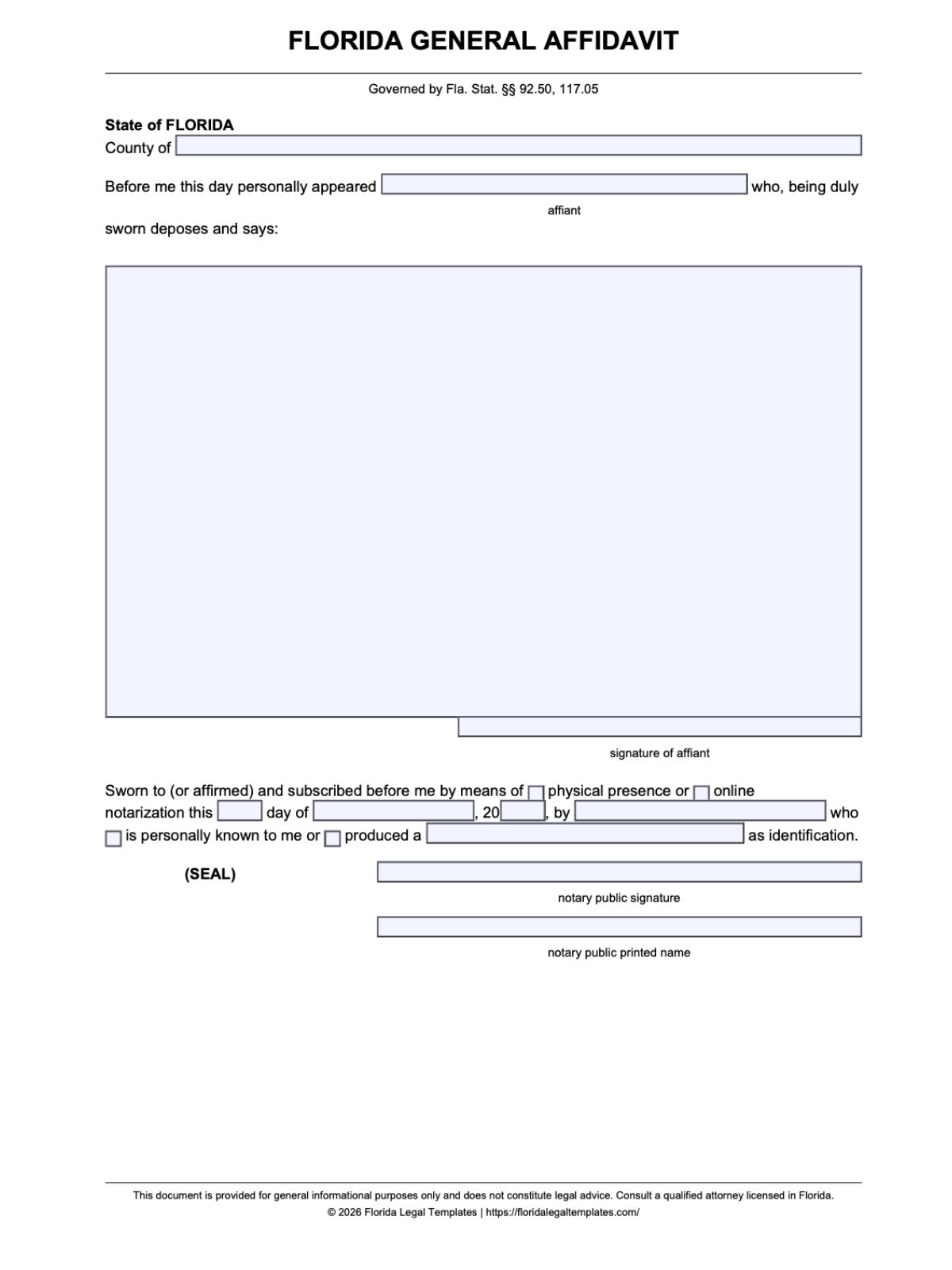
A general affidavit Florida template provides a flexible format that can be used across a wide range of situations. Whether you need a blank affidavit form Florida for personal or professional use, the structure remains largely consistent.
What the document includes:
- Affiant identification (full legal name and details)
- Statement of facts (clear, numbered paragraphs)
- Oath or affirmation clause
- Signature block
- Notary jurat section (if notarized)
Who should use this:
- Individuals making sworn statements
- Parties submitting verified documents to banks or employers
- Individuals supporting legal claims or disputes
- Anyone needing a state of Florida affidavit form for formal declarations
When this template may NOT be sufficient:
- Real estate affidavits that must be recorded
- Probate-specific affidavits with statutory requirements
- Court-mandated forms with strict formatting rules
- Documents requiring witnesses (such as wills)
A general affidavit is highly versatile—but it is not a substitute for specialized legal documents.
What Is a Florida Affidavit Template?
A Florida affidavit template is a written statement of facts that is legally verified either under oath or under penalty of perjury.
Under Florida law, affidavits are governed by rules relating to sworn declarations and notarization requirements. These rules come primarily from Florida Statutes Chapters 92 and 117.
Because Florida recognizes multiple forms of sworn declarations, readers often benefit from reviewing more specialized affidavit categories before choosing a general format. Situations involving estate matters or inherited property may require a family relationship declaration for probate purposes rather than a broad personal affidavit.
Legal nuance
An affidavit in Florida must follow one of two legally valid formats:
- Notarized affidavit
- Signed in front of a notary
- Includes a jurat confirming the oath
- Unsworn declaration
- Not notarized
- Must include exact statutory “penalties of perjury” wording
Critical distinction
- Affidavit (notarized) → Requires an oath administered by a notary
- Unsworn declaration → Valid without a notary, but only if it includes exact statutory language
Key implication
If you use the wrong format—or miss required wording—the affidavit may be rejected or considered legally invalid.
Key Florida Laws That Affect Florida Affidavit Template
Summary of Applicable Laws
| Topic / Issue | Florida Legal Rule | Governing Statute |
|---|---|---|
| Notary Requirement | Must include jurat (oath required) | Fla. Stat. § 117.05(13) |
| Alternative Declaration | Allowed with statutory perjury language | Fla. Stat. § 92.525(1)(b) |
| Capacity Requirement | Must be competent to understand oath | Fla. Stat. § 90.601 |
| Identity Verification | Notary must verify identity via valid ID | Fla. Stat. § 117.05(5) |
| Perjury Penalty | False statements are a criminal offense | Fla. Stat. § 92.525(3) |
Execution errors are one of the most common reasons affidavits get rejected by courts, lenders, and government agencies. When a document contains clerical mistakes, incorrect names, or recording issues, a sworn correction document for inaccurate records may be necessary to fix the problem before resubmission.
Practical Impact & Document Clauses
Florida law places strict requirements on how affidavits are executed. Under Fla. Stat. § 117.05, a notarized affidavit must include a jurat, confirming that the affiant was sworn or affirmed before the notary. An acknowledgment alone is not sufficient and will invalidate the affidavit.
Florida also allows an alternative under Fla. Stat. § 92.525. This permits an unsworn declaration, but only if it includes the exact statutory wording:
“Under penalties of perjury, I declare that I have read the foregoing [document] and that the facts stated in it are true.”
Identity verification is another critical requirement. Under Fla. Stat. § 117.05(5), the notary must confirm the affiant’s identity using valid government-issued identification or personal knowledge before administering the oath.
Violations carry serious consequences. Under Fla. Stat. § 92.525(3), knowingly making false statements in an affidavit constitutes a third-degree felony, which can result in criminal penalties. Additionally, a notary who signs a jurat without administering an oath may also face criminal liability under Fla. Stat. § 117.105.
In real-world terms:
- Missing jurat → affidavit invalid
- Incorrect wording → rejected by institutions
- False statements → criminal prosecution
- Improper notarization → legal liability for both parties
When to Use Florida Affidavit Template
A Florida affidavit template is used whenever a sworn statement of facts is required.
Common use cases:
- Providing verified information to a bank or employer
- Supporting court filings or legal claims
- Confirming identity, residency, or financial details
Practical scenarios:
- Declaring facts in a legal dispute
- Submitting sworn statements in administrative processes
- Verifying personal or business information
When NOT to use:
- Contracts or agreements
- Documents requiring witnesses
- Specialized affidavits (real estate, probate, or court-specific forms)
Don’t Replace a Court-Approved Affidavit with a Generic One
A legally valid affidavit is not always the correct affidavit. Florida circuit courts, clerks, and state agencies frequently require their own approved affidavit forms for specific proceedings. Family law is a common example. The Florida Supreme Court has adopted mandatory forms for many family cases, including financial affidavits and other sworn filings, and a generic affidavit usually will not satisfy those filing requirements. Likewise, probate courts and some administrative agencies may require affidavits containing statutory findings or case-specific language that a standard template does not include.
Using a generic affidavit in those situations can result in the clerk issuing a deficiency notice, delaying the case until the proper form is filed. Before relying on a general affidavit, check whether the court handling your matter, or the agency requesting the document, has published its own required form or local filing instructions. A general affidavit is best used when no statute, court rule, or agency procedure prescribes a specific affidavit for that purpose. (Florida Family Law Rules of Procedure, mandatory forms adopted under Fla. Fam. L. R. P. 12.285 and related Supreme Court-approved family law forms; local court requirements may also apply.)
Choosing the right document is essential—using a general affidavit in the wrong situation can lead to rejection or legal complications.
General affidavits are frequently used to verify personal information in housing, school, and residency-related situations where supporting documentation is required. For cases specifically involving proof of domicile or address verification, a Florida residency verification statement is usually more appropriate than a generic sworn declaration.
How to Create or Fill Out the Florida Affidavit Template
Creating a valid Florida affidavit form requires more than just writing a statement—it must follow legal execution rules.
Step-by-step process:
- Identify the affiant
- Include full legal name and relevant details
- Write the statement of facts
- Use clear, numbered paragraphs
- Stick to factual, verifiable information
- Include an oath or affirmation clause
- Required for notarized affidavits
- Choose execution method
- Notarized affidavit OR unsworn declaration
- Insert the correct “magic words”
-
For unsworn declarations:
“Under penalties of perjury, I declare that I have read the foregoing [document] and that the facts stated in it are true.”
-
- Add signature block
- Affiant must sign
- Complete notary jurat (if applicable)
-
Must follow statutory format:
“Sworn to (or affirmed) and subscribed before me…”
-
- Verify identity
- Present valid ID to notary
- Sign in presence of notary
- Physical or approved remote notarization required
- Retain copies
- Keep signed document for records
If the affidavit is being used alongside business transactions or contractual obligations, supporting agreements should also be reviewed for consistency with the sworn statements being made. For example, independent professionals may reference an existing service arrangement contract or independent contractor work agreement when confirming payment terms or project details under oath.
Practical tips:
- Avoid opinions—stick to facts
- Keep statements concise and organized
- Double-check statutory wording before signing
Limitations and Legal Considerations
A general affidavit Florida is a private document—it is not automatically filed with any government agency.
Key limitations:
- Not valid without proper oath or declaration
- Not suitable for all legal situations
Florida-specific constraints:
- Must comply with notarization or statutory declaration rules
- Must meet identity verification requirements
High-risk scenarios:
- Using acknowledgment instead of jurat
- Signing without notary present
- Omitting required perjury language
Edge cases:
- Real estate affidavits must be recorded
- Court-specific affidavits may have additional requirements
- Remote online notarization must follow approved procedures
Ignoring these limitations can result in rejection or legal consequences.
The Remote Online Notarization (RON) Certificate Trap
A high-frequency compliance error occurs when an affiant uses an approved Florida Remote Online Notarization (RON) service but the notary public utilizes a traditional, pre-printed physical notary stamp block. Under Fla. Stat. § 117.05(4)(h) and Chapter 117, Part II, any notarial certificate executed via online audio-video technology must explicitly state whether the signor appeared by physical presence or by online notarization.
If a remote notary administers a valid verbal oath and signs the document digitally but leaves a boilerplate jurat that reads only “Sworn to and subscribed before me this day…” without appending the mandatory statutory tag “by means of [ ] physical presence or [X] online notarization,” the document contains a fatal face defect. Florida government agencies, banks, and circuit court clerks will routinely reject the affidavit as administratively non-compliant, forcing the filer to repeat the entire remote signing process and pay secondary session fees. Always confirm that your remote notary’s electronic jurat block matches the explicit disclosure mandates of modern Florida RON statutes.
Common Mistakes to Avoid
Using acknowledgment instead of jurat
Consequence: The affidavit becomes legally invalid.
Missing required perjury wording
Consequence: Unsworn declaration is not enforceable.
Signing outside notary presence
Consequence: Notarization is invalid and may expose the notary to liability.
Providing false information
Consequence: Criminal penalties under Fla. Stat. § 92.525(3).
Using the wrong affidavit type
Consequence: Document may be rejected or ineffective for its intended purpose.
Frequently Asked Questions (FAQ)
Does a Florida affidavit require notarization?
Not always. Under Fla. Stat. § 92.525, an unsworn declaration can be used instead if it includes the required statutory wording.
Can I use an unsworn declaration instead of a notarized affidavit in Florida?
Yes, but only if it includes the exact “penalties of perjury” statement required by Florida law.
What happens if I sign an affidavit without a notary present?
The affidavit will be invalid because Florida law requires the affiant to be present when the oath is administered.
Is an acknowledgment the same as an affidavit in Florida?
No. An acknowledgment only confirms identity, while an affidavit requires an oath. Without a jurat, the document is not a valid affidavit.
A properly executed Florida affidavit template ensures your statement is legally valid, enforceable, and accepted by courts and institutions. The key is not just what you write—but how you execute it under Florida law.