
What Florida Law Says About Security Deposits
When money changes hands at the beginning of a lease, Florida law focuses less on how much a landlord collects and more on how that money is handled afterward. Under Florida Statutes § 83.49, residential landlords have strict responsibilities for safeguarding security deposits, notifying tenants where the funds are held, and returning the deposit or properly claiming against it within specific statutory deadlines.
For both landlords and tenants, most security deposit disputes don’t arise because of the amount collected. They arise because someone missed a deadline, used the wrong bank account, failed to send the required notice, or deducted money without following Florida’s statutory procedure. Those mistakes can determine whether a landlord keeps part of the deposit or loses the legal right to claim against it altogether.
Understanding Florida security deposit laws before a lease begins and again when it ends helps prevent avoidable disputes and ensures both parties know what the law actually requires.
Candice Hayden, Legal Writer
Ross Bridger, Real Estate Attorney
What are Florida Security Deposit Laws
Florida law does not place a statutory limit on the amount a landlord may request as a residential security deposit. Instead, the law imposes detailed rules governing how deposits must be held, disclosed, and returned. While many landlords request one or two months’ rent, that is a market practice rather than a legal maximum.
From a practical standpoint, every residential landlord should focus on three core obligations established under Fla. Stat. § 83.49:
- Hold the tenant’s deposit using one of the legally permitted methods.
- Provide the required written disclosure within the statutory deadline (subject to the small-landlord exception).
- Return the deposit promptly or follow the statutory claim procedure before withholding any portion of it.
Rather than viewing these as administrative formalities, landlords should treat them as compliance requirements that directly affect whether they can legally retain any part of a tenant’s Florida rental security deposit. Missing one procedural step can eliminate rights that otherwise would have existed.
For tenants, these same rules create important protections. They establish where deposit funds must be kept, when a landlord must communicate, and how a tenant can challenge deductions they believe are improper.
Where Your Deposit Legally Has to Sit
One of the most misunderstood aspects of Florida security deposit law is that the landlord cannot simply deposit security money into any business or personal account.
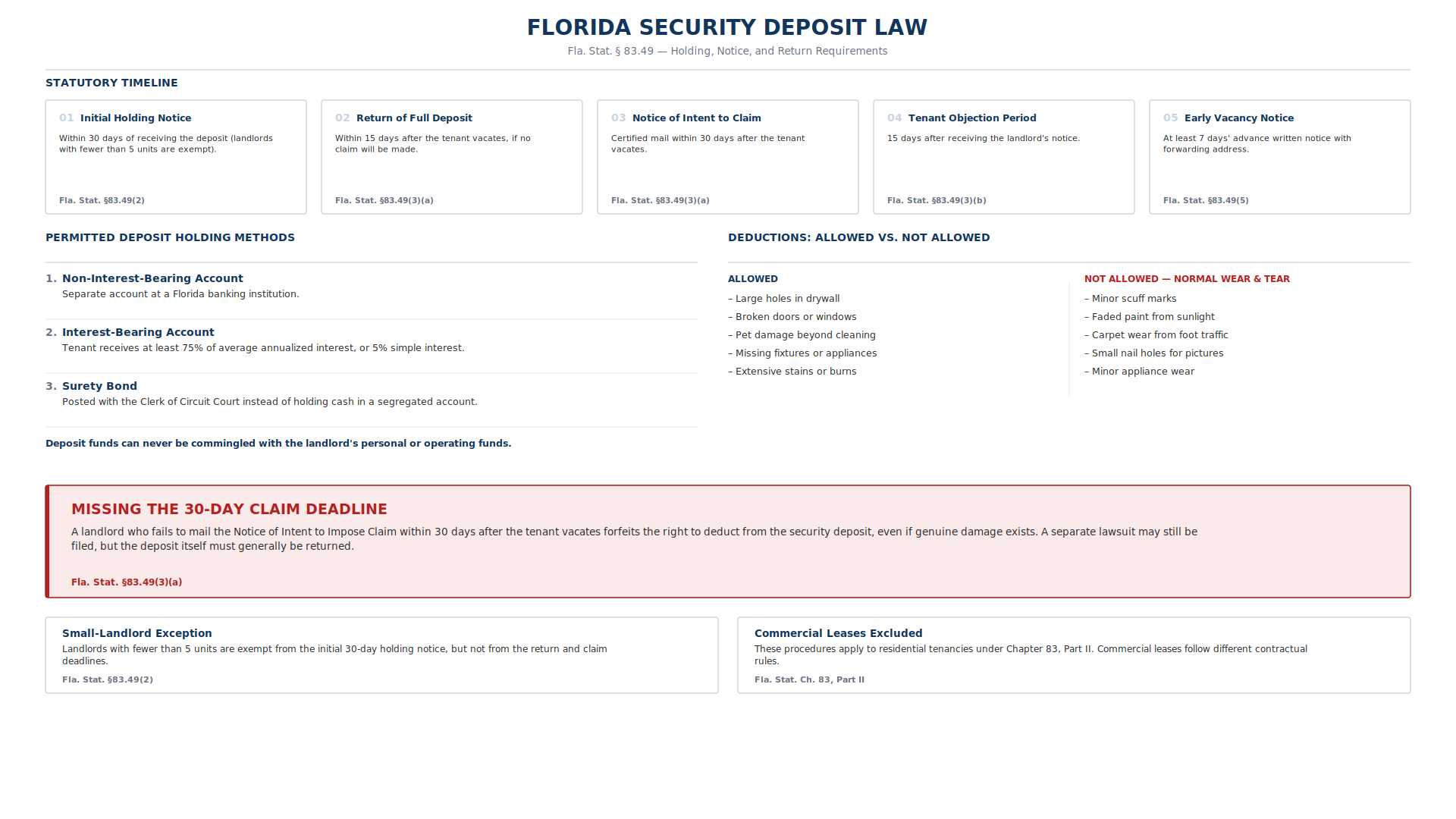
Florida requires security deposits to be maintained in one of three legally authorized ways:
- A separate non-interest-bearing account at a Florida banking institution.
- A separate interest-bearing account, with the tenant receiving at least 75% of the average annualized interest earned or 5% simple interest, depending on how the account is structured.
- A surety bond posted with the Clerk of the Circuit Court in the county where the rental property is located instead of maintaining the cash in a segregated account.
One rule applies regardless of which option is chosen: security deposit funds cannot be commingled with the landlord’s personal or operating money.
In practice, commingling is one of the easiest compliance mistakes to make, particularly for landlords managing only a few rental properties. Even when there is no dispute with the tenant, mixing security deposits into an operating account creates unnecessary legal exposure because the statute specifically requires separate handling of those funds.
Another point that often surprises landlords is that security deposits themselves are not registered with the State of Florida, the Department of Business and Professional Regulation (DBPR), or Sunbiz. The arrangement remains a private contractual matter between landlord and tenant.
The filing requirement depends on the surety-bond option used. Generally, the bond is filed with the Clerk of the Circuit Court in the county where the dwelling unit is located, while a landlord or agent renting dwelling units in five or more counties may elect the statutory bond option filed with the Secretary of State.
Landlords managing fewer than five rental units receive one limited exception. They are exempt from the statutory requirement to provide the initial 30-day holding notice. That exemption does not eliminate the obligation to properly safeguard deposits or comply with the return and claim deadlines that apply when the tenancy ends.
The Statutory Timeline That Controls Everything
The deadlines in Florida’s security deposit statute are where many disputes are won or lost. Each deadline serves a different purpose, and missing one can significantly affect the landlord’s legal rights.
| Topic / Issue | Florida Legal Rule | Governing Statute |
|---|---|---|
| Initial holding notice | In the lease agreement or within 30 days after receiving the deposit (except qualifying landlords with fewer than 5 units) | Fla. Stat. § 83.49(2) |
| Return of full deposit | Within 15 days after tenant vacates if no claim will be made | Fla. Stat. § 83.49(3)(a) |
| Notice of intent to impose claim | Certified mail to the tenant’s last known mailing address, or e-mail in accordance with § 83.505, within 30 days after termination of the rental agreement | Fla. Stat. § 83.49(3)(a) |
| Tenant objection period | 15 days after receiving the landlord’s notice | Fla. Stat. § 83.49(3)(b) |
| Early vacancy notice by tenant | At least 7 days’ written notice by certified mail or personal delivery, unless the written rental agreement provides otherwise, with an address where the tenant may be reached | Fla. Stat. § 83.49(5) |
These timelines work together rather than independently. For example, a landlord who intends to deduct for property damage cannot simply send an itemized bill whenever it is convenient. The required notice must be sent within the statutory 30-day period after termination of the rental agreement, by certified mail to the tenant’s last known mailing address or by e-mail in accordance with § 83.505. Once that deadline expires, the legal consequences become much more serious.
Likewise, tenants should avoid assuming that silence means everything is resolved. If a statutory claim notice arrives, the law provides only 15 days to submit a written objection. Waiting too long may allow the landlord to proceed with the claim under the statutory process.
What Happens When Landlords Miss the 30-Day Window
Few procedural mistakes carry consequences as severe as failing to send the Notice of Intent to Impose Claim within the required 30 days.
Under Florida law, a landlord who misses this deadline forfeits the right to impose a claim against the security deposit. That means the landlord generally cannot keep part of the deposit for alleged damages through the statutory security deposit process, even if actual damage exists.
That does not necessarily eliminate every legal remedy. Florida law still allows the landlord to pursue a separate lawsuit seeking compensation for property damage if appropriate. What is lost is the ability to satisfy that claim by withholding money from the tenant’s security deposit under Fla. Stat. § 83.49.
This is also why the statute prescribes specific disclosure language and requires certified mail for the notice of claim. In practice, disputes often center less on the damage itself and more on whether the landlord can prove timely statutory compliance. Certified mail receipts, mailing records, and properly drafted notices frequently become the most important evidence if litigation follows.
What Can (and Can’t) Be Deducted
A security deposit is intended to protect a landlord against actual financial loss—not to cover every expense associated with preparing a rental unit for the next tenant. Under Florida security deposit laws, a landlord may assert a claim against the deposit for amounts properly owed under the rental agreement or for qualifying damages, but must still follow the statutory notice process before retaining any portion of the deposit.
In practice, landlords commonly make deductions for:
- Unpaid rent owed under the lease.
- Unpaid utility charges that the lease makes the tenant responsible for but were billed to the landlord.
- Physical damage caused by the tenant, occupants, or guests that goes beyond ordinary use of the property.
What landlords cannot deduct for is normal wear and tear. Florida law distinguishes ordinary wear from damage claims, and landlords using the deposit framework should not treat routine deterioration from ordinary use as tenant-caused damage.
Examples of normal wear and tear include:
- Minor scuff marks from everyday living.
- Faded interior paint caused by sunlight.
- Carpet wear from regular foot traffic.
- Small nail holes used to hang pictures.
- Minor appliance wear from normal use.
Examples of damage that may justify a deduction include:
- Large holes in drywall.
- Broken doors or windows.
- Pet damage beyond ordinary cleaning.
- Missing fixtures or appliances.
- Extensive stains or burns requiring replacement rather than routine cleaning.
The distinction matters at move-out. A tenant can object to a claim within 15 days after receiving the landlord’s notice, so landlords should be able to connect each charge to an actual condition rather than treating routine aging as damage.
Situations Where a Deduction May Not Hold Up
Even if legitimate damage exists, a landlord’s claim can still fail if the statutory procedure is ignored. A deduction becomes difficult to enforce when:
- The required notice was never sent.
- The notice was mailed after the statutory 30-day deadline.
- The landlord failed to use certified mail.
- The deduction relates to conditions that existed before the tenant moved in.
- The landlord cannot reasonably document the claimed damage.
One practical example involves a tenant who leaves before the lease expires without providing the required 7-day advance written notice under Fla. Stat. § 83.49(5). In that situation, Florida law relieves the landlord of the obligation to send the formal 30-day notice of claim. That does not mean the landlord automatically keeps the entire deposit. The tenant may still recover any undisputed balance after legitimate claims are resolved.
Sending (or Responding to) the Notice of Intent to Claim
The Notice of Intent to Impose Claim is the document that determines whether a landlord may legally retain part of a tenant’s Florida tenant security deposit. Because Florida law specifies both timing and content, overlooking either requirement can jeopardize the entire claim.
Steps for Landlords
If you intend to withhold any portion of the deposit:
- Determine the amount of the proposed deduction.
- Prepare a written notice identifying the damages or other basis for the claim.
- Include language substantially matching the statutory notice required by Fla. Stat. § 83.49(3)(a).
- Send the notice by certified mail to the tenant’s last known mailing address, or via e-mail if both parties signed the written lease addendum consenting to digital delivery under Fla. Stat. § 83.505.
- Ensure the notice is mailed within 30 days after the tenant vacates.
The notice must substantially follow the statutory form prescribed by Florida law. Rather than paraphrasing it, landlords should closely follow the statutory language to avoid disputes over compliance. See Fla. Stat. § 83.49 for the required notice language.
From a practical standpoint, landlords should also retain:
- Certified mail receipts.
- Photographs documenting damage.
- Move-in and move-out inspection reports.
- Repair invoices and estimates.
These records often become the strongest evidence if the tenant disputes the deduction.
Steps for Tenants
Receiving a notice of claim does not automatically mean the landlord is entitled to keep the money.
If you disagree with the proposed deductions:
- Review the notice carefully.
- Compare the claimed damage with your move-in records and photographs.
- Submit a written objection within 15 days after receiving the notice.
- Keep copies of your objection and proof that it was delivered.
If no written objection is made within the statutory period, Florida law authorizes the landlord to proceed with the claim and return any remaining balance of the deposit.
Limitations and Legal Considerations
Not every lease falls under Florida’s residential security deposit rules.
The procedures discussed in this guide apply to residential tenancies governed by Chapter 83, Part II of the Florida Statutes. Commercial leases often contain different contractual provisions and are not controlled by the same statutory framework.
Another common misconception concerns the amount of the deposit. Because Florida has no statutory cap, some landlords assume they have unlimited discretion. In reality, collecting a larger deposit also means assuming greater responsibility for complying with the holding, disclosure, accounting, and return requirements imposed by law.
Interest is another area where confusion arises. Florida law allows landlords to choose among several approved methods of holding security deposits. The tenant cannot require the landlord to select an interest-bearing account if another statutory method is used. The decision belongs to the landlord, provided the chosen method complies with Fla. Stat. § 83.49. See the Florida Residential Landlord and Tenant Act for the governing residential tenancy framework.
Finally, landlords using the surety bond option should remember that the bond must be filed with the appropriate Clerk of the Circuit Court. Many small landlords overlook this filing obligation because security deposits themselves are never registered with Sunbiz or DBPR.
Common Landlord Mistakes That Cost the Entire Deposit
Security deposit disputes often turn on a handful of compliance details. The most important are the 30-day claim-notice deadline, the required notice method under § 83.49 and § 83.505, proper segregation of deposit funds, and records showing the condition of the property.
Missing the 30-Day Claim Deadline
This is the most expensive compliance mistake. If the statutory notice is not mailed within 30 days after the tenant vacates, Florida law generally prevents the landlord from asserting a claim against the security deposit, even if legitimate damage exists. The landlord may still pursue a separate lawsuit, but the deposit itself must generally be returned.
Mixing Deposit Funds With Operating Accounts
Commingling security deposits with business or personal funds violates the statutory holding requirements and creates unnecessary legal exposure during disputes or audits.
Using an Incomplete Notice
Many landlords prepare their own deduction letters without including the required statutory language. Omitting the required wording can create avoidable challenges to the notice’s validity.
Charging for Normal Wear and Tear
Replacing an aging carpet, repainting faded walls, or performing routine turnover cleaning are common expenses of property ownership. Attempting to recover those costs through a Florida landlord security deposit frequently leads to objections and may weaken the landlord’s overall claim.
Poor Documentation
Even when damage is genuine, photographs, inspection reports, repair invoices, and certified mail receipts often determine whether the landlord can successfully defend the deduction. Waiting until after litigation begins to organize evidence is usually too late.
Frequently Asked Questions (FAQ)
Can a landlord in Florida still sue me for damages after the 30-day window to claim against my deposit has passed?
Yes. Missing the statutory 30-day notice generally prevents the landlord from claiming against the security deposit, but it does not necessarily eliminate the right to file a separate lawsuit seeking compensation for property damage.
What happens if my landlord never sent me the required 30-day holding notice when I moved in does that affect their right to deduct later?
Landlords with five or more rental units are generally required to provide the initial holding notice within 30 days after receiving the deposit. That requirement is separate from the procedures governing deductions at the end of the tenancy, and landlords should comply with both. See Fla. Stat. § 83.49.
If I object to my landlord’s deduction notice within 15 days, what actually happens next do I have to go to court?
Submitting a timely written objection preserves your disagreement with the proposed deduction. Whether the dispute proceeds to court depends on whether the parties can resolve the matter voluntarily. Florida law does not automatically require litigation simply because an objection is filed.
Does a landlord with fewer than five rental units still have to follow the 15/30-day return and claim deadlines?
Yes. The small-landlord exception applies only to the initial 30-day holding notice after receiving the deposit. It does not remove the statutory deadlines governing the return of deposits or notices of intent to impose claims after the tenancy ends.
Legal Disclaimer: This article provides general information about Florida security deposit laws and is not legal advice. Laws may change, and individual circumstances can affect how the law applies. For advice about a specific situation, consult a qualified Florida attorney.