
Florida Sublease Agreement (Free Printable PDF & Word)
A Florida sublease agreement protects the relationship between you and your subtenant, but it does nothing to change your legal standing with your landlord, and that distinction is one most tenants don’t fully understand until something goes wrong. I’ve seen original tenants face eviction proceedings because their subtenant stopped paying rent, even though a signed sublease agreement florida attorneys would consider perfectly valid was sitting in a drawer the whole time.
The original lease remains the controlling document, so the first step is to check whether it requires the landlord’s consent to a sublease. If consent is required, the tenant should obtain that approval before proceeding, while Florida’s security deposit rules generally continue to govern the landlord’s relationship with the original tenant. The template below is built to address both sides of that arrangement, covering what the subtenant owes you and what you still owe your landlord.
Candice Hayden, Legal Writer
Ross Bridger, Real Estate Attorney
Florida Sublease Agreement (PDF, Printable, Fillable)
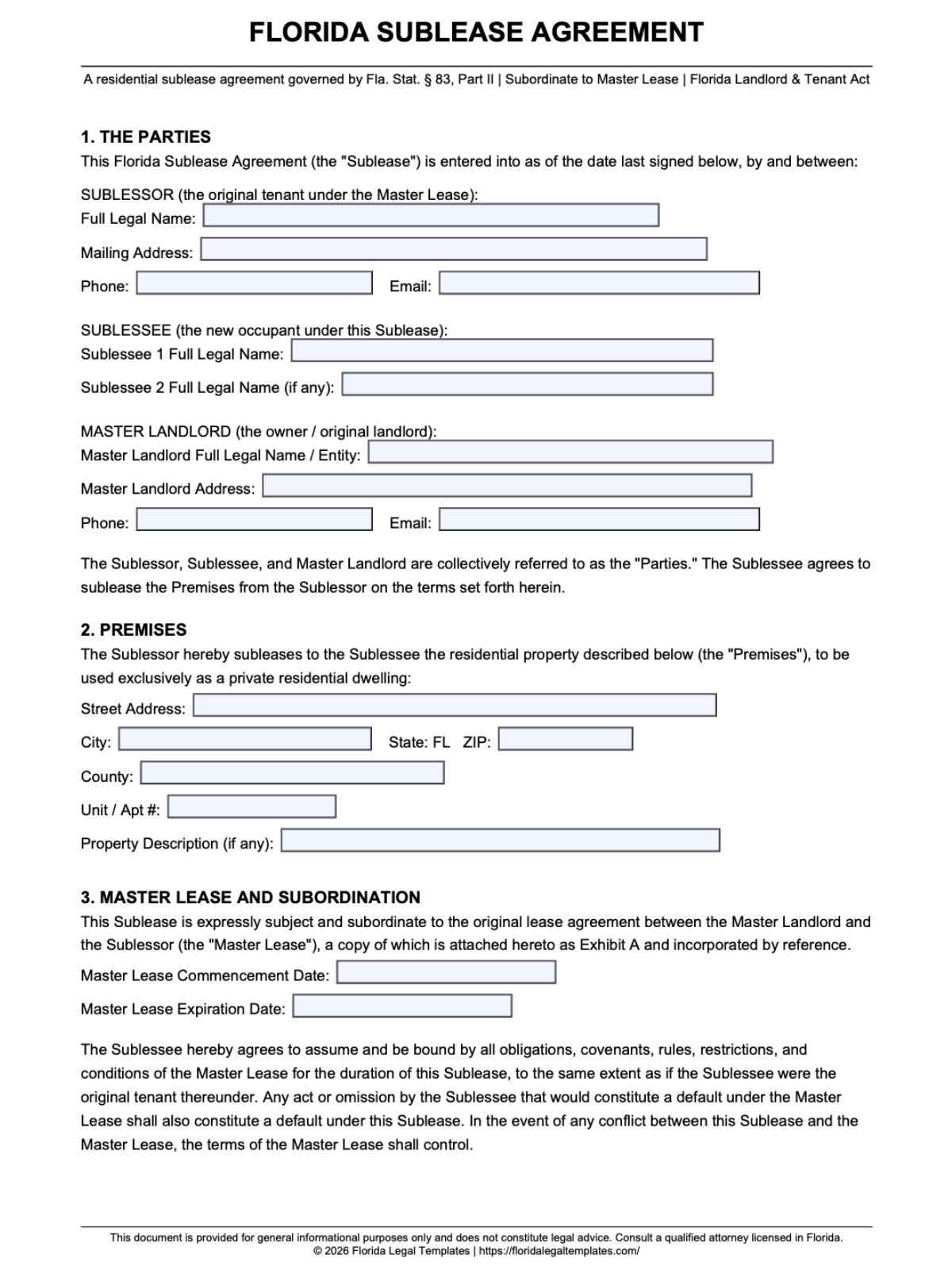
A Florida sublease agreement template provides a structured way to create a legally compliant contract between the original tenant (sublessor) and the new occupant (sublessee).
What the document includes:
- Sublease term (must not exceed master lease duration)
- Rent terms between sublessor and sublessee
- Security deposit handling and return conditions
- Incorporation of the master lease terms
Who should use this:
- Tenants temporarily relocating but keeping their lease
- Tenants renting out a room or portion of the property
- Subtenants entering a structured rental arrangement
When this template may NOT be sufficient:
- If the master lease prohibits subleasing without written landlord consent
- When transferring the entire lease (assignment is required instead)
- Commercial or multi-party leasing situations
A Florida sublet agreement is effective only when it aligns with the master lease and applicable law.
Before allowing a new occupant into the property, it’s important to evaluate their reliability using a tenant screening and verification form. This helps the original tenant reduce risk and ensure the sublease arrangement is backed by qualified occupants.
What Is a Florida Sublease Agreement?
A Florida sublease agreement is a contract where:
- The original tenant becomes the Sublessor
- The new occupant becomes the Sublessee
For a residential arrangement covered by Chapter 83, the Florida Residential Landlord and Tenant Act (Fla. Stat. §§ 83.40–83.683)provides the statutory framework, although particular statutory duties depend on the parties’ roles and the specific provision involved.
Key legal nuance:
The sublessor takes on contractual responsibilities toward the sublessee, but the original tenant does not automatically become the statutory landlord for every purpose under Chapter 83.
Sublease vs assignment:
- Sublease: Original tenant remains legally responsible
- Assignment: Lease rights are transferred entirely
Execution validity:
No notarization is generally required, and Fla. Stat. § 689.01 expressly provides that subscribing witnesses are not required for a lease of real property.
Core limitation:
A sublease remains subject to the master lease, so it should not grant the sublessee rights or a term that exceed what the original tenant holds under that lease.
A sublease operates within an existing lease, which means understanding the original agreement is critical. Reviewing a standard residential lease structure and obligations can help clarify how responsibilities flow from landlord to tenant and then to subtenant.
Key Florida Laws That Affect Florida Sublease Agreement
Summary of Applicable Laws
| Topic / Issue | Florida Legal Rule | Governing Statute |
|---|---|---|
| Governing Law | Residential landlord-tenant law applies to subleases | Fla. Stat. §§ 83.40–83.683 |
| Security Deposit Rules | 15 days to return deposit or 30-day notice for claims | Fla. Stat. § 83.49(3)(a) |
| Default Notice (Rent) | 3-day notice is required for nonpayment of rent before termination/eviction proceedings under Fla. Stat. §83.56(3), excluding Saturdays, Sundays, and court-observed legal holidays. | Fla. Stat. § 83.56(3) |
| Execution Formalities | No witness requirement for validity | Fla. Stat. § 689.01 |
| Prohibited Actions | Cannot waive rights or use self-help eviction | Fla. Stat. §§ 83.47, 83.67 |
Because a sublease creates a layered tenancy, it’s important to understand how different lease types interact. In some cases, transitioning to a flexible periodic rental arrangement may be more appropriate when long-term commitments are uncertain.
Practical Impact & Document Clauses
These statutes directly control how a sublease contract Florida must be written and enforced.
- The sublessor must act as a landlord, including issuing a formal 3-day notice for unpaid rent. In 2026, a 3-day notice for nonpayment should demand the rent due under the applicable rental agreement; Florida’s statutory definition of rent also includes other payments that the written agreement designates as rent. Fla. Stat. § 83.56
- If a security deposit is collected, the sublessor must comply with strict return timelines under Fla. Stat. § 83.49
- The agreement must include required disclosures such as:
- Radon Gas Warning: Verbatim paragraph embedded within the text of the agreement Fla. Stat. § 404.056)
- Security-deposit holding information must be provided as required by Fla. Stat. §83.49, including the applicable 30-day notice rule; the statute’s subsection (2) does not apply to landlords who rent fewer than five individual dwelling units.
- The sublease should identify the sublessor and provide a reliable address for notices and legal communications; Fla. Stat. §83.50 separately imposes disclosure requirements on landlords.
- For a residential rental agreement with a term of 1 year or longer, Fla. Stat. §83.512 requires the statutory landlord to provide a separate flood disclosure; whether that statutory duty applies directly to a sublessor should be confirmed for the particular arrangement.
The most important structural rule is that the sublease remains subject to the master lease. If the master lease ends because its term expires or the landlord lawfully terminates it, the subtenant’s rights may also end, so the sublease should make that relationship clear from the beginning.
Failure to comply with these laws can:
- Invalidate parts of the agreement
- Prevent deposit recovery
- Expose the sublessor to damages for unlawful eviction
Be Careful If the Landlord Starts Accepting Rent From the Subtenant
One situation creates confusion faster than almost anything else: the landlord begins accepting rent directly from the subtenant after learning about the sublease. Many original tenants assume this automatically transfers the lease or releases them from liability. It usually does not.
Unless the landlord signs a separate agreement releasing the original tenant or executes a formal lease assignment or new lease, the original tenant generally remains responsible for every obligation under the master lease. Simply cashing a rent check from the subtenant is not, by itself, a substitute for a written release. Whether the landlord’s conduct creates a direct landlord-tenant relationship with the subtenant depends on the specific facts and should not be assumed. Florida courts analyze these situations individually rather than applying a single automatic rule.
If your landlord agrees to accept rent from the subtenant, ask for the arrangement in writing. The document should clearly state whether the landlord is only accepting payment as a convenience or whether they are releasing you from future liability. That single paragraph can determine whether you remain responsible for unpaid rent, property damage, or lease violations months after you have moved out.
When to Use Florida Sublease Agreement
A Florida sublease agreement is useful when a tenant wants to transfer occupancy without ending their lease.
Common use cases:
A Florida sublease is most useful when the original tenant remains bound by the master lease but needs another person to occupy the premises for part of the remaining term. Before using one, compare the proposed arrangement with the master lease’s subletting and occupancy restrictions.
Practical scenarios:
The practical issue is whether the proposed occupant will receive possession under the original tenant’s leasehold or simply share the premises with the original tenant. If the original tenant remains in possession and the parties are primarily sharing space, a roommate or shared-housing agreement may be a better fit.
When NOT to use:
- Full transfer of lease (assignment required)
- Unauthorized subleasing prohibited by the master lease
- Commercial or mixed-use leasing
Using a sublease when the master lease does not permit the arrangement can put the original tenant in breach. Before handing over possession, check the lease for subletting, occupancy, and landlord-consent requirements.
If the arrangement involves shared occupancy rather than full control of the unit, a shared housing agreement between occupants can better define responsibilities and reduce conflicts that a standard sublease may not fully address.
How to Create or Fill Out the Florida Sublease Agreement
Creating a sublease agreement Florida requires careful attention to both the master lease and statutory requirements.
Step-by-step process:
- Review the master lease
- Confirm subleasing is allowed
- Identify consent requirements
- Obtain landlord consent (if required)
- Written approval is strongly recommended
- Identify the parties
- Sublessor (original tenant)
- Sublessee
- Define the property
- Entire unit or specific portion
- Set the sublease term
- Cannot exceed master lease duration
- Define rent terms
- Amount, due date, payment method
- Include security deposit terms
- Amount collected
- Location of funds
- Required statutory disclosure language
- Insert mandatory disclosures and optional notice frameworks
- Radon Consumer Warning: Text block reproduced exactly as written within the lease document (Fla. Stat. § 404.056).
- Security Deposit Allocation: Statutory banking notice delivered to the sublessee within 30 days of fund collection (Fla. Stat. § 83.49).
- Flood History Form: A separate standalone written disclosure form required under Fla. Stat. § 83.512 if the sublease spans a duration of 1 year or longer.
- Electronic delivery may be authorized through the addendum required by Fla. Stat. §83.505, allowing qualifying notices to be sent by e-mail when the statutory requirements are satisfied.
- Attach the master lease
- Incorporate its terms into the sublease
- Execute the agreement
- Signatures required
- No notarization required
Practical tips:
- Clearly assign responsibilities for rent, damages, and utilities
- Maintain written communication between all parties
- Avoid informal or verbal subleasing arrangements
Limitations and Legal Considerations
A Florida sublease agreement is a private contract and does not require filing with any government agency.
Key limitations:
- The sublease remains subject to the master lease, including its occupancy, use, and subletting restrictions.
- If the master lease ends, the sublessee’s rights may also end, depending on the circumstances and any separate agreement with the landlord.
Legal constraints:
- Cannot waive tenant rights under Fla. Stat. § 83.47
- Cannot use self-help eviction methods under Fla. Stat. § 83.67
High-risk scenarios:
- Subleasing without required consent
- Default by the original tenant leading to eviction
Edge cases:
- Partial subleases (room rentals)
- Conflicts with short-term rental restrictions
Failure to consider these limitations can result in eviction or financial liability.
A sublease governs occupancy but does not address financial arrangements between parties. If there are repayment obligations or shared expenses beyond rent, a document outlining repayment and financial terms may be necessary to clearly define those responsibilities.
Common Mistakes to Avoid
Subleasing without landlord consent
If the master lease requires consent, failure to obtain it is a breach.
Consequence: Lease termination and possible eviction.
Ignoring master lease restrictions
Not aligning the sublease with original lease terms.
Consequence: Sublease becomes unenforceable.
Extending beyond master lease duration
Setting a longer sublease term than allowed.
Consequence: Automatic invalidity of the excess term.
Missing required disclosures
Omitting radon warning or deposit notice.
Consequence: Legal non-compliance and potential liability.
Mishandling security deposits
Failing to follow the 15-day/30-day security-deposit rules can jeopardize a claim against the deposit. Under §83.49(3)(a), the claim notice may be sent by certified mail or by e-mail when the requirements of §83.505 are satisfied.
Consequence: Loss of rights to claim damages.
Skipping eviction notice requirements
Not providing a 3-day notice before action.
Consequence: Delayed eviction and legal complications.
Attempting self-help eviction
Lockouts or shutting off utilities.
Consequence: A landlord who violates Fla. Stat. §83.67 may face actual and consequential damages or three months’ rent, whichever is greater, plus costs and attorney’s fees; a sublessor should avoid any self-help lockout or utility shutoff as well.
Frequently Asked Questions (FAQ)
Do I need landlord permission to sublease in Florida?
The answer depends first on the master lease. If the lease requires landlord consent to a sublease, the tenant should obtain that consent before proceeding. Fernandez v. Vazquez, 397 So. 2d 1171 (Fla. 3d DCA 1981), involved a commercial lease and should not be treated as a blanket rule governing every residential sublease.
However, because most modern master leases explicitly grant landlords absolute discretion to deny requests, moving forward without a written “Consent to Sublease” form signed by the owner constitutes an actionable lease breach.
Is a Florida sublease agreement legally valid without notarization?
Yes. Florida law does not require notarization for residential subleases to be valid.
Who is responsible if the subtenant does not pay rent?
The original tenant (sublessor) remains fully responsible to the landlord, even if the sublessee fails to pay.
What happens if the master lease is terminated during a sublease?
Ordinarily, a sublease depends on the continued existence of the master lease, so termination of the master lease can end the sublease as well, although the legal effect can depend on the circumstances and any separate agreement with the landlord.
A Florida sublease works only within the rights created by the master lease. Before signing, compare the two documents, confirm any required landlord approval, and make sure the sublease clearly addresses rent, possession, deposits, and what happens if the master lease ends.
Legal Disclaimer: This article provides general information about Florida sublease agreements and is not legal advice. Florida landlord-tenant laws can vary based on the lease terms and specific circumstances. Consider consulting a qualified Florida attorney before entering into or enforcing a sublease.