
Florida Roommate Agreement (Free Printable, PDF & WORD)
A Florida roommate agreement sits in an unusual legal position because it governs the relationship between people sharing a rental property rather than replacing the landlord-tenant relationship. When two people are co-tenants on the same lease, neither one is generally the other’s landlord, so their private disputes may be governed by the roommate agreement and other applicable law rather than by the landlord’s rights and duties under Chapter 83.
I’ve watched roommate situations fall apart over shared expenses, guests, and move-out timelines where neither person had any recourse under landlord-tenant law because the relationship simply didn’t fit that legal framework. The florida roommate contract template below is drafted with that distinction in mind, covering the terms that actually hold up when a co-tenancy goes sideways and a judge is reading a civil contract rather than a rental agreement.
Candice Hayden, Legal Writer
Ross Bridger, Real Estate Attorney
Florida Roommate Agreement (PDF, Printable, Fillable)
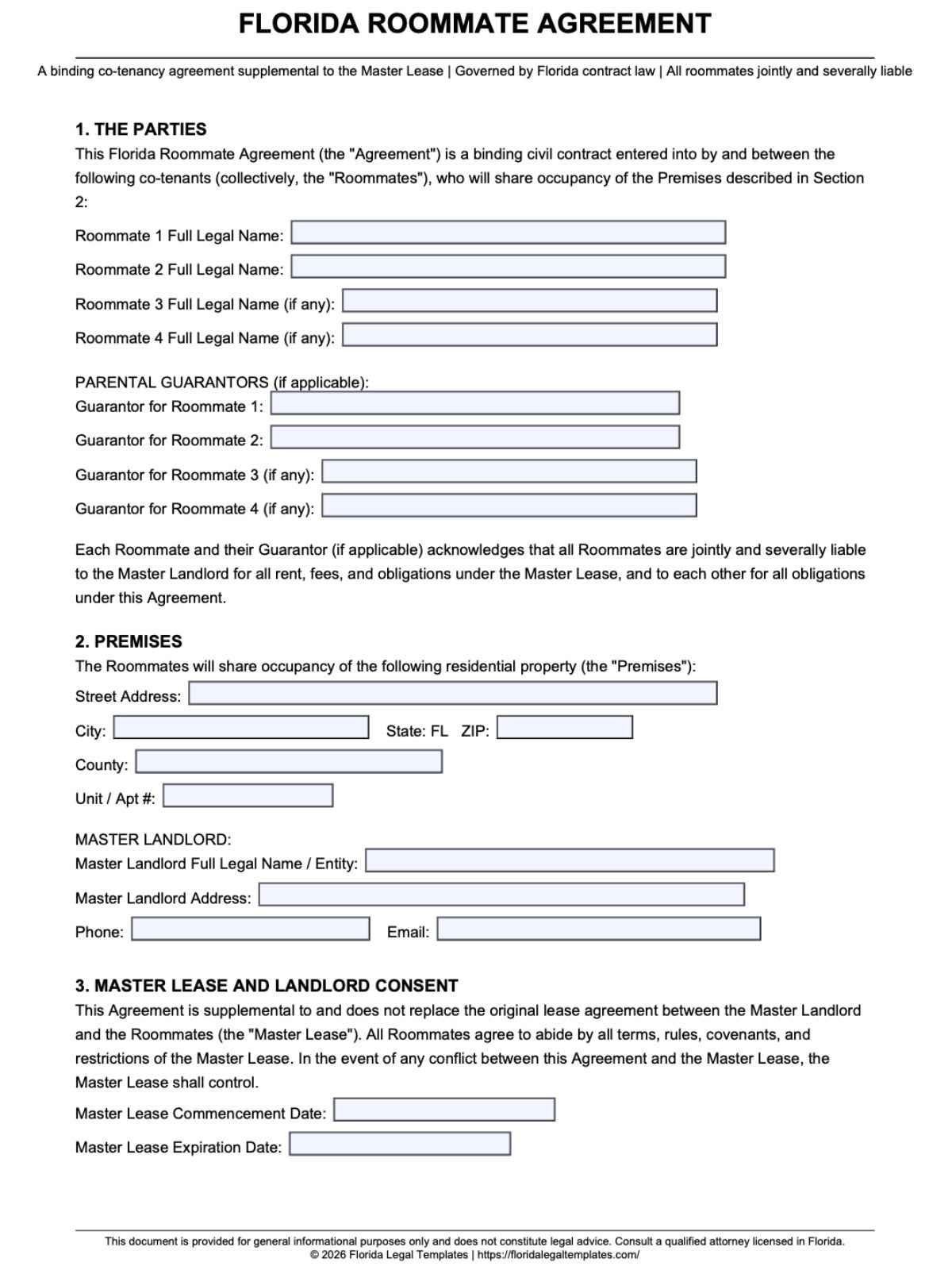
A Florida roommate contract in fillable or printable format provides a clear structure for managing shared living arrangements.
What the document includes:
- Rent division and payment obligations
- Utility sharing arrangements
- House rules (guests, noise, cleaning schedules)
- Shared expenses (internet, groceries, maintenance)
- Internal dispute resolution terms
Who should use this:
- Co-tenants sharing a leased property
- Friends or individuals renting together
- Tenants adding a new roommate mid-lease
When this template may NOT be sufficient:
- Subleasing arrangements (use a sublease agreement instead)
- Landlord-tenant contracts
- Commercial or multi-unit leasing situations
A shared housing agreement Florida is best used to regulate internal relationships—not landlord rights.
Before adding a new roommate to an existing lease, it’s a good practice to evaluate their reliability using a tenant screening and background verification document. This helps reduce financial risk and ensures all occupants are properly assessed before sharing responsibilities.
What Is a Florida Roommate Agreement?
A Florida roommate agreement is generally a private contract between individuals living together in a rental property. It can outline financial responsibilities and behavioral expectations, but the legal relationship between the occupants depends on how the living arrangement is actually structured.
Legal framework:
- Governed by Florida contract law
- Subordinate to:
- The master lease
- The Florida Residential Landlord and Tenant Act
Key distinctions:
- Roommate agreement ≠ lease
- Roommate agreement ≠ sublease
Execution validity:
- No general notarization requirement
- No general witness requirement
Critical limitation:
A roommate agreement cannot override the master lease or impose obligations on a landlord who is not a party to the agreement. For example, if the lease prohibits pets, roommates cannot authorize one through this agreement.
Because a roommate agreement operates within an existing lease, understanding the primary contract is essential. Reviewing a standard residential lease structure and tenant obligations can help clarify how responsibilities are ultimately enforced by the landlord.
Key Florida Laws That Affect Florida Roommate Agreement
Summary of Applicable Laws
| Topic / Issue | Florida Legal Rule | Governing Statute |
|---|---|---|
| Age & Capacity | Must be at least 18 to enter binding contract | Fla. Stat. § 743.07(1) |
| Writing Requirement | Required if agreement exceeds 1 year | Fla. Stat. § 725.01 |
| Execution Formalities | No witness requirement | General contract law |
| Notarization | Not required for validity | General contract law |
| Eviction Restrictions | Florida law restricts self-help measures in landlord-tenant situations, and a roommate should not assume that changing locks, cutting off utilities, or removing another occupant is a lawful way to resolve a possession dispute. | Fla. Stat. § 83.67 |
Practical Impact & Document Clauses
These rules define how enforceable a Florida roommate agreement actually is.
First, parties generally have full contractual capacity at age 18 under Fla. Stat. § 743.07(1), although Florida law provides limited exceptions affecting the contractual capacity of some minors. If the agreement is for a lease longer than one year or is an agreement that cannot be performed within one year, Fla. Stat. § 725.01 generally requires a signed writing for an action to enforce it.
Second, unlike leases, there are no mandatory disclosures or statutory “magic words.” This gives flexibility in drafting but also increases the risk of vague or incomplete agreements.
Third, and most important, the roommate agreement is subordinate to the master lease. If it conflicts with lease terms, it becomes legally ineffective. This creates a real-world risk: a roommate agreement does not shield you from “Joint and Several Liability.” If your roommate fails to pay the landlord, you are still 100% responsible for the full rent. This agreement can provide evidence of your roommate’s contractual obligation and may support a civil claim for reimbursement if your roommate fails to pay the amount agreed.
Finally, eviction rules still apply. Even if a roommate violates the agreement, you cannot remove them by force. Under Fla. Stat. § 83.67, self-help eviction—such as changing locks or shutting off utilities—is prohibited and can result in liability.
While roommate agreements offer flexibility, they do not replace formal lease structures. In cases where occupants require a defined tenancy arrangement, a comprehensive rental agreement outlining legal terms may provide stronger enforceability under Florida law.
Essential Clauses Every Florida Roommate Agreement Should Include
A roommate agreement is only as useful as the details it contains. Vague promises often lead to disagreements because each roommate remembers the arrangement differently.
A well-written agreement should clearly address:
Rent Payments
Specify exactly how rent is divided, when it must be paid, and how payments will be made.
Utilities
List every shared utility, including electricity, water, internet, gas, trash service, and streaming subscriptions if they are shared.
Security Deposit
State how each roommate contributed to the security deposit and how any refund will be divided after deductions.
Household Responsibilities
Identify who handles routine cleaning, lawn care, trash removal, and other shared responsibilities.
Guests
Set reasonable expectations for overnight guests, extended stays, parties, and visitors using common areas.
Pets
Clarify whether pets are permitted and who is financially responsible for pet-related damage or additional fees.
Shared Purchases
If roommates purchase furniture, kitchen appliances, or household supplies together, note who owns each item if someone moves out.
Move-Out Notice
Require roommates to give advance written notice before leaving the property whenever possible. This gives everyone time to find a replacement or adjust financial arrangements.
The more specific these provisions are, the fewer misunderstandings tend to arise later.
What Happens If Your Roommate Stops Paying Rent?
One of the biggest misconceptions among roommates is believing that each person is responsible only for their own share of the rent. In most Florida leases, that isn’t how it works.
If the lease makes the co-tenants jointly and severally liable, the landlord can generally seek the full rent from any tenant who is liable under the lease—not just the roommate who failed to pay. Even if your roommate agreed to pay half the rent, the landlord isn’t bound by that private arrangement because they weren’t a party to your roommate agreement.
For example, if your monthly rent is $2,000 and your roommate leaves without paying their $1,000 share, the landlord may still require you to pay the entire $2,000 to avoid default under the lease.
A written roommate agreement becomes important after you’ve paid the landlord. It serves as evidence that your roommate agreed to contribute a specific amount, which can help support a reimbursement claim through Florida’s civil court system if necessary.
To protect yourself, keep records of:
- Rent payments
- Utility payments
- Bank transfers or payment app receipts
- Text messages or emails discussing shared expenses
- A signed copy of the roommate agreement
These records can become valuable evidence if a payment dispute ends up in court.
How Security Deposits Work Between Roommates
Security deposits often become the most disputed issue when roommates move out.
Florida law regulates how landlords must handle security deposits with tenants, but it usually does not determine how roommates divide the money among themselves. Unless the lease or a separate written agreement says otherwise, the landlord generally returns the deposit according to the lease—not according to whatever arrangement the roommates made privately.
Your roommate agreement should answer questions such as:
- How much did each roommate contribute?
- How will deductions for damage be divided?
- Who pays if one roommate causes damage beyond normal wear and tear?
- What happens if one roommate moves out before the lease ends?
Addressing these issues before moving in is much easier than trying to resolve them after the tenancy ends.
What Happens If a Roommate Wants to Move Out Early?
People’s circumstances change. A roommate may accept a new job, transfer schools, or simply decide they no longer want to live in the property.
Moving out, however, does not automatically end legal obligations under the lease.
If the departing roommate remains on the lease, they may continue to be responsible for lease obligations unless the landlord formally releases them or the lease and applicable law provide another valid way to end those obligations. Likewise, the remaining roommates may still be responsible for the full rent if no replacement is found.
To reduce disputes, your roommate agreement should explain:
- How much notice must be given before moving out
- Whether the departing roommate must help locate a replacement
- How shared bills will be handled during the transition
- When the departing roommate will receive their share of the security deposit, if applicable
Planning for this possibility in advance can prevent significant financial disagreements later.
When to Use This Florida Roommate Agreement
A roommate agreement Florida template is useful whenever multiple people share a rental property.
Common use cases:
- Splitting rent among roommates
- Defining shared expenses and responsibilities
- Establishing house rules to avoid conflict
Practical scenarios:
- Friends renting together
- Adding a roommate mid-lease
- Shared apartments or houses
When NOT to use:
- Subleasing situations
- Landlord-tenant agreements
- Lease transfers or assignments
Using this agreement in the wrong context can create confusion about legal responsibilities.
If the arrangement involves one tenant renting space to another rather than equal co-tenancy, a subletting agreement between original tenant and occupant is more appropriate, as it establishes a clearer legal relationship and liability structure.
How to Create or Fill Out the Florida Roommate Agreement
Creating a Florida roommate contract is mainly about putting the financial and household arrangements in writing before a disagreement starts.
Step-by-step process:
- Confirm master lease compliance
- Ensure no terms violate lease restrictions
- Identify all roommates
- Include full legal names
- Define financial responsibilities
- Rent split
- Utility division
- Payment deadlines
- Set house rules
- Cleaning schedules
- Guest policies
- Noise expectations
- Define shared expenses
- Internet, groceries, maintenance
- Include dispute resolution terms
- Internal process for resolving conflicts
- Specify duration
- Align with lease term where applicable
- Execute the agreement
- Signatures required
- No notarization required
Practical tips:
- Put important payment and household arrangements in writing rather than relying on memory.
- Be specific about rent shares, utilities, guests, pets, and move-out responsibilities.
- Update the agreement if the rent split, occupants, or other major terms change.
What a Florida Roommate Agreement Cannot Do
Although a roommate agreement is an important document, it has limits.
It cannot:
- Override the terms of the master lease.
- Change the landlord’s legal rights.
- Prevent the landlord from seeking unpaid rent from any tenant named on the lease.
- Authorize activities prohibited by the lease, such as keeping unauthorized pets or occupants.
- Allow roommates to resolve a possession dispute by changing locks, disconnecting utilities, or removing another occupant’s belongings. A roommate should use the appropriate legal process rather than assume that self-help will lawfully terminate another occupant’s right to possession.
Instead, the agreement primarily serves as evidence of each roommate’s obligations if a disagreement later requires legal resolution.
Documents You Should Keep
Even the best roommate agreement is much easier to enforce when supported by good records.
Consider keeping copies of:
- The signed roommate agreement
- The master lease
- Rent receipts
- Utility bills
- Payment confirmations from bank transfers or payment apps
- Emails and text messages discussing shared expenses
- Photos documenting the property’s condition when moving in and moving out
Maintaining organized records can make resolving disputes significantly easier if disagreements arise.
Limitations and Legal Considerations
A Florida roommate agreement is a private contract and does not require filing with any government authority.
Key limitations:
- Cannot override the master lease
- Cannot change landlord rights
Legal constraints:
- Does not eliminate joint liability to the landlord
- Does not by itself give one co-tenant the landlord’s eviction rights against another co-tenant named on the master lease
High-risk scenarios:
- One roommate stops paying rent
- Lease violations affecting all tenants
Edge cases:
- Unequal rent distribution disagreements
- Replacing a roommate mid-lease
If these risks are not addressed clearly, disputes can escalate quickly.
A roommate agreement governs internal obligations but does not cover financial arrangements beyond shared living costs. If roommates are lending money or structuring repayments between themselves, a formal agreement for documenting repayment obligations may be necessary to avoid disputes and ensure clarity.
Common Mistakes to Avoid
Assuming the agreement overrides the lease
Roommate agreements cannot contradict lease terms.
Consequence: Lease violations and possible eviction.
Not putting the agreement in writing
Verbal agreements are difficult to enforce.
Consequence: Financial disputes and lack of legal clarity.
Ignoring joint liability risks
Each tenant may still be responsible for full rent.
Consequence: One roommate may be forced to cover unpaid amounts.
Failing to define financial responsibilities clearly
Vague terms lead to misunderstandings.
Consequence: Ongoing disputes and payment issues.
Attempting to remove a roommate without legal process
Changing locks or removing belongings is illegal.
Consequence: Liability under Fla. Stat. § 83.67.
Not updating the agreement
Circumstances change over time.
Consequence: Outdated terms and new conflicts.
Frequently Asked Questions (FAQ)
Is a Florida roommate agreement legally binding?
Yes, if it meets basic contract requirements such as mutual agreement, legal capacity, and clear terms.
Can a roommate agreement override a lease in Florida?
No. The master lease always takes priority. Any conflicting clause in the roommate agreement is unenforceable.
What happens if one roommate doesn’t pay rent?
The landlord can still pursue any tenant for the full amount due, regardless of internal agreements between roommates.
Can I force a roommate to leave using this agreement?
No. If both roommates are co-tenants named on the master lease, neither roommate has the legal standing to evict the other; only the landlord can initiate eviction proceedings. However, if you are the sole tenant on the master lease and you separately rent space to another person, the legal relationship may be that of landlord and tenant, in which case the applicable Chapter 83 procedures may govern possession after a breach. A Chapter 82 unlawful-detainer remedy can apply in circumstances involving a person who is not a tenant, but the specific statutory requirements depend on the person’s status and the applicable Chapter 82 provision; it is not limited simply to guests who have no agreement to pay rent.
A Florida roommate agreement cannot replace the lease or change your obligations to the landlord, but it can significantly reduce misunderstandings between the people sharing the home. By clearly documenting rent obligations, utility payments, household rules, security deposit arrangements, and move-out procedures, roommates establish a written record of their expectations before problems develop.
If a dispute later arises over unpaid rent, shared expenses, or property damage, a carefully drafted roommate agreement can provide valuable evidence of what each person agreed to do. Taking the time to create a detailed agreement before moving in is often far easier—and far less expensive—than trying to resolve avoidable conflicts after they occur.
Legal Disclaimer:This article provides general information about Florida roommate agreements and is not legal advice. Laws and individual lease terms can vary, so consider consulting a Florida attorney about your specific situation.