
Florida Rental Application [Free Fillable PDF & Word]
A Florida rental application does more than collect information about a prospective tenant — it’s the document that establishes whether a landlord’s screening process was consistent, and inconsistency is where most Fair Housing complaints actually originate.
I’ve seen landlords use the same tenant application Florida law doesn’t prohibit, ask the same questions of every applicant, and still end up in a Fair Housing investigation because they applied the criteria differently depending on who was sitting across from them. Florida’s 2023 preemption law under F.S. § 83.425 placed regulation of residential tenancies, including the screening process and rental application fees covered by Chapter 83, under state law effective July 1, 2023, but it did not remove the separate federal and state Fair Housing requirements that apply to how landlords screen applicants. The florida rental application form below is built to give landlords a consistent, documentable process from the first inquiry to the final decision.
Candice Hayden, Legal Writer
Ross Bridger, Real Estate Attorney Last Updated: September 22, 2026
Florida Rental Application Form (PDF, Printable, Fillable)
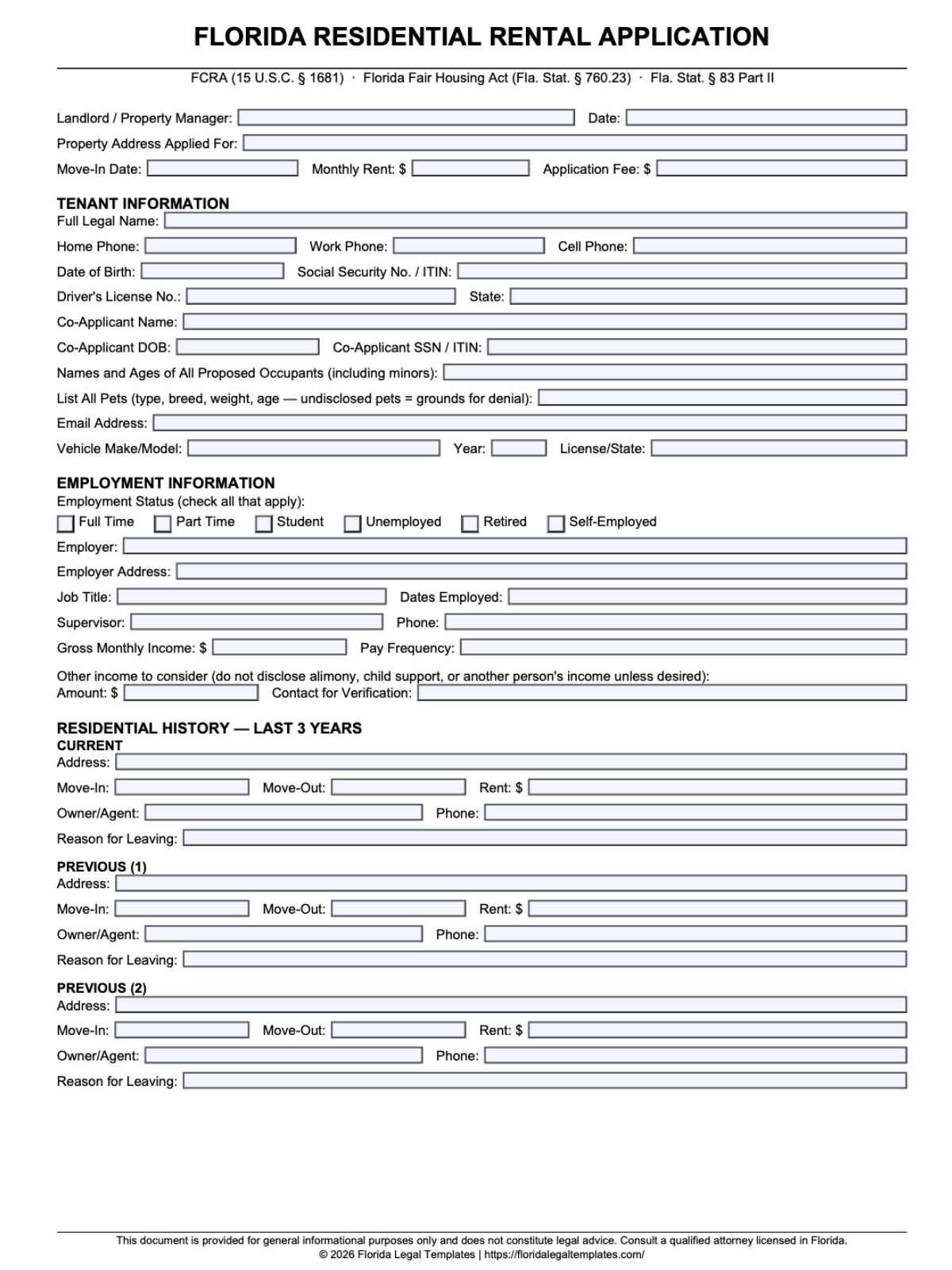
A Florida rental application form provides a structured and compliant way to collect and evaluate tenant information.
What the document includes:
- Applicant’s personal details (name, contact, ID)
- Employment and income verification
- Rental history and references
- Authorization for credit and background checks
- Application fee and, if applicable, holding-deposit terms; the separate flood disclosure required by Fla. Stat. § 83.512 is provided at or before execution of a residential rental agreement for a term of 1 year or longer.
Who should use this:
- Landlords screening prospective tenants
- Property managers handling applications at scale
- Tenants submitting rental applications
When this template may NOT be sufficient:
- HOA or condominium applications with additional approval layers
- Commercial leasing applications
- Government-subsidized or regulated housing programs
A tenant application Florida form should be tailored to the property type, especially where associations impose separate requirements.
What Is a Florida Rental Application?
A Florida rental application is a pre-lease screening document used to evaluate whether a prospective tenant meets a landlord’s criteria.
Legal framework:
- Governed by:
- Florida Fair Housing Act (Fla. Stat. § 760.23)
- Florida Residential Landlord and Tenant Act
- Federal Fair Housing Act
- Fair Credit Reporting Act (15 U.S.C. § 1681)
Key legal nuance:
The application itself does not create a tenancy, but the screening process is still subject to laws that apply before a lease is signed. For example, Florida’s Fair Housing Act applies to discriminatory rental decisions, while the FCRA governs the use of consumer reports in tenant screening.”
Execution validity:
- No notarization required
- No witness requirement
Practical implication:
Problems can arise before a lease is signed, particularly when a landlord obtains a consumer report without a permissible purpose or applies different screening standards to similarly situated applicants.
Since a rental application is only the pre-screening step, it should not be confused with legally binding lease documents. Once an applicant is approved, the relationship is formalized through a complete residential lease agreement used for tenant occupancy or, in flexible arrangements, a month-to-month rental contract with defined notice terms.
Key Florida Laws That Affect Florida Rental Application
Summary of Applicable Laws
| Topic / Issue | Florida Legal Rule | Governing Statute |
|---|---|---|
| Anti-Discrimination | Cannot deny or treat applicants differently based on protected classes | Fla. Stat. § 760.23 |
| Credit/Background Checks | Must have a permissible purpose under 15 U.S.C. § 1681b and satisfy the applicable FCRA certification requirements for tenant screening; written applicant authorization is not a general federal prerequisite to obtaining a tenant-screening consumer report. | 15 U.S.C. § 1681b |
| Adverse Action Notice | Must provide an adverse-action notice when an adverse action is based in whole or in part on a consumer report, including the required reporting-agency information and other disclosures required by 15 U.S.C. § 1681m. | 15 U.S.C. § 1681m |
| Age Age and contracting capacity | Florida generally removes the disability of nonage at age 18; § 743.045 provides a specific residential-lease rule for certain 17-year-old foster-care youth who meet the statute’s requirements and present the required court order. | Fla. Stat. §§ 743.07, 743.045 |
| Condominium transfer fee | A condominium association’s transfer-approval fee may not exceed $150 per applicant when the statutory requirements for association approval and the fee are satisfied. (with a spouse, or a parent and dependent children, counted as one applicant), under Fla. Stat. § §718.112(2)(k). | Fla. Stat. § §718.112(2)(k) |
Applicant Provided Screening Reports Can Change the Background Checks Process
Many landlords assume they must order a new credit and background report for every applicant. Federal law provides another option that can save both time and application costs. The Fair Credit Reporting Act does not restrict or explicitly govern a landlord’s voluntary business choice to review a portable screening dossier provided directly by a consumer. However, 15 U.S.C. § 1681j concerns free consumer-report disclosures and should not be cited as a Florida statutory authorization or prohibition concerning reusable tenant-screening reports. Florida’s proposed 2025 reusable-screening legislation did not become law. Landlords must also understand that while states like Colorado or Illinois legally enforce portable screening rules, Florida does not currently have a statutory reusable-tenant-screening-report requirement. A 2025 proposal, CS/HB 43, died in committee, and a 2026 Senate proposal initially included similar provisions before those provisions were removed from the committee substitute.
In practice, this is most useful when an applicant has recently paid for a screening report while applying for multiple rentals. If the landlord accepts that report, the application should clearly state whether additional screening will still be required and whether any application fee will be reduced or remain unchanged. This avoids later disputes from applicants who believe they were charged for a report that was never ordered.
Landlords should also remember that accepting an applicant’s existing report does not eliminate Fair Housing or FCRA obligations. Screening standards must still be applied consistently to every applicant, and if the landlord ultimately denies the application based on information contained in that report, the usual adverse action requirements under the FCRA still apply.
Practical Impact & Document Clauses
These rules affect what a rental application Florida PDF should document, particularly the screening criteria, applicant authorizations, fee terms, and information needed to support a consistent screening process.
For example, Before obtaining a tenant-screening consumer report, a landlord must have a permissible purpose under the FCRA and satisfy the reporting company’s applicable certification requirements. Written applicant authorization may be used as part of the landlord’s screening process, but a landlord’s failure to obtain written consent is not, by itself, a violation of the FCRA where another permissible purpose applies.
f a landlord takes an adverse action based in whole or in part on a consumer report, the landlord must provide the notices and disclosures required by 15 U.S.C. § 1681m, including information about the reporting agency and the applicant’s rights; depending on the information used, the statute also requires additional written or electronic disclosures.
Florida law also prohibits discriminatory housing practices under Fla. Stat. § 760.23. Screening criteria should be applied consistently, because charging different fees or denying applicants because of a protected characteristic can create liability under Florida’s Fair Housing Act.
Fee structures vary depending on the property:
- Florida law does not impose a general statewide cap on rental application fees charged by ordinary residential landlords.
- Condominium association transfer-approval fees are capped at $150 per applicant under Fla. Stat. § 718.112(2)(k).
Additionally, if a landlord collects a holding deposit, the application must clearly define forfeiture terms. Without this clarity, disputes over refunds become difficult to enforce.
Failure to follow these rules can lead to:
- Federal liability under FCRA
- State-level discrimination claims
- Invalid screening outcomes and disputes
The compliance requirements during screening directly impact how future agreements are structured. For example, once a tenant is selected, landlords often transition into a standard Florida lease document covering core rental terms, ensuring consistency between screening criteria and lease obligations.
When to Use Florida Rental Application
A Florida rental application form should be used before any lease agreement is signed.
Common use cases:
- Screening prospective tenants
- Verifying financial stability and rental history
- Comparing multiple applicants
Practical scenarios:
- Residential property leasing
- Multi-applicant selection processes
- Property management workflows
When NOT to use:
- Lease agreements (this does not create tenancy)
- Informal tenant selection without screening
- Commercial leasing processes
A written application gives the landlord a record of the information and screening criteria used when evaluating an applicant, which can be especially useful when multiple applicants are being considered.
Rental applications are particularly important in shared housing or partial occupancy setups. In such cases, landlords may later use a room-specific rental agreement for shared properties or, where tenants share equal responsibility, a co-tenant living arrangement agreement to clearly define roles and obligations.
How to Create or Fill Out the Florida Rental Application
Creating a tenant application Florida requires both accuracy and compliance.
Step-by-step process:
- Collect applicant information
- Full name, contact details, identification
- Gather employment and income details
- Employer, salary, verification
- Request rental history
- Previous landlords and references
- Pro-Tip: Florida Statutes §83.505 now permits landlords and tenants to agree to electronic delivery of Chapter 83 notices, but the election must be made through a signed rental-agreement addendum that explains the voluntary nature of the election and allows either party to revoke it.
- Include authorization clause
- Written authorization for credit and background checks, when used to document the applicant’s permissible purpose for the report
- Define application fee terms
- Clearly state amount and whether it is non-refundable
- Include holding deposit terms (if applicable)
- Define when it is forfeited (e.g., failure to sign lease after approval)
- Apply consistent screening criteria
- Ensure compliance with Fair Housing laws
- Execute the application
- Before screening, the landlord should document a permissible purpose under the FCRA and satisfy the reporting company’s certification requirements; a signed authorization may be used to document that purpose.
Practical tips:
- Use consistent evaluation standards for all applicants
- Avoid collecting unnecessary sensitive information
- Store applicant data securely due to privacy risks
Limitations and Legal Considerations
A Florida rental application is generally used as part of the landlord’s private screening process rather than as a document filed with a state or local housing agency.
Key limitations:
- Does not create tenancy rights
- Cannot bind either party to a lease
Legal constraints:
- Must comply with FCRA for credit screening
- Must comply with Fair Housing laws
High-risk scenarios:
- Denying applicants without proper documentation
- Charging HOA application fees above statutory limits
- Failing to process a military service member’s application within the statutory deadline
Edge cases:
- Multiple applicants applying jointly
- Conditional approvals requiring higher deposits
Because screening happens before the lease is signed, mistakes in the application process can still affect the landlord’s compliance with fair-housing and consumer-reporting requirements.
The High-Stakes 7-Day Service member Mandate
While a landlord generally controls the timing of its ordinary screening process, Fla. Stat. § 83.683 requires the landlord to complete a servicemember’s rental application within 7 days after submission and provide written approval or denial within that period. Under Fla. Stat. § 83.683, If a prospective tenant is a servicemember, the landlord must complete processing of the application and notify the applicant in writing of approval or denial, including the reason for a denial, within 7 days after submission. If the application is denied, the landlord must explicitly outline the legal reasons for the rejection in that written notice.
If a timely denial is not issued within the 7-day period, the landlord must lease the rental unit to the servicemember if all other terms of the application and lease are complied with; similar requirements apply when a condominium, cooperative, or homeowners’ association conducts the screening
The statute mandates that the landlord must proceed to lease the residential unit to the service member if all other standard criteria are met. The seven-day rule also applies when a condominium, cooperative, or homeowners’ association requires a prospective servicemember tenant to complete an application. Absent a timely denial, the association must allow the unit or parcel owner to lease to the servicemember, and the landlord must lease if all other application and lease terms are satisfied. Landlords must always log the exact time stamp of application submission to ensure their screening pipeline does not accidentally force an automatic lease approval.
A rental application cannot replace a lease or create enforceable tenancy rights. If the arrangement involves business use instead of residential occupancy, a commercial leasing document for business premises must be used, as it follows a separate legal framework.
Common Mistakes to Avoid
Running credit checks without written authorization
Obtaining a consumer report without a permissible purpose or otherwise failing to comply with the FCRA can create federal liability.
Consequence: Civil liability under the FCRA.
Discriminatory screening practices
Applying different standards based on protected classes.
Consequence: Penalties under Fla. Stat. § 760.23.
Failing to issue adverse action notice
Rejecting applicants without proper notice.
Consequence: Non-compliance with federal law.
Not disclosing non-refundable fees
Unclear fee terms lead to disputes.
Consequence: Contract disputes and refund claims.
Misrepresenting holding deposit terms
Failing to define forfeiture conditions.
Consequence: Loss of enforceability.
Charging excessive HOA application fees
Exceeding $150 cap.
Consequence: Violation of Florida statutes.
Frequently Asked Questions (FAQ)
Can a landlord run a credit check without permission in Florida?
Not necessarily. Federal law requires a permissible purpose for obtaining a consumer report, and the landlord must satisfy the applicable FCRA requirements; written authorization is not a universal prerequisite to tenant screening.
Is there a limit on rental application fees in Florida?
There is no general cap for landlords. However, HOA and condominium associations cannot charge more than $150 per applicant.
What happens if a rental application is denied based on credit?
The landlord must provide an adverse action notice with details of the credit reporting agency used.
Do I need to sign a rental application before screening can occur?
A signed application can document the applicant’s information and the landlord’s screening process, but federal law does not universally require a signed rental application as the authorization for every tenant-screening consumer report.
A Florida rental application is most useful when it documents the criteria actually used to evaluate applicants. For example, if a landlord uses a consumer report, the file should preserve the screening process and any required adverse-action documentation rather than relying on an informal approval or denial.
Legal Disclaimer
This article provides general information about Florida rental applications and is not legal advice. Laws and requirements may change, and individual circumstances can affect how the law applies. Consider consulting a qualified Florida attorney for advice about your specific situation.