
Florida Commercial Lease Agreement [Free Fillable PDF]
A Florida commercial lease agreement covers significantly more ground than most business owners expect when they sit down to sign one, and the stakes for getting it wrong are much higher than in a residential rental situation. Unlike residential tenants, commercial tenants in Florida operate under Chapter 83 Part I, which provides almost no statutory protections — meaning the written lease is essentially the only rulebook either side has.
I’ve seen business owners shocked to discover that changing the locks after a missed payment is completely illegal, creating a massive liability trap for landlords. While commercial leases allow broad contractual freedom, Florida law strictly outlaws self-help evictions across the board under Fla. Stat. § 83.05. Even if a lease addresses remedies after default, a landlord must follow Florida’s statutory rules for recovering possession rather than relying on self-help measures.
Candice Hayden, Legal Writer
Ross Bridger, Real Estate Attorney
Florida Commercial Lease Agreement (PDF, Printable, Fillable)
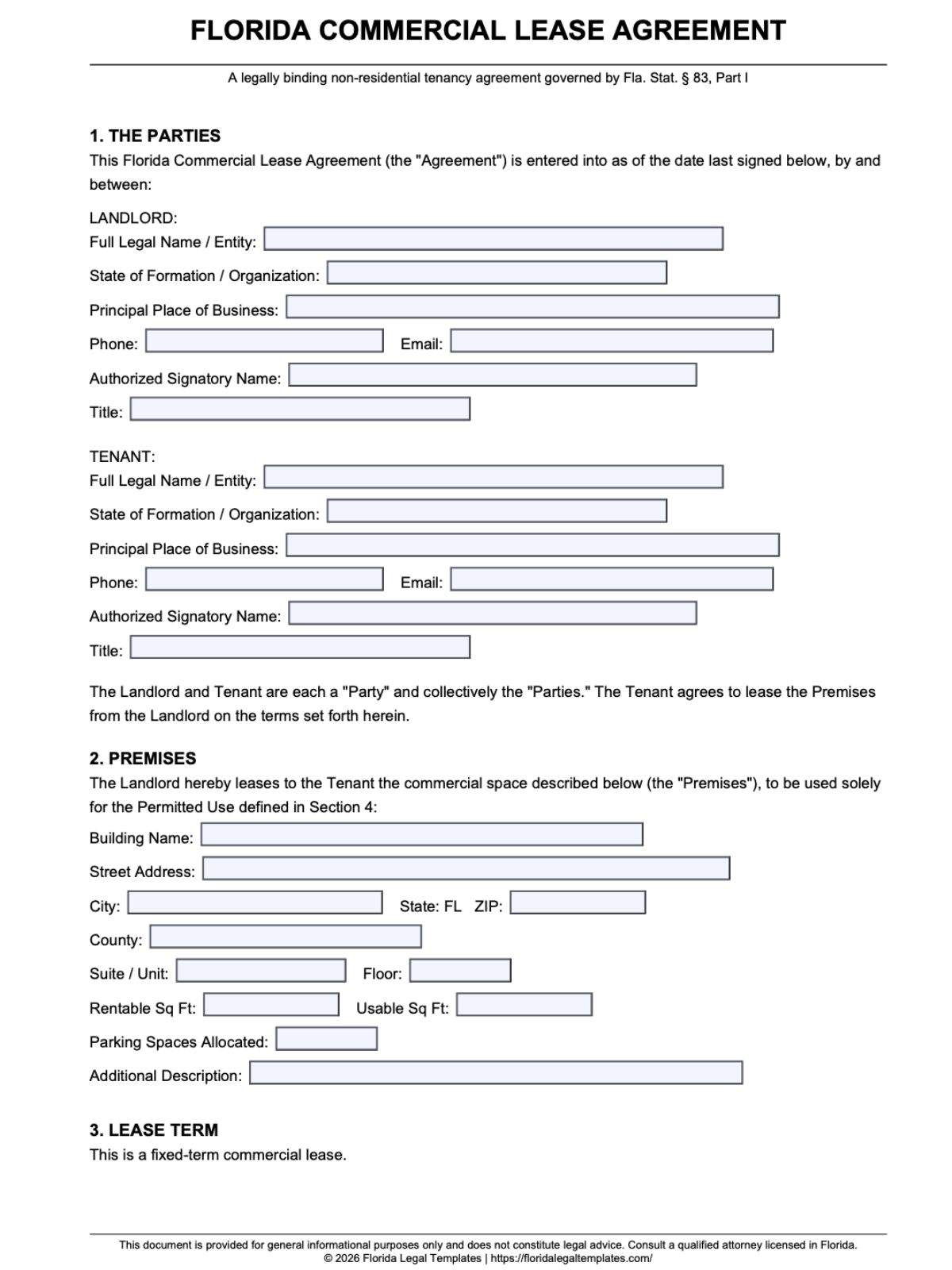
A Florida commercial lease agreement PDF gives landlords and business tenants a written place to spell out the premises, rent, term, permitted use, default rules, and other terms that matter to the tenancy.
What the document includes:
- Lease term (fixed or multi-year agreements)
- Rent structure (base rent, CAM charges, additional fees)
- Default provisions and remedies
- Possession and permitted use clauses
Who should use this:
- Commercial landlords leasing business property
- Business tenants (retail, office, warehouse)
- Property managers handling leasing operations
When this template may NOT be sufficient:
- Highly negotiated corporate leases
- Build-to-suit or development agreements
- Complex multi-tenant commercial centers
A Florida business lease agreement template works well for standard leasing but may require customization for complex transactions.
Before entering into a long-term business lease, parties often align broader contractual expectations through a service-based agreement outlining obligations. This can help clarify operational responsibilities that may not be fully detailed within a standard lease structure.
What Is a Florida Commercial Lease Agreement?
A Florida commercial lease agreement is a contract that governs the rental of property for business use. It is regulated under Florida’s nonresidential tenancy laws.
Under Florida law, commercial leases are governed by Fla. Stat. §§ 83.001–83.251 (Nonresidential Tenancies), which outline landlord and tenant rights in business leasing arrangements.
Key distinctions:
- Commercial leases allow broader negotiation than residential leases
- Tenants have fewer statutory protections compared to residential tenants
Execution validity:
- No subscribing witnesses are required for a lease of real property under Fla. Stat. § 689.01.
- Must generally be in writing and signed by the party to be charged if the lease term exceeds one year under Fla. Stat. § 725.01
This means an oral lease for more than one year may be unenforceable under Florida’s Statute of Frauds, making a signed written lease essential.
Although commercial leases offer flexibility, it’s important to distinguish them from residential arrangements governed by stricter protections. For comparison, reviewing a residential tenancy framework and protections can help highlight key legal differences in rights and obligations.
Key Florida Laws That Affect Florida Commercial Lease Agreement
Summary of Applicable Laws
| Topic / Issue | Florida Legal Rule | Governing Statute |
|---|---|---|
| Governing Law | Commercial leases governed by nonresidential tenancy law | Fla. Stat. §§ 83.001–83.251 |
| Rent Default Notice | 3-day written notice to pay rent or vacate | Fla. Stat. § 83.20(2) |
| Lease Violation Notice | 15-day notice to cure certain material breaches when the lease is silent on the cure period | Fla. Stat. § 83.20(3) |
| Month-to-Month Termination | Minimum 15 days’ written notice | Fla. Stat. § 83.03(3) |
| Holdover Tenant | A landlord may demand double rent when a tenant refuses to surrender possession after the lease ends, as provided by Fla. Stat. § 83.06. | Fla. Stat. § 83.06 |
In situations where tenancy terms are shorter or transitional, landlords may instead consider a flexible short-term leasing option, though it must still align with nonresidential notice requirements under Florida law.
Practical Impact & Document Clauses
These rules matter most when the lease addresses default, termination, and possession because the statutory requirements can change what a landlord may do after a tenant breaches the agreement.
For example:
- A default clause should address the applicable statutory notice requirements for unpaid rent, including the 3-day written notice required before removal under Fla. Stat. § 83.20(2).
- Breach provisions should address the applicable cure period, noting that Fla. Stat. § 83.20(3) supplies a 15-day period when the lease is silent on the issue.
- Month-to-month termination clauses must reflect the 15-day notice rule, which differs from residential leases
While Fla. Stat. § 404.056(5) requires the specified radon notification to appear on at least one document, form, or application executed at or before the execution of a rental agreement for a building.
A major legal update affects modern leases: Florida’s commercial rent tax under Fla. Stat. § 212.031 was repealed effective October 1, 2025. Lease tax provisions should therefore be reviewed and updated rather than relying on the former commercial-rent tax rule.
Failure to comply with these rules can:
- Delay eviction rights
- Create unenforceable clauses
- Lead to financial loss or litigation
Additionally, Florida law generally requires landlords to recover possession through the statutory court process rather than by using self-help measures.
When to Use Florida Commercial Lease Agreement
A commercial lease agreement Florida businesses use should identify the business premises, permitted use, rent structure, lease term, and remedies that will govern the nonresidential tenancy.
Common use cases:
- Retail storefronts
- Office spaces
- Industrial or warehouse facilities
Appropriate scenarios:
- Fixed-term leases for business operations
- Long-term occupancy agreements
- Establishing enforceable landlord-tenant relationships
When NOT to use:
- Residential rental situations
- Short-term licenses or temporary occupancy
- Informal arrangements without contractual structure
The more important distinction is whether the property is being leased for a nonresidential use covered by Chapter 83 Part I; residential tenancies generally fall under Chapter 83 Part II instead.
If the arrangement involves transferring lease rights or allowing another business to occupy the space, a sublease agreement for business premises may be more appropriate to clearly define liability between the original tenant and the new occupant.
Common Mistakes to Avoid
1. Using residential lease templates
Commercial leases need terms that match the nonresidential rules in Chapter 83 Part I, including the parties’ agreed rent, permitted use, default remedies, and possession procedures.
Consequence: Misalignment with Florida law and unenforceable terms.
2. Missing required notice provisions
Not including 3-day or 15-day notices.
Consequence: Delayed eviction process and legal setbacks.
3. Ignoring Statute of Frauds
Oral leases longer than one year.
Consequence: Lease becomes legally void.
4. Overlooking holdover penalties
Failing to address tenant overstays.
Consequence: Loss of leverage; inability to claim double rent.
5. Including outdated tax clauses
Referencing repealed commercial rent tax.
Consequence: Confusion and incorrect rent calculations.
6. Attempting self-help eviction
Lockouts or utility shutoffs.
Consequence: Legal liability and potential damages.
7. Ignoring landlord lien rights
Not understanding statutory protections.
Consequence: Missed enforcement opportunities for unpaid rent.
How to Create or Fill Out the Florida Commercial Lease Agreement
Drafting a Florida commercial lease agreement means getting the business terms right while also accounting for Florida rules on notice, possession, holdovers, recording, and other nonresidential tenancy issues.
Step-by-step process:
- Identify parties
- Identify each party by the legal name that will appear on the lease and confirm whether the business entity or an individual will be the tenant.
- Define the premises
- Describe the leased premises precisely enough to identify the space covered by the agreement, including the address and any suite, unit, or other identifying information.
- Set the lease term
- Must be in writing if longer than one year (Fla. Stat. § 725.01)
- Establish rent structure
- Base rent
- Additional costs (maintenance, utilities, taxes if applicable)
- Include default and notice provisions
- 3-day notice for unpaid rent
- 15-day notice for lease violations
- Add holdover clause
- Reflect double rent liability if tenant remains after expiration
- Insert required disclosures
- Radon gas disclosure
- Define remedies and dispute procedures
- Outline enforcement mechanisms. Pro-Tip: Include a clause authorizing service of notice via email or a designated portal, as 2026 Florida court procedures increasingly favor documented electronic service to speed up commercial evictions.
- Execute agreement
- Signatures required
- Notarization optional unless filing a memorandum of lease
Practical tips:
- Clearly define permitted business use
- Align rent escalation with lease duration
- Consider filing a Memorandum of Lease for long-term protection
Limitations and Legal Considerations
A Florida commercial lease agreement generally does not need to be recorded to be enforceable between the parties, but recording a lease of one year or longer can affect its priority against certain creditors and subsequent purchasers under Fla. Stat. § 695.01.
Key limitations:
- Oral leases exceeding one year are void under Fla. Stat. § 725.01
- Cannot bypass statutory eviction procedures
Important considerations:
- Recording a lease or appropriate memorandum can help protect a tenant’s interest against certain subsequent purchasers and creditors under Florida’s recording statute.
- Commercial tenants are governed by Chapter 83 Part I rather than the residential provisions in Part II, so the lease itself often carries more of the parties’ negotiated terms.
Effect of Selling the Property During the Lease
One issue that catches both landlords and business tenants off guard is what happens if the commercial property is sold before the lease expires. Many people assume the lease automatically “starts over” with the new owner. It doesn’t. In most cases, the buyer takes ownership subject to the existing lease and becomes the new landlord, inheriting the lease obligations that run with the property. The practical problem is notice. If a tenant continues sending rent to the former owner after the sale because nobody communicated the change, disputes can arise over whether rent was actually paid.
This is one reason many attorneys recommend recording a Memorandum of Lease for long-term commercial tenancies, especially where the tenant is investing substantial money into build-outs or improvements. Recording puts future purchasers on notice that a lease exists, even though the financial terms remain private. It can also reduce disputes if ownership changes years into the tenancy. While Florida law does not require commercial leases to be recorded to be enforceable, recording a memorandum is often inexpensive insurance for leases that extend well beyond a typical business term. (Recording procedures vary by county clerk of court.)
Legal constraints:
- Florida landlords generally must recover possession through an action for possession or another civil action determining the right to possession, rather than through self-help.
- Florida landlords have a statutory lien for rent on specified tenant property under Fla. Stat. § 83.08. To maximize protection, the lease should explicitly include a “Security Interest” clause to supplement this statutory lien under Florida’s UCC rules.
Edge cases:
- Business closure or abandonment
- Subleasing and assignment disputes
Missing the applicable notice, possession, recording, or holdover rules can lead to avoidable disputes over rent, possession, and the parties’ rights under the lease.
A commercial lease governs property use but does not cover asset ownership transfers. For transactions involving equipment or business asset sales tied to the premises, a document for transferring ownership of goods may be required to properly record the transaction and protect both parties.
Frequently Asked Questions (FAQ)
Does a Florida commercial lease need to be in writing?
Yes, if the lease term exceeds one year. Under Florida law, oral leases beyond one year are invalid.
What notice is required for nonpayment of rent in Florida commercial leases?
A landlord must provide a 3-day written notice to pay rent or vacate before proceeding with eviction.
Can a landlord lock out a commercial tenant in Florida?
No. Self-help eviction is prohibited. Landlords must use the court eviction process.
What happens if a commercial tenant stays after lease expiration?
Under Fla. Stat. § 83.06, a landlord may demand double the monthly rent when a tenant refuses to surrender possession after the lease ends.
A properly drafted Florida commercial lease agreement should match the parties’ business deal and Florida’s nonresidential tenancy rules. In particular, landlords and tenants should pay close attention to written lease requirements, statutory notices, possession remedies, holdover rent, and recording issues before signing a long-term agreement.
Legal Disclaimer:This article provides general legal information about Florida commercial lease agreements and is not legal advice. Laws and legal requirements may change, and individual circumstances can affect how the law applies. Consider consulting a qualified Florida attorney before entering into or relying on a commercial lease agreement.