Florida Residential Lease Agreement [Free Printable, Fillable PDF]
A Florida residential lease agreement can look thorough on paper and still have clauses in it that Florida law treated as void the moment both parties signed. Under F.S. §83.47, a rental-agreement provision is void and unenforceable to the extent it purports to waive or preclude rights, remedies, or requirements under Part II of Chapter 83 or limit liability arising under law, so landlords who copy broad maintenance waivers or liability disclaimers from out-of-state templates may be creating protections that Florida law will not enforce.
A Florida residential lease agreement can look polished and still contain a clause that does not fit Florida’s landlord-tenant rules. If you’re starting from a Florida residential lease agreement PDF, the useful question is not how long the form is or how professional it looks, but whether its rent, deposit, maintenance, entry, and termination provisions match the requirements that actually apply in Florida.
Candice Hayden, Legal Writer
Ross Bridger, Real Estate Attorney Last Updated: November 6, 2026
Florida Residential Lease Agreement (PDF, Printable, Fillable)
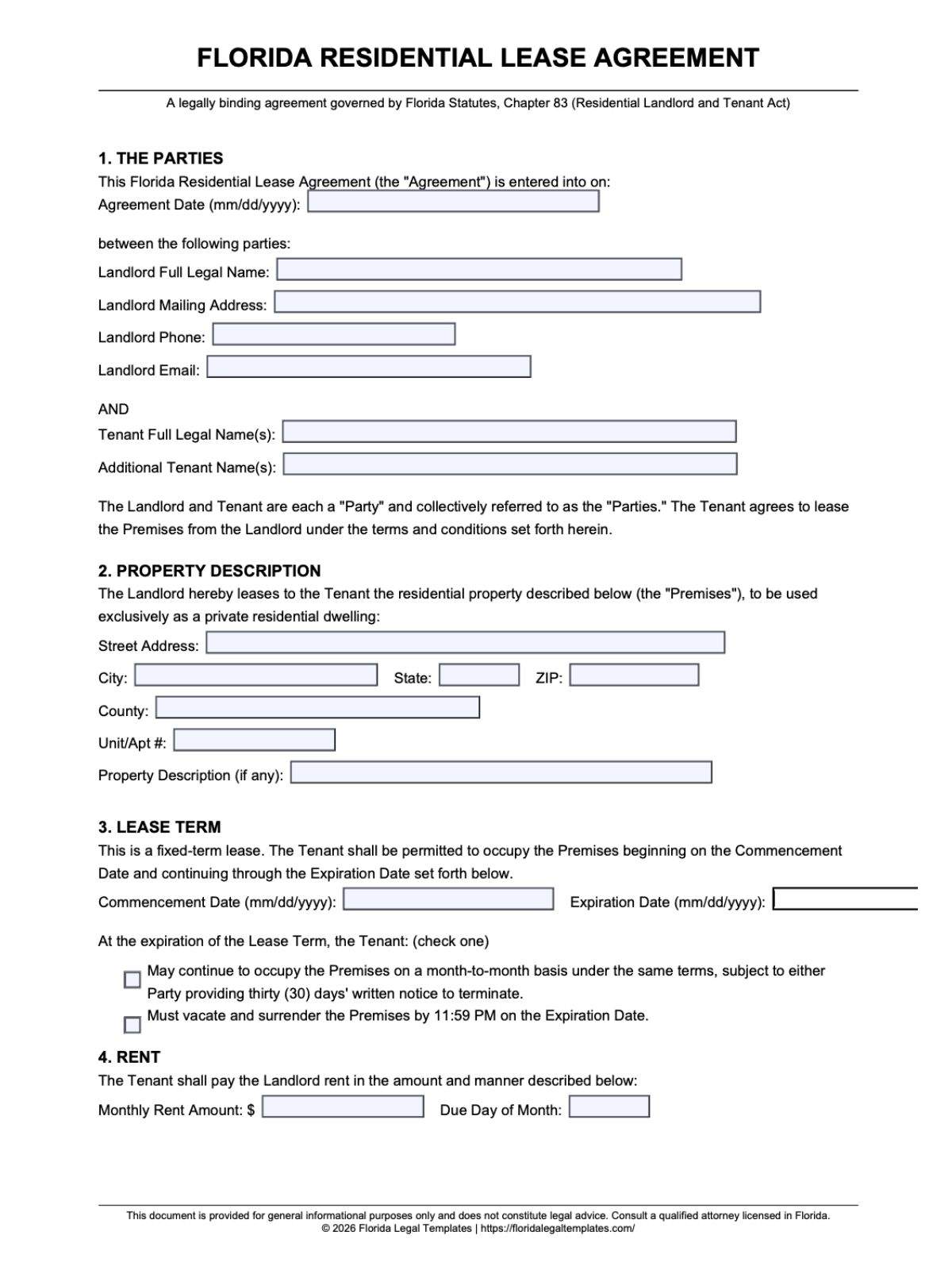
A Florida residential lease agreement PDF or printable template allows landlords and tenants to quickly create a structured rental contract while maintaining legal compliance.
What the document includes:
- Lease term (fixed duration such as 6 or 12 months)
- Monthly rent, due dates, and late fee terms
- Security deposit amount and handling terms
- Maintenance and repair responsibilities
- Required Florida disclosures:
- Radon gas warning (Fla. Stat. § 404.056)
- Security deposit handling, holding method, and required disclosures (Fla. Stat. § 83.49)
- Landlord or authorized agent contact information (Fla. Stat. § 83.50)
- Mandatory standalone Flood Risk Disclosure form (Required under Fla. Stat. § 83.512 for all residential leases with a term of one year or longer)
Who should use this:
- Residential landlords renting houses, apartments, or condos
- Property managers handling leasing operations
- Tenants reviewing contractual obligations before signing
When this template may NOT be sufficient:
- Commercial or mixed-use properties
- Multi-party ownership or corporate leasing structures
- Situations requiring customized legal provisions
A residential rental agreement Florida template works best for standard residential use but must be reviewed carefully to ensure it reflects current Florida statutory requirements.
While residential leases are typically fixed-term, some arrangements require more flexibility. In such cases, a monthly tenancy structure may be more suitable, particularly when either party prefers shorter commitment periods.
What Is a Florida Residential Lease Agreement?
A Florida residential lease agreement is a written contract that establishes the terms of a residential tenancy between a landlord and tenant, which may be for a specific duration or, depending on the agreement and rent-payment period, operate as a periodic tenancy. It is governed specifically by Florida’s statutory framework for residential rentals.
Under Florida law, these agreements are regulated by the Florida Residential Landlord and Tenant Act (Fla. Stat. §§ 83.40–83.684), which defines the rights, obligations, and legal protections of both parties.
Key distinctions:
- Residential lease: May establish a specific duration or other agreed tenancy terms
- Rental agreement: Under Fla. Stat. § 83.43(13), a written or oral agreement, including amendments or addenda, for a duration of less than one year that provides for the use and occupancy of premises.
Execution and validity:
- No notarization required for enforceability
- No witness requirement due to the 2020 amendment to Fla. Stat. § 689.01
- Becomes binding once signed by both landlord and tenant
This makes a Florida residential lease agreement a private but legally enforceable contract, provided it complies with statutory rules and includes all required disclosures.
Key Florida Laws That Affect This Florida Residential Lease Agreement
Summary of Applicable Laws
| Topic / Issue | Florida Legal Rule | Governing Statute |
|---|---|---|
| Governing Law | Residential leases governed by Florida Residential Landlord and Tenant Act | Fla. Stat. §§ 83.40–83.683 |
| Landlord Entry | Minimum 24 hours’ advance notice required for non-emergency repairs; entry must occur between 7:30 a.m. and 8:00 p.m. | Fla. Stat. § 83.53(2) |
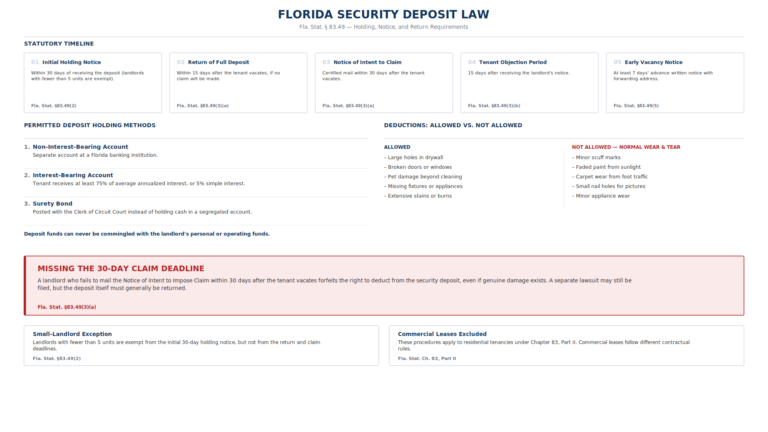
| Security Deposit Return |
15 days to return the deposit if no claim is intended, or 30 days to provide written notice of an intended claim; the tenant generally has 15 days after receiving the notice to object, and the landlord must remit the remaining deposit within 30 days after the claim notice (Fla. Stat. § 83.49(3)). |
Fla. Stat. § 83.49(3)(a) |
| Month-to-Month Termination | Minimum 30 days’ written notice before the end of the monthly period under Fla. Stat. § 83.57(3) | Fla. Stat. § 83.57(3) |
| Prohibited Clauses | Cannot waive tenant rights or limit landlord liability | Fla. Stat. § 83.47 |
| Self-Help Eviction | Lockouts or utility shutoffs strictly prohibited | Fla. Stat. § 83.67 |
Practical Impact & Document Clauses
These statutory rules directly control how a Florida residential lease agreement must be drafted.
For example:
- The lease should include an entry clause that reflects the 24-hour advance notice requirement for repairs and the permitted entry hours between 7:30 a.m. and 8:00 p.m. under Fla. Stat. § 83.53
- The security deposit clause must reflect the strict 15-day return or 30-day notice requirement under Fla. Stat. § 83.49
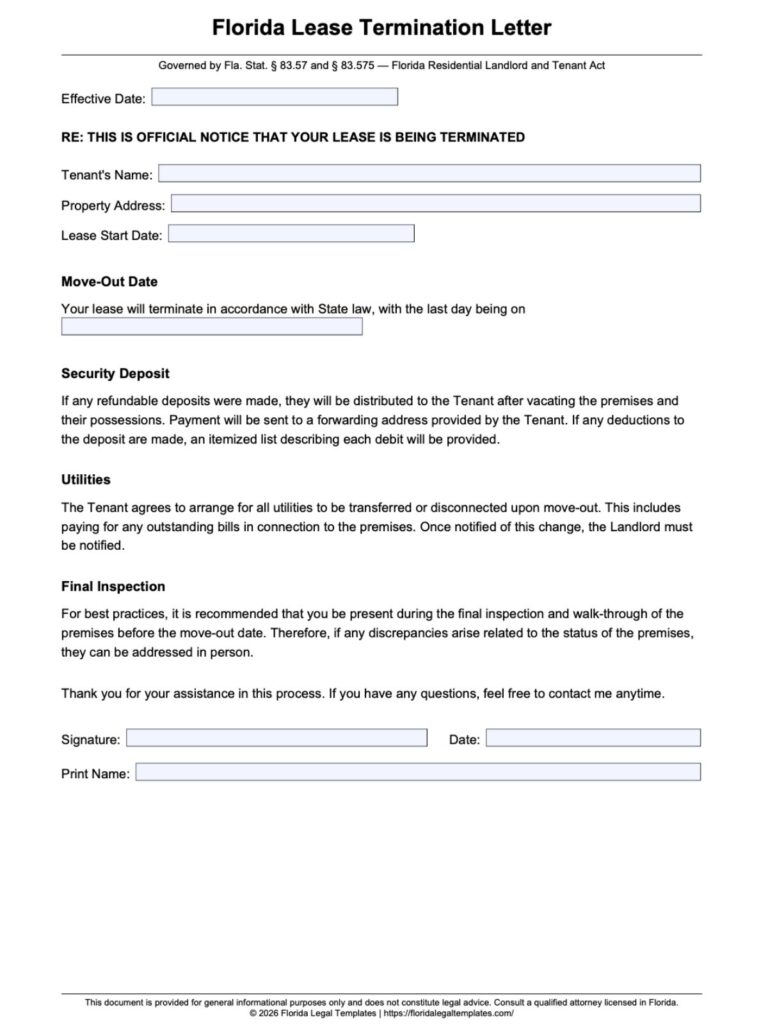
- The termination clause for a month-to-month tenancy without a specific duration must reflect the 30-day written notice requirement under Fla. Stat. § 83.57(3). For fixed-term rental agreements, any contractual notice requirement for nonrenewal must comply with the 30-to-60-day limits in Fla. Stat. § 83.575.
- If rent remains unpaid when due, the landlord must deliver a written demand for payment of the rent or possession of the premises. If the default continues for 3 days, excluding Saturday, Sunday, and court-observed legal holidays, the landlord may terminate the rental agreement under Fla. Stat. § 83.56(3).
Florida law also requires specific disclosures:
- Radon gas notification on at least one document, form, or application executed at or before the rental agreement, using the statutory language required by Fla. Stat. § 404.056
- Security deposit holding disclosure provided in the lease or within 30 days after receiving the deposit, identifying the financial institution or surety bond and whether interest is payable, as required by Fla. Stat. § 83.49(2). This particular disclosure requirement does not apply to landlords renting fewer than five individual dwelling units.
- Landlord or authorized agent’s name and address for receiving notices and demands, as required by Fla. Stat. § 83.50
- A separate, standalone written Flood Risk Disclosure form addressing the landlord’s knowledge of flooding during the landlord’s ownership, related insurance claims, and flood-damage assistance, as required by Fla. Stat. § 83.512 for rental agreements with a term of 1 year or longer
- Federal lead-based paint disclosure materials required for most pre-1978 housing, including the required lead-warning statement, known lead-hazard information, available records, and EPA pamphlet
If these requirements are missing or handled incorrectly, the consequences depend on the particular disclosure involved:
-
A landlord who fails to provide the required security deposit claim notice within 30 days generally forfeits the right to impose a claim against the deposit, although a separate damages action may remain available.
-
A landlord who violates the flood-disclosure requirement may face the termination remedy provided by Fla. Stat. § 83.512 when the tenant suffers qualifying substantial flood damage.
-
Failure to comply with applicable statutory duties may expose either party to legal claims, but missing a disclosure does not automatically invalidate the entire lease.
Additionally, any attempt to waive tenant protections is invalid under Fla. Stat. § 83.47, and illegal eviction practices can trigger significant financial liability.
A Lease Cannot Take Away the Tenant’s Right to Send a 7-Day Notice Before Withholding Rent
One clause that regularly causes problems is language stating that a tenant may never withhold rent if repairs are not made. In Florida, that provision is unenforceable if it conflicts with the tenant’s rights under Fla. Stat. § 83.60(1).
The catch is that tenants cannot simply stop paying because something is broken. Before a tenant may raise material noncompliance with the landlord’s maintenance obligations as a defense based on nonpayment of rent, § 83.60(1)(b) generally requires 7 days to elapse after the tenant gives written notice specifying the noncompliance and indicating the intention not to pay rent because of it. If the issue is fixed within that period, the tenant must continue paying rent under the lease. If it is not corrected, the statute provides a potential defense in a later eviction action, but only if the required procedure was followed.
This is why many Florida landlords include a clause reminding tenants of the statutory notice process instead of trying to prohibit rent withholding altogether. Under Fla. Stat. § 83.60(1)(b), a tenant must give written notice identifying the maintenance problem and stating the intention not to pay rent because of it, then allow seven days to pass before raising the landlord’s material noncompliance as a defense in an eviction action. The procedure does not give tenants an unrestricted right to stop paying rent, so a lease should explain the statutory requirements rather than promise protections the law will not enforce.
When to Use This Florida Residential Lease Agreement
A Florida residential lease agreement is useful when the landlord and tenant want the length of the tenancy, rent schedule, deposit terms, and responsibilities recorded in writing. If the agreement does not specify how long the tenancy will last, Fla. Stat. § 83.46(2) generally determines its duration by the period for which rent is payable.
Common use cases:
-
Setting a definite beginning and ending date for a residential tenancy
-
Recording monthly rent, payment dates, and security deposit arrangements
-
Establishing responsibilities for repairs, property access, and maintenance
-
Documenting the conditions that apply when the tenancy ends or is not renewed
Applicable property types:
- Single-family homes
- Apartments
- Condominiums (with HOA considerations)
When NOT to use:
- Short-term or vacation rentals
- Commercial leasing arrangements
- Informal occupancy without contractual structure
Using the wrong type of agreement can create enforcement issues, particularly when statutory protections are not properly addressed.
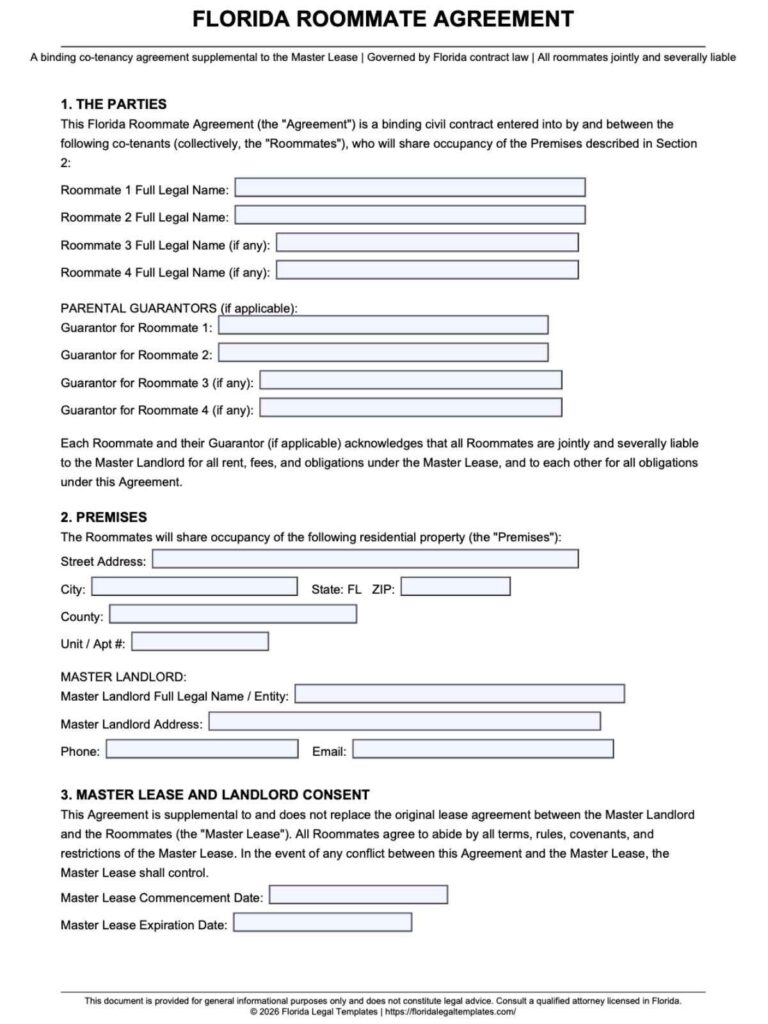
If occupancy involves shared living arrangements, using a shared responsibility agreement between tenants can help clearly define obligations and avoid conflicts that a standard lease may not address in detail.
How to Create or Fill Out the Florida Residential Lease Agreement
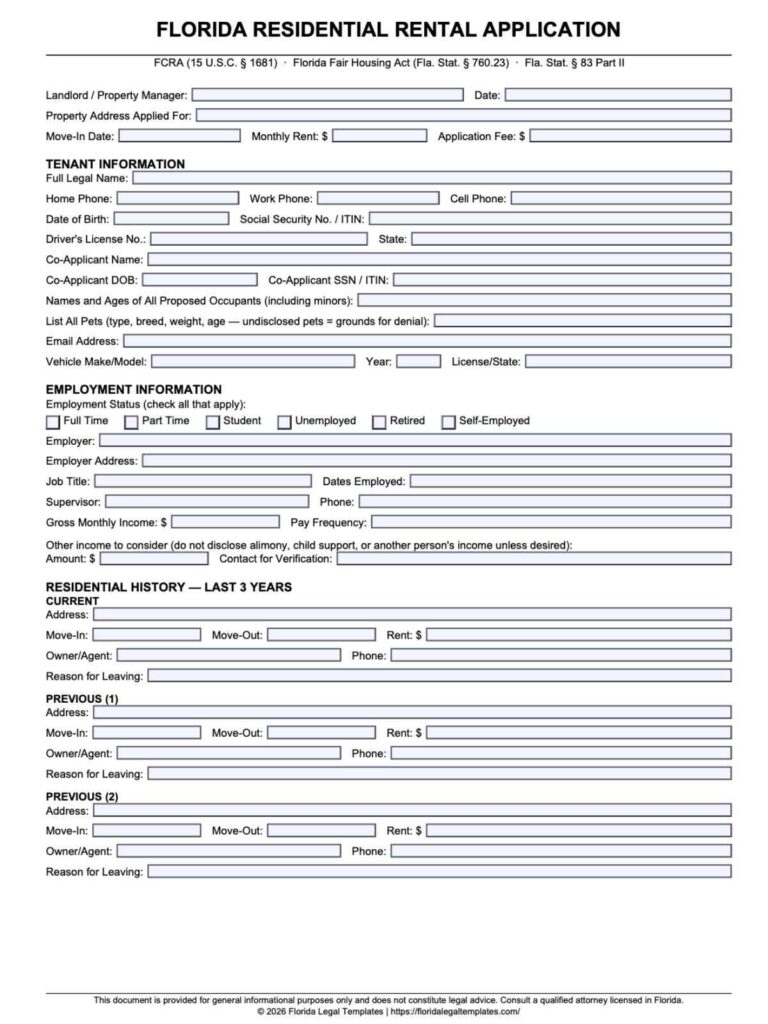
Creating a Florida residential lease agreement PDF using a rental application first requires attention to both structure and legal compliance.
Step-by-step process:
- Identify the parties
- Include landlord’s legal name
- Provide authorized agent details (required under Fla. Stat. § 83.50)
- Describe the property
- Full address and unit details
- Define lease term
- Fixed duration with clear start and end dates
- Set rent terms
- Monthly rent, due date, and late fee policy
- Include security deposit terms
- Amount collected
- Location of funds
- Required statutory disclosure language
- Insert mandatory disclosures (“magic words”)
- Radon gas consumer notification using the statutory wording on at least one document, form, or application executed at the time of or before the rental agreement (under Fla. Stat. § 404.056)
- Security deposit bank account notification generated within a strict 30-day window (Fla. Stat. § 83.49(2))
- A separate, standalone written Flood Risk Disclosure document under Fla. Stat. § 83.512 for any residential tenancy spanning 1 year or longer
- Federal Lead-Based Paint disclosure form and EPA booklet for pre-1978 housing stock
- Define entry and maintenance rules
- Reflect statutory notice requirements
- Clarify responsibilities
- Execute the agreement
- Signatures of both parties
- No notarization required
Practical tips:
- Align rent due dates with lease start date
- Avoid including unenforceable clauses
- Maintain signed copies for documentation
Selecting the correct agreement type during drafting is critical. For example, if lease rights may be transferred or delegated, a tenant-to-tenant transfer document should be considered to ensure proper legal structure and liability coverage.
Limitations and Legal Considerations
Before signing a Florida residential lease, check whether the property and tenancy fall within Part II of Chapter 83. Fla. Stat. § 83.42 excludes certain arrangements from the Residential Landlord and Tenant Act, so not every residential occupancy is governed by precisely the same statutory rules.
Key limitations:
-
Certain occupancies are excluded from Part II of Chapter 83.
-
A lease cannot waive the protections preserved by Fla. Stat. § 83.47.
-
Security deposit obligations depend on the applicable provisions of Fla. Stat. § 83.49.
Important edge cases:
-
A lease for more than one year does not require subscribing witnesses under the lease exception in Fla. Stat. § 689.01.
-
A written agreement is generally preferable to an oral arrangement because it provides evidence of the parties’ agreed terms.
Legal risks:
- Invalid clauses may be struck from the contract
- Non-compliance may lead to financial penalties
- Increased exposure to disputes and litigation
Common Mistakes to Avoid
1. Missing required disclosures
Failure to provide the mandatory radon warning, security deposit banking disclosure, landlord contact details, or the separate written flood history disclosure under Fla. Stat. § 83.512.
Consequence: If a landlord violates the flood-disclosure requirement and the tenant later suffers substantial personal-property loss or damage from flooding, the tenant may terminate the rental agreement by giving written notice and surrendering possession within 30 days after the damage or loss. To qualify, the statutory threshold must be met: the cost of repairing or replacing the damaged personal property must equal at least 50% of its market value on the date of flooding. In addition, the landlord must refund rent and other amounts paid in advance for periods after termination under Fla. Stat. § 83.512.
2. Using outdated templates
Templates that do not reflect updated laws such as the 30-day termination requirement.
Consequence: Legal non-compliance and disputes.
3. Including prohibited clauses
Attempting to waive tenant rights or limit landlord liability.
Consequence: Clauses are void under Fla. Stat. § 83.47.
4. Mishandling security deposits
- Not returning within 15 days
- Failing to notify within 30 days
Consequence: Loss of claim rights and potential liability.
5. Violating entry rules
Entering property without notice or outside permitted hours.
Consequence: Breach of tenant rights under Florida law.
6. Attempting self-help eviction
Lockouts or utility shutoffs to force vacancy.
Consequence: Liability for actual and consequential damages or three months’ rent, whichever is greater, plus costs and attorney’s fees under Fla. Stat. § 83.67(6).
A residential lease governs possession—not ownership or financial structuring. In situations involving financial obligations or secured arrangements, a formal lending agreement may be required to clearly document repayment terms and legal responsibilities beyond tenancy.
Frequently Asked Questions (FAQ)
Is a Florida residential lease agreement legally valid without notarization?
Yes. Florida law does not require notarization. A signed agreement is legally binding as long as it meets contract requirements.
What is the updated notice period for terminating a month-to-month lease in Florida?
Under Fla. Stat. § 83.57(3), the required notice period is 30 days, reflecting recent legislative updates.
What happens if required disclosures are missing from the lease?
Missing disclosures—such as radon warnings or deposit notices—can:
- Make portions of the lease unenforceable
- Expose the landlord to legal claims
- Reduce enforceability in disputes
How should a landlord handle a security deposit under Florida law?
A landlord must:
-
Hold the security deposit using one of the methods permitted under Fla. Stat. § 83.49(1), including a qualifying Florida financial institution account or a statutory surety bond.
-
Provide the required holding disclosure in the lease or within 30 days after receiving the deposit, unless the landlord qualifies for the exemption for those renting fewer than five individual dwelling units.
-
Return the deposit within 15 days after termination if no claim is intended.
-
If imposing a claim, send written notice within 30 days after termination. The tenant generally has 15 days after receiving that notice to object, and the landlord must remit the remaining balance within 30 days after the claim notice.
Failure to follow these rules can result in loss of deposit rights and legal liability.
Before signing, compare the lease against the actual arrangement between the landlord and tenant. Pay particular attention to the security deposit provisions under Fla. Stat. § 83.49, the flood disclosure required for qualifying one-year agreements under § 83.512, and the notice procedures that apply when the tenancy ends. A document that addresses these requirements clearly is a better starting point for avoiding disputes than a generic lease copied from another state.
Legal Disclaimer: This article provides general information about Florida residential lease agreements and is not legal advice. Additionally, laws and requirements may change, and individual circumstances can affect how the law applies. Therefore, consider consulting a qualified Florida attorney for advice about a specific situation.