
Florida Lease Addendum Template [Free Printable, Fillable PDF]
A florida lease addendum is what turns a verbal agreement between a landlord and tenant into something either party can actually enforce. Florida courts generally apply the parol evidence rule to written lease agreements, which means prior or contemporaneous oral agreements generally cannot be used to contradict the written terms, although recognized exceptions can apply depending on the circumstances.
A lease addendum florida drafted and signed at the time of the modification gives that agreement the same legal weight as the original lease, whether the change involves pet permission, a parking arrangement, a sublease approval, or a fee-in-lieu-of-security-deposit arrangement that must comply with the written-agreement requirements of F.S. §83.491. I’ve watched straightforward disputes over verbal agreements turn complicated quickly once one party produced the original written lease and the other produced nothing.
The florida addendum to lease template below covers the essential elements Florida courts look for when an addendum is challenged the specific modification being made, the date it takes effect, and the signatures of every party bound by the original agreement.
Candice Hayden, Legal Writer
Ross Bridger, Florida, Real Estate Attorney
Florida Lease Addendum Template (PDF, Fillable, Printable)
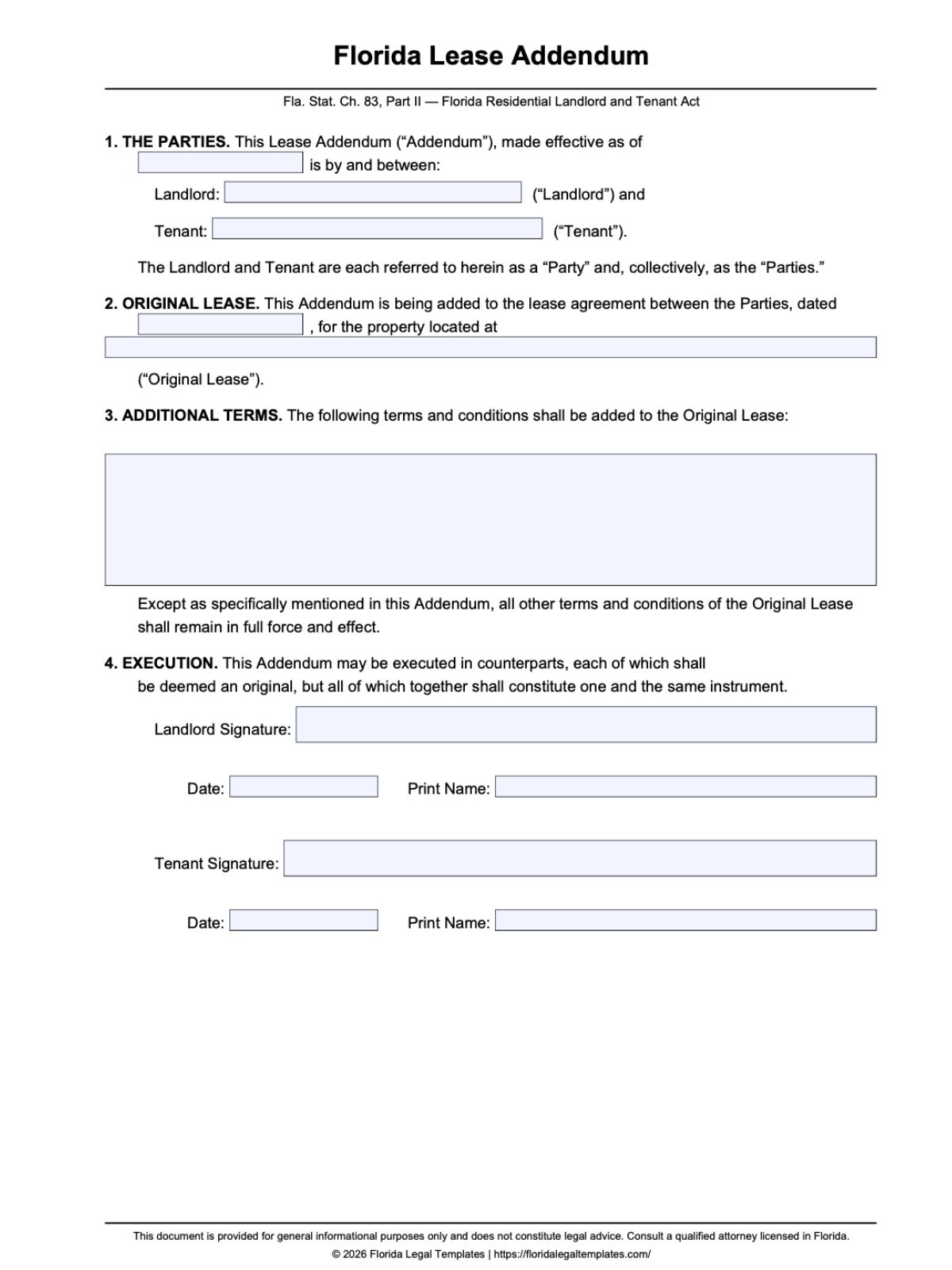
A florida lease addendum template is designed to formally modify an existing rental agreement while preserving the remainder of the lease. Most templates include:
- Names of the landlord and tenant
- Rental property address
- Date of the original lease
- Effective date of the addendum
- New terms or modifications
- Signature blocks for all parties
Florida landlords often use addenda for operational issues that were not fully addressed in the original lease. Common examples include:
- Pet addenda
- Parking agreements
- Smoking policies
- Occupancy changes
- Early termination agreements
- Electronic notice consent forms
- Fee-in-lieu-of-security-deposit arrangements
Although people often use the terms interchangeably, there are small differences between these documents:
- Lease Addendum: Adds new terms while leaving the original lease intact
- Florida Lease Amendment: Changes existing lease language
- Lease Rider: Usually addresses a very specific issue or policy
A standard Florida lease addendum form is usually appropriate for routine residential tenancy changes. However, a template may not be sufficient when:
- The modification extends the lease term beyond one year
- The tenancy involves commercial property
- The addendum attempts to waive tenant protections
- Ownership interests are changing
- The addendum creates complex financial obligations
In those situations, customized legal drafting is usually safer than relying solely on a fillable form.
What Is a Lease Addendum in Florida?
Under Florida law, a lease addendum is a supplemental agreement attached to an existing lease contract. It does not replace the original lease unless the parties expressly state otherwise.
The original lease terms remain enforceable except for the portions specifically modified by the addendum.
For example:
- A pet addendum may add monthly pet rent
- A parking addendum may assign a reserved parking space
- An occupancy addendum may approve an additional resident
- An early termination addendum may establish liquidated damages for breaking the lease early
Florida courts generally treat lease addenda under ordinary contract law principles. That means the document typically becomes enforceable only if:
- Both parties voluntarily agree
- The terms are sufficiently clear
- The addendum is properly signed
A landlord generally cannot impose a new addendum unilaterally during an active lease term unless the original lease specifically allows those rule changes.
A lease addendum only works when it is attached to a valid rental contract. If the original tenancy terms were never properly documented, reviewing a broader Florida residential rental contract format or a standard state lease agreement structure can help clarify how addenda interact with the primary lease terms.
Key Florida Laws That Affect Lease Addenda
| Topic / Issue | Florida Legal Rule | Governing Statute |
|---|---|---|
| Execution Formalities | The parties should sign the addendum to document their agreement to the modified lease terms | Fla. Stat. § 689.01 |
| Early Termination Fees | Fee cannot exceed 2 months’ rent and requires separate addendum | Fla. Stat. § 83.595(4) |
| Electronic Delivery Consent | Email delivery of statutory notices requires written consent | Fla. Stat. § 83.505 |
| Fee in Lieu of Deposit | Addendum must contain statutory disclosure language | Fla. Stat. § 83.491 |
| Radon Disclosure | Residential leases over 45 days require statutory radon warning | Fla. Stat. § 404.056(5) |
| Waiver Restrictions | Lease terms cannot waive statutory tenant protections | Fla. Stat. § 83.47 |
| Attorney Fee Reciprocity | Prevailing party may recover reasonable attorney fees | Fla. Stat. § 83.48 |
Florida residential lease addenda are governed primarily by the Florida Residential Landlord and Tenant Act under Florida Statutes Chapter 83, Part II.
These rules directly affect enforceability. For example, a landlord who uses an invalid early termination clause may lose the ability to collect liquidated damages entirely. Likewise, attempting to waive tenant entry notice rights through an addendum can render the clause void under Florida law.
Certain disclosures are especially strict. Florida statutes require exact or substantially similar statutory wording in some addenda. Omitting required “magic words” can undermine the document even if both parties signed it.
Execution and Signature Requirements
Having the landlord and all adult tenants sign the addendum provides clear evidence that the parties agreed to the modified lease terms.
Witnesses and notarization are not required for residential or commercial lease addenda under Florida law. While Fla. Stat. § 689.01 historically required two subscribing witnesses for instruments conveying real property interests exceeding one year, the Florida Legislature explicitly amended § 689.01 to exempt all leases of real property and lease-related instruments. Consequently, a lease extension or addendum modifying a multi-year lease is fully valid and enforceable without subscribing witnesses, provided it is signed by all bound parties.
Practically, unsigned addenda create major enforcement problems during disputes or eviction proceedings because the landlord may struggle to prove the tenant actually agreed to the modified terms.
Mandatory Florida Disclosure Clauses
Some Florida lease addenda require specific statutory disclosure language.
One of the most important examples is the Radon Gas notification required on at least one document executed at or before a rental agreement under Fla. Stat. § 404.056(5), subject to the statutory exception for residential transient occupancy lasting 45 days or less.
The disclosure must state:
“RADON GAS: Radon is a naturally occurring radioactive gas that, when it has accumulated in a building in sufficient quantities, may present health risks to persons who are exposed to it over time. Levels of radon that exceed federal and state guidelines have been found in buildings in Florida. Additional information regarding radon and radon testing may be obtained from your county health department.”
Florida also requires special disclosure wording for fee-in-lieu-of-security-deposit arrangements. Those written agreements must include the required disclosure in substantially the form specified by Fla. Stat. §83.491(4), which explicitly begins with:
“THIS FEE IS NOT A SECURITY DEPOSIT AND PAYMENT OF THE FEE DOES NOT ABSOLVE THE TENANT OF ANY OBLIGATIONS…”* and concludes with the mandatory alert: *”THIS DISCLOSURE IS BASIC. PLEASE REFER TO PART II OF CHAPTER 83, FLORIDA STATUTES, TO DETERMINE YOUR LEGAL RIGHTS AND OBLIGATIONS.”
These disclosure requirements are not merely technical formatting rules. Missing language can create enforceability issues during litigation.
Early Termination Fee Rules
Florida landlords who want to use the statutory early termination fee remedy must have the tenant accept it when the rental agreement is made through a separate addendum.
Under Florida law:
- The fee cannot exceed two months’ rent
- The notice requirement cannot exceed 60 days
- The addendum must contain statutory election language
The required statutory choice block under Fla. Stat. § 83.595(4) substantially includes:
[ ] I agree, as provided in the rental agreement, to pay $ ________ as liquidated damages or an early termination fee…
[ ] I do not agree to liquidated damages or an early termination fee…
Landlords who omit this statutory framework risk losing the protection of the liquidated damages provision.
Electronic Notice Consent Requirements
Florida landlords cannot simply decide to send statutory notices by email.
Under Fla. Stat. § 83.505, electronic delivery of eviction or noncompliance notices generally requires a separate written agreement or addendum authorizing electronic communication.
Without that consent, emailed notices may not satisfy Florida notice requirements.
This issue commonly becomes important during eviction cases where improper notice can delay proceedings or create procedural defenses for tenants.
Restrictions on Unenforceable Addendum Terms
Florida law prohibits landlords from using lease addenda to waive statutory tenant protections.
Under Fla. Stat. § 83.47, unenforceable clauses may include:
- Waivers of landlord negligence liability
- Waivers of the tenant’s right to statutory entry notice
- Jury trial waivers
- Provisions limiting statutory tenant remedies
For example, a landlord cannot use an addendum to waive statutory protections governing landlord access, including the 24-hour notice requirement that applies to repair entry under Florida law.
Even if the tenant signs the addendum, Florida courts may refuse to enforce the prohibited provision.
For an electronic-notice addendum, §83.505(1) requires the parties to make a voluntary election using the statutory checkbox format, with each party able to opt in or opt out of electronic delivery.
Attorney Fee Reciprocity in Florida
Some lease addenda attempt to make only the tenant responsible for attorney fees.
Florida law overrides many of those one-sided provisions.
Under Fla. Stat. § 83.48, attorney fee rights in residential tenancy disputes are reciprocal. That means the prevailing party may recover reasonable attorney fees regardless of whether the addendum was drafted in favor of the landlord alone.
When to Use a Florida Lease Addendum
A florida lease amendment or addendum is commonly used when parties want to modify a lease without replacing the entire agreement.
Common situations include:
- Adding pet restrictions or pet rent
- Updating parking assignments
- Approving additional occupants
- Authorizing electronic notices
- Creating smoking policies
- Establishing early termination procedures
- Replacing a security deposit with recurring fees
However, addenda are not appropriate for every situation.
A new lease agreement may be more appropriate when:
- Ownership of the property changes
- The tenancy structure fundamentally changes
- Multiple major lease terms are being rewritten
- The parties are entering a completely new tenancy arrangement
Some tenancy changes are significant enough that modifying the existing lease may not be the best approach. For example, if a tenant arrangement becomes temporary or flexible, a month-to-month tenancy document may fit better than repeated addenda. Likewise, adding a replacement occupant may require a separate shared housing agreement between tenants to clearly define financial responsibilities.
Common Types of Florida Lease Addenda
Pet Addendum
Usually addresses:
- Breed restrictions
- Pet deposits or monthly pet fees
- Damage liability
- Noise or nuisance issues
Early Termination Addendum
Typically includes:
- Liquidated damages provisions
- Notice deadlines
- Statutory election language
Fee-in-Lieu-of-Deposit Addendum
Often covers:
- Monthly fee obligations
- Non-refundable payment disclosures
- Continued tenant liability for damages
Parking Addendum
May establish:
- Assigned spaces
- Towing authorization
- Guest parking restrictions
Smoking Addendum
A Florida smoking addendum can identify prohibited smoking areas and responsibility for odor or cleaning costs, while any cannabis-related restriction should be stated as a lease rule rather than treated as a substitute for applicable law.
Occupancy Addendum
Often used for:
- Additional residents
- Long-term guests
- Occupancy limits
Electronic Notice Addendum
Used to authorize:
- Email notice delivery
- Electronic communication procedures
Subleasing issues are often handled incorrectly through informal addenda alone. When a tenant is temporarily transferring occupancy rights, using a dedicated Florida sublease arrangement usually provides clearer liability terms and better protection for all parties involved.
How to Create or Fill Out a Florida Lease Addendum
When preparing a florida lease addendum, accuracy matters more than length.
Step 1: Identify the Original Lease
Include:
- Original lease date
- Names of all parties
- Property address
Step 2: Clearly Describe the Modification
Avoid vague wording.
Instead of writing:
- “Tenant may have pets”
Specify:
- Allowed pet types
- Weight restrictions
- Monthly fees
- Damage responsibilities
Step 3: Avoid Conflicts With Existing Lease Terms
Conflicting language creates litigation risk.
The addendum should clearly state:
- Which terms are being modified
- Whether all remaining lease terms stay unchanged
If You Have Multiple Addenda, State Which One Controls
Many Florida landlords use several addenda over the life of a tenancy. A pet addendum may be signed at move-in, a parking addendum six months later, and an occupancy addendum the following year. Problems arise when a newer addendum accidentally contradicts language in an earlier one without specifying which document takes priority.
A simple priority clause can prevent that dispute. For example:
“If this Addendum conflicts with any prior lease addendum concerning the same subject matter, the terms of this Addendum control. All other provisions of the Lease and any unrelated addenda remain in full force and effect.”
That sentence can make a significant difference in court. Florida contract law generally requires judges to interpret all lease documents together to reconcile conflicting terms whenever possible. Under Fla. Stat. § 83.43(13), a “rental agreement” legally encompasses all written amendments and addenda. Adding a clear clause that identifies which document governs eliminates the ambiguity that often leads to expensive litigation over parking assignments, pet permissions, rent concessions, or occupancy limits as multiple signed addenda accumulate over several lease renewals.
Step 4: Include Required Florida Disclosures
If applicable, include:
- Radon disclosure language
- Early termination election language
- Fee-in-lieu statutory warning
Step 5: Obtain Proper Signatures
The addendum should be signed by:
- Landlord
- All adult tenants
Step 6: Attach the Addendum to the Lease
Executed addenda should remain attached to the original lease documents for future enforcement purposes.
Before drafting new rental terms, landlords commonly verify tenant history and payment reliability through a Florida tenant screening application. Keeping written proof of payments alongside the updated lease terms is also important, especially when rent amounts or fees change through an addendum, which is why many landlords also maintain a documented rent payment record.
Can a Landlord Add New Rules Mid-Lease in Florida?
Generally, no.
A landlord generally cannot change the agreed lease terms during an active lease term without a contractual basis or the tenant’s agreement, although the result depends on the language of the existing rental agreement and the proposed change.
For example, a landlord normally cannot suddenly impose:
- New parking fees
- New pet restrictions
- Mandatory amenity charges
mid-lease without agreement.
Attempting unilateral changes can create enforceability problems and may weaken the landlord’s position during future disputes.
Limitations and Legal Considerations
Florida lease addenda have important legal limits.
They cannot:
- Override statutory tenant protections
- Eliminate required notices
- Waive negligence liability
- Circumvent disclosure requirements
Poor drafting can also create enforcement issues.
For example:
- Ambiguous clauses may be interpreted against the landlord
- Improper early termination provisions may fail entirely
- Unauthorized electronic notices may be legally ineffective
During eviction litigation, landlords may also need to attach both the lease and relevant addenda to the complaint pursuant to Florida procedural rules.
Lease addenda cannot override broader contract or liability principles under Florida law. In situations involving confidentiality obligations with contractors, vendors, or property managers, landlords sometimes rely on separate agreements such as a Florida confidentiality agreement rather than attempting to insert unrelated business protections into a residential lease addendum.
Common Mistakes to Avoid
Forgetting Required Signatures
Unsigned addenda are harder to enforce in court.
Omitting Mandatory Disclosure Language
Missing statutory wording may invalidate key provisions.
Charging Illegal Early Termination Fees
Florida caps these fees at two months’ rent under qualifying arrangements.
Attempting to Waive Tenant Rights
Florida law voids many waiver provisions automatically.
Using Vague Language
Unclear pet, parking, or occupancy rules often create disputes.
Sending Notices by Email Without Consent
Electronic delivery generally requires written authorization.
Imposing Mid-Lease Changes Unilaterally
Tenants are not automatically required to accept new rules during the lease term.
Frequently Asked Questions
Does a lease addendum need to be notarized in Florida?
Usually no. Most residential lease addenda do not require notarization or witnesses. However, additional execution formalities may become relevant if the addendum effectively modifies lease duration beyond one year under Florida property law.
Can a landlord change lease terms with an addendum after move-in?
Usually only with tenant agreement. Florida landlords generally cannot impose unilateral lease changes during an active lease term unless the original lease expressly authorizes those modifications.
Is a Florida lease addendum legally binding without witnesses?
Yes, in most residential situations. Florida generally relies on mutual consent and proper signatures rather than witness requirements for ordinary residential lease addenda.
What happens if a lease addendum conflicts with the original lease?
Courts typically analyze the wording and intent of both documents together. A properly drafted addendum may control the modified issue, but ambiguous conflicts can create litigation risk and enforcement uncertainty.
Legal Disclaimer: This article provides general information about Florida lease addenda and is not legal advice. Laws and requirements may change, and the appropriate terms for a lease or addendum depend on the specific circumstances. Consider consulting a qualified Florida attorney for advice about your situation.