
Early Lease Termination by Landlord in Florida (Explained)
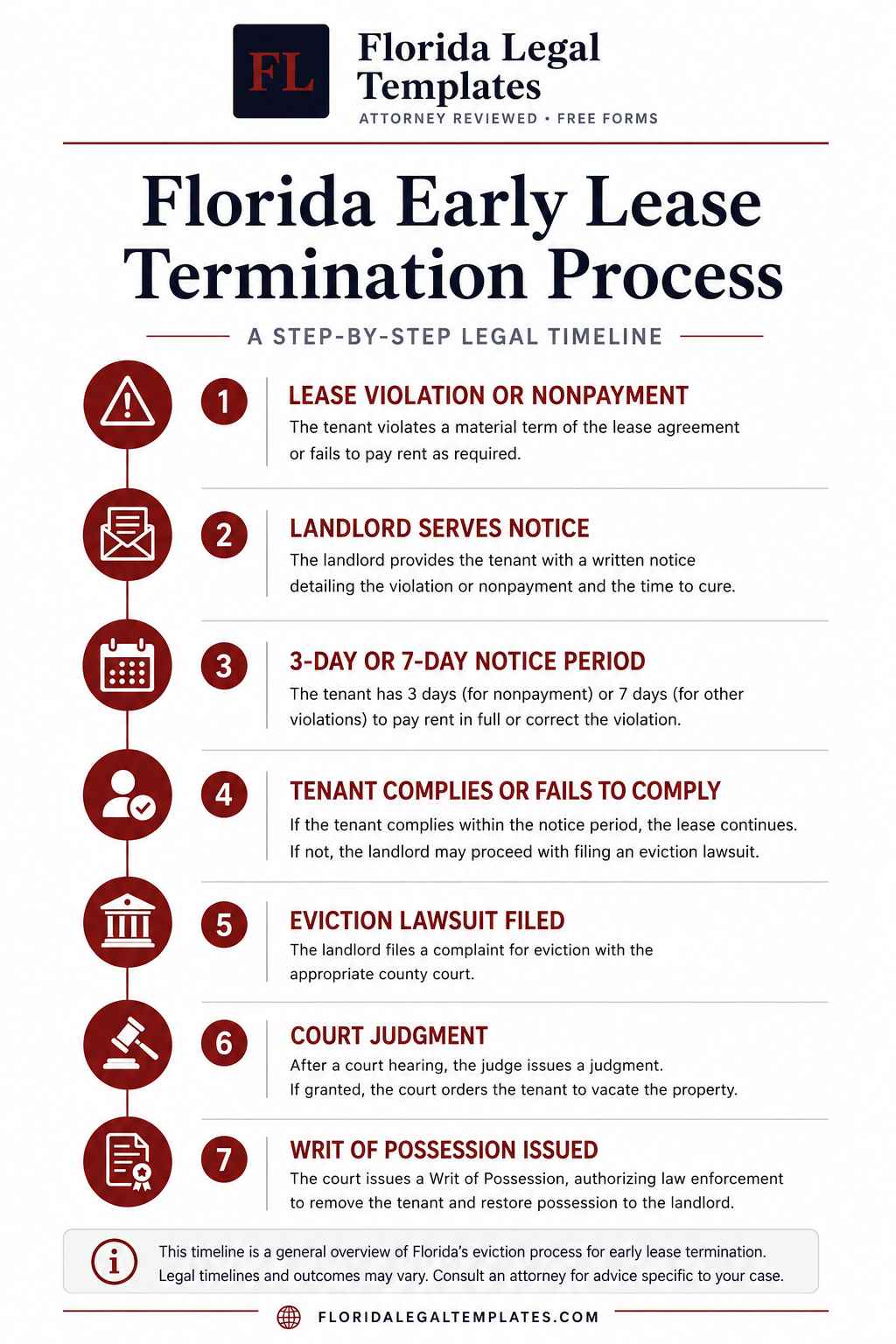
Early lease termination by landlord florida is one of the areas where the gap between what a landlord believes they are entitled to do and what Florida law actually permits is widest — and crossing that line even once, even with a genuinely problematic tenant, can cost more than the original violation ever would have. Florida’s termination framework under F.S. §83.56 generally requires a landlord to deliver the notice required for the specific violation before pursuing possession: a 3-day notice for nonpayment of rent, a 7-day notice to cure certain curable violations, or a 7-day notice to vacate for specified violations that are not subject to a cure opportunity.
What the framework does not permit under any circumstances is what Florida calls a self-help remedy — F.S. §83.67 explicitly prohibits landlords from changing locks, shutting off utilities, removing a tenant’s belongings, or taking any other action designed to force a tenant out without going through the statutory notice and eviction process, and the penalty for violating that prohibition is statutory damages of three months rent or actual damages whichever is greater.
I’ve watched landlords with legitimate grievances — two months of unpaid rent, significant property damage, documented lease violations — face damages claims that exceeded what the tenant owed them simply because they changed the locks without serving proper notice first. The florida landlord early lease termination template and breakdown below cover the correct notice type for each violation category, how to deliver it properly, and what happens if the tenant does not comply within the statutory cure period.
Candice Hayden, Legal Writer
Ross Bridger, Florida, Real Estate Attorney
Can a Landlord Terminate a Lease Early in Florida?
Florida distinguishes between fixed-term leases and month-to-month tenancies.
With a fixed-term lease, the landlord is generally bound for the full lease duration unless one of the following applies:
- The tenant materially breaches the lease
- The tenant violates Florida landlord-tenant laws
- The written lease contains an enforceable early termination clause
- Another contract-based termination right exists within the lease itself
Under Florida law, a landlord generally cannot terminate a fixed-term residential lease early simply for convenience when the tenant has not breached the lease and no applicable contractual or statutory termination right exists.
That means a landlord usually cannot terminate a lease simply because:
- The property is being sold
- The owner wants to reoccupy the property
- Market rents have increased
- The landlord no longer likes the tenancy arrangement
Month-to-month tenancies operate differently because they are periodic tenancies rather than fixed contractual terms. Under Fla. Stat. § 83.57(3), either the landlord or the tenant must provide written notice ofnot less than 30 days prior to the end of the monthly rental period to legally terminate a month-to-month arrangement. By contrast, a fixed-term lease creates contractual obligations that Florida courts generally enforce unless a legally valid basis for termination exists.
Legal Grounds for Early Lease Termination by a Landlord
Nonpayment of Rent
Nonpayment of rent is one of the most common lawful grounds for lease termination under Fla. Stat. § 83.56.
Before terminating the tenancy or filing for eviction, the landlord must serve a legally compliant 3-day notice demanding payment or possession. Florida law requires extremely specific statutory wording for this notice. Courts routinely dismiss eviction actions when landlords alter the required language or miscalculate the deadline.
The notice must substantially include:
“You are hereby notified that you are indebted to me in the sum of $______ for the rent and use of the premises…”
The 3-day period excludes Saturdays, Sundays, and legal holidays. Incorrectly counting weekends is a common procedural defect that can invalidate the notice.
Another major compliance issue involves partial rent acceptance. Under current Fla. Stat. § 83.56(5)(a), accepting partial rent for the period does not by itself waive the landlord’s right to terminate for the noncompliance, but the landlord must follow one of the statute’s procedures before filing the possession action.
Curable Lease Violations
Certain lease violations must first be capable of correction before the tenancy can be terminated.
Examples may include:
- Unauthorized pets
- Excessive noise complaints
- Improper occupancy
- Failure to maintain cleanliness standards
Under Fla. Stat. § 83.56(2)(b), the landlord must provide a 7-day notice giving the tenant an opportunity to cure the violation.
Florida requires statutory “magic words” in this notice. The notice must substantially state:
“Demand is hereby made that you remedy the noncompliance within 7 days…”
The notice also warns that repeat violations within 12 months may result in termination without another opportunity to cure.
This repeat-violation provision is operationally important because landlords often lose eviction cases when they fail to document earlier violations properly.
Incurable Non-Compliance
Some tenant conduct is considered so serious that Florida law permits immediate termination without an opportunity to cure.
Examples can include:
- Intentional property destruction
- Serious criminal activity
- Violent misconduct
- Repeated severe lease violations
Under Fla. Stat. § 83.56(2)(a), the landlord may issue a 7-day unconditional quit notice. While the lease termination itself is immediate, Florida law mandates that the tenant be granted a standard timeframe to physically vacate the premises. The notice must substantially state:
The notice must substantially state:
“You are advised that your lease is terminated effective immediately. You shall have 7 days from the delivery of this letter to vacate the premises. This action is taken because [cite the noncompliance].”
Because these notices eliminate the tenant’s opportunity to correct the problem, Florida courts strictly scrutinize both the underlying factual basis for the alleged misconduct and whether the mandatory 7-day wrap-up language was explicitly included.
Lease-Based Early Termination Clauses
Some leases contain specific clauses allowing early termination under limited circumstances.
Examples may include:
- Redevelopment clauses
- Owner occupancy clauses
- Sale contingency provisions
Fla. Stat. § 83.595 primarily addresses the landlord’s remedies after a tenant breaches or elects to terminate early. Its early termination fee provision permits a fee of up to two months’ rent when the statutory requirements are met, including the tenant’s agreement at the time the rental agreement was made and a separate addendum.
Whether such provisions are enforceable depends heavily on:
-
Absolute statutory compliance with Fla. Stat. § 83.595
-
The penalty fee strictly adhering to the two-month rent cap
-
The presence of the tenant’s signature on the separate liquidated damages addendum
-
Whether proper notice procedures are followed
Vague or poorly drafted lease clauses, or a failure to execute the mandatory separate statutory addendum, can render the clause completely void and create major litigation risks for the landlord.
The Landlord “Double-Dipping” Limitation (§ 83.595(4))
A common misunderstanding arises when landlords assume that an early termination addendum gives them the right to end a fixed-term lease because they want to sell or reoccupy the property. Under Fla. Stat. § 83.595(4), an agreed early termination fee generally applies when the tenant elects to terminate the rental agreement early.
The fee may not exceed two months’ rent and must have been agreed to at the time the rental agreement was made, with the tenant signing a separate addendum. The statute also provides that, in addition to the early termination fee, the landlord may recover rent and other charges accrued through the end of the month in which the landlord retakes possession, as well as charges for damage to the dwelling unit.
Florida Laws That Govern Landlord Early Termination
| Topic / Issue | Florida Legal Rule | Governing Statute |
|---|---|---|
| Nonpayment termination | Requires 3-day notice with statutory wording | Fla. Stat. § 83.56(3) |
| Curable lease violations | Tenant gets 7 days to cure | Fla. Stat. § 83.56(2)(b) |
| Incurable violations | Immediate termination notice permitted | Fla. Stat. § 83.56(2)(a) |
| Self-help eviction ban | Lockouts and utility shutoffs prohibited | Fla. Stat. § 83.67 |
| Partial rent acceptance | May waive eviction rights | Fla. Stat. § 83.56(5) |
| Fixed-term lease limitations | No general no-fault termination right | Florida contract law |
Florida’s residential eviction process is highly technical. Even when a tenant clearly violated the lease, procedural defects can derail the landlord’s case.
Courts often focus less on whether the tenant breached the lease and more on whether the landlord followed the exact statutory process required under Chapter 83.
Improper notices frequently result in:
- Case dismissals
- Delayed possession
- Additional filing costs
- Attorney fee exposure
- Restarted notice periods
Why Florida Notice Language Matters
Florida eviction notices are part of the statutory process, not merely warning letters. For example, § 83.56 specifies different notice requirements for nonpayment, curable lease violations, and violations for which the tenant is not given a cure opportunity.
Common notice defects include:
- Incorrect notice dates
- Missing statutory wording
- Improper calculation of business days
- Incomplete property addresses
- Incorrect rent amounts
A landlord may have a valid legal claim yet still lose possession temporarily because the notice failed to comply with statutory requirements.
Using a generic early termination of lease agreement by landlord Florida form can create major compliance risks if the document is not tailored to Florida law.
What Happens if the Landlord Violates These Rules
Improper termination practices can create serious legal consequences for landlords.
Potential outcomes include:
- Dismissed eviction lawsuits
- Delayed removal of tenants
- Liability for damages
- Attorney’s fees awards
- Additional court costs
Florida also strictly prohibits self-help eviction tactics under Fla. Stat. § 83.67.
Landlords cannot:
- Change locks
- Remove tenant belongings
- Shut off utilities
- Block access to the property
Violations can expose the landlord to actual damages or 3 months’ rent, whichever is greater, plus attorney’s fees.
Required Florida Notices for Early Lease Termination
3-Day Notice for Nonpayment of Rent
The 3-day notice is used when rent remains unpaid.
Key compliance requirements include:
- Excluding weekends and legal holidays
- Including the precise rent amount owed
- Using substantially compliant statutory language
- Properly identifying the leased premises
Delivery methods commonly include:
-
Hand delivery
-
Posting at the premises
-
Mailing
-
Electronic delivery (Email)
Under Florida law, electronic delivery by email is permitted when the parties have signed the statutory addendum agreeing to electronic delivery and have provided valid email addresses. A notice sent under § 83.505 is deemed delivered when sent unless the email is returned as undeliverable. Proof of service is operationally important because disputes often arise over whether the tenant actually received the notice.
7-Day Notice to Cure Non-Compliance
This notice applies to curable lease violations.
The tenant must be given an opportunity to correct the problem within 7 days.
The notice should clearly identify:
- The lease violation
- The corrective action required
- The deadline to cure
If similar misconduct occurs again within 12 months, the landlord may terminate without another cure opportunity.
7-Day Unconditional Quit Notice
This notice is reserved for serious or incurable violations.
Examples may include:
- Intentional destruction of property
- Violent conduct
- Serious criminal activity
Unlike curable notices, this form immediately terminates the tenancy and requires the tenant to vacate.
Because these notices carry substantial consequences, factual documentation is critical.
Delivery and Service Requirements
Florida law treats service of notice as a foundational procedural step.
Best practices include:
- Retaining copies of notices
- Photographing posted notices
- Documenting delivery dates
- Keeping payment ledgers and violation records
Documentation becomes especially important when the tenant disputes delivery, the amount of rent claimed, or the facts supporting the notice, because the landlord may later need to prove both the notice and the underlying noncompliance in court.
What Landlords Cannot Legally Do in Florida
Illegal “Self-Help” Evictions
Florida prohibits landlords from forcing tenants out without a court order.
Unlawful conduct includes:
- Changing locks
- Removing doors
- Disconnecting utilities
- Removing tenant property
- Blocking entry access
Only the sheriff executes the writ of possession after judgment, with the residential possession procedure in Fla. Stat. § 83.62 requiring 24 hours’ notice conspicuously posted on the premises.
Terminating a Fixed-Term Lease Without Legal Cause
A landlord’s personal preference is generally insufficient to terminate a fixed-term lease early.
Florida law usually does not allow termination merely because:
- The owner wants to sell
- The landlord wants higher rent
- The owner wants to move into the property
Absent a lease clause or tenant breach, the landlord generally must honor the lease duration.
Accepting Partial Rent After Serving Notice
Under Fla. Stat. § 83.56(5), accepting partial rent after serving a termination notice may waive the landlord’s right to proceed on that notice.
This creates a common procedural trap.
Landlords sometimes unknowingly invalidate their eviction position by accepting partial payment without following statutory safeguards.
How the Florida Eviction Process Works After Early Termination
Tenant Compliance vs Non-Compliance
After receiving notice, the tenant may:
- Cure the violation
- Pay the rent owed
- Vacate voluntarily
- Contest the allegations
- Ignore the notice
The next procedural steps depend on the tenant’s response.
Filing an Eviction Lawsuit
If the tenant fails to comply, the landlord may file an eviction action in county court.
The landlord typically must attach:
- The lease agreement
- The termination notice
- Proof of service
- Payment records or violation evidence
Florida eviction filings are generally submitted electronically through the county court system.
The Court Registry Rule Can Decide the Entire Case
Once a possession action is filed, a tenant who raises a defense other than payment generally must comply with the court-registry requirement in Fla. Stat. § 83.60(2), which can become an important procedural issue in a nonpayment case. Under Fla. Stat. § 83.60(2), a tenant who wants to challenge the eviction generally must pay the alleged unpaid rent into the court registry, or file a motion asking the court to determine the correct amount if the rent claimed is disputed. This deadline runs from service of process: under Fla. Stat. § 83.60(2), the tenant generally has 5 days, excluding Saturdays, Sundays, and legal holidays, to pay the alleged rent into the court registry or file a motion to determine the amount.
This changes settlement discussions. A landlord with complete payment records and a properly calculated rent ledger is in a much stronger position because the registry amount is usually based on the rent alleged in the complaint unless the court orders otherwise. On the other hand, a tenant who files an answer but does not comply with the court registry requirement may have defenses to possession struck, allowing the landlord to seek a default judgment for possession while any separate claim for money damages continues. This procedural step does not replace the notice requirements under Chapter 83, but it frequently becomes the turning point in contested nonpayment eviction cases.
Court Judgment and Writ of Possession
If the landlord prevails, the court may issue a final judgment for possession.
The sheriff — not the landlord — executes the writ of possession.
This distinction matters because landlords who attempt self-enforcement can face substantial liability under Florida law.
Situations Where a Landlord Usually Cannot Break the Lease Early
Landlords generally cannot terminate a fixed-term lease early solely because of:
- Property sales
- Owner move-in plans
- Rising market rents
- Personal disagreements with tenants
- Minor lease disputes
- Retaliation prohibited by Fla. Stat. § 83.64 when the landlord’s action is primarily retaliatory, subject to the statute’s good-cause provision.
Florida generally requires landlords to honor a fixed-term residential lease unless a valid statutory, contractual, or tenant-breach basis permits earlier termination.
Common Mistakes Landlords Make When Ending a Lease Early
Frequent landlord mistakes include:
- Using incorrect notice periods
- Counting weekends improperly
- Omitting statutory wording
- Accepting rent after serving notice
- Attempting self-help eviction
- Failing to document violations
- Using generic forms not tailored to Florida law
These mistakes can result in:
- Dismissed eviction cases
- Delayed possession
- Repeated filing costs
- Tenant damage claims
- Attorney fee exposure
Operationally, many landlords underestimate how technical Florida eviction compliance can become.
Frequently Asked Questions
Can a landlord break a lease early in Florida without tenant fault?
Usually no. Florida generally does not allow landlords to terminate a fixed-term residential lease early without legal cause or a valid lease-based termination clause.
Can a landlord evict a tenant after selling the property in Florida?
Not automatically. A property sale alone usually does not terminate a fixed-term lease unless the lease specifically permits termination after sale.
What happens if a Florida eviction notice contains incorrect wording?
Florida courts may dismiss the eviction action if the notice fails to substantially comply with statutory requirements under Chapter 83.
Can a landlord change the locks after giving a termination notice?
No. Under Fla. Stat. § 83.67, self-help lockouts are prohibited even after notice expiration.
Does accepting partial rent cancel a Florida eviction notice?
It may. Under Fla. Stat. § 83.56(5), accepting partial rent can waive termination rights tied to that notice under certain circumstances.
Key Takeaways for Florida Landlords and Tenants
Florida landlords cannot usually terminate a fixed-term lease early without legal cause, a material tenant breach, or an enforceable lease provision allowing termination.
Strict compliance with Florida notice requirements is essential. Minor procedural mistakes — especially incorrect statutory wording or improper date calculations — can invalidate eviction actions.
Florida also strictly prohibits self-help evictions. Landlords must obtain a court judgment and sheriff-enforced writ of possession before removing a tenant from the property.
For both landlords and tenants, the safest approach is careful documentation, strict statutory compliance, and close review of the written lease terms before attempting any early termination process.
Legal Disclaimer:This article provides general information about Florida landlord-tenant law and is not legal advice. Laws and procedures may change, and individual circumstances can affect your rights and obligations. Consult a qualified Florida attorney for advice about your specific situation.