
Florida Lease Termination Letter [Free Printable, Fillable PDF]
A florida lease termination letter is the written notice Florida law requires to formally end a tenancy and the distinction between a written termination letter and an informal text, email, or verbal conversation matters more than most landlords and tenants expect when a dispute surfaces later. Florida’s termination requirements under F.S. §83.57 are specific about both the notice period and the form it must take: a month-to-month tenancy requires 30 days written notice delivered before the end of the rental period, and a lease termination letter florida that does not satisfy those requirements does not start the clock regardless of when the other party acknowledged it.
The delivery method matters as much as the content. For a termination notice under Fla. Stat. § 83.57, the notice must be given in the manner provided by § 83.56(4), while electronic delivery requires compliance with § 83.505. I’ve worked with tenants who believed they had properly ended their tenancy with an email exchange, only to face a rent liability claim months later because the florida lease termination notice never met the statutory written notice standard their lease required. The template and breakdown below cover what the letter must include, how it must be delivered, and how the notice period is calculated correctly under Florida law for both month-to-month and fixed-term tenancies.
Candice Hayden, Legal Writer
Ross Bridger, Florida, Real Estate Attorney
Florida Lease Termination Letter Template
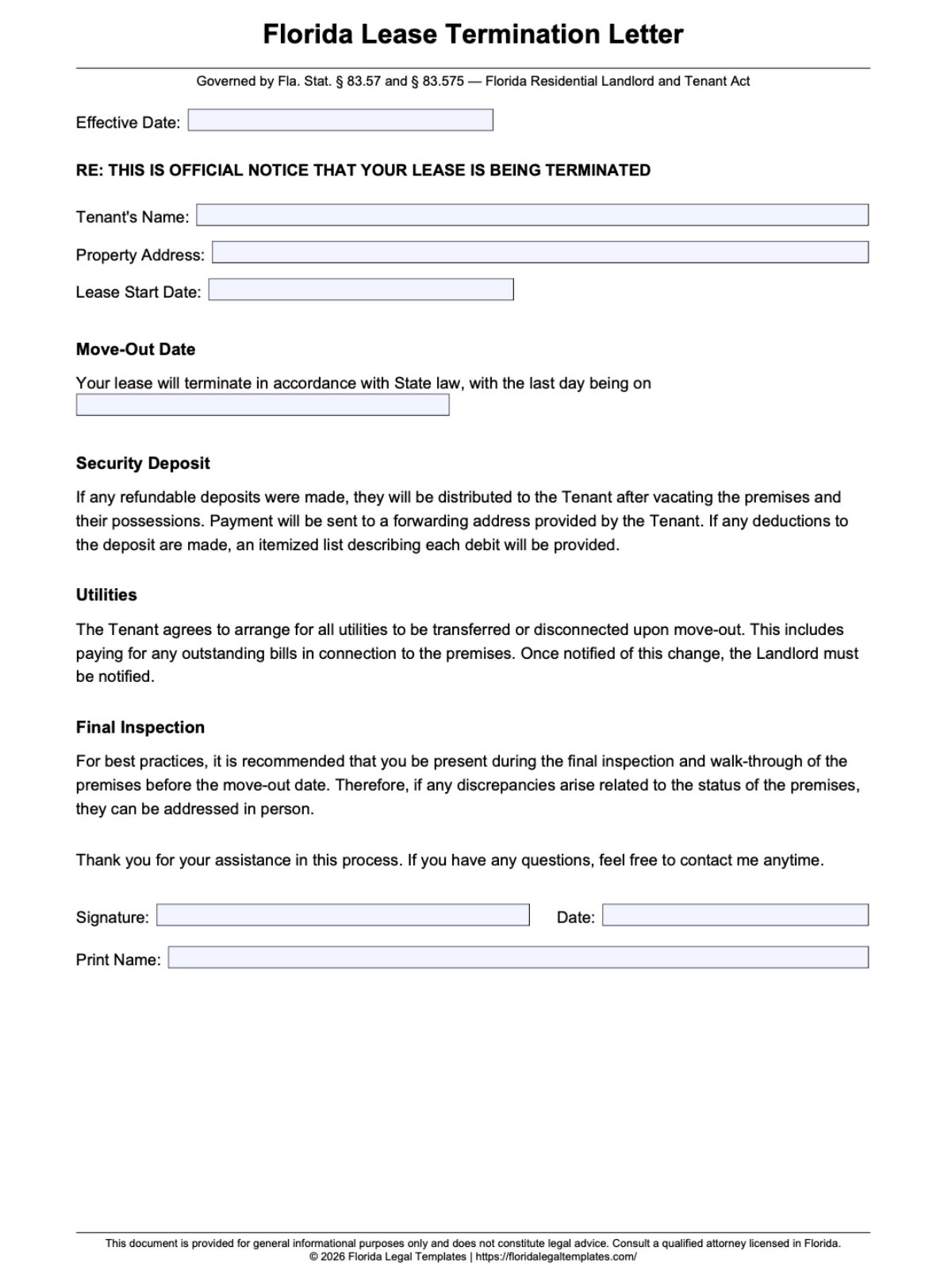
A Florida lease termination letter template is designed for residential tenancy termination and non-renewal situations governed by Florida’s Residential Landlord and Tenant Act. These templates are commonly available in:
- PDF format
- Printable forms
- Fillable digital documents
The document is typically used by:
- Landlords ending a month-to-month tenancy
- Tenants planning to vacate a rental property
- Parties declining renewal of a fixed-term lease
A properly structured template usually includes:
- Full landlord and tenant identification
- Rental property address
- Lease termination date
- Notice delivery date
- Signature block
- Request for forwarding address information
The forwarding address request serves a practical legal purpose because Fla. Stat. § 83.49 requires landlords to send certain security-deposit notices after move-out and requires tenants who vacate or abandon in the circumstances covered by subsection (5) to provide an address where they may be reached.
This template may not be sufficient for:
- Nonpayment eviction proceedings
- Lease breach disputes
- Immediate termination claims
- Commercial lease terminations
- Mobile home tenancy disputes
A Florida lease termination letter is different from:
- Florida eviction notices
- 3-day notices for unpaid rent
- 7-day cure or termination notices
- Lease renewal agreements
- Mutual lease termination agreements
Those documents involve different statutory procedures and legal consequences.
What Is a Florida Lease Termination Letter?
A Florida lease termination letter is a written notice that formally communicates a party’s intent to end a residential tenancy. In most situations, it functions as a notice document rather than a negotiated contract.
The document is commonly used in two separate scenarios:
- Terminating a periodic tenancy, such as a month-to-month rental
- Declining renewal of a fixed-term lease at the natural end of the lease term
Written notice is legally significant because Florida generally requires residential tenancy termination notices to be in writing. Oral conversations, informal text messages, or casual verbal move-out discussions generally do not satisfy statutory notice requirements for residential tenancies.
The notice serves several legal and operational purposes:
- Establishes unequivocal intent to terminate the tenancy
- Creates proof of notice delivery
- Reduces disputes about move-out timing
- Preserves evidence before a holdover dispute arises
A vague or conditional statement such as “I might move next month” can create uncertainty and weaken enforcement if a later dispute occurs.
Situations Where Florida Lease Termination Letter Is Commonly Used
Florida lease termination letters are frequently used in everyday rental transitions, including:
- A landlord ending a month-to-month tenancy
- A tenant moving out at the end of a lease
- Non-renewal of a fixed-term rental agreement
- Employment or family relocation
- Property sale or owner occupancy plans
- Avoiding automatic renewal penalties
- Preventing disputes over move-out dates
For example, many Florida leases contain automatic renewal or notice-of-nonrenewal provisions. Under Fla. Stat. § 83.575, certain lease clauses imposing penalties for failing to provide advance notice may only be enforceable if the landlord gives a reminder notice within a specific statutory window.
Other situations require different documents entirely. A lease termination letter should not replace:
- Eviction notices for lease violations
- Notices for unpaid rent
- Early lease termination agreements
- Lease amendment documents
Using the wrong form can delay enforcement or create procedural problems later in court.
Key Florida Laws That Affect Lease Termination Notices
| Topic / Issue | Florida Legal Rule | Governing Statute |
|---|---|---|
| Periodic tenancy termination | Month-to-month tenancy requires at least 30 days’ written notice before the end of the rental period | Fla. Stat. § 83.57 |
| Fixed-term lease non-renewal | Lease notice windows may require 30–60 days’ advance notice | Fla. Stat. § 83.575 |
| Delivery methods | Notice may be mailed, hand-delivered, or left at residence if recipient is absent | Fla. Stat. § 83.56(4) |
| Electronic delivery | Email notice is only valid if executed via a voluntary, standalone addendum containing the specific checkbox layout required by the state. | Fla. Stat. § 83.505 |
| Security deposit forwarding | Florida’s security-deposit statute requires the landlord’s disclosure to advise the tenant to provide a new address so the landlord can send notices concerning the deposit. | Fla. Stat. § 83.49(2)(d) |
| Retaliatory termination protections | Retaliatory termination notices are prohibited | Fla. Stat. § 83.64 |
Florida’s termination rules are highly procedural. Even when a landlord or tenant has a valid reason for ending the tenancy, defective timing or delivery can invalidate the notice entirely. This often causes the tenancy to roll into another rental period.
Florida courts also distinguish between voluntary lease termination and eviction enforcement. A lease termination letter alone does not physically remove a tenant from the property. If the tenant remains after expiration of the notice period, formal court action may still be required.
Additional statutory guidance appears in the Florida Residential Landlord and Tenant Act.
The “End-of-Rental-Period” Rule
Under Fla. Stat. § 83.57, a month-to-month tenancy may be terminated by either party with at least 30 days’ written notice before the end of the monthly rental period.
That means a landlord or tenant generally cannot terminate the lease mid-cycle.
For example:
- If rent is due on the first day of each month, the rental period typically runs from the 1st through the last day of the month.
- To terminate effective June 30, notice generally must be delivered no later than May 31.
- Delivering notice on June 2 would usually invalidate termination for June 30 and extend the tenancy into the next rental cycle.
This timing trap creates many failed holdover claims because parties incorrectly assume “30 days” means any arbitrary calendar date.
Moving Out Early Does Not Automatically End the Tenancy
One situation that surprises both landlords and tenants is when the tenant physically leaves the property before the termination date in the notice. Vacating and returning the keys before the stated termination date does not necessarily eliminate the tenant’s remaining obligations. Whether the tenancy or the tenant’s liability ends early can depend on the parties’ agreement, the lease, and the landlord’s treatment of the surrendered or abandoned premises.
In practice, this is where documentation matters. If both parties decide to end the tenancy before the statutory notice period expires, they should confirm that agreement in writing, identify the agreed termination date, and document key return. Otherwise, a landlord may argue the original notice controls, while a tenant may mistakenly believe that moving out alone ended all obligations.
This distinction also affects security deposit issues. Landlords should perform the move-out inspection based on the actual surrender of possession, but any claim against the deposit must still follow the notice procedures in Fla. Stat. § 83.49. Likewise, tenants should keep evidence of the date possession was returned, such as a signed key receipt or written acknowledgment, because that often becomes the most persuasive evidence if a later dispute arises over rent, damages, or the condition of the property.
Fixed-Term Lease Non-Renewal Rules
Fixed-term leases operate differently from month-to-month tenancies.
Under Fla. Stat. § 83.575, a fixed-term rental agreement may require the tenant or landlord to give between 30 and 60 days’ notice before the lease expires if the agreement contains the required notice provision.
Florida law also places limits on liquidated damages provisions tied to non-renewal notice failures. If a lease imposes penalties for failing to provide advance notice, the landlord must provide a separate reminder notice within 15 days before the tenant’s notification window begins.
Failure to provide the required reminder notice can prevent the landlord from enforcing the liquidated-damages provision under this subsection.
The “Constructive Surrender & Acceptance” Rent Trap
A common operational issue arises when a tenant delivers a 30-day lease termination letter under Fla. Stat. § 83.57, but physically vacates the property and turns in the keys 15 days early. If a landlord retakes possession after a tenant leaves early, the effect on the tenancy and any remaining rent liability depends on the circumstances and the remedy the landlord elects under Fla. Stat. § 83.595; accepting keys alone does not necessarily establish an accepted surrender.
Under Florida common law, the moment a landlord retakes exclusive possession and control of the unit for their own benefit, the underlying tenancy terminates immediately. Retaking possession may affect the landlord’s available remedies, but it does not create an automatic rule that all remaining rent is waived in every case. If a landlord accepts keys before the stated termination date but does not intend to accept an early surrender, documenting that understanding in writing can help reduce a later dispute over possession and rent liability.
Legally Valid Delivery Methods
Florida law provides several ways to deliver a written termination notice, including:
- Mailing the notice
- Delivering a true copy of the notice
- E-mailing the notice when the parties have agreed to electronic delivery in accordance with Fla. Stat. § 83.505
- Leaving a copy at the residence if the tenant is absent
Electronic delivery, including email, may be valid when the parties have signed the addendum required by Fla. Stat. § 83.505 and provided the designated email addresses.
Proof of delivery matters because disputes frequently arise over whether notice was properly received. Retaining mailing receipts, photographs, or signed acknowledgments can become important evidence if litigation later occurs.
Practical Impact & Document Clauses
Several clauses in a Florida lease termination letter carry significant legal weight:
- Termination date clause
- Delivery certification
- Forwarding address request
- Signature block
Defective notices can create serious operational problems, including:
- Delayed move-out timelines
- Failed holdover possession claims
- Unenforceable lease penalties
- Security deposit disputes
Even a technically correct notice can fail if the termination date does not match the rental cycle.
How to Fill Out a Florida Lease Termination Letter
Identify the Parties and Property
Include:
- Full legal names of landlord and tenant
- Complete rental property address
- Unit number if applicable
Errors in property identification can create ambiguity in multi-unit buildings.
State the Lease Type
Specify whether the tenancy is:
- Month-to-month
- Fixed-term
This distinction directly affects notice timing requirements under Florida law.
Calculate the Correct Notice Deadline
Carefully calculate the notice period using the rental cycle rather than arbitrary calendar dates.
Example:
- Rent due July 1
- Desired termination August 31
- Notice should generally be delivered no later than July 31
Late delivery can unintentionally extend the tenancy into another month.
Clearly State the Termination Date
Use direct and unequivocal language.
Avoid vague phrases such as:
- “Planning to move soon”
- “Possibly terminating next month”
The notice should clearly state the exact termination date.
Request a Forwarding Address
Requesting a forwarding address helps facilitate:
- Security deposit communications
- Future mailing needs
- Post-tenancy notices
This becomes especially important when landlords later issue deposit claim notices.
Sign and Deliver the Notice Properly
Florida law does not require notarization or subscribing witnesses for a standard residential lease termination letter.
A clean signature is generally sufficient.
Parties should:
- Retain copies
- Document delivery date
- Preserve mailing evidence if applicable
Delivery, Timing, and Proof Issues That Commonly Cause Disputes
Many Florida lease termination disputes arise from procedural mistakes rather than substantive disagreements.
Common problems include:
- Serving notice too late in the rental cycle
- Assuming “30 days” means any date
- Relying solely on text messages
- Failing to preserve delivery evidence
Certified mail is not always legally required, but it may provide stronger evidence than regular mail in contested cases.
When tenants are absent, Florida law generally permits leaving the notice at the residence. However, documenting the circumstances of delivery can help avoid future factual disputes.
Lease clauses that conflict with Florida law may also become unenforceable, particularly when they attempt to shorten statutory rights.
Legal Risks and Operational Limits
Florida law prohibits certain retaliatory conduct by landlords under Fla. Stat. § 83.64, including specified actions taken primarily because a tenant exercised protected rights.
- Code enforcement complaints
- Repair requests
- Tenant union participation
Discriminatory terminations may also create exposure under federal and state fair housing laws.
A lease termination letter does not itself remove a tenant. If the rental agreement has been lawfully terminated and the tenant does not vacate, the landlord may need to pursue possession through the procedure provided by Fla. Stat. § 83.59.
The document is also not filed with any Florida government agency. It remains a private contractual notice unless later introduced in litigation.
Common Mistakes to Avoid
Common Florida lease termination errors include:
- Serving notice too late
- Using the wrong termination date
- Attempting mid-month termination
- Sending notice only by text or email
- Ignoring lease-specific notice provisions
- Forgetting forwarding address requests
- Using eviction notice language unnecessarily
- Assuming notarization is required
- Overlooking retaliatory termination restrictions
A missed notice deadline can push a month-to-month termination into the next rental period, while a defective delivery method can create a separate dispute over whether notice was properly given.
Florida Lease Termination Letter vs Related Rental Documents
Lease Termination Letter vs Eviction Notice
A lease termination letter ends a tenancy relationship through notice and expiration.
An eviction notice addresses breach-related enforcement, such as unpaid rent or lease violations.
Lease Termination Letter vs Lease Renewal Agreement
A lease termination letter ends occupancy rights.
A lease renewal agreement extends or modifies tenancy terms.
Lease Termination Letter vs Early Lease Termination Agreement
A termination letter is generally unilateral notice.
An early termination agreement is typically a negotiated mutual release between landlord and tenant.
Lease Termination Letter vs Notice to Vacate
“Notice to vacate” is a broader phrase that may refer to several different notice types.
A Florida lease termination letter is specifically tied to lawful tenancy conclusion procedures.
Frequently Asked Questions
Can a Florida landlord terminate a month-to-month lease without giving a reason?
Generally, yes. Florida law permits lawful non-renewal of month-to-month tenancies with proper written notice under Fla. Stat. § 83.57. However, retaliatory terminations prohibited by Florida law remain unenforceable.
What happens if a Florida lease termination notice is delivered late?
Late notice commonly causes the tenancy to roll into another rental period. For example, missing the deadline for a June 30 termination may extend the tenancy into July.
Is a text message or email valid for ending a Florida lease?
Yes, in some circumstances. Florida law permits electronic delivery of notices when the parties have signed the required electronic-delivery addendum and otherwise comply with Fla. Stat. § 83.505.
Does a Florida lease termination letter need to be notarized?
No. Florida law does not require notarization for an ordinary residential tenancy termination notice under §§ 83.56, 83.57, or 83.575.
Can a tenant leave before the lease ends using this letter?
Not automatically. A lease termination letter for non-renewal differs from an early termination right. Leaving before expiration of a fixed-term lease may still create financial liability unless another legal basis or mutual agreement exists.
Legal Disclaimer:This article provides general information about Florida lease termination laws and is not legal advice. Laws and requirements may change, and the appropriate notice or procedure depends on the specific circumstances of the tenancy. Consider consulting a qualified Florida attorney for advice about your situation.