
Free Florida Gift Affidavit Template | Printable PDF
If you’re transferring a car, boat, or other property to a family member without taking any payment, you may be asked to provide a Florida Gift Affidavit. It’s most commonly used during vehicle title transfers to show that ownership changed hands as a genuine gift not a sale and that no money or other valuable consideration was involved.
Many people assume that writing “gift” on the title is enough. In practice, it often isn’t. For a tax-exempt motor-vehicle gift, Florida requires the title application to be accompanied by the required sworn statement confirming the nature of the gift and that no monetary consideration or outstanding lien was assumed. A separate affidavit can be used to document those facts, but it does not replace the title-transfer paperwork.
This article includes a free Florida Gift Affidavit template, explains when it should be used, walks through each section of the document, and highlights the mistakes that can lead to rejected paperwork, unexpected taxes, or questions about whether the transfer was truly a gift.
Candice Hayden, Legal Writer
Maria Rosso, Florida Probate, Guardianship and Estate Planning Attorney
Free Florida Gift Affidavit Template (PDF & WORD)
Our free Florida Gift Affidavit template is designed for individuals who need to document a legitimate gift transfer and create a notarized record of the transaction.
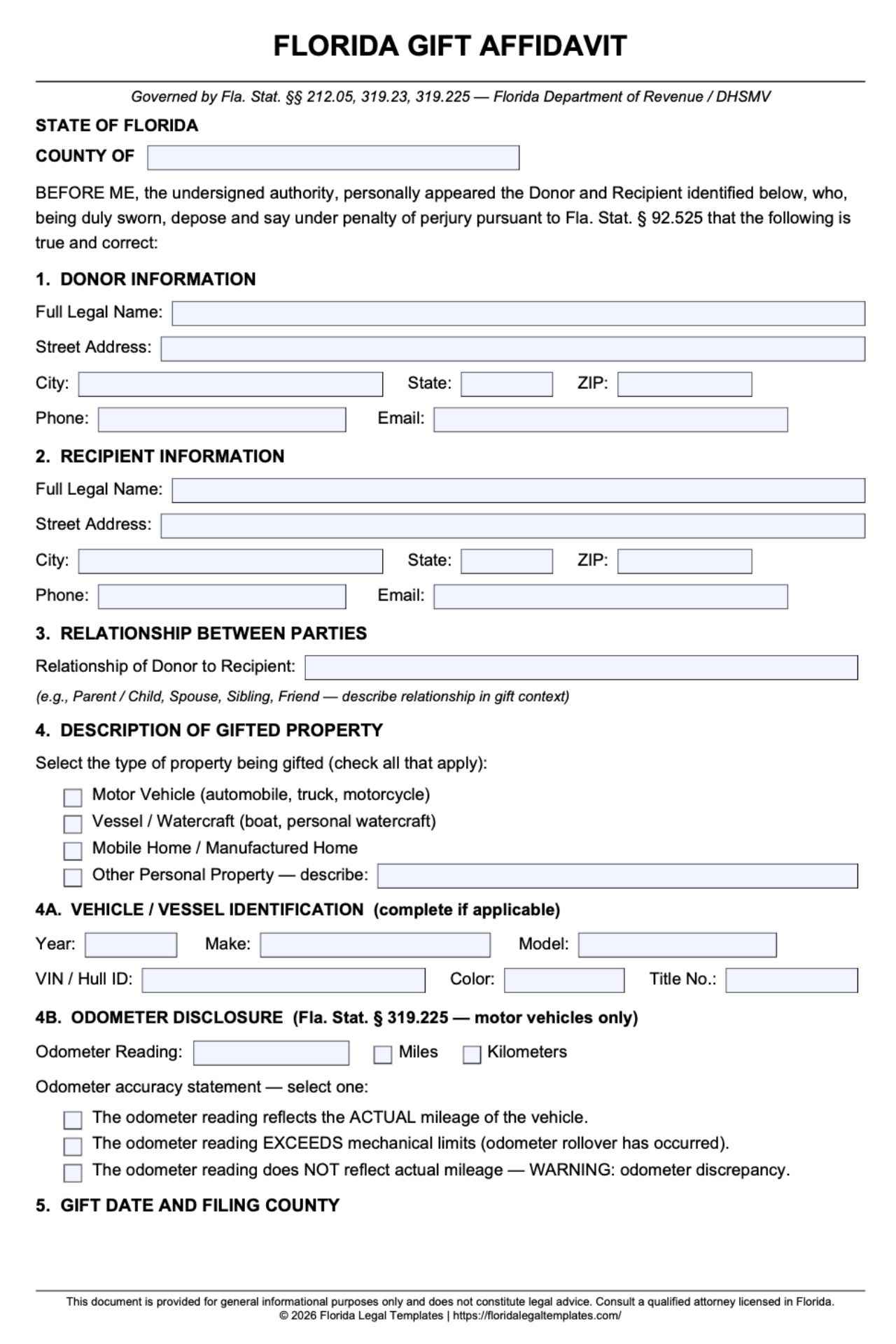
The template includes:
- Donor and recipient (donee) identification
- Property description section
- Date of transfer
- Sworn declaration confirming no consideration was exchanged
- Notary jurat
- Signature blocks for all parties
The template is appropriate for:
- Motor vehicle gifts
- Vessel transfers
- Mobile home gifts
- Cash gifts
- Personal property
- Family transfers
- Gifts between friends
When this template is not enough
A gift affidavit is not a universal transfer document.
For example:
- A real estate gift still requires a properly executed deed. The affidavit only supports the transaction—it does not transfer ownership by itself.
- Transfers involving corporations or business entities are treated differently under Florida law. Florida generally presumes consideration exists between individuals and corporate entities, meaning a private affidavit alone cannot eliminate tax liability.
Understanding these limitations before completing the document can prevent rejected filings and unexpected tax assessments.
What Is a Gift Affidavit in Florida?
A Florida Gift Affidavit is a sworn statement confirming that property was voluntarily transferred as a genuine gift rather than sold.
Its primary purpose is evidentiary.
It does not transfer ownership.
Instead, it proves:
- the donor intended to make a gift,
- the recipient accepted it,
- no money or valuable consideration changed hands.
Ownership is transferred through the appropriate legal instrument:
- Certificate of Title (vehicles)
- Vessel title
- Mobile home title
- Warranty or Quitclaim Deed (real estate)
- Other ownership documents depending on the asset
The affidavit simply supports those documents when a government agency or court needs proof that the transfer was truly a gift.
For example, when parents give a vehicle to an adult child, the Florida Department of Highway Safety and Motor Vehicles (FLHSMV) may require a sworn statement confirming that no payment was made before granting the applicable sales tax exemption.
Gift Affidavit vs. Bill of Sale
People often confuse between gift affidavit and bill of sale because both accompany ownership transfers.
They serve entirely different purposes.
| Gift Affidavit | Bill of Sale |
|---|---|
| Documents a gift | Documents a sale |
| States no consideration was exchanged | States purchase price |
| Supports tax exemption claims | Supports taxable sales |
| Sworn under oath | Usually not sworn |
| Requires notarization as an affidavit | Not always notarized |
If any payment, trade, debt assumption, or valuable consideration exists, the transaction may legally become a sale instead of a gift.
Using the wrong document can lead to tax reassessments and legal complications.
Florida Statutes Governing Gift Affidavits (Reference Table)
| Topic / Issue | Florida Legal Rule | Governing Statute |
|---|---|---|
| Execution Formalities | Personal property gift declarations require no witnesses under common law; however, Florida generally requires a written instrument signed in the presence of two subscribing witnesses to convey an interest in real property, subject to the statutory exceptions and electronic-witnessing provisions in § 689.01. | Fla. Stat. § 689.01 |
| Notary Requirement | If you use a separate affidavit, it should be properly sworn before an authorized officer, such as a notary, using the appropriate jurat. For a motor-vehicle gift, however, the current exemption rule focuses on the required sworn statement accompanying the title-transfer application. | Fla. Stat. § 92.50 and Fla. Stat. § 117.05 |
| Vehicle Sales Tax Exemption | Vehicle gift transfers claiming the exemption require a sworn statement confirming that the title passed without consideration valued in money and that the applicant is not assuming an outstanding lien. | F.A.C. Rule 12A-1.007(25) (authorized under Fla. Stat. § 212.05) |
| Documentary Stamp Tax | For Florida documentary stamp tax purposes, the result depends on whether the real-property transfer involves taxable consideration. Section 201.02 treats money, discharged obligations, and mortgage or other encumbrance amounts as consideration, so assuming a mortgage can create documentary stamp tax even when the parties describe the transfer as a gift. | Fla. Stat. § 201.02 |
| False Statements | Knowingly submitting a false written statement to mislead a public servant can constitute a second-degree misdemeanor under Fla. Stat. § 837.06, while willful tax evasion can trigger additional penalties and offenses under Florida’s tax laws. | Fla. Stat. § 837.06 & Fla. Stat. § 212.15 |
| Fraudulent Transfers | A transfer made with actual intent to hinder, delay, or defraud creditors, or a transfer meeting the statute’s other specified conditions, may be subject to remedies under Florida’s fraudulent-transfer laws. | Fla. Stat. § 726.105 |
Florida law focuses less on the title of the document and more on whether the facts support a legitimate gift.
If investigators later discover hidden payments, undisclosed debt assumptions, or side agreements, the affidavit can quickly become evidence of a false sworn statement instead of proof of a lawful gift.
The affidavit is therefore much more than paperwork—it is a sworn declaration carrying significant legal consequences.
Practical Impact & Document Clauses
A well-prepared Florida gift affidavit contains several clauses that directly affect whether government agencies accept the document.
Why the jurat matters
If you use a separate gift affidavit, make sure the notarial certificate matches the type of act being performed. A jurat is used when the signer is swearing or affirming the truth of the statement, while an acknowledgment serves a different notarial purpose.
The statutory jurat should contain language substantially similar to:
STATE OF FLORIDA, COUNTY OF ____________
Sworn to (or affirmed) and subscribed before me by means of ☐ physical presence or ☐ online notarization, this ____ day of ________, 20, by ____________________.
Without this sworn oath, the document may lose its evidentiary value and may not satisfy agency requirements.
The “no consideration” clause
The most important statement in a vehicle gift affidavit Florida document is the declaration that ownership transferred without consideration.
Florida’s administrative rules require the affidavit to clearly establish that:
- no money was paid,
- no property was exchanged,
- no trade occurred,
- no outstanding lien or debt was assumed by the recipient.
A compliant statement typically reads:
The undersigned Donor and Donee declare under penalty of perjury that the vehicle described herein was transferred as an absolute gift, and that the title passed completely without monetary payment, trade, or other consideration valued in money, and that no outstanding lien or debt was assumed by the new owner.
This language directly supports eligibility for Florida’s vehicle gift tax exemption.
Why omissions cause problems
Even small drafting mistakes can delay approval.
Examples include:
- forgetting the VIN,
- omitting the donor’s address,
- failing to include the sworn “no consideration” statement,
- using an acknowledgment instead of a jurat,
- signing before meeting the notary.
FLHSMV staff routinely review these issues before processing tax-exempt title transfers. A missing sworn statement or incomplete affidavit often results in the application being returned for correction rather than approved immediately.
Corporate transfers require extra caution
One of the least understood Florida rules involves business entities.
When property moves:
- from an individual to a corporation,
- from a corporation to an individual,
- or between corporations,
Florida generally presumes consideration exists.
A privately drafted affidavit cannot overcome that presumption. Even if both parties insist the transfer was intended as a gift, Florida may assess sales tax based on the asset’s fair market value.
Understanding this distinction before filing can prevent unexpected tax bills and lengthy disputes with state authorities.
How to Complete the Florida Gift Affidavit
A gift affidavit is more than a simple declaration that someone received property for free. Because it is a sworn statement, every detail should accurately reflect the transaction. Small inconsistencies—such as an incorrect VIN, incomplete property description, or missing jurat—can delay processing or raise questions about the validity of the transfer.
Step 1: Identify the Donor and Donee
Begin by entering the full legal names and current residential addresses of both parties.
Avoid using:
- Nicknames
- Initials in place of full names
- Business names when the transfer is between individuals
The information should match the names appearing on the title or other ownership documents to avoid discrepancies during processing.
Step 2: Describe the Property Accurately
The property description should be detailed enough that there is no doubt about what is being transferred.
For a vehicle, this typically includes:
- Year
- Make
- Model
- Vehicle Identification Number (VIN)
- Title number, if available
For a vessel, include identifying registration information.
If the affidavit is prepared in connection with a real estate gift, reference the property’s legal description as it appears in the deed rather than relying only on the street address.
Incomplete descriptions are a common reason supporting documents must be corrected before the transfer can proceed.
Step 3: Include the Required “No Consideration” Statement
The heart of every Florida gift affidavit is the sworn declaration confirming that the transfer was made without consideration.
For vehicle gifts, the statement should clearly establish that:
- the transfer was an absolute gift,
- no money changed hands,
- no property was exchanged,
- no trade occurred, and
- no outstanding lien or debt was assumed by the recipient.
Removing or modifying these concepts can weaken the affidavit’s purpose because they directly support the claimed tax treatment of the transfer.
Step 4: Sign Before a Notary Public
Because this document is an affidavit, it must be signed under oath before a Florida notary public.
The parties should not sign the affidavit beforehand.
Instead, they should appear before the notary, present acceptable identification, take the required oath or affirmation, and sign the document in the notary’s presence. Florida also permits online notarization where authorized, provided the statutory jurat reflects the method used.
Step 5: Verify the Jurat Is Completed Properly
After the affidavit has been signed, the notary completes the jurat.
This section confirms that the donor and recipient personally appeared, took an oath or affirmation, and signed the affidavit on the stated date.
Many rejected affidavits involve problems with the notarial certificate rather than the body of the document itself, which may require a correction affidavit. An acknowledgment is not a substitute for the jurat required for an affidavit.
Step 6: Submit or Retain the Affidavit
The final step depends on the type of property involved.
For vehicles, vessels, and mobile homes, submit the notarized affidavit with the title application and supporting documents to the FLHSMV or your local County Tax Collector’s office.
For real estate, the affidavit is generally retained with the parties’ records while the deed is recorded with the appropriate county office.
Before leaving the tax collector’s office, confirm that every supporting document—including the original title, application forms, and affidavit—is included. Missing paperwork is one of the most common reasons gift transfers require additional visits.
Vehicle Gifts vs. Real Property Gifts: Two Different Paths
One of the biggest misconceptions about a Florida gift affidavit is that the same process applies to every type of property. It doesn’t. The document may be called a “gift affidavit” in both situations, but how it’s used depends entirely on what you’re giving away.
If you’re gifting a motor vehicle, vessel, or mobile home, the affidavit is typically part of the title transfer process and supports a claim that the transfer qualifies for Florida’s sales tax exemption. If you’re gifting real estate, ownership is transferred through a deed, while the affidavit serves only as supporting documentation if questions arise about the nature of the transfer or the tax treatment.
Treating these transactions the same can result in rejected paperwork, unexpected taxes, or delays that could have been avoided with the correct filing process.
Vehicle, Vessel, and Mobile Home Gifts
When transferring a vehicle or vessel as a gift, the affidavit accompanies the ownership documents submitted to the Florida Department of Highway Safety and Motor Vehicles (FLHSMV) or your local County Tax Collector’s office.
A typical submission package includes:
- The physical Certificate of Title with “GIFT” and a $0 value entered in the sales price field
- Application for Certificate of Motor Vehicle Title (Form HSMV 82040)
- The current HSMV 82040 title application, including its Sales Tax Exemption Certification section, should be completed as applicable; the current form allows the applicant to identify the transfer as a gift and attest under penalties of perjury.
- Any applicable state title processing, registration, and license plate transfer fees
The affidavit’s primary purpose is to support the donor’s and recipient’s sworn statement that the transfer occurred without monetary payment, trade, or other valuable consideration. If accepted, it helps establish eligibility for Florida’s vehicle gift sales tax exemption under the applicable administrative rules.
Jointly Owned Vehicles: A Gift Affidavit Cannot Fix a Missing Signature
One situation catches families by surprise is when the vehicle title lists more than one owner. Before worrying about the gift affidavit, check exactly how the owners are shown on the Florida title.
If the title joins the owners with “AND,” every listed owner must generally sign the title transfer because each has an ownership interest that must be conveyed. If one owner refuses, is unavailable, or has died, the transfer may require additional documentation before the tax collector can process it. Also, If the title joins the owners with “OR,” either owner may generally sign to transfer the vehicle under FLHSMV title procedures.
This distinction matters because a properly completed gift affidavit does not cure a defective title assignment. People often arrive at the tax collector’s office with a notarized affidavit, only to learn that the title itself was not executed by the required owner or owners. The result is usually a rejected application, even though the transfer was genuinely intended as a gift.
Before completing the affidavit, compare the owner names on the Certificate of Title with the donor information and confirm that every required signature will be available on the day the title is transferred.
Real Property Gifts
Real estate follows an entirely different legal process.
A gift affidavit does not transfer ownership of land or a house. Instead, ownership passes through a properly executed Warranty Deed or Quitclaim Deed.
Unlike a vehicle title transfer, the affidavit is generally not recorded with the county. Instead, it is usually retained with the parties’ records in case questions later arise regarding the transfer or the documentary stamp tax paid.
The deed—not the gift affidavit—is the operative document for conveying the real property, and the deed should be recorded in the county’s official records as required by Florida recording law.
Another important distinction involves documentary stamp tax. Florida’s § 201.02 calculates tax by reference to consideration and specifically includes mortgage and other encumbrance amounts in the definition of consideration. As a result, assuming a mortgage can create documentary stamp tax even when the parties describe the transfer as a gift.
A Practical Example
Imagine two siblings receive gifts from their parents.
The first receives a family vehicle.
To complete the transfer, the parties sign a notarized gift affidavit, complete the title paperwork, and submit everything to the County Tax Collector along with Form HSMV 82040.
The second receives a vacant parcel of land.
In that situation, the parents execute and record a deed transferring ownership. Although they may keep a gift affidavit with their records, recording the affidavit alone would not transfer ownership because only the deed has that legal effect.
Although both transactions involve gifts, the paperwork, filing location, and tax treatment are fundamentally different.
When a Gift Affidavit Should Not Be Used
A Florida gift affidavit only supports transfers made entirely without consideration.
It should not be used if:
- The recipient pays any amount of money to the donor.
- Another asset is exchanged as part of the transaction.
- The recipient assumes an outstanding vehicle loan.
- The recipient agrees to take over a mortgage on gifted real estate.
- The transaction involves an individual and a corporation or two business entities where Florida presumes consideration exists.
Attempting to characterize these transactions as gifts can result in additional taxes, reassessment of the transfer, and, in serious cases, allegations that the affidavit contains false sworn statements.
Limitations and Legal Considerations
A Florida gift affidavit is persuasive evidence of a gift, but it does not override other areas of Florida law. Understanding its limits is just as important as knowing when to use it.
It Cannot Change the Nature of the Transaction
Calling a transfer a gift does not automatically make it one.
If the recipient provides cash, assumes a loan, exchanges another asset, or gives any other valuable consideration, the transaction may legally be treated as a sale regardless of what the affidavit says.
The state can assess taxes based on the actual substance of the transaction rather than its label.
It Does Not Override Corporate Presumptions
Transfers involving corporations, partnerships, or other business entities are subject to different rules.
Even if both parties describe the transfer as a gift,Florida’s motor-vehicle sales-tax rules presume consideration in specified transfers involving corporations and partnerships, so the applicable entity-transfer rule should be reviewed rather than assuming that an individual-style gift exemption applies. A privately prepared affidavit cannot eliminate that presumption or prevent the state from assessing tax based on the property’s fair market value.
It Cannot Protect Assets From Creditors
Some people mistakenly believe they can transfer property to a family member using a gift affidavit after financial problems arise.
The affidavit provides no such protection.
If a court determines the transfer was intended to place assets beyond the reach of creditors without reasonably equivalent value being received, the transaction may be set aside under Florida’s fraudulent transfer laws.
In other words, a properly notarized affidavit does not validate a transfer that the law otherwise considers fraudulent.
It Is Not a Substitute for a Deed
When real estate is involved, the affidavit is supporting evidence—not the document that transfers ownership.
Without a properly executed and recorded deed, ownership of the property does not pass simply because the parties signed a gift affidavit.
It Cannot Repair an Earlier Sale
If the parties originally exchanged money and later decide to prepare a gift affidavit to reduce taxes or simplify the paperwork, the affidavit will not change what actually occurred.
Government agencies and courts evaluate the underlying facts, not just the language used in a document. Creating a gift affidavit after consideration has already been exchanged can expose both parties to tax reassessments and potentially much more serious legal consequences if the sworn statements are false.