
Florida Warranty Deed: Free PDF & Word Template
If you need a Florida warranty deed to transfer real estate with the strongest level of title protection available under Florida law, using the correct form matters just as much as signing it. Florida imposes specific execution, recording, and statutory wording requirements that are different from many other states. A missing witness, omitted preparer statement, or overlooked homestead signature can delay recording—or in some situations, prevent a valid transfer altogether.
Our Florida warranty deed form is designed to include the fields commonly required for recording, including space for the parcel identification number, the mandatory radon gas disclosure, preparer information, witness signatures, and a notary acknowledgment. Whether you’re transferring property after a sale, conveying real estate between family members, or preparing closing documents, understanding how the document works is just as important as completing the blanks.
Candice Hayden, Legal Writer
Maria Rosso, Florida Probate, Guardianship and Estate Planning Attorney
Florida Warranty Deed Form (Printable PDF & WORD Format)
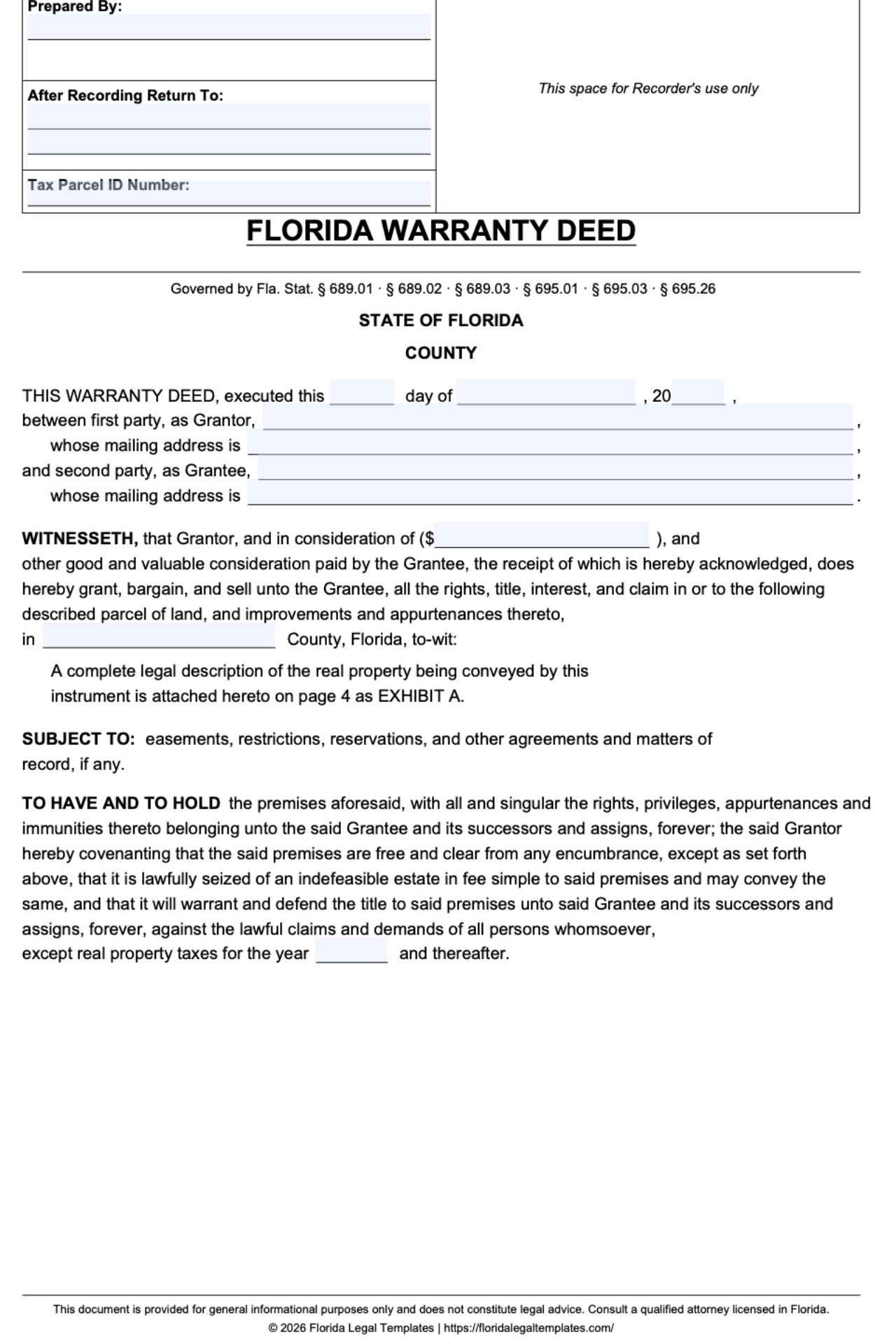
Our Florida warranty deed form is available in multiple formats for different filing and drafting needs.
Available formats
- Fillable PDF
- Microsoft Word (DOCX)
- Printable version
What’s already built into the template?
The template includes dedicated sections for:
- Property Appraiser Parcel Identification (Folio) Number
- Legal property description
- Florida Radon Gas Disclosure
- Preparer’s name and mailing address
- Two subscribing witness signature blocks
- Printed names beneath each signature
- Notary acknowledgment
- Grantor and grantee information
These sections are included because Florida law and recording practice call for several of these details to appear on or accompany a deed, although the legal effect of omitting a particular item can vary.
Who is this template designed for?
This template is commonly suitable for:
- Individual property sellers
- Homeowners transferring property
- Family real estate transfers
- Real estate attorneys preparing closing documents
- Title companies
- Estate administration transfers where a general warranty deed is appropriate
When a template may not be enough
A fill-in-the-blank document is not appropriate for every transaction.
Professional drafting is often necessary when:
- the property is Florida homestead and one spouse will not sign;
- title is currently held by a trust or other legal entity;
- known liens, easements, judgments, or title defects must be specifically excluded from the warranties; or
- customized exception clauses are required.
Those situations frequently require language beyond a standard warranty deed Florida template, particularly because a grantor may otherwise assume liability for title defects that were never intended to be covered.
What Is a Florida Warranty Deed?
A Florida warranty deed is a legal instrument used to transfer ownership of real property while providing the grantee with the broadest warranties available under Florida law. Rather than merely conveying ownership, the grantor promises that they own the property, have the legal authority to transfer it, and will defend the title against lawful claims arising from any point in the property’s history.
That last point is what distinguishes a general warranty deed Florida from many other deed types.
Unlike documents that simply transfer whatever ownership interest exists, a warranty deed places continuing contractual obligations on the grantor. If a previously undisclosed title defect later surfaces—even one created decades before the grantor acquired the property—the grantor may still be responsible under Florida’s statutory warranties.
General Warranty Deed vs. Special Warranty Deed
One of the most common misunderstandings involves confusing these two documents.
A General Warranty Deed protects the buyer against title defects dating back to the property’s earliest ownership history.
A Special Warranty Deed, by contrast, limits the grantor’s warranties to problems that arose only during the grantor’s own ownership.
That distinction becomes especially significant when transferring:
- inherited property,
- older homes,
- commercial real estate,
- investment properties with lengthy ownership histories.
Someone selling inherited property may unknowingly guarantee title defects created long before they inherited the property if they sign a General Warranty Deed without carefully considering the risks.
Florida’s Statutory Shortcut
Florida law provides a statutory form that allows drafters to create full warranty protections without listing every individual covenant separately.
Under Fla. Stat. § 689.02, the prescribed granting language acts as legal shorthand. When combined with the statutory warranty language, it automatically incorporates the full package of title covenants recognized under Florida law.
Instead of several lengthy contractual promises, the statute allows specific wording to accomplish the same legal effect.
This is why experienced real estate professionals generally avoid rewriting these clauses in their own words.
The Statutory Language That Makes a Florida Warranty Deed Enforceable
Florida’s statutory warranty deed relies on more than signatures. Certain clauses and execution requirements are what transform a piece of paper into a legally recordable conveyance that carries full title warranties.
Required Granting & Warranty Clauses (Fla. Stat. § 689.02 / § 689.03)
Florida protects specific statutory language that creates the traditional full warranty deed.
The deed should include the statutory granting language:
“…granted, bargained, and sold to the said grantee, and grantee’s heirs and assigns forever…”
It should also contain the statutory warranty language:
“…does hereby fully warrant the title to said land, and will defend the same against the lawful claims of all persons whomsoever.”
When these phrases are used as authorized by Florida law, they automatically incorporate the statutory covenants described in Fla. Stat. § 689.03, including the covenant against encumbrances and the obligation to defend title.
Rather than serving as decorative legal language, these phrases determine the scope of the grantor’s legal responsibility after closing.
Trying to modernize or abbreviate these provisions may create uncertainty regarding the warranties being conveyed and can introduce avoidable legal disputes during future title examinations.
For the statutory language, see: Fla. Stat. § 689.02 and Fla. Stat. § 689.03.
Mandatory Radon Gas Disclosure (Fla. Stat. § 404.056(5))
While Florida law mandates a specific radon gas warning, this consumer notification applies strictly to purchase contracts and long-term lease agreements under Fla. Stat. § 404.056(5). Including this text on the deed itself is a persistent boilerplate habit rather than a statutory mandate. Because § 404.056(5) requires the radon notice on a qualifying real-estate document rather than specifically on the deed, omitting the notice from the deed itself does not by itself make the deed invalid.
Execution & Recording Table
| Topic / Issue | Florida Legal Rule | Governing Statute |
|---|---|---|
| Witnesses | Grantor must sign before two subscribing witnesses | Fla. Stat. § 689.01(1) |
| Deed acknowledgment or proof | Execution must be acknowledged, proved by a subscribing witness, or otherwise authenticated in a manner permitted by Florida law | Fla. Stat. § 695.03 |
| Preparer Information | The instrument must show the name and post-office address of the natural person who prepared it or supervised its preparation. | Fla. Stat. § 695.26(1)(b) |
| Witness Names & Addresses | The legibly printed, stamped, or typed name AND the complete physical post office address of each subscribing witness must appear directly beneath their respective signatures to avoid immediate recording rejection. | Fla. Stat. § 695.26(1)(c) |
| Parcel Identification Number | Space for the Property Appraiser parcel (folio) number must be included | Fla. Stat. § 689.02(2) |
These requirements may seem administrative, but each one plays a practical role in the recording process. County recording offices routinely review deeds for statutory compliance before accepting them into the public records. Missing preparer information, omitted printed names, or an incomplete notary acknowledgment can delay recording even if the parties intended to complete the transfer correctly.
Beyond recording, these formalities also help protect the property’s chain of title. A properly executed and recorded deed provides public notice of the ownership change, reducing the risk of later disputes during title searches, refinancing, or future sales.
Practical Impact & Document Clauses
Every section on a Florida warranty deed serves a legal purpose:
- The preparer block allows the clerk to identify who drafted the instrument if recording issues arise.
- The parcel identification field helps match the deed with the county property appraiser’s records and minimizes indexing errors.
- Witness signature lines satisfy Florida’s execution requirements and help establish the authenticity of the grantor’s signature.
- The notary acknowledgment verifies the identity of the grantor and is required before the deed is eligible for recording.
If one of these elements is missing, the consequences often follow a predictable chain: the clerk may reject the deed for recording, the transfer may be delayed, and unresolved defects can surface later during a title search or real estate transaction.
General Warranty Deed vs. Special Warranty Deed vs. Quitclaim Deed in Florida
Choosing the right deed is just as important as completing it correctly. Although all three documents transfer an interest in real estate, they allocate legal risk very differently. Using the wrong deed can expose the grantor to unexpected liability or leave the grantee with fewer protections than anticipated.
| Deed Type | Best Used For | Title Protection | Grantor’s Liability |
|---|---|---|---|
| General Warranty Deed | Traditional home sales and arms-length real estate transactions | Protects against title defects from the property’s entire ownership history | Highest—grantor warrants title against all lawful claims, even those arising before they owned the property |
| Special Warranty Deed | Transfers by trustees, personal representatives, corporations, or business entities | Protects only against defects that arose during the grantor’s ownership | Limited to the grantor’s period of ownership |
| Quitclaim Deed | Family transfers, divorce settlements, adding or removing a spouse from title, correcting title issues | No warranties of title | Minimal—the grantor transfers only whatever interest they currently have, if any |
A general warranty deed Florida is generally expected when a buyer is paying full market value and wants assurance that the title is free from undisclosed historical defects. The grantor is effectively standing behind the property’s entire chain of title.
A Special Warranty Deed narrows that promise. It assures the buyer only that the grantor did not create title problems during their ownership. This is why corporate sellers, banks, trustees, and estate representatives frequently prefer special warranty deeds—they cannot realistically guarantee events that occurred decades before they became involved with the property.
A Quitclaim Deed serves a different purpose altogether. Rather than guaranteeing ownership, it simply transfers whatever interest the grantor may have. It is commonly used between family members or to resolve title issues where warranties are unnecessary.
Why choosing the wrong deed matters
Florida’s statutory warranties carry significant legal consequences.
Under Fla. Stat. § 689.03, a grantor signing a standard General Warranty Deed without properly excluding known encumbrances may become personally responsible for curing title defects—even if those defects originated many years before they acquired the property.
For example, imagine someone inherits a home that has an old utility easement or an undiscovered recorded restriction from several decades ago. If they later sell the property using a General Warranty Deed without appropriate exceptions, they could face a breach-of-warranty claim despite never creating the problem themselves.
For that reason, grantors should carefully consider whether the broad warranties of a Florida warranty deed accurately reflect the transaction.
How to Complete a Florida Warranty Deed
Completing a Florida warranty deed form involves more than filling in names and signing at the bottom. Each section contributes to the document’s enforceability and recordability.
Following a structured process helps avoid recording delays and future title disputes.
Step 1: Identify the Grantor and Grantee
Enter each party’s legal name exactly as it appears on the current recorded deed.
Avoid:
- nicknames;
- inconsistent middle initials;
- abbreviated legal entity names.
Even small discrepancies can complicate future title searches or require corrective documentation.
Step 2: Insert the Complete Legal Description and Parcel Identification Number
Do not rely solely on the street address.
The deed should include:
- the complete legal description taken from the prior recorded deed;
- the Property Appraiser’s Parcel Identification (Folio) Number.
Florida law also requires space on the deed for the parcel identification number before recording.
A practical tip is to compare the legal description with the county Property Appraiser’s records before signing. Copying an outdated or incomplete description from another document is one of the more common reasons corrective deeds become necessary.
Step 3: Determine Whether an Exceptions Clause Is Needed
This is one of the most overlooked drafting decisions.
An exceptions clause identifies matters that are not covered by the grantor’s warranties.
Examples may include:
- recorded easements;
- utility rights-of-way;
- existing mortgages being assumed;
- restrictive covenants;
- unpaid taxes that will be resolved at closing.
Without properly drafted exceptions, a grantor using a General Warranty Deed may unintentionally guarantee against matters they never intended to insure.
Step 4: Sign Before Two Witnesses
Florida requires the grantor to sign in the presence of two subscribing witnesses.
Each witness should also sign the deed, and their printed names should appear beneath their signatures.
Unlike many states that require only notarization, Florida treats witness signatures as an essential execution requirement rather than a mere formality.
Step 5: Complete the Notary Acknowledgment
After execution, the grantor’s signature must be acknowledged before a notary public.
The notary verifies the identity of the signer and completes the acknowledgment required for recording.
Without a proper acknowledgment, the county clerk cannot record the deed.
Step 6: Calculate Documentary Stamp Tax
Before recording, documentary stamp tax must generally be paid.
For most Florida counties, the tax is:
- $0.70 per $100 (or fractional part thereof) of the taxable consideration.
Miami-Dade County follows different rules:
- In Miami-Dade County, the state documentary stamp tax on deeds is $0.60 per $100, while a separate local documentary surtax may apply to certain transactions other than those involving only a single-family residence.
- an additional surtax may apply to commercial property.
This difference frequently causes calculation errors for people using statewide examples.
Step 7: Provide Required Identification
Florida also uses identity-verification procedures designed to reduce property fraud.
Recording requirements vary by applicable clerk procedures; the article should not state that § 28.2225 creates a statewide requirement that the person presenting a deed provide a photocopy of government-issued identification.
Although many people focus on signatures and notarization, overlooking this procedural requirement can delay recording.
Step 8: Record the Original Deed
Submit the completed original deed to the County Clerk of the Circuit Court (or County Comptroller) in the county where the real estate is located.
Recording establishes the public chain of title and protects the grantee’s ownership against many later competing claims.
Homestead Property and Spousal Signature Requirements
Florida’s homestead rules are among the most significant reasons a standard deed template cannot be used without understanding the property’s ownership status.
Under Article X, section 4(c) of the Florida Constitution, a married owner generally must be joined by the spouse when alienating protected homestead by mortgage, sale, or gift. Florida law recognizes a narrower interspousal exception: a sole owner may use a deed to transfer the homestead to the owner and spouse as tenants by the entirety without the spouse joining as a grantor.
This surprises many homeowners. Someone may appear on the deed as the only owner yet still lack the legal authority to transfer the homestead independently.
Why this rule exists
Florida’s homestead protections are intended to preserve important family property rights.
Requiring both spouses to participate helps prevent one spouse from unknowingly losing the family’s primary residence through a unilateral transfer.
Unlike many deed defects that can be corrected later, failure to obtain the required spousal signature can have much more serious consequences.
A deed may be void from the beginning
If a protected homestead is conveyed without required spousal joinder, the deed may be void ab initio, although the result can depend on the property’s homestead status and any applicable waiver or exception.
That distinction matters because a void deed generally cannot be cured simply by recording additional paperwork. In many situations, an entirely new conveyance will be necessary.
Common situations where this requirement is overlooked
Even experienced property owners occasionally miss this issue in situations such as:
- spouses who are separated but remain legally married;
- second marriages involving blended families;
- property acquired before marriage that later became the marital homestead;
- transfers between family members without a traditional closing.
These transactions often appear straightforward until a title company discovers the missing spouse during a later refinance or sale. By then, correcting the problem can delay closing, require additional signatures, or create unnecessary legal expense.
Recording, Taxes, and Title Priority
Signing a Florida warranty deed does not complete the transfer in practical terms. The final step is recording the deed in the county where the property is located. Recording places the transfer into the public land records, establishes priority against later claims, and helps preserve a clear chain of title for future sales, refinancing, or inheritance.
An unrecorded deed may still be valid between the parties, but it can create significant problems if another purchaser or creditor acquires an interest in the property before the deed is recorded.
Where to Record the Deed
Under Fla. Stat. § 695.01, the original executed deed should be recorded with the County Clerk of the Circuit Court (or County Comptroller) in the county where the real estate is physically located.
Recording offices review the document before accepting it into the public records. Common items checked include:
- Proper grantor signatures
- Two subscribing witnesses
- Notary acknowledgment
- Printed names beneath signatures
- Preparer’s name and mailing address
- Parcel Identification (Folio) Number field
- Recording fees and documentary stamp tax
If required information is missing, the clerk may reject the deed for recording until the deficiencies are corrected.
Documentary Stamp Tax
Florida imposes a documentary stamp tax on most real estate transfers when the deed is recorded.
The standard rate is:
$0.70 for every $100 (or fraction thereof) of the consideration paid.
Example
If a property sells for $450,000:
- $450,000 ÷ 100 = 4,500 taxable units
- 4,500 × $0.70
- Documentary Stamp Tax = $3,150
Miami-Dade County Exception
Miami-Dade County follows different rules.
For single-family residences:
- $0.60 per $100
Commercial property may also be subject to an additional surtax.
People frequently calculate taxes using the statewide rate without realizing Miami-Dade has its own statutory exception, resulting in incorrect filing amounts and recording delays.
Identity Verification Requirements
Florida counties may use identity-verification and title-fraud-prevention procedures when recording real estate documents. These procedures can vary by county, so parties should check with the applicable county clerk or recorder for current submission requirements. The individual presenting the deed may be required to provide a clear photocopy of a government-issued photo identification.
Although this step does not affect the validity of the deed itself, failing to satisfy recording procedures can delay acceptance into the public records.
Why Recording Matters
Recording does much more than create a public copy of the deed.
It:
- establishes priority against later purchasers;
- protects the grantee’s ownership interest;
- preserves the property’s chain of title;
- assists future buyers and lenders during title examinations; and
- reduces the likelihood of ownership disputes years later.
Imagine a seller signs deeds transferring the same property to two different buyers. The buyer who properly records first will often have stronger legal protection than someone who delays recording, depending on the circumstances.
For that reason, recording should be completed promptly after execution rather than postponed.
Costly Mistakes That Create Title Defects
Many deed problems start with ordinary paperwork mistakes rather than intentional misconduct. In Florida, a missing witness, incorrect legal description, or unresolved homestead issue can become a title problem that is much harder to fix later.
The following mistakes are among the most expensive to correct.
Missing or Only One Witness
Florida requires two subscribing witnesses.
If only one witness signs—or none at all—the deed does not satisfy the statutory execution requirements under Fla. Stat. § 689.01(1).
This is more than a recording problem.
Failure to execute the deed properly can prevent legal title from transferring and may require:
- a corrective deed;
- additional signatures from all parties; or
- in more complicated situations, a quiet title lawsuit.
If the grantor has died or cannot be located, correcting the defect becomes considerably more difficult.
Omitting Known Liens or Encumbrances
A General Warranty Deed provides broad title covenants, including covenants recognized under § 689.03, so known or intended exceptions should be addressed expressly when appropriate.
If the grantor knows about:
- recorded easements,
- unpaid taxes,
- existing mortgages,
- restrictive covenants,
- judgment liens,
those matters should be addressed appropriately within the deed or related closing documents.
Otherwise, under Fla. Stat. § 689.03, the grantor may become personally liable for breaching the warranty against encumbrances—even when the problem originated with an owner decades earlier.
Many sellers mistakenly assume they are only guaranteeing what they personally know about. A General Warranty Deed extends much further than that.
Missing Spousal Signature on Homestead Property
Few mistakes create more serious consequences.
If a married homeowner transfers Florida homestead property without the required spousal joinder, the deed may be void from the beginning, not simply defective.
Because the transfer itself may fail, future buyers, lenders, and title insurers are likely to require corrective action before proceeding with another transaction.
This issue frequently surfaces years later when someone attempts to refinance or sell the property.
Vague or Incorrect Legal Description
The street address alone is not enough.
A deed should contain the complete legal description of the property together with the appropriate parcel identification information.
Problems arise when people:
- copy descriptions from tax bills instead of recorded deeds;
- omit portions of the legal description;
- reference the wrong parcel;
- rely solely on mailing addresses.
An inaccurate legal description can result in:
- recording rejection;
- boundary disputes;
- uncertainty regarding what property was actually conveyed.
Before signing, compare the legal description with the most recently recorded deed and the county property appraiser’s records. The parcel number can help confirm the property, but it does not replace the deed’s legal description under Fla. Stat. § 689.02(2).
Frequently Asked Questions (FAQ)
Can a Florida warranty deed be challenged years after recording if a title defect from a previous owner surfaces?
Yes. Recording does not eliminate historical title defects. One purpose of a General Warranty Deed is that the grantor promises to defend the grantee against lawful claims arising from the property’s prior ownership history. If an undisclosed defect later comes to light, the grantor may face liability under the warranties created by Fla. Stat. § 689.03.
Does a missing preparer statement on page one invalidate an otherwise properly signed and notarized deed?
Not necessarily. However, Fla. Stat. § 695.26(1)(b) requires the preparer’s name and mailing address to appear on the first page before the deed can be recorded. Without that information, the clerk may reject the document until it complies with Florida’s recording requirements.
What happens if a spouse’s signature was omitted from a homestead transfer?
If the property qualifies as protected Florida homestead and the required spouse did not join in the conveyance, the issue is far more serious than a clerical error. Under Florida law, the deed may be void from its inception. In many cases, recording the defective deed does not cure the problem, and a new properly executed conveyance may be necessary.
If the grantor dies before the documentary stamp tax is paid, does the deed still transfer valid title?
The validity of the conveyance and the recording process are separate issues. Florida requires documentary stamp tax to be paid when the deed is recorded. If recording requirements—including payment of applicable taxes—have not been satisfied, additional legal and procedural issues may arise before the transfer is fully reflected in the public records. Because the consequences depend on the specific circumstances of the transaction and timing, professional legal guidance is often appropriate.
Legal Disclaimer:This article provides general information about Florida warranty deeds and is not legal advice. Deed requirements and title issues can depend on the property, parties, county recording practices, and transaction documents. Consider consulting a Florida real estate attorney or title professional for transaction-specific advice.