
Florida Revocable Living Trust Template [Free PDF & Word]
A Florida revocable living trust only does what it promises if it was funded and funding is the step that most people who create one never complete. Florida’s Trust Code under F.S. §736 sets out the execution requirements for a valid revocable living trust florida, and meeting those requirements is genuinely straightforward: the testamentary portions of a revocable trust must be executed with the same formalities required for a Florida will, including the required signature and two attesting witnesses. A notary is not required for the trust’s basic execution formalities, although notarization may be used for a self-proving affidavit or for acknowledgment of a deed or other real-estate instrument being recorded.
What the statute does not do is transfer your property into the trust for you. A florida living trust that was properly drafted and executed but never used to retitle the family home, the bank accounts, or the investment portfolio controls none of those assets at death they pass through probate exactly as if the trust had never existed.
I’ve worked with families who believed their parents had planned carefully, only to discover after the fact that the florida trust document sitting in a filing cabinet was essentially decorative. The template and breakdown below cover both what Florida law requires to create a valid revocable living trust and just as importantly what funding actually means and why it cannot be treated as an afterthought.
Candice Hayden, Legal Writer
Maria Rosso, Florida Probate, Guardianship and Estate Planning Attorney
Florida Revocable Living Trust Form (PDF & Template)
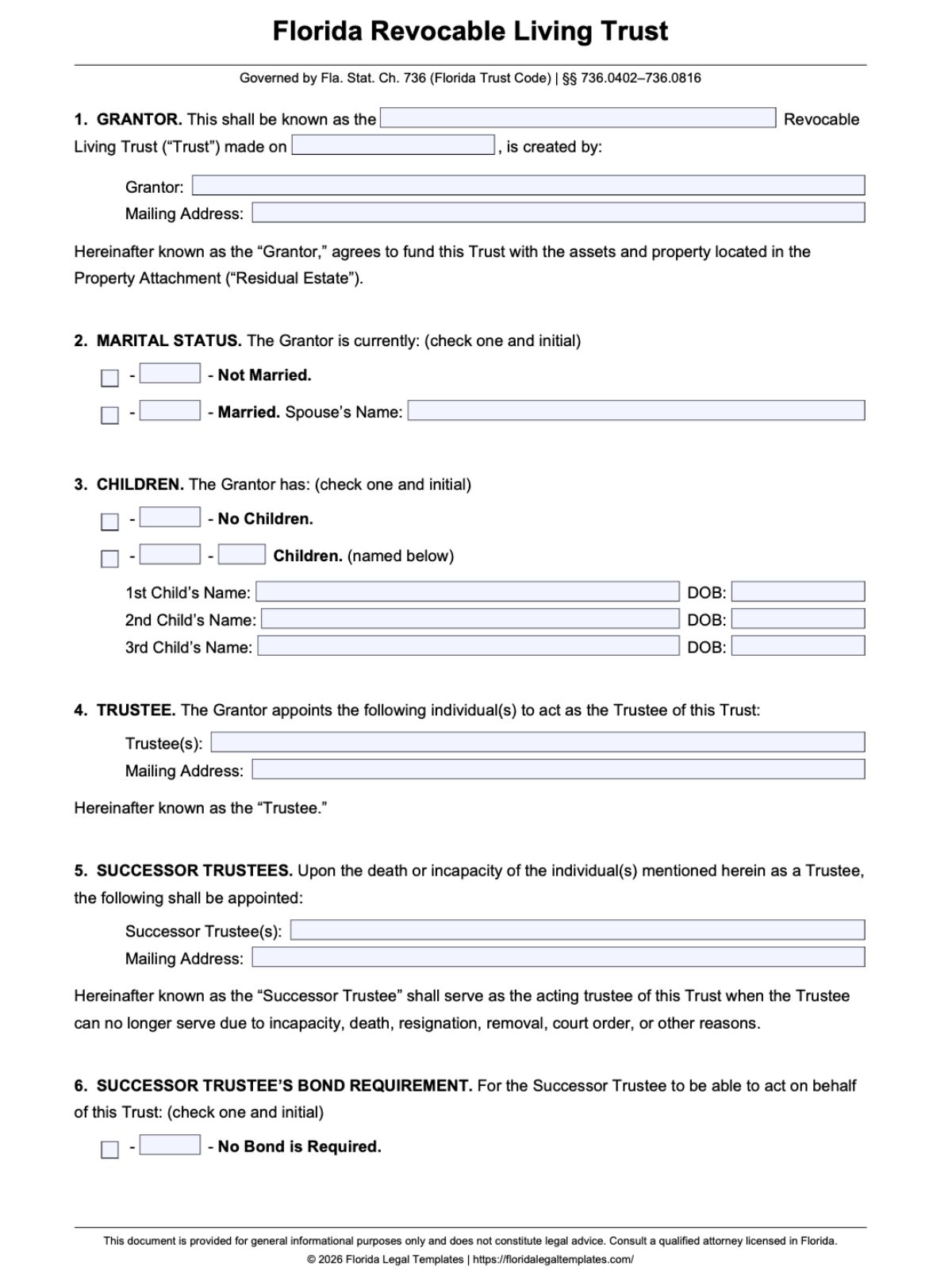
A florida revocable living trust form typically contains the core provisions needed to establish and operate the trust under Florida law. Most templates include:
- Settlor identification
- Trustee and successor trustee appointments
- Beneficiary distribution instructions
- Revocation and amendment powers
- Trust funding language
- Trustee authority provisions
- Spendthrift protection clauses
A generic trust form downloaded online may not properly address Florida-specific legal requirements. A professionally drafted revocable trust agreement florida residents use should account for Florida homestead rules, witness execution standards, and statutory trust provisions under the Florida Trust Code.
A standard florida revocable trust template may be appropriate for:
- Married couples with ordinary estate plans
- Individuals who own Florida real estate
- Parents organizing inheritance distributions
- Retirees seeking probate avoidance
However, a free florida revocable trust form may not be sufficient for:
- Blended family disputes
- Tax-sensitive estates
- Beneficiaries with disabilities
- Business succession planning
- Homestead devise complications involving spouses or minor children
Most revocable living trust form florida templates are available in:
- PDF format
- Printable versions
- Fillable digital forms
Under Florida law, a revocable trust remains a private agreement during the settlor’s lifetime and is generally not filed with the court or registered with the state.
Many estate plans using a revocable trust are paired with a backup will document for probate overflow assets in case property is accidentally left outside the trust. Individuals planning incapacity protection alongside trust administration may also benefit from reviewing a durable financial authority form to allow asset management before a successor trustee takes control.
What Is a Revocable Living Trust in Florida?
A revocable trust florida residents create is a legal arrangement where the settlor transfers ownership of assets into a trust while retaining the right to amend, revoke, or control the trust during life.
Under Florida law, the settlor commonly serves as the initial trustee, meaning they continue managing trust property as usual. Upon incapacity or death, a successor trustee takes over administration according to the trust terms.
For a Florida reader, the practical difference is simple: a will generally controls property at death, while a properly funded revocable trust can hold and manage property during the settlor’s lifetime and after death.
- A will only becomes effective after death
- A revocable trust can operate during lifetime and incapacity
- Trust assets may avoid probate
- Trust administration generally remains more private
A revocable trust also differs from an irrevocable trust because the settlor retains control and can revoke the arrangement at any time while competent.
Florida residents commonly use revocable trusts for:
- Probate avoidance
- Privacy preservation
- Incapacity planning
- Managing multiple properties
- Streamlining inheritance transfers
After the settlor’s death, the trust usually becomes functionally irrevocable, and the successor trustee must follow the distribution instructions contained in the trust agreement.
A revocable trust is only one part of a broader Florida estate plan. Many families also prepare advance healthcare directives such as a life-support declaration document so medical treatment preferences remain enforceable during incapacity situations that fall outside ordinary trust administration.
Key Florida Laws That Affect This Document
Florida revocable trusts are governed primarily by the Florida Trust Code under Chapter 736 of the Florida Statutes.
| Topic / Issue | Florida Legal Rule | Governing Statute |
|---|---|---|
| Execution Formalities | Revocable trusts with testamentary provisions must be executed with the same formalities as a will, including two witnesses | § 736.0403(2)(b) |
| Capacity Requirements | The settlor must have the capacity required to make a Florida will, which generally means being of sound mind and at least 18 years old or an emancipated minor | § 736.0601 |
| Notice of Trust | For a trust described in §733.707(3), the trustee must file a Notice of Trust after the settlor’s death with the appropriate probate court | § 736.05055 |
| Spendthrift Protection | A trust can include a spendthrift provision to restrict certain creditor claims against a beneficiary’s trust interest, provided the provision satisfies §736.0502 | § 736.0502 |
| Trustee Self-Dealing | Trustees cannot engage in self-dealing transactions unless properly authorized | § 736.0802 |
| No-Contest Clauses | Clauses penalizing beneficiaries for contesting a trust are unenforceable in Florida | § 736.1108 |
Florida law imposes strict execution requirements on revocable trusts because they often function as will substitutes. If the testamentary portions of the trust are not properly executed, inheritance provisions may become vulnerable to litigation or invalidation.
Florida also imposes operational duties on trustees. A successor trustee who mishandles trust assets, ignores fiduciary obligations, or engages in self-dealing may face court challenges and personal liability.
For statutory reference, see the official Florida Legislature resources for Florida Trust Code Chapter 736 and Florida Probate Code Chapter 732.
Execution Requirements Under Florida Law
Pursuant to Florida Statutes § 736.0403(2)(b), the testamentary portions of a revocable trust must be executed with the same formalities required for a valid will.
This generally requires:
- The settlor to sign at the end of the document
- Two attesting witnesses
- Witnesses signing in the presence of the settlor and each other
Improper execution can create serious problems. If witness requirements are not satisfied, beneficiaries may challenge the trust, and certain dispositive provisions could become unenforceable.
Self-Proving Affidavit and Notarization
Florida law does not strictly require notarization to make a revocable trust valid. However, many florida revocable living trust pdf templates include a self-proving affidavit signed before a notary.
The affidavit helps streamline administration after death by reducing the need to locate witnesses later during probate-related proceedings.
Relevant statutory authority appears under Fla. Stat. § 732.503.
Spendthrift Clauses and Creditor Protection
Florida permits spendthrift clauses that restrict a beneficiary’s creditors from reaching future trust distributions.
Under Florida Statutes § 736.0502, compliant trust language commonly states:
“The interest of a beneficiary in the income or principal of this trust may not be voluntarily or involuntarily transferred before payment or delivery of the interest to the beneficiary by the trustee.”
These provisions primarily protect beneficiaries, not the settlor. Because the trust remains revocable during life, the settlor’s own creditors can generally still reach trust assets.
Florida Homestead Restrictions
Florida homestead law creates unique estate-planning complications. Under §732.4015 and the Florida Constitution, homestead generally cannot be devised if the owner is survived by a spouse or minor child, subject to the statutory and constitutional exceptions.
As a result, a florida revocable living trust should contain carefully drafted homestead provisions addressing:
- Surviving spouse rights
- Minor child protections
- Devise limitations
- Waiver considerations
The homestead rules deserve particular attention because §732.4015 treats certain trust dispositions of homestead as devises, so a trust provision that conflicts with the statute may not produce the intended result.
Trustee Duties and Self-Dealing Restrictions
Trustees owe fiduciary duties to beneficiaries and must act in good faith when administering trust assets.
Under Florida Statutes §736.0802, a trustee’s conflicted transaction involving trust property may be voidable unless an applicable statutory or trust-authorized exception applies:
- Purchase trust property personally
- Sell personal assets to the trust
- Use trust property for personal gain
- Enter conflicted transactions without authorization
Improper self-dealing transactions may become voidable and expose the trustee to legal liability.
Invalid No-Contest Clauses in Florida
Florida Statutes §736.1108 makes provisions that purport to penalize an interested person for contesting a trust or bringing certain trust proceedings unenforceable.
Section 736.1108 addresses the enforceability of penalty clauses in trust instruments; it does not establish a closed list of grounds for challenging a trust.
A clause attempting to automatically disinherit someone for contesting the trust is generally void under Florida public policy.
When to Use a Florida Revocable Trust
Florida revocable living trust is most useful when the owner wants one structure to manage trust-owned property during life and distribute that property after death without putting each funded asset through probate.
Common situations include:
- Homeowners seeking probate avoidance
- Families with multiple real estate properties
- Incapacity planning
- Privacy-focused estate planning
- Structured inheritance planning for children
- Married couples organizing shared assets
A revocable trust may be less useful for individuals with:
- Very small estates
- Minimal probate exposure
- Immediate creditor-protection goals
- Medicaid planning objectives requiring irrevocable transfers
Because revocable trusts remain amendable and controlled by the settlor, they generally do not provide the same asset protection benefits as irrevocable trust structures.
How to Create or Fill Out a Florida Revocable Living Trust
Choose the Parties to the Trust
The trust should clearly identify:
- The settlor
- Initial trustee
- Successor trustee
- Beneficiaries
Many settlors appoint themselves as trustee during life and designate a trusted family member or professional fiduciary as successor trustee.
Identify Trust Property
The trust agreement should identify the categories of assets intended for transfer, including:
- Real estate
- Bank accounts
- Brokerage accounts
- Business interests
- Valuable personal property
The trust only controls property properly transferred into it.
Draft Distribution Instructions
The trust should explain how assets will pass after death, including:
- Immediate distributions
- Delayed inheritance schedules
- Contingency beneficiaries
- Ongoing management for younger beneficiaries
Vague instructions often lead to beneficiary disputes.
Include Florida-Specific Clauses
A professionally drafted florida revocable trust should address Florida-specific issues such as:
- Spendthrift language
- Trustee authority provisions
- Homestead restrictions
- Amendment rights
- Revocation procedures
Properly Execute the Trust
Florida execution requirements should be followed carefully. The trust should be signed before two witnesses, and many settlors also execute a self-proving affidavit before a notary.
Improper execution remains one of the most common reasons trusts become vulnerable to litigation.
Fund the Trust
Creating the trust alone is not enough. Assets must be retitled into the trust’s name.
Common funding mistakes include:
- Forgetting to transfer deeds
- Leaving bank accounts outside the trust
- Failing to coordinate beneficiary designations
An unfunded trust may fail to accomplish probate-avoidance goals.
When transferring business interests or privately owned assets into a trust, supporting ownership records often become important during administration. For example, individuals funding trusts with vehicles, boats, or recreational assets frequently organize related ownership transfer documentation to preserve clean title records and reduce disputes involving inherited property.
Trust Funding and Asset Transfer Issues
Trust funding is often the most overlooked part of estate planning. Even a properly drafted revocable trust florida document may fail operationally if assets are never transferred into the trust.
Commonly transferred assets include:
- Florida real estate
- Brokerage accounts
- Non-retirement investment accounts
- Certain personal property
Some assets require special planning or are commonly excluded, including:
- Retirement accounts
- Vehicles
- Joint tenancy property
After the settlor’s death, a successor trustee may need to provide documentation establishing the trustee’s authority when dealing with trust-owned real estate; §736.1017 specifically addresses certifications of trust that may be furnished instead of the full trust instrument.
Additionally, trustees generally must file a Notice of Trust with the probate court under Florida Statutes § 736.05055.
Trust funding mistakes often occur when asset ownership records are incomplete or inconsistent. In situations involving small probate estates or omitted assets, families sometimes also rely on a simplified estate collection affidavit to handle certain property transfers outside full formal administration proceedings.
Limitations and Legal Considerations
Revocable Trusts Do Not Eliminate All Probate Risks
Even with a trust, probate may still become necessary for:
- Omitted assets
- Improperly titled property
- Certain creditor proceedings
July 2026 Statutory Update: Assets left outside a trust may still require probate, depending on how they are owned and whether a pour-over will applies. Effective July 1, 2026, Florida increased the threshold for Summary Administration to $150,000 under Ch. 2026-57. An estate meeting the statutory requirements may qualify for Summary Administration rather than Formal Administration.
Many estate plans still include a pour-over will to capture assets unintentionally left outside the trust.
Although revocable trusts help manage probate exposure, they do not replace every estate-planning document. Many Florida residents still execute a healthcare decision authorization form to appoint someone for medical decisions that trustees generally cannot make under trust authority alone.
No Immediate Asset Protection for the Settlor
A revocable trust does not shield the settlor’s own assets from creditors during life because the settlor retains control over trust property.
Individuals seeking stronger creditor protection often explore irrevocable trust structures instead.
The Sole Identity Merger Problem
Under Fla. Stat. §736.0402(1)(e), a trust cannot be created if the same person is the sole trustee and sole beneficiary. The statute does not require a separate remainder beneficiary merely because the settlor is also the trustee and a lifetime beneficiary. Simply acting as the sole lifetime trustee and lifetime beneficiary does not invalidate a standard living trust, provided remainder beneficiaries are named to inherit after death.
Ongoing Administrative Responsibilities
Even revocable trusts require maintenance. Trustees and settlors should:
- Maintain records
- Update trust assets
- Review successor trustee designations
- Amend the trust after major life changes
A trust that still names a deceased successor trustee or no longer matches the owner’s accounts and deeds can leave the successor trustee with avoidable administration work.
The Joint Trust “Homestead Half-Step” Trap
A widespread drafting error occurs when a married couple executes a single Joint Revocable Living Trust to hold their real estate, rather than keeping separate individual trusts. Under Florida common law and property appraiser rules, if a primary residence is transferred into a joint trust where the surviving spouse does not possess an absolute, unconditional lifetime right to revoke or amend the trust as to their share, the property appraiser may determine that a change of ownership occurred upon the first spouse’s death.
Joint-trust ownership can create homestead and property-tax questions after the first spouse’s death, but the Save Our Homes assessment rules depend on the specific ownership and transfer involved, and Florida law contains exceptions for certain transfers between spouses and qualifying survivorship transfers. The surviving spouse will retain the physical home but lose their accumulated tax protections, causing a massive, unexpected spike in annual property taxes. When using a joint trust in Florida, the trust and deed should be reviewed carefully for homestead rights and post-death ownership consequences rather than relying on §196.041 alone.
Common Mistakes to Avoid
Common errors involving revocable trusts in florida include:
- Using non-Florida trust templates
- Ignoring witness formalities
- Failing to fund the trust
- Naming unreliable successor trustees
- Violating homestead restrictions
- Including unenforceable no-contest clauses
- Leaving conflicting beneficiary designations outside the trust
- Drafting vague inheritance instructions
- Engaging in trustee self-dealing
- Failing to update the trust after divorce, remarriage, or major asset changes
These mistakes can lead to probate litigation, delayed distributions, invalid trust provisions, or unintended inheritance outcomes.
Florida Revocable Living Trust vs Other Estate Planning Documents
Revocable Trust vs Last Will and Testament
A will generally passes through probate, while properly funded trust assets may avoid probate entirely.
Trusts also provide greater privacy because they are not typically filed publicly during the settlor’s lifetime.
Revocable Trust vs Irrevocable Trust
A revocable trust allows ongoing control and flexibility. An irrevocable trust generally involves surrendering control in exchange for potential tax or creditor-protection benefits.
Revocable Trust vs Transfer-on-Death Planning
Transfer-on-death designations can simplify certain account transfers but may not provide centralized estate management or incapacity planning like a trust.
Trusts also handle more complex distribution structures more effectively.
Frequently Asked Questions
Does a revocable living trust avoid probate in Florida?
Properly funded trust assets can generally avoid probate administration in Florida. However, assets left outside the trust may still require probate proceedings.
Does a Florida revocable trust need to be notarized?
Florida law does not strictly require notarization for validity, but many trusts include notarized self-proving affidavits to simplify later administration.
Can I put my Florida homestead into a revocable trust?
Yes, but Florida homestead restrictions must be handled carefully, particularly when the settlor is survived by a spouse or minor child.
What happens if a revocable trust is never funded?
An unfunded trust may fail to avoid probate because the trust does not control assets that were never transferred into it.
Can a revocable trust protect assets from creditors in Florida?
Generally, no. Because the settlor retains control, creditors can usually still reach trust assets during the settlor’s lifetime.
Does a trustee need to file anything after the settlor dies in Florida?
Yes. Under Florida Statutes § 736.05055, trustees generally must file a Notice of Trust with the probate court after the settlor’s death.
Legal Disclaimer: This article provides general information about Florida revocable living trusts and is not legal advice. Laws and procedures may change, and individual circumstances can affect the outcome. Consider consulting a qualified Florida attorney for advice about your specific situation.