
Florida Non-Military Affidavit (Free PDF Form & Requirements)
A Florida non-military affidavit is a court filing used before a court may enter a default judgment against an individual defendant who has failed to respond to a lawsuit. Rather than serving as a general sworn statement, it confirms whether the defendant is protected by the federal Servicemembers Civil Relief Act (SCRA). Without a compliant affidavit, a default judgment may be delayed—or even reopened later if the defendant is found to have been on active military duty.
Whether you are filing a civil lawsuit, foreclosure, eviction, small claims case, or certain family law matter, the military-status affidavit helps the court determine whether SCRA protections affect a requested default judgment. Using the form appropriate to your case and keeping a record of how you verified the defendant’s status can prevent avoidable delays.
Candice Hayden, Legal Writer
Maria Rosso, Florida Probate, Guardianship and Estate Planning Attorney
Free Florida Non-Military Affidavit Template
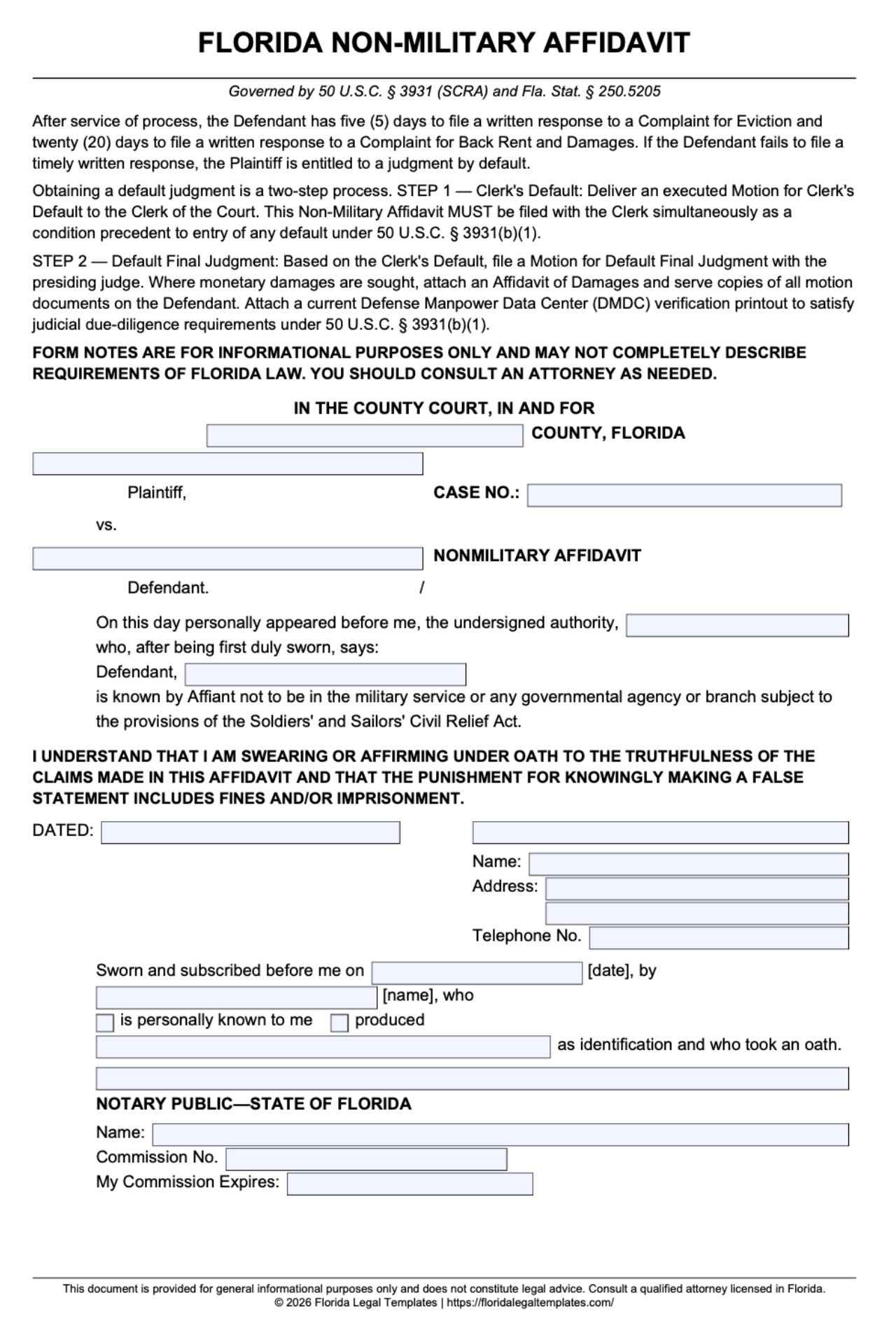
Our free Florida Non-Military Affidavit template follows the structure commonly used in Florida courts and aligns with:
- Florida Family Law Form 12.912(b) for family law proceedings
- General civil litigation defaults are governed by Fla. R. Civ. P. 1.500, while Form 1.988 is the Florida Supreme Court form for a judgment after default; the military-status affidavit requirement comes from 50 U.S.C. § 3931.
- Florida Small Claims default procedures where applicable
The template includes:
- Court caption
- Plaintiff and defendant information
- Three required military status declarations
- Space for supporting facts
- DMDC verification attachment reference
- Notary acknowledgment or Florida unsworn declaration
- Signature block
This template is appropriate for:
- Plaintiffs
- Attorneys
- Process servers
- Individuals requesting a Clerk’s Default or Default Judgment
Important limitation
A Florida Non-Military Affidavit applies only to individual defendants.
It should never be used when the defendant is:
- Corporation
- LLC
- Partnership
- Trust
- Other business entity
Business entities cannot serve in the U.S. military. Filing a military affidavit for an LLC or corporation demonstrates a procedural error and does not satisfy the court’s requirements.
What Is a Non-Military Affidavit in a Florida Case?
A Florida Non-Military Affidavit serves a narrower purpose than an ordinary affidavit: it gives the court the military-status information required before it enters judgment against a defendant who has not appeared.
Federal law protects active-duty service members from losing lawsuits through default judgments simply because military service prevented them from responding. Before granting a default judgment against a non-appearing individual, the court must know whether that person is entitled to those protections.
Its purpose is to give the court the information it needs to apply the SCRA before entering judgment.
Instead of proving liability, the affidavit answers one procedural question:
Is the defendant currently protected by the Servicemembers Civil Relief Act?
Because of this purpose, the affidavit is filed within the existing court case rather than as a standalone legal document.
Common proceedings requiring it include:
- Civil lawsuits
- Debt collection actions
- Foreclosures
- Residential eviction cases
- Certain family law matters
- Small claims cases
Its practical role is simple: it clears—or blocks—the path toward default depending on the defendant’s military status.
Key Florida & Federal Laws Governing Florida Non-Military Affidavit
The SCRA and Florida Default Judgment Rules
| Topic / Issue | Florida Legal Rule | Governing Statute |
|---|---|---|
| Mandatory Condition Precedent for Default | Plaintiff must file an affidavit addressing military status before default judgment | 50 U.S.C. §3931(b)(1); Fla. R. Civ. P. 1.500 |
| Execution & Verification Standards | Must be sworn before a notary/deputy clerk or signed under Florida’s unsworn declaration statute | Fla. Stat. § 92.525; Fla. Stat. §117.05(13) |
| Attorney Ad Litem Appointment | If the defendant appears to be in military service, the court may not enter judgment until it appoints an attorney to represent the defendant. | 50 U.S.C. § 3931(b)(2) & Fla. Stat. § 250.82 |
| Mandatory Stay of Proceedings | The court must grant a stay of at least 90 days when the defendant is in military service and the statutory conditions for a stay under 50 U.S.C. § 3931(d) are met. | 50 U.S.C. §3931(d) |
| False Affidavit Penalties | Knowingly making or using a false military affidavit can result in a federal fine or imprisonment for not more than one year, or both, and a knowingly false written declaration may also constitute third-degree felony perjury under Florida law. | 50 U.S.C. § 3931(c) & Use § 92.525(3) for the written-declaration point; § 837.02 separately addresses false statements under oath in official proceedings. |
The SCRA establishes nationwide protections for active-duty servicemembers, while Florida’s procedural rules determine how those protections operate inside Florida courts. Together, they require plaintiffs to verify military status before obtaining a default judgment.
Equally important is the affidavit’s verification. Whether signed before a notary or completed as an unsworn declaration under Florida law, the signer is making statements under penalty of perjury. Unsupported assumptions or careless guesses expose the affiant to significant legal consequences.
What Happens After You File It
The next procedural step depends entirely on the military status declared in the affidavit.
Defendant is NOT on active duty
If the affidavit demonstrates that the defendant is not in military service and the remaining default requirements are satisfied, the clerk or court may proceed with entering default.
Defendant IS on active duty
Federal law prevents an immediate default judgment.
Instead:
- the court appoints an independent Attorney Ad Litem,
- the servicemember’s interests receive additional protection,
- proceedings may be stayed for at least 90 days if military service materially affects the ability to appear.
Military status cannot be determined
If military status cannot be determined, the affidavit should state that fact and describe the efforts made to determine the defendant’s status; the court may also require a bond before entering judgment.
Simply checking “unknown” without explaining investigative efforts often delays the default process.
Skipping the affidavit
Failing to file a compliant affidavit creates substantial procedural risk.
If a default judgment was entered during the defendant’s military service or within 60 days after service ended, the court may reopen the judgment if the statutory requirements for reopening under 50 U.S.C. § 3931(g) are met. Courts also take false affidavits seriously because knowingly misrepresenting military status may expose the signer to both federal criminal liability and Florida perjury charges.
When using Florida’s unsworn declaration procedure under Fla. Stat. § 92.525 instead of formal notarization, the document must include the verbatim statutory verification phrase:
“Under penalties of perjury, I declare that I have read the foregoing document and that the facts stated in it are true”
This declaration must appear at the end of or immediately below the document being verified and above the signature; using different wording may fail to satisfy the statutory verification method.
The Three Required Status Declarations (And How to Choose)
Florida forms may provide several ways to document military status. Under 50 U.S.C. § 3931(b)(1), the affidavit must state whether the defendant is in military service or state that the plaintiff is unable to determine that status.
1. Defendant IS currently on active duty
Select this only when available evidence confirms active military service.
Once this declaration is made, default procedures change significantly because additional protections become mandatory.
2. Defendant IS NOT currently on active duty
This declaration requires more than personal belief.
The affidavit should establish factual support that:
- the defendant is not currently serving,
- If referring to Form 12.912(b): the respondent is not now on active duty and has not been on active military service within the 30 days immediately before the affidavit.
- reasonable investigation supports that conclusion.
A Defense Manpower Data Center (DMDC) status certificate is commonly useful evidence of military status, but the federal statute does not make a DMDC certificate mandatory in every case.
3. Military status cannot be determined
Sometimes available information is inconsistent.
Examples include:
- employer provides uncertain information;
- relatives disagree about military status;
- defendant cannot be located;
- identifying information is incomplete.
In these situations, the affidavit should explain the investigative steps already taken rather than making an unsupported assumption.
Courts generally expect documented due diligence instead of speculation.
A common mistake is selecting “Not in military” simply because the plaintiff has never known the defendant to serve. That assumption alone is rarely sufficient if challenged later.
Execution, Notarization & DMDC Verification
Completing the affidavit properly involves more than filling in blanks.
A practical workflow looks like this:
Step 1 — Investigate military status
Gather available identifying information and determine whether military service can be verified.
Step 2 — Obtain DMDC verification
Whenever possible, obtain an official Department of Defense Manpower Data Center certificate showing military status.
If a certificate cannot be obtained, document every reasonable effort made to verify service.
A “No Active Duty” DMDC Certificate Is Only as Good as the Information You Search
One mistake that causes avoidable challenges is treating every DMDC certificate as conclusive. The Defense Manpower Data Center can only search the identifying information you provide. If the defendant’s Social Security number, date of birth, or even the spelling of their legal name is incorrect, the certificate may report “No Active Duty” even though the search did not actually identify the right person.
In practice, if you do not have enough information to perform a reliable search, explain that limitation in the affidavit and describe the additional steps you took to verify military status, such as reviewing court records, prior contracts, employment records, or requesting identifying information obtained during service of process. Attaching a DMDC certificate generated from incomplete or questionable data without that explanation can weaken, rather than strengthen, your showing of due diligence.
The SCRA requires the affidavit to state whether the defendant is in military service or that the plaintiff is unable to determine military status after making a good-faith investigation. See 50 U.S.C. § 3931(b)(1). A carefully documented explanation of why the search could not be completed accurately is often more defensible than relying on an unreliable “No Active Duty” result alone.
Step 3 — Complete the appropriate declaration
Choose only one of the three required status statements and include supporting facts—not merely a checked box.
Step 4 — Execute the affidavit
Either:
- sign before a Florida Notary Public or Deputy Clerk, or
- execute the document using Florida’s authorized unsworn declaration language.
Step 5 — Attach supporting documentation
Rather than merely mentioning the DMDC search, attach the certificate as an exhibit whenever available. Courts commonly view attached documentation as stronger evidence of reasonable diligence.
Step 6 — File with the court
The affidavit is generally filed electronically through the Florida Courts E-Filing Portal with the clerk handling the pending case, subject to the filing procedures that apply in the particular court and case.
In family-law cases using Form 12.912(b), the affidavit is filed with the applicable motion for default; in other cases, follow the filing procedure required by the court and applicable rules.
Limitations and When This Affidavit Doesn’t Apply
A Florida Non-Military Affidavit has a very specific purpose. It is designed to satisfy the court’s obligation under the Servicemembers Civil Relief Act (50 U.S.C. § 3931) before entering a default judgment against an individual who has not appeared in a case. Using it outside that context—or for the wrong type of defendant—can delay proceedings and create unnecessary procedural issues.
It does not apply to businesses or other legal entities
One of the most common filing errors is submitting a non-military affidavit for a business defendant.
This affidavit applies only to natural persons because only individuals can serve in the United States Armed Forces. It should never be used for:
- Corporations
- Limited Liability Companies (LLCs)
- Partnerships
- Trusts
- Government agencies
- Other legal entities
If your lawsuit is against a corporation or LLC that failed to respond, the court may still require proof supporting the default, but the SCRA military-status requirement concerns individual defendants rather than business entities.
It is not recorded in public land records
Unlike deeds, mortgages, or certain final judgments, a Florida Non-Military Affidavit is not a recordable real estate document.
Instead, it becomes part of the court file in the pending litigation. It generally appears in county public records only if attached as an exhibit to a recorded final judgment.
Filing the affidavit does not guarantee a default judgment
Many plaintiffs mistakenly believe filing the affidavit automatically entitles them to a default judgment.
It does not.
The affidavit satisfies only one procedural requirement. The court must still determine whether:
- service of process was valid;
- sufficient time has passed for the defendant to respond;
- all procedural requirements for default have been satisfied; and
- no federal military protections prevent the requested judgment.
Even after a default is entered, military status can become an issue if later evidence shows the defendant qualified for SCRA protection when the judgment was entered.
Common Mistakes That Get Default Judgments Reopened
Most challenges to default judgments do not arise because the plaintiff misunderstood the underlying claim. Instead, they stem from procedural shortcuts taken before requesting the default.
Assuming the defendant is not in military service
Perhaps the most frequent mistake is relying on personal assumptions instead of evidence.
Statements such as:
- “I don’t think they serve.”
- “I’ve known them for years.”
- “Their family said they weren’t in the military.”
are poor substitutes for documented verification.
Whenever practical, obtain a Defense Manpower Data Center (DMDC) certificate. If one cannot be obtained, explain exactly what investigative steps were taken before completing the affidavit.
Using the wrong Florida form
Florida has different procedural forms depending on the type of case.
For example:
- Family law proceedings commonly use Form 12.912(b).
- General civil litigation follows Form 1.988 conventions.
- Small claims actions follow separate procedural rules governing defaults.
Using language from an unrelated affidavit or another state’s form may require correction before the court proceeds.
Omitting supporting due diligence
Checking a military-status box without explaining why that conclusion was reached creates unnecessary risk.
Courts frequently expect supporting facts such as:
- DMDC verification;
- direct communication with the defendant;
- employer confirmation;
- observations documented by the process server; or
- other reasonable investigative efforts.
Attaching the DMDC certificate as an exhibit often strengthens the filing because it provides independent documentation supporting the affidavit’s conclusion.
Forgetting the required verification language
When the affidavit is not notarized, Florida law requires the statutory declaration contained in Fla. Stat. § 92.525.
Without the required perjury statement, the affidavit may not satisfy Florida’s verification requirements.
Filing a false affidavit
Knowingly misrepresenting military status carries consequences far beyond having the filing rejected.
Federal law authorizes criminal penalties for false military-status affidavits, while Florida law also recognizes criminal liability for perjury under Fla. Stat. § 837.02.
Landlords, lenders, and creditors who intentionally bypass SCRA protections in eviction proceedings or foreclosure proceedings also risk court sanctions, dismissal of their actions, and potential civil liability.
The practical consequence
If a default judgment is entered without a compliant affidavit and the defendant later proves they were entitled to SCRA protections, the court may reopen the judgment after military service ends. That can force the litigation to begin again, increasing legal costs, delaying enforcement, and undoing months of work that could have been avoided through proper compliance.
Frequently Asked Questions (FAQ)
Can a default judgment be reversed later if the non-military affidavit turns out to be wrong?
Yes. If a default judgment was entered without complying with the requirements of the Servicemembers Civil Relief Act, and the defendant later establishes that they were entitled to military protections, the judgment may be reopened under federal law. Beyond delaying the case, knowingly submitting inaccurate information can expose the affiant to criminal penalties.
Is a DMDC certificate legally required, or is my own due diligence enough?
Federal law requires the affidavit to state facts supporting the defendant’s military status. Although a DMDC certificate is not expressly mandated in every case, Florida courts commonly expect it or other well-documented evidence demonstrating reasonable due diligence. As a practical matter, attaching the certificate significantly reduces the likelihood of challenges to the affidavit.
What happens to my case if the affidavit shows the defendant is in active military service?
A default judgment generally cannot proceed in the ordinary course. Under the SCRA and Florida’s military protection framework, the court may appoint an Attorney Ad Litem to protect the servicemember’s interests and stay the proceedings for at least 90 days when military service materially affects the defendant’s ability to appear or defend the case.
Can I use one non-military affidavit for a foreclosure case and a separate eviction case against the same person?
No. A Florida Non-Military Affidavit is case-specific. Each lawsuit has its own court file, procedural history, and filing requirements. Even if both cases involve the same defendant, a separate affidavit should be prepared and filed in each action because the court evaluates military status within the context of the individual proceeding.
Legal Disclaimer:This article is for general informational purposes only and is not legal advice. Florida court procedures and filing requirements can vary by case type and judicial circuit, so consider consulting a Florida attorney before relying on this affidavit in a pending case.