Florida Affidavit of Heirship (Free Fillable PDF Template)
A Florida affidavit of heirship helps identify the people who may be entitled to inherit from someone who died without a will, but it does not transfer property on its own — and the gap between what the document establishes and what institutions will actually do with it is where most families run into trouble.
Under Florida’s intestate succession laws at F.S. §732.101, an affidavit of heirs can document the family pedigree and heir relationships, but whether a bank, title company, or county recorder can act on it depends on the applicable statute and procedure — a private affidavit does not automatically substitute for a court order.
I’ve watched families spend weeks preparing a thorough, properly notarized florida affidavit of heirs only to have a title company decline it because their underwriting standards required a probate court order regardless of how clear the heirship was. The template and breakdown below explain what a Florida heirship affidavit can document, when a statutory procedure under F.S. §735.304 may apply, and when a different probate or asset-specific procedure is required, which institutions are most likely to honor it and which typically won’t, and when a Summary Administration petition may be the more reliable path forward, particularly because Florida increased the §735.201 estate-value threshold to $150,000 effective July 1, 2026.
Candice Hayden, Legal Writer
Maria Rosso, Florida Probate, Guardianship and Estate Planning Attorney
Florida Affidavit of Heirship (PDF, Printable, Fillable)
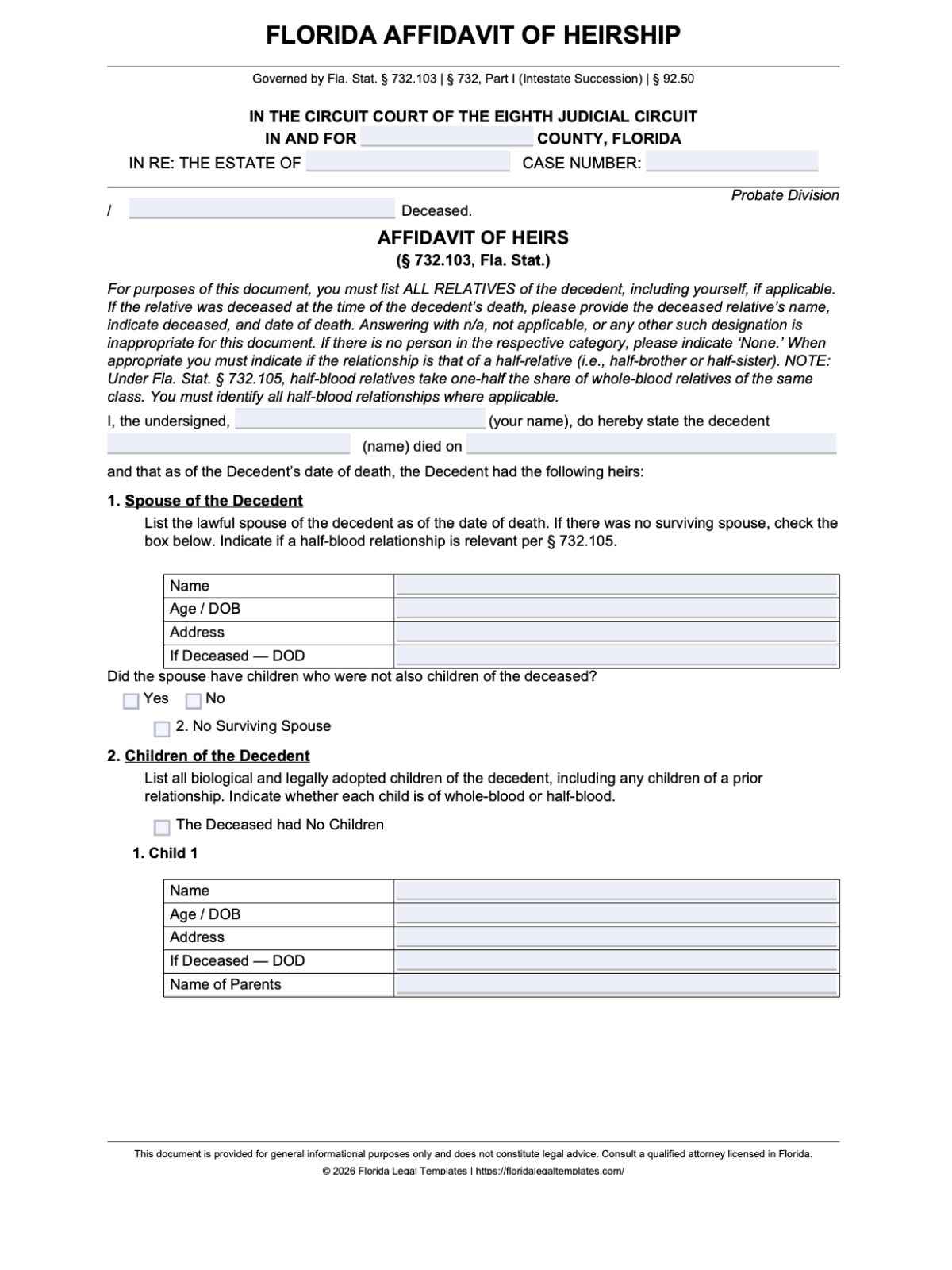
A Florida affidavit of heirs template provides a structured format to document family relationships and identify heirs under Florida law. These forms are typically available as printable or fillable documents.
What the document includes:
- Decedent’s full name and date of death
- Statement confirming no valid will exists (if applicable)
- Detailed family history (spouse, children, prior marriages)
- Identification of all legal heirs and their relationships
- Declaration regarding estate debts (if required for specific use cases)
- Notary jurat or statutory perjury declaration
Who should use this:
- Heirs of a deceased person without a will
- Individuals handling small estates or personal property
- Persons transferring vehicles or claiming limited assets
When this template may NOT be sufficient:
- Transferring probate real estate usually requires the appropriate probate or other legally sufficient title procedure; an informal heirship affidavit alone should not be assumed to transfer title.
- Estates with disputes among heirs
- Estates with significant debts
- Complex or multi-state estates
Key insight: An affidavit of heirs Florida document helps identify heirs—but it does not legally transfer ownership of real estate.
What Is an Affidavit of Heirship in Florida?
An affidavit of heirship in Florida is a sworn statement used to establish the legal heirs of a deceased person when no will exists. It is based on Florida’s intestate succession laws, which determine how property is distributed.
Under Florida law, heirship is governed by Title XLII, Chapter 732, which defines who qualifies as a legal heir when someone dies intestate (without a will).
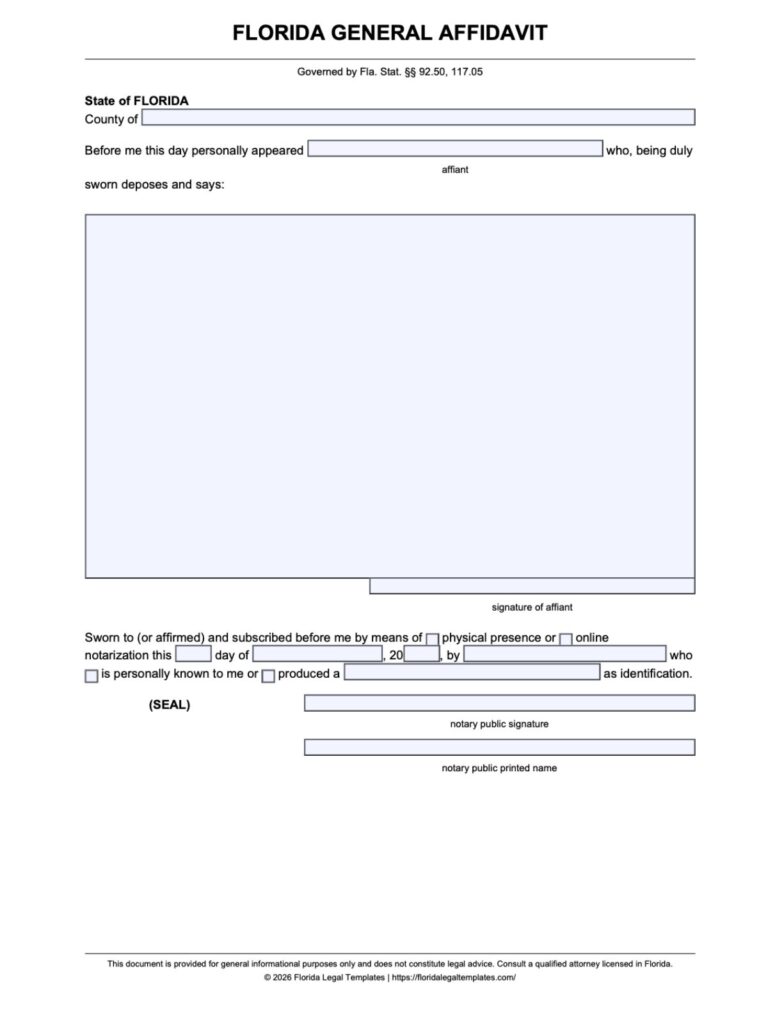
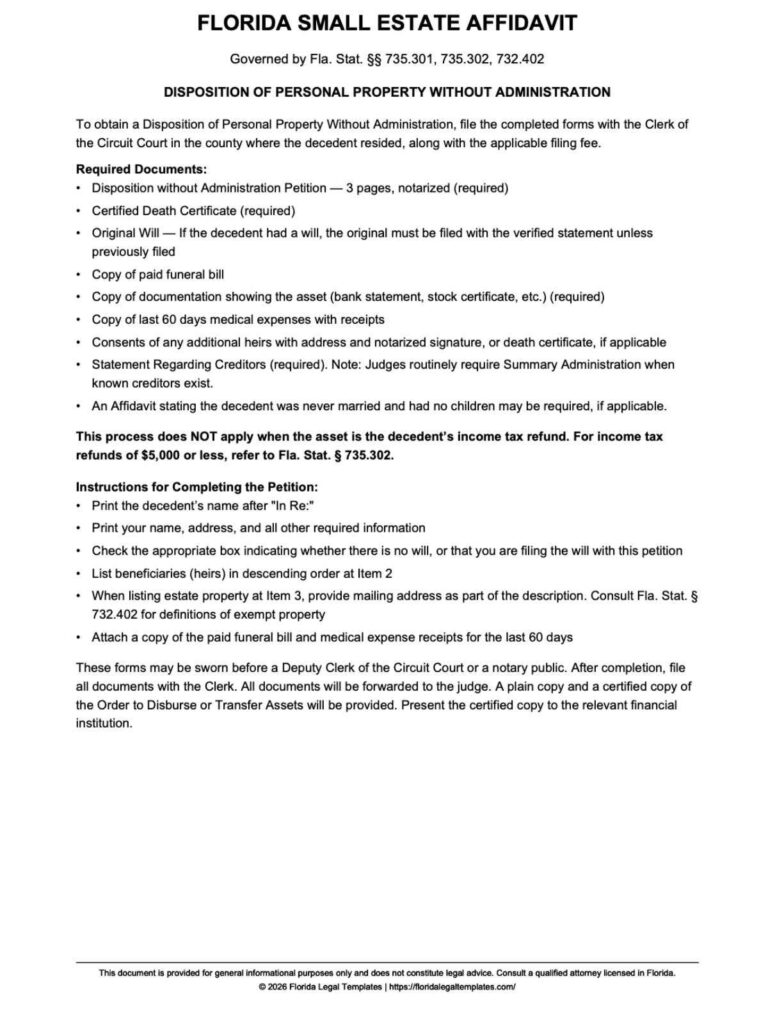
Florida probate law uses several different sworn estate documents depending on the asset involved, readers handling inheritance matters may also want to review other Florida affidavit formats commonly used in probate and property matters. For estates that qualify for simplified administration, a small estate transfer affidavit for limited probate situations may sometimes provide a more reliable procedural path.
Legal nuance:
This document is typically used in limited situations where:
- The estate qualifies for simplified handling
- No formal probate administration is necessary for certain assets
Critical distinction:
- Affidavit of heirship → Identifies heirs
- Probate court order → Transfers legal ownership
Key implication:
Do not treat a private heirship affidavit as a substitute for the title procedure applicable to Florida real estate. Florida Courts identifies real estate held solely by the decedent as a probate asset, while special homestead and title rules can change the analysis. If a deed or closing depends on the decedent’s ownership being cleared, the title company or probate court should be consulted before relying on an affidavit alone.
Key Florida Laws That Affect Florida Affidavit of Heirship
Summary of Applicable Laws
| Topic / Issue | Florida Legal Rule | Governing Statute |
|---|---|---|
| Intestate Heir Determination | Defines who qualifies as legal heirs | Fla. Stat. Ch. 732 |
| Small Estate Affidavit Use | For qualifying intestate estates, §735.304 now permits disposition without administration when the decedent has been dead more than 1 year and the nonexempt personal property does not exceed $20,000 plus specified preferred funeral and last-60-days medical and hospital expenses; the $20,000 threshold took effect July 1, 2026.
For §735.304, the decedent must have been deceased for more than 1 year; a different provision, §735.301, addresses certain estates consisting only of exempt property and specified expenses. |
Fla. Stat. Ch. 735 |
| Notary Requirement (Jurat) | When the document must be verified, it should use the oath, affirmation, or statutory written declaration authorized for that particular use; an acknowledgment is a different notarial act. | Fla. Stat. § 117.05(13) |
| Unsworn Declaration Option | Allowed only with statutory perjury wording | Fla. Stat. § 92.525 |
| Vehicle Title Transfer | Allows heir-based transfer without probate if conditions met | Fla. Stat. § 319.28 |
| Creditor Liability (2 Years) | Florida generally bars claims against the estate, personal representative, and beneficiaries 2 years after death, subject to the exceptions in Fla. Stat. §733.710; a separate claim-filing period applies when a Notice to Creditors is published under §733.702. | Fla. Stat. § §733.702 |
In Florida, “Heirship” is a strict pyramid. If the decedent is survived by descendants who are all also descendants of the surviving spouse, and the surviving spouse has no other descendant, the surviving spouse takes the entire intestate estate under §732.102(2). If one or more surviving descendants of the decedent are not lineal descendants of the surviving spouse, the surviving spouse receives one-half under §732.102(3); the spouse also receives one-half under §732.102(4) when all of the decedent’s surviving descendants are also the spouse’s descendants but the spouse has a descendant who is not a descendant of the decedent.
Florida’s heirship rules become especially important when inherited property must be cleared for sale or transfer after death. In situations involving estate tax liens or probate-related title issues, an estate tax lien release affidavit used in Florida probate administration may also be required before title companies will approve a closing.
Practical Impact & Document Clauses
Florida law strictly controls how an affidavit of heirs Florida can be used. Under Fla. Stat. Chapter 732, heirs must be identified according to intestate succession rules. Any mistake in listing heirs—such as excluding a child—can invalidate the affidavit.
When the document is notarized as an oath or affirmation, the notary must complete the appropriate jurat or notarial certificate under Fla. Stat. § 117.05; a statutory written declaration under §92.525 may be available when the applicable law authorizes that form of verification. If a written declaration is authorized or required instead of an oath or affirmation, the document must include the statutory wording prescribed by Fla. Stat. § 92.525:
“Under penalties of perjury, I declare that I have read the foregoing document and that the facts stated in it are true.”
For vehicle transfers, the affidavit must also include a specific declaration under Fla. Stat. § 319.28, confirming the estate has no debts and that heirs have agreed on distribution.
Real-world risks if rules are violated:
- Missing heirs → invalid inheritance claims
- Incorrect wording → document rejection
- False statements → potential criminal penalties, depending on the form of verification and applicable law
- Improper use → title defects or legal disputes
When to Use Florida Affidavit of Heirship
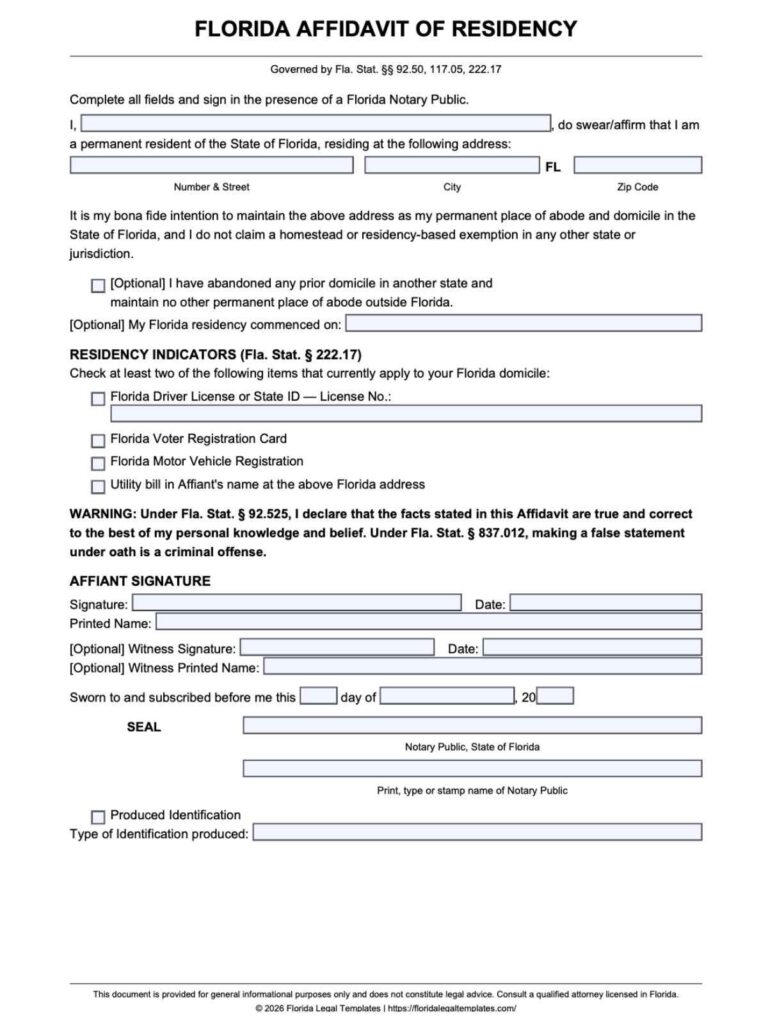
A Florida heirship affidavit is not a one-size-fits-all probate document. The legal effect depends on why you are signing it and which asset you are trying to collect or transfer.
Common use cases:
- Establishing heirs when no will exists
- Claiming small personal property assets
- Transferring vehicle ownership without probate
Practical scenarios:
- Collecting funds from small bank accounts
- Transferring a car title through FLHSMV
- Supporting simplified probate filings
When NOT to use:
- Transferring real estate title
- Resolving disputes among heirs
- Estates with significant creditor claims
Using this document in the wrong context can delay asset transfer or create legal issues.
One of the most common practical uses for a Florida heirship affidavit is transferring vehicles owned by a deceased family member when the estate qualifies for simplified handling. In those cases, supporting ownership records such as a Florida motor vehicle transfer document can help verify title history and reduce delays during FLHSMV processing.
How to Create or Fill Out the Florida Affidavit of Heirship
Completing a Florida affidavit of heirs requires accuracy and strict compliance with Florida law.
Step-by-step process:
- Identify the decedent (name and date of death)
- Confirm that no valid will exists
- Determine heirs under Florida intestate succession law
- List all heirs and their relationships
- Provide a clear family history (marriages, children, etc.)
- Confirm estate status (debts and agreements among heirs)
- Include required statements:
- Vehicle transfer clause (if applicable)
- Perjury statement (if not notarized)
- Add signature block
- Complete notary jurat or include unsworn declaration
- Submit based on asset type:
- Bank → directly to institution
- Vehicle → FLHSMV or tax collector
- Probate → court filing
Accuracy is critical when documenting family relationships, prior marriages, and legal heirs. If errors are discovered later in recorded probate or title documents, a Florida correction affidavit for clerical or recording mistakes may be needed to resolve inconsistencies before financial institutions or title companies will accept the paperwork.
Practical tips:
- Check the family history against the decedent’s marriage, birth, adoption, and death records before signing.
- Make sure children from prior relationships are included when they are heirs under Chapter 732.
- If the affidavit is being used under a specific statute, such as §319.28 or §735.304, use the statements required for that procedure rather than assuming a generic affidavit will work.
Limitations and Legal Considerations
A Florida affidavit of heirship has important limits. It can document the family relationships relevant to intestate succession, but it does not by itself provide the probate authority needed to transfer a probate asset. Real estate also requires special care because Florida’s homestead rules can change the probate analysis.
Florida-specific constraints:
- The applicable procedure depends on the asset and the statute being used.
- If verification is required, use the oath, affirmation, or statutory written declaration authorized for that particular procedure.
High-risk scenarios:
- Leaving out a person who may be an heir under Chapter 732
- Treating a private affidavit as authority to transfer a probate asset
- Using a generic affidavit when a specific statutory procedure, court filing, or title process applies
Edge cases:
Blended families and prior marriages deserve extra attention because Florida’s intestate shares depend on the surviving spouse’s descendants as well as the decedent’s descendants. Under §732.102, for example, a spouse may receive the entire intestate estate in one family configuration but only one-half in another.
Florida law generally requires a probate or other legally sufficient court procedure to clear title to probate real estate, although homestead property is subject to special rules and may require a separate determination.
Court-Authorized Disposition (§ 735.304) vs. Unofficial Private Affidavits
A frequent source of confusion for grieving families is confusing a self-prepared, private “Affidavit of Heirship” with a statutory Disposition Without Administration of Intestate Property under Fla. Stat. § 735.304. While an informal private affidavit may be accepted by the FLHSMV for vehicle title transfers under Fla. Stat. § 319.28, banks and financial institutions are under no legal obligation to release bank accounts or securities based solely on an un-filed private document.
To obtain distribution of qualifying intestate personal property without administration, an heir at law may file the affidavit required by Fla. Stat. §735.304, after which the court may authorize payment, transfer, disposition, delivery, or assignment of the property by letter or other writing under seal. This process is available if the intestate estate consists only of exempt personal property under § 732.402, constitutionally exempt personal property, and nonexempt personal property not exceeding $20,000 (pursuant to CS/HB 1337) plus preferred funeral and last 60 days’ medical expenses. Once the probate judge reviews the affidavit and issues an official authorization letter under the seal of the court, third-party institutions are statutorily discharged from liability and legally mandated to release the funds.
An affidavit of heirship does not replace broader estate planning documents or probate authority when ownership rights are disputed. In estates involving incapacity planning, delegated authority, or management of financial affairs before death, a durable financial authority document under Florida law serves a completely different legal purpose and should not be confused with heirship documentation.
Common Mistakes to Avoid
Omitting a legal heir
Consequence: Invalid affidavit and potential inheritance disputes
Using affidavit to transfer real estate
Consequence: Title defects and rejection by title insurers
Missing jurat or perjury clause
Consequence: Document becomes legally invalid
Incorrect family history
Consequence: Misdistribution of assets and legal challenges
Ignoring creditor liability
Consequence: Personal financial liability for estate debts
Under Fla. Stat. § 92.525, false statements in the affidavit can result in criminal penalties for perjury.
Frequently Asked Questions (FAQ)
Can a Florida affidavit of heirship transfer real estate?
No. Florida law requires probate court involvement to transfer real estate. An affidavit alone is not sufficient.
Do I need a notary for an affidavit of heirs in Florida?
A notarized oath or affirmation is one way to verify the document. A written declaration under § 92.525 may be used only when the applicable law, rule, or court order authorizes or requires that method of verification, and the statutory requirements must be followed.
How long are heirs liable for estate debts in Florida?
Under Fla. Stat. §735.304, recipients of property may be personally liable for a pro rata share of lawful estate claims, limited to the value of the property actually received; the separate two-year limitation is governed by §733.710.
Can I transfer a car title using an affidavit of heirship in Florida?
Yes. Under Fla. Stat. § 319.28, a vehicle title can be transferred using an affidavit if the estate has no debts and heirs agree on distribution.
A properly prepared Florida affidavit of heirship can simplify the handling of certain assets after death. However, because it does not replace probate for real estate and carries legal risks if used incorrectly, it must be completed carefully and in full compliance with Florida law.
Legal Disclaimer: This article provides general information about Florida estate and probate procedures and is not legal advice. Florida law and individual probate requirements can vary depending on the assets, family circumstances, debts, and documents involved. Consider consulting a Florida probate attorney before relying on an affidavit to transfer or collect estate property.