
Affidavit of No Florida Estate Tax Due (Free PDF Template)
The affidavit of no Florida estate tax due — commonly known as the DR-312 — is a form that Florida law no longer requires for most estates, yet it still shows up as a checklist item during property transfers because some title companies haven’t updated their procedures to reflect a change that took effect years ago.
Florida estate tax was eliminated for qualifying decedents who died after December 31, 2004, but the affidavit and lien provisions in Fla. Stat. § 198.32 remained in the statutes until the 2023 legislation changed their application. Effective July 1, 2023, Ch. 2023-207 changed Florida’s estate-tax affidavit and lien requirements for qualifying estates; for decedents who died after December 31, 2004, Fla. Stat. § 198.32(3) provides that the personal representative is not required to file the affidavit and the estate is not subject to the statutory lien. For estates covered by the 2023 changes, the DR-312 filing requirement no longer applies to probate proceedings commenced on or after July 1, 2023, or to probate proceedings pending on that date for which a final discharge had not been entered.
Estate representatives can still encounter delays when an outdated title checklist asks for a form that Florida law no longer requires, particularly when the closing agent has not confirmed what the underwriter actually needs.
The dr 312 affidavit florida information below explains what the form was, why it’s no longer required, and what to say when a title company asks for it anyway.
Candice Hayden, Legal Writer
Maria Rosso, Florida Probate, Guardianship and Estate Planning Attorney
Affidavit of No Florida Estate Tax Due (Form DR-312 PDF, Printable, Fillable)
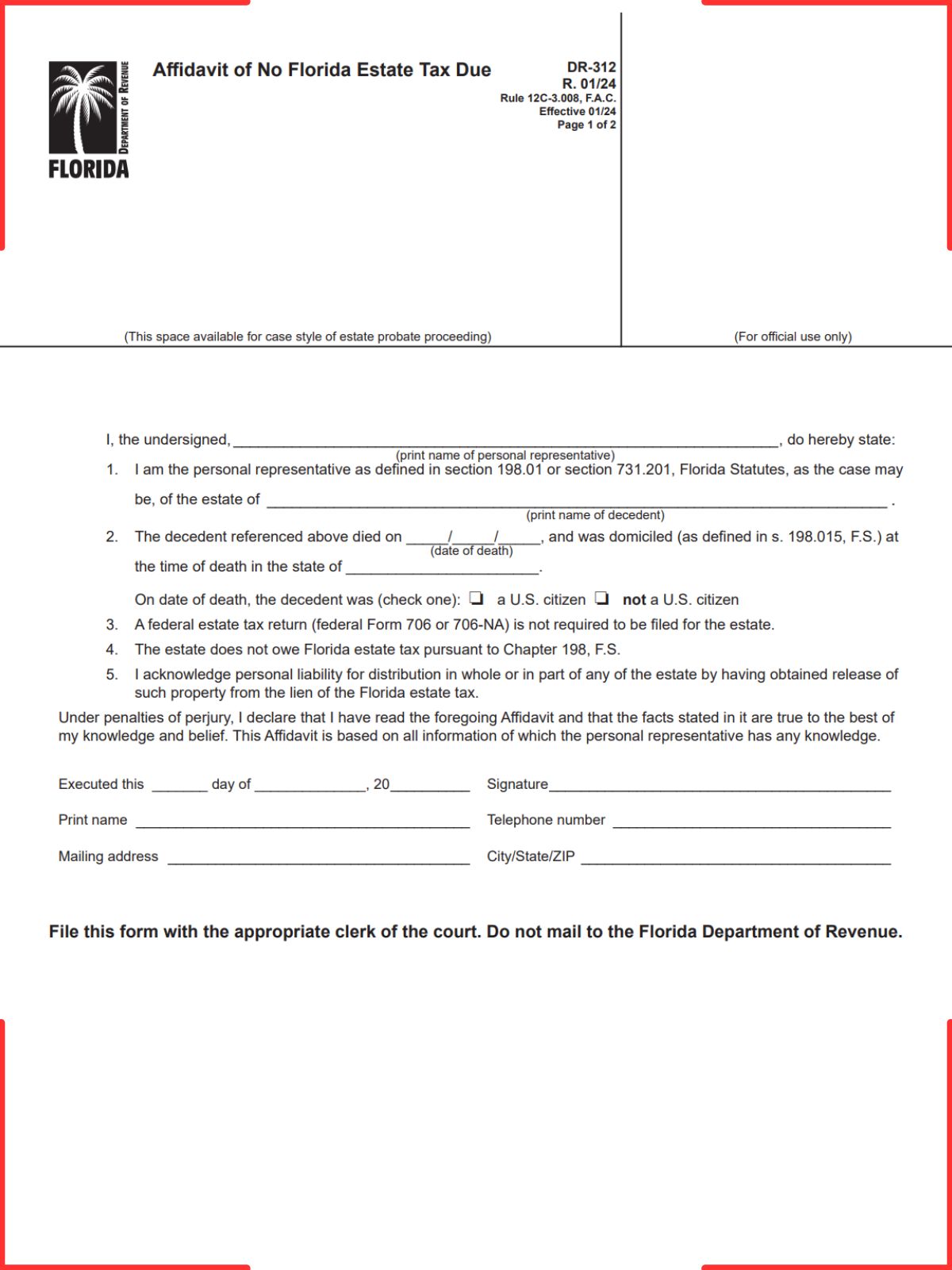
The Florida affidavit of no estate tax due (Form DR-312) is a Florida Department of Revenue estate-tax affidavit, but its current relevance is narrow because the 2023 law removed the filing requirement for qualifying estates. The Department still publishes the form, but its practical relevance is largely historical or limited to reviewing older estate-tax procedures and records.
What the document includes:
- Identification of the decedent (name and date of death)
- Identification of the affiant (personal representative or qualifying person)
- Statement that the estate is not subject to Florida estate tax
- Confirmation that no federal estate tax return (IRS Form 706) is required
- Mandatory acknowledgment of personal liability under Florida law
- Statutory perjury declaration (“magic words”)
- Statutory declaration under penalties of perjury
Who should use this:
- Personal representatives handling an older estate proceeding for which the DR-312 procedure remains relevant
- Persons in possession who fall within the statutory definition of personal representative under Chapter 198
- Parties reviewing historical Florida estate-tax records or title issues involving an older proceeding
When this template may NOT be sufficient:
- For an older probate proceeding in which the former Florida procedure still has to be reviewed, DR-313 was used when a federal Form 706 or 706-NA was required and no Florida estate tax was due.
- Complex estates with possible tax exposure
- Ongoing probate disputes
- Multi-state estate issues
Key insight:Historically, DR-312 was used as evidence of nonliability and to address the Florida estate-tax lien; for qualifying decedents who died after December 31, 2004, § 198.32(3) now provides that the estate is not subject to that statutory lien..
What Is an Affidavit of No Florida Estate Tax Due?
An affidavit of no Florida estate tax due is a sworn statement confirming that:
- No Florida estate tax is owed, and
- No federal estate tax return is required
Historically, the affidavit was used as evidence of nonliability and to address the Florida estate-tax lien; for qualifying post-2004 estates, the 2023 law provides that the statutory lien does not apply.
Under Florida law, this process is governed by Fla. Stat. § 198.32.
Florida Administrative Code Rule 12C-3.0015 historically governed the affidavit, and the Department of Revenue is pursuing rulemaking in 2026 to repeal the obsolete estate-tax rule.
Florida probate procedures involve several different sworn estate documents, readers handling inherited property may also benefit from reviewing other Florida affidavit forms commonly used in probate and title matters. In situations involving transfer of property after death without formal administration, a small estate transfer affidavit for simplified probate situations may also become relevant.
Legal nuance:
Florida’s estate tax system is tied to federal thresholds. This means:
- For the limited older proceedings in which DR-312 remains relevant under the Department of Revenue’s form instructions, the estate must not be required to file federal Form 706 or 706-NA.
- If a federal return is required → this affidavit is not allowed
Critical distinction:
Historical distinction between DR-312 and DR-313:
- DR-312 → Historically used when no federal estate tax return (Form 706 or 706-NA) was required.
- DR-313 → Historically used when a federal estate tax return was required, but no Florida estate tax was due.
Important: Neither affidavit is generally required for Florida probate proceedings under the post-July 1, 2023 rules. The forms remain relevant primarily when discussing older probate proceedings or the historical Florida estate-tax procedure.
Key implication:
For an older estate where an estate-tax record still needs to be reviewed, the decedent’s date of death and probate history are more important than simply preparing a DR-312. For qualifying post-2004 estates, § 198.32(3) provides that the estate is not subject to the statutory lien.
Key Florida Laws That Affect Affidavit of No Florida Estate Tax Due
Summary of Applicable Laws
| Topic / Issue | Florida Legal Rule | Governing Statute |
|---|---|---|
| Use of Affidavit to Show Nonliability | Provides evidence of nonliability for Florida estate tax when the estate is not taxable and no federal estate tax return is required | Fla. Stat. § 198.32(2) |
| Eligibility to Sign | May include a person in actual or constructive possession of estate property when no executor, administrator, or curator has been appointed, qualified, and is acting | Fla. Stat. § 198.01(2) |
| Notary / Verification Requirement | The current DR-312 uses a written declaration under penalties of perjury rather than a notarial jurat | Fla. Stat. § 92.525 |
| Perjury Declaration | Must include statutory perjury wording | Fla. Stat. § 92.525 |
| 2023 Update | Eliminated for New Probates. Effective July 1, 2023, the requirement to file DR-312 was technically abolished for all new probate proceedings. Beginning July 1, 2023, personal representatives do not have to file DR-312 or DR-313 under Florida’s estate-tax procedures. | Fla. Stat. § 198.32(3) |
What to Do if a Title Company Still Demands Form DR-312
A closing may still be delayed when an old title checklist includes a “recorded DR-312,” even though Florida eliminated the filing requirement for qualifying estates involving decedents who died after December 31, 2004. The key question is not whether the state requires the form. It is whether the title underwriter will insure over the issue.
If you’re told a DR-312 is mandatory, ask the closing agent whether the request comes from the title insurer’s underwriting guidelines or is simply a legacy checklist item. Those are not the same thing. Many underwriters will accept a copy of the Florida Department of Revenue’s guidance confirming that the filing requirement was repealed for post-2004 deaths, together with probate records or other evidence showing no federal estate tax return was required, instead of insisting on a retired state form. Florida Department of Revenue TIP #23C03-01 confirms the repeal of the filing requirement.
This conversation can save days or even weeks. Before paying someone to prepare a DR-312, ask the title company exactly what underwriting requirement remains unsatisfied. In many cases, the issue is not the absence of the form itself, but the underwriter’s need for documentation establishing that no enforceable Florida estate tax lien exists under the current version of Fla. Stat. § 198.32.
The affidavit’s legal effect is closely tied to probate authority, title clearance, and the authority of the person signing on behalf of the estate. When estate representatives are managing broader legal or financial responsibilities, documents such as a Florida power of attorney for legal and financial authority are often reviewed alongside probate-related filings to confirm who can act in connected transactions.
Practical Impact & Document Clauses
Historically, the affidavit could be used as evidence of nonliability and to address the Florida estate-tax lien. For qualifying post-2004 estates, however, §198.32(3) provides that the estate is not subject to that statutory lien.
Florida law also expands who can sign the affidavit. Under Fla. Stat. § 198.01(2), when no executor, administrator, or curator is appointed, qualified, and acting, the term ‘personal representative’ can include a person in actual or constructive possession of property included in the decedent’s gross estate.
Two clauses are legally critical:
- Personal liability acknowledgment:
Under Fla. Stat. § 198.23, a personal representative can become personally liable for estate tax if property is distributed without the tax being paid or secured, or without obtaining a statutory release when one is required. - Perjury declaration:
The affidavit must include statutory language under Fla. Stat. § 92.525.
A knowingly false written declaration under Fla. Stat. § 92.525(2) constitutes perjury by false written declaration, a third-degree felony under § 92.525(3).
Additionally, notarization must comply with Fla. Stat. § 117.05, which requires a jurat (oath)—not just a signature acknowledgment.
Real-world consequences:
- Missing clauses → document rejected
- An improperly executed document may be rejected by the authority receiving it, but the current DR-312 form itself does not impose a general Florida notary-jurat requirement.
- Knowingly false written declarations can result in perjury consequences, and separate estate-tax liability may arise when the requirements of Chapter 198 apply.
- Improper filing → lien remains on property
When to Use Affidavit of No Florida Estate Tax Due
For a current Florida estate, first determine whether DR-312 is actually required before preparing it. For qualifying estates covered by the July 1, 2023 changes, Florida no longer requires the affidavit.
Common use cases:
- Reviewing an older estate-tax record
- Responding to a title or probate request concerning an older proceeding
- Confirming whether a historical Florida estate-tax filing was required
Practical scenarios:
- An older probate proceeding involving Florida real property
- A title review that raises a historical estate-tax issue
- Reviewing whether DR-312 or DR-313 was part of the former procedure
When NOT to use:
- Federal estate tax return is required
- Estate exceeds federal filing threshold
- Tax liability is uncertain
- Ongoing IRS or tax disputes
This affidavit may still arise during an inherited property transaction when a title company or other party requests documentation concerning a historical Florida estate-tax lien. If the estate includes transferred vehicles or titled personal property, related ownership records such as a Florida vehicle transfer document may also need to match probate and title records before closing can proceed smoothly.
How to Create or Fill Out the Affidavit of No Florida Estate Tax Due
For estates covered by the 2023 changes, a new DR-312 generally is not required. If a title company, court, or other authority is asking about an older estate-tax affidavit, first confirm why the document is being requested and whether the proceeding falls within the limited circumstances in which the former DR-312 procedure remains relevant.
Step-by-step process:
- Identify the decedent (name and date of death)
- Confirm no federal estate tax return (Form 706) is required
- Identify the affiant (qualified under Florida law)
- Declare that the estate is not subject to Florida estate tax
- Include the mandatory personal liability acknowledgment
- Insert the statutory perjury statement:
- “Under penalties of perjury…”
- Complete the written declaration under penalties of perjury and sign the form as instructed.
- Sign the current form as instructed and follow any separate execution or recording requirements imposed by the applicable court or recording authority.
- For an older proceeding in which a DR-312 is still being used, the Department’s instructions say it may be recorded with the clerk of the circuit court in the county or counties where the decedent owned property.
- OR file it within the probate case if applicable
Practical tips:
- For a decedent who dies in 2026, the federal Form 706 filing threshold is $15 million, although a Form 706 may also be required for circumstances such as a portability election.
- Use exact statutory wording—do not paraphrase
- If an older estate-tax proceeding still requires use of a DR-312, follow the applicable Department of Revenue instructions and the recording requirements applicable to that proceeding.
Critical rule: Do not mail Form DR-312 to the Florida Department of Revenue; the Department’s instructions direct users to file it with the appropriate clerk when the form is applicable.
Accuracy is critical when identifying heirs, estate property, and the person authorized to sign the affidavit. In probate situations where ownership rights or family succession are unclear, reviewing a Florida heirship declaration used to establish inheritance rights can help ensure the estate documentation remains consistent across filings and title records.
Limitations and Legal Considerations
This affidavit is limited in scope and should be used carefully.
Key limitations:
- It is not a tax return
- It cannot be used if federal estate tax applies
- It does not eliminate actual tax liability
Florida-specific constraints:
- Must include the personal liability acknowledgment
- Must comply with Fla. Stat. § 198.32
High-risk scenarios:
- Misrepresenting estate value
-
Using DR-312 without first determining which historical estate-tax procedure applies
- Failing to properly record the affidavit
Edge cases:
- Multi-county property ownership (the applicable recording requirements may involve more than one county)
- Joint tenancy property
- Estates near federal filing thresholds
This affidavit does not resolve disputes involving estate debts, financial disclosures, or contested liabilities between beneficiaries and creditors. In situations involving sworn financial disclosures during probate litigation or support proceedings, a Florida financial disclosure affidavit serves a separate legal purpose and follows different procedural requirements.
Common Mistakes to Avoid
Using DR-312 when federal return is required
Consequence:The document may be rejected or may not satisfy the applicable filing or title requirement
Missing personal liability clause
Consequence: Legal defect and possible rejection
Not including perjury statement
Consequence: The document may not satisfy the applicable legal or procedural requirements
Preparing DR-312 without first confirming that it is required
Consequence: You may spend time preparing or recording a form that Florida law no longer requires for a qualifying estate.
Filing with wrong authority
Consequence: The filing may not satisfy the applicable procedural requirement
Real consequences:
- Title defects
- Delayed real estate closings
- Personal financial liability
- Criminal penalties
Frequently Asked Questions (FAQ)
Do I need to file Form DR-312 with the Florida Department of Revenue?
No. For qualifying estates covered by the post-July 1, 2023 rules, DR-312 does not have to be filed with the clerk or sent to the Department of Revenue. If an older proceeding still calls for the form, follow the applicable filing instructions for that proceeding.
Who can sign an affidavit of no Florida estate tax due?
Under Fla. Stat. § 198.01, a person in actual or constructive possession of estate property may fall within the statutory definition of personal representative when no executor, administrator, or curator has been appointed, qualified, and is acting.
What happens if I sign DR-312 and taxes are later owed?
A personal representative may become personally liable for unpaid Florida estate tax when the conditions in Fla. Stat. § 198.23 are met.
Is this affidavit still required after the 2023 law changes?
Not always by statute. However, a title company or underwriter may still ask for estate-tax documentation during a particular transaction, even though Florida law no longer requires DR-312 for qualifying estates.
The more important question today is whether a DR-312 is required at all. For qualifying estates affected by the July 1, 2023 changes, it generally is not; when an older estate or title record still raises the issue, the decedent’s date of death and the probate proceeding’s history should be checked before anyone prepares or records the form.
Legal Disclaimer: This article is for general informational purposes only and is not legal or tax advice. Florida estate and probate requirements can vary based on the circumstances and date of the proceeding. Consider consulting a qualified Florida attorney or tax professional for advice about your specific situation.