
Florida Power of Attorney [Free PDF & Word Template]
A Florida power of attorney gives someone you trust the legal authority to act on your behalf — but only if the document meets the specific requirements Florida law has required since 2011, and many templates circulating online still don’t. Under F.S. §709.2105, a valid Florida power of attorney requires two witnesses and notarization, while F.S. §709.2201 provides that an agent may exercise only authority specifically granted in the power of attorney rather than relying on a general blanket statement — because Florida law does not treat a general statement giving an agent authority to do everything the principal can do as an express grant of specific authority under §709.2201, and a document that does not clearly grant the authority the agent needs may create problems when a bank or other third party reviews the agent’s authority.
I’ve seen family members arrive at a bank with a power of attorney form florida that was signed, witnessed, and notarized, only to be turned away because the document granted authority in general terms rather than specifying each power the agent was permitted to exercise. The template and explanation below are built around Florida’s current Chapter 709 requirements so the document works when your family actually needs it, not just when it’s sitting in a drawer.
Candice Hayden, Legal Writer
Maria Rosso, Florida Probate, Guardianship and Estate Planning Attorney
Free Florida Power of Attorney Form (PDF & Printable)
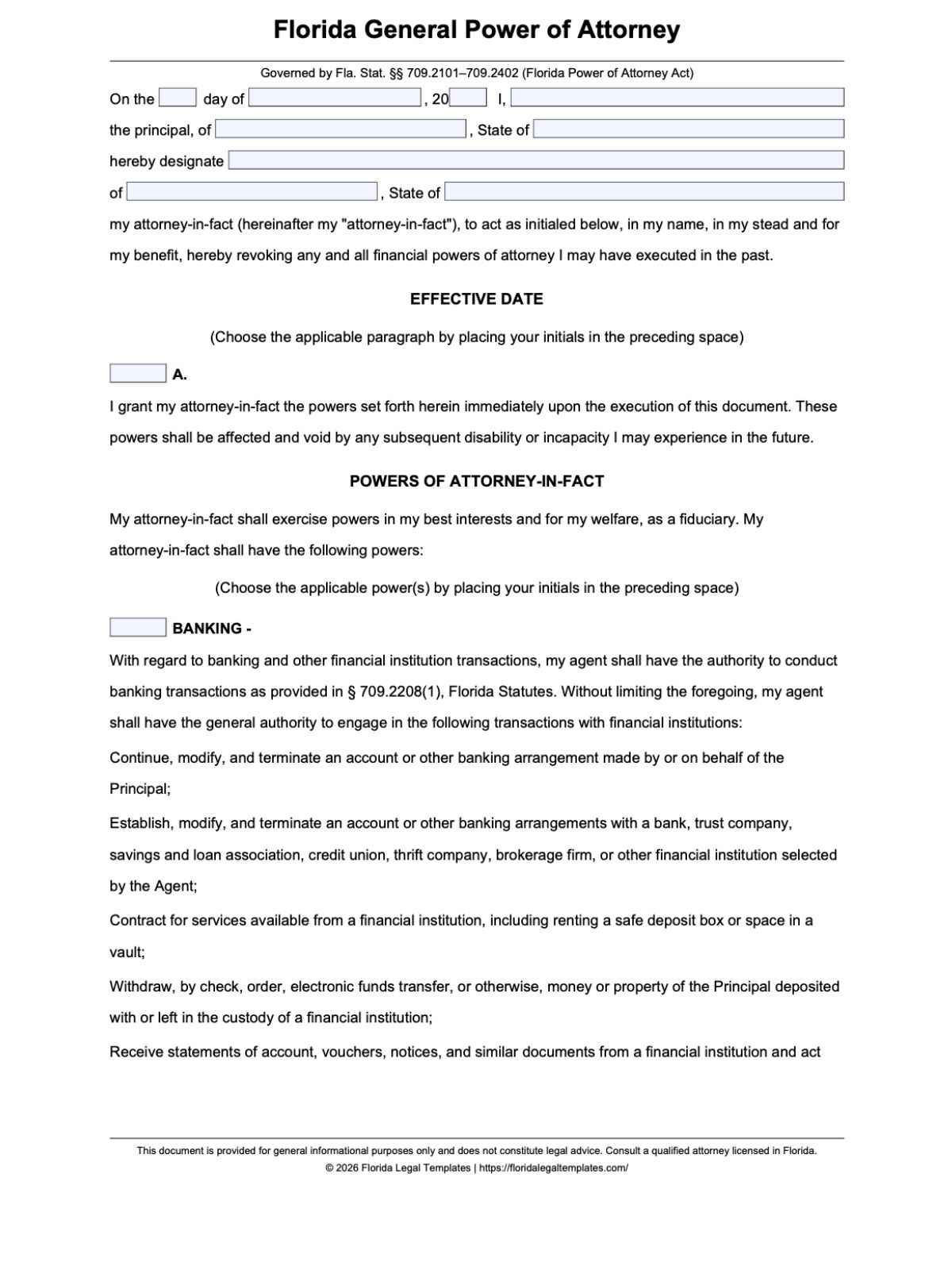
A Florida power of attorney form typically authorizes an agent to manage financial or legal matters for the principal. Most printable and fillable forms include:
- Principal identification information
- Agent appointment provisions
- Banking and financial authority
- Real estate authority
- Durable authority language
- Investment and contract powers
- Witness and notary sections
A Florida power of attorney template may work well for:
- Adults planning for future incapacity
- Seniors organizing long-term financial affairs
- Individuals traveling frequently
- Families helping aging parents manage finances
However, a standard template may not fully address:
- Complex business ownership
- Multi-state real estate holdings
- Medicaid planning concerns
- Advanced tax strategies
- High-conflict family situations
If you are comparing Florida power of attorney forms, focus on whether the document contains the authority you actually need and whether it satisfies Florida’s execution requirements. A form can look complete and still fail to give the agent the specific authority required for a transaction.
Using a sample can help explain formatting and authority structure, but the document still must comply with Florida statutory execution requirements to be legally effective.
What Is a Florida Power of Attorney?
A Florida power of attorney is a written legal instrument governed by the Florida Power of Attorney Act. It authorizes an agent to act on behalf of the principal regarding financial, contractual, or property matters.
Common powers may include:
- Banking transactions
- Property management
- Real estate transactions
- Tax matters
- Investment authority
- Contract execution
Florida recognizes several types of authority structures, including:
- Durable power of attorney
- General power of attorney
- Limited authority arrangements
A durable power of attorney generally remains effective if the principal later becomes incapacitated. A general power of attorney may terminate upon incapacity depending on its wording and structure.
A Florida power of attorney is also different from:
-
A health care surrogate designation, although a durable power of attorney may also specifically grant an agent authority to make health care decisions under Fla. Stat. § 709.2201(2)(c)
- Guardianship proceedings ordered by a court
- A last will and testament, which becomes effective after death
Under Florida law, powers of attorney generally become effective immediately upon execution.
A financial power of attorney is only one part of a broader incapacity and estate planning strategy. Many Florida residents also prepare a medical treatment directive and a Florida probate distribution document to address health care decisions and post-death asset transfers separately.
Key Florida Laws That Affect This Document
| Topic / Issue | Florida Legal Rule | Governing Statute |
|---|---|---|
| Witness Requirements | POA must be signed before two subscribing witnesses | Fla. Stat. § 709.2105(2) |
| Notary Requirement | Principal must acknowledge signature before notary | Fla. Stat. § 709.2105(2) |
| Agent Eligibility | Agent must be an adult or qualified financial institution | Fla. Stat. § 709.2105(1) |
| Springing POAs | Most springing POAs created after Oct. 1, 2011 are invalid | Fla. Stat. § 709.2108 |
| “Superpowers” Rule | Certain powers require separate initials or signatures | Fla. Stat. § 709.2202(1) |
| Real Estate Recording | A power of attorney used to execute a real-estate conveyance should be recorded as required to protect the transaction against later creditors or purchasers without notice. | Fla. Stat. § 695.01 |
| Termination at Death | Agent authority ends immediately upon principal’s death | Fla. Stat. § 709.2109(1)(a) |
A bank or other third party reviewing a Florida power of attorney may focus on whether the document was properly executed and whether the agent actually received the authority needed for the transaction. For qualifying banking and investment transactions, § 709.2120 gives four days, excluding weekends and legal holidays, as a presumed reasonable acceptance or rejection period.
A problem with execution or authority can matter most when the agent needs to act quickly. For banking and investment transactions covered by §709.2120, a financial institution or broker-dealer generally has four days, excluding Saturdays, Sundays, and legal holidays, as the statutory presumption for a reasonable acceptance or rejection period.
You can review the governing Florida statutes directly through the Florida Legislature website:
Florida Witness and Notary Requirements
Under Florida law, The principal must sign in the presence of two witnesses. Florida law requires two subscribing witnesses and acknowledgment before a notary, but the statute does not provide a “100% enforceability” guarantee based on having everyone sign in the same room during one ceremony.
Pursuant to Fla. Stat. § 709.2105(2), the principal must also acknowledge the signature before a notary public. Unlike some estate planning documents, notarization is not optional for a Florida power of attorney.
Improper execution can create serious operational problems, including:
- Bank refusal
- Rejected real estate transactions
- Litigation over agent authority
- Delays during emergencies
Even a technically minor signing mistake may render the document ineffective.
Florida’s Immediate Effectiveness Rule
Except for statutory exceptions, a Florida power of attorney is ineffective if it provides that it will become effective only at a future date or upon a future event or contingency.
Under Florida law, authority typically becomes effective immediately upon execution rather than waiting for future incapacity.
This rule creates important practical consequences:
- Agents may gain immediate access to financial authority
- Principals must select agents carefully
- Broad authority can create abuse risks if the wrong person is chosen
Florida law does contain a narrow exception involving certain active-duty military personnel.
Florida “Superpowers” Requirements
Florida imposes heightened requirements for certain high-risk financial powers sometimes called “superpowers.”
Under Fla. Stat. § 709.2202, certain powers require the principal to sign or initial next to each specific enumeration, including creating or modifying certain trusts, making gifts, creating or changing survivorship rights, creating or changing beneficiary designations, waiving certain survivor-benefit rights, and disclaiming property or powers of appointment.
Florida law treats these as separately enumerated powers because §709.2202 requires the principal to sign or initial next to each specific enumeration. Florida law requires the principal to sign or initial next to each specific enumeration covered by § 709.2202, so a general authorization should not be treated as a substitute for the required specific enumeration.
A broad statement such as “my agent may do anything I can do” is legally insufficient for these powers.
This is one of the most commonly misunderstood areas of Florida power of attorney law.
Real Estate Recording Rules
A standard Florida power of attorney normally remains a private document between the parties involved.
However, when a power of attorney is used for a real-estate conveyance, transfer, or mortgage, recording the power of attorney can be necessary to protect the transaction against creditors or subsequent purchasers without notice under Fla. Stat. § 695.01.
Title companies and county recording offices may reject unrecorded authority documents during closings.
When an agent is authorized to manage rental or investment property, additional real estate documentation may also become relevant during administration. For example, landlords and property owners often rely on a Florida residential leasing contract or related occupancy agreements when handling tenant matters through an authorized agent.
Non-Delegable Duties and Termination Rules
Certain powers cannot legally be delegated through a Florida power of attorney.
Under Florida law, an agent generally cannot:
- Execute or revoke a will
- Vote in public elections
- Swear to affidavits based on the principal’s personal knowledge
Florida law also provides that agent authority terminates immediately upon the principal’s death.
A power of attorney cannot:
- Control funeral arrangements after death
- Replace probate administration
- Transfer estate assets after death
Once the principal dies, the agent’s authority under the power of attorney ends, and post-death administration must be handled under the laws and documents that govern the principal’s estate.
Practical Impact & Document Clauses
Florida statutory rules directly affect:
- Durable authority provisions
- Banking clauses
- Real estate authority sections
- “Superpower” initialing areas
- Revocation language
Common drafting problems include:
- Missing initials
- Improper notarization
- Ambiguous authority grants
- Outdated agent appointments
These issues frequently surface during medical emergencies or urgent financial situations when families need the document to work immediately.
When to Use a Florida Power of Attorney
A Florida power of attorney is commonly used by:
- Adults planning for incapacity
- Seniors managing long-term finances
- Individuals traveling extensively
- Families assisting aging relatives
- People wanting to avoid guardianship proceedings
The document can be especially valuable during:
- Hospitalization
- Extended travel
- Cognitive decline
- Real estate transactions
However, a power of attorney alone may not fully address:
- Health care decision-making
- Business succession planning
- Estate distribution after death
- Complex trust administration
Additional estate planning documents are often necessary.
A power of attorney is especially valuable for aging adults who want someone trusted to handle banking, contracts, and financial management during incapacity. Families coordinating broader incapacity planning often also review a long-term durable authority arrangement designed to remain effective if cognitive decline or medical incapacity later occurs.
How to Create or Fill Out the Florida Power of Attorney
Identify the Principal
Use the principal’s complete legal name and identifying information. The principal must have legal capacity at signing.
Select a Trustworthy Agent
The agent will often receive broad financial authority. Reliability, honesty, and sound financial judgment are critical.
Naming successor agents may also help avoid future operational issues.
Define the Scope of Authority
Clearly identify which powers are granted, including:
- Banking authority
- Investment authority
- Property management
- Tax authority
Vague language frequently causes disputes with banks and third parties.
Address Florida “Superpowers” Carefully
Certain powers require separate initials or signatures under Florida law.
These separate-enumeration rules matter because § 709.2202 requires the principal to sign or initial next to each specific enumerated power rather than relying on a general grant of authority.
Include Durable Authority Language
Durable authority provisions allow the power of attorney to continue operating if the principal later becomes incapacitated.
Without proper durability language, authority may terminate at the exact moment it becomes most needed.
Execute the Document Properly
Florida generally requires:
- Two subscribing witnesses
- Proper notarization
- Formal execution procedures
Signing errors can invalidate the document entirely.
Record the Document if Real Estate Powers Will Be Used
If the agent will handle real estate transactions, recording may become mandatory at the county level.
Many title companies require recorded authority before accepting property conveyances.
Distribute Copies Securely
Copies are often provided to:
- Agents
- Attorneys
- Financial institutions
- Trusted family members
Keep the original in a secure place and make copies available to the agent and institutions that may need to review it. Under § 709.2106(5), a photocopy or electronically transmitted copy generally has the same effect as the original, although an original may be required when the POA is being recorded to affect real-property title.
Review and Update the Document Periodically
Review the document after:
- Divorce
- Death or incapacity of the agent
- Major financial changes
- Relocation to another state
Because banks and financial institutions may ask for supporting documentation when reviewing a power of attorney, keep the executed document and any related records organized so the agent can respond promptly if a third party requests additional information under Chapter 709.
Limitations and Legal Considerations
A Florida power of attorney gives an agent authority to act within the powers granted, but it does not itself transfer ownership of the principal’s property, replace a will, or continue after the principal’s death. Before signing, review the specific powers granted and the execution requirements in Chapter 709.
Operational issues may also arise when:
- Banks question older documents
- Third parties request updated forms
- Family disputes develop
- Elder exploitation concerns emerge
Proper document control and revocation procedures are important to reduce misuse risks.
The 4-Day Bank Acceptance Rule & Agent’s Affidavit (§ 709.2119)
A common point of friction occurs when an agent presents a valid Florida Power of Attorney to a bank or financial institution and the manager refuses to act on it immediately or insists on sending it to an internal legal department. Under Fla. Stat. § 709.2120(1), a financial institution or broker-dealer must accept or reject the power of attorney within a reasonable time, with four days—excluding Saturdays, Sundays, and legal holidays—presumed reasonable for qualifying banking and investment transactions.
Under Fla. Stat. § 709.2120(2), a third party cannot legally demand an additional or internal bank-specific power of attorney form if the presented document is validly executed under Florida law. However, under Fla. Stat. § 709.2119(2), the bank may request that the agent execute a statutory Agent’s Affidavit, swearing under oath that the principal is alive, domiciled in a specific jurisdiction, and that the authority has not been revoked, suspended, or terminated. If the agent provides this executed affidavit (or an opinion of counsel) and the bank still refuses to honor the POA without statutory cause, a third person that improperly rejects the power of attorney may be subject to a court order requiring acceptance and liability for damages, including reasonable attorney fees and costs.
A Florida power of attorney cannot transfer assets after death or replace probate administration. Once the principal dies, estate administration typically shifts to probate-related documents such as a Florida will for estate administration or other court-recognized inheritance documents.
Common Mistakes to Avoid
One of the easiest execution problems to avoid is missing the acknowledgment before a notary. Under §709.2105(2), the principal must sign the POA with two subscribing witnesses and acknowledge the signature before a notary public, subject to the statutory alternative in §695.03.
Other major errors include:
- Failing to obtain two witnesses
- Forgetting initials for “superpowers”
- Choosing an unreliable agent
- Assuming authority begins only after incapacity
- Attempting to authorize prohibited acts
People also frequently forget to:
- Record the document for real estate transactions
- Revoke outdated authority forms
- Update agents after divorce or family changes
Another major misunderstanding is believing a power of attorney remains valid after death. Under Florida law, agent authority ends immediately upon the principal’s death.
Frequently Asked Questions (FAQ)
Does a Florida power of attorney need to be notarized?
Yes. Florida law requires the principal’s signature to be acknowledged before a notary public.
Are springing powers of attorney valid in Florida?
Most springing powers of attorney created after October 1, 2011 are invalid under Florida law.
Can a Florida power of attorney be used after death?
No. The agent’s authority terminates immediately upon the principal’s death.
Does a Florida power of attorney need to be recorded?
Recording is generally unnecessary unless the document will be used for real estate transactions involving property conveyances or mortgages.
What powers require separate initials under Florida law?
Powers involving trusts, gifts, beneficiary changes, and survivorship rights generally require separate signed acknowledgment or initials.
Can a bank refuse a Florida power of attorney?
Yes, but Florida law limits when a bank or other third party may reject a power of attorney. Under §709.2120, rejection may be permitted in circumstances such as a good-faith belief that the POA is invalid or the agent lacks authority, or when a timely request for an affidavit, translation, legal opinion, or other permitted information is refused.
What If a Bank Demands Its Own Power of Attorney Form?
A bank cannot simply require a different power-of-attorney form for authority already granted in a properly presented POA. Under §709.2120(2), a third person may not require an additional or different POA form for authority granted in the document presented, although §709.2119 permits certain additional requests, including an agent affidavit or an opinion of counsel in specified circumstances. Under Fla. Stat. § 709.2120, a person asked to accept a power of attorney may request limited additional information, such as an affidavit from the agent or an opinion of counsel in certain circumstances, before deciding whether to honor it. If those reasonable requests are satisfied, an unjustified refusal can expose the institution to a court order requiring acceptance and potential liability for attorney’s fees.
This can matter when a bank is reviewing the document for a time-sensitive transaction. If the institution makes a permitted request for an agent affidavit, an English translation, an opinion of counsel, or other information authorized by § 709.2119, responding promptly may help the institution complete its review without requiring a new power of attorney. Before assuming the document is defective, ask the institution exactly what statutory concern it has identified and whether it is requesting an affidavit or legal opinion permitted under Florida’s Power of Attorney Act.
Legal disclaimer: This article provides general information about Florida power of attorney law and is not legal advice. Florida law can change, and individual circumstances may require advice from a licensed Florida attorney.