
Florida Lost Title Application (Free PDF HSMV 82101 Form)
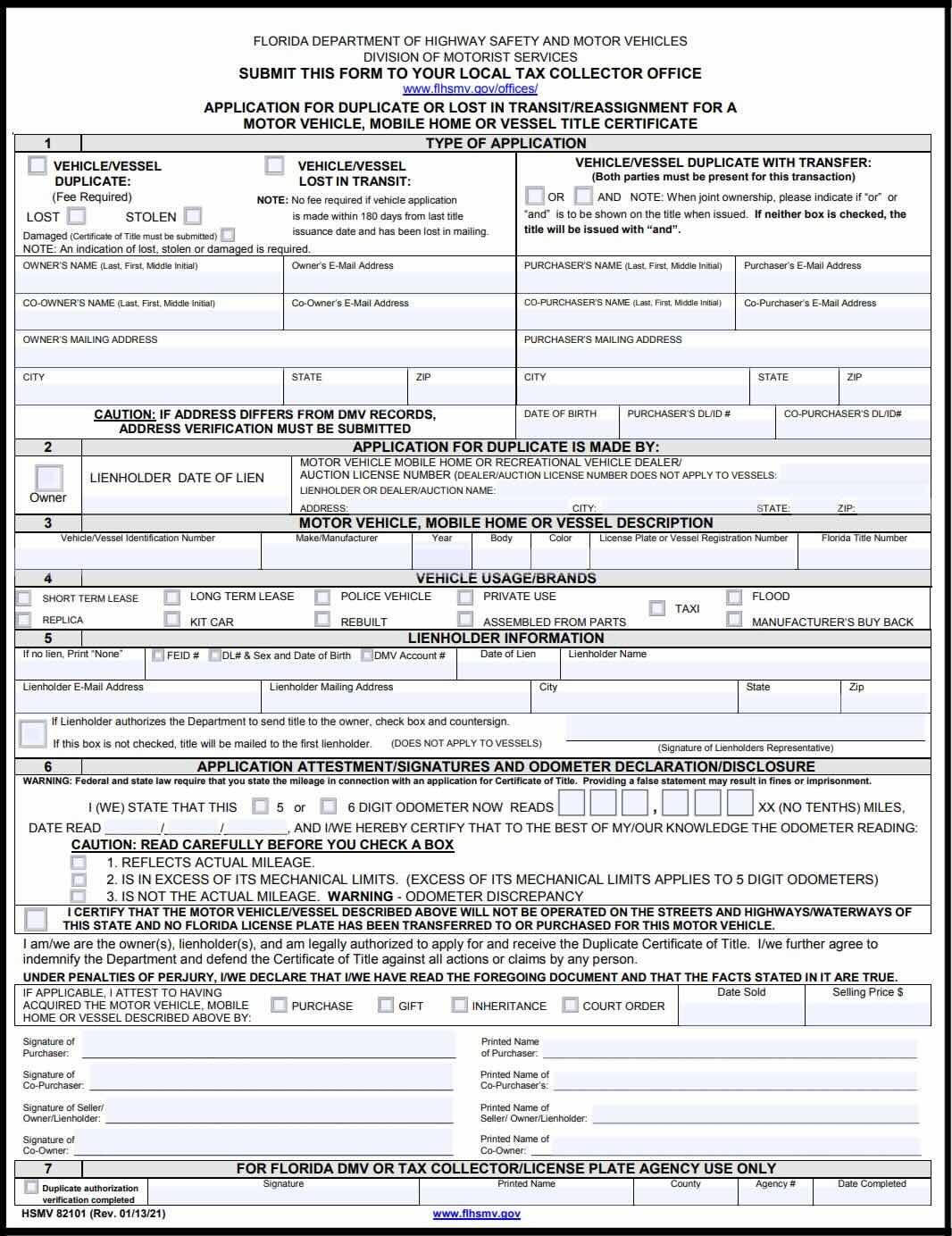
You’re ready to sell your car, trade it in, or take care of some other title paperwork and then you realise you can’t find the title. It happens. If the vehicle is titled in Florida, you’ll need to replace the missing certificate before you can complete a normal title transfer. Form HSMV 82101 is the application Florida uses for a duplicate title. You can use it when the original was lost, stolen, damaged, or never made it to you in the first place.
There are a couple of things worth checking before you start filling out the form. If a bank or finance company is still listed as the lienholder, you may have to deal with them before the duplicate can be issued to you. And if two people are listed as owners, the way their names are joined “AND” or “OR” determines who has to sign. If the title was actually lost in the mail after Florida issued it, that’s a little different. There is a 180-day lost-in-transit rule, and the current HSMV 82101 instructions also require at least 20 days to have passed since issuance when the title has not arrived by mail.
In this article, you can get the Florida duplicate title application (HSMV 82101) and see when it should be used, what Florida law requires, how to fill it out, where to file it, and what fees apply. I’ve also covered the situations where this form is not the right one, what happens to the old title after a duplicate is issued, and the mistakes that can cause problems with your application.
Candice Hayden, Legal Writer
Carly Johansson, Florida Contract Attorney
Free Florida Duplicate Title Application (Form HSMV 82101)
Get PDF
Form HSMV 82101 is the Florida application used for a duplicate or lost-in-transit title involving a motor vehicle, mobile home, or vessel. It is intended for the registered owner or owners, a lienholder, or an authorized agent acting with the required authority.
The application collects information such as:
- Applicant and ownership information
- Vehicle, mobile home, or vessel identification information
- Required owner or lienholder signatures
- The statutory verification or perjury declaration
- Odometer information when applicable to a motor vehicle
There is an important distinction if a lien remains on the Florida title record. An owner cannot use HSMV 82101 to remove or bypass an unsatisfied lien. When a lien remains on the record, Florida’s delivery rules generally send the title to the first lienholder or to the owner as directed by the lienholder’s notice of lien; HSMV 82101 also provides an authorization option for certain motor vehicle and mobile home titles.
If the problem is not that the title is missing, HSMV 82101 may also be the wrong document. For example, correcting title information or changing information on an existing title involves a different filing process.
What Counts as a “Lost” Title Under Florida Law?
A Florida title can require replacement because it has been lost, stolen, destroyed, mutilated, or lost in transit. The important distinction is whether the title was previously received by the owner.
A normal lost-title situation occurs when the owner once possessed the certificate but can no longer locate it. A lost-in-transit situation is different: Florida issued the title, but the certificate was lost in the mail and never reached the intended recipient.
That distinction matters because Florida provides a specific 180-day window for a title lost in transit. Under Fla. Stat. § 319.29(3), an owner or lienholder may apply for reissuance within 180 days of the title’s issuance without an additional fee for that reissuance.
A duplicate title does not create a new ownership interest. It reissues evidence of the title already recorded by the state. That is why the application is tied to the existing ownership and lien records rather than functioning as a new title application.
Florida Laws Governing Duplicate Title Applications
Statutory Requirements at a Glance
| Topic / Issue | Florida Legal Rule | Governing Statute |
|---|---|---|
| Execution formalities | If owners are joined by “AND,” all titled owners must sign. If joined by “OR,” either owner may sign. | Fla. Stat. §§ 319.22 & 319.29(1) |
| Sworn verification / declaration | The application may be verified under oath or through the statutory written declaration under penalty of perjury. | Fla. Stat. §§ 319.29(1) &Fla. Stat. § 92.525 |
| Lienholder control | An unsatisfied lien can prevent the owner from receiving the duplicate unless the lienholder satisfies or authorizes the required release/delivery. | Fla. Stat. § 319.24 & 319.29(1) |
| Lost-in-transit exemption | A replacement may be requested without an additional fee within 180 days after issuance when the title was lost in transit. | Fla. Stat. § 319.29(3) |
| Duplicate-title fees | Motor vehicle duplicate title: $75.25 electronic-title fee plus applicable county service fees; Fast Title adds $10. Vessel duplicate title: $6 base fee plus $5 expedited fee. | Fla. Stat. §§ 319.32 & 328.11(1)-(2) |
The signature rules are easy to overlook. The ownership wording matters: where ownership is joined by “AND,” every titled owner must participate. Where it is joined by “OR,” either owner can execute the application.
The verification requirement also deserves attention. Florida law permits verification through a written declaration under penalty of perjury rather than requiring notarization in every situation. The statutory declaration begins: “Under penalties of perjury, I declare that I have read the foregoing document and that the facts stated in it are true.” Fla. Stat. § 92.525 provides the written-declaration method.
For motor vehicles subject to Florida’s odometer-disclosure requirements, the application requires the current odometer reading and the applicable mileage declaration; vehicles with model years 2011 or newer are exempt after 20 years, while vehicles with model years 2010 or older are exempt after 10 years.
An active lien is a separate issue from a lost certificate. Florida’s title system gives the lienholder control over delivery where an unsatisfied lien remains on the record. That means a properly completed application does not automatically give an owner the right to receive a clear duplicate title.
When You’ll Actually Need This Form (and When You Won’t)
HSMV 82101 makes sense when the title is missing but the vehicle’s ownership is already established in Florida’s records.
Common situations include:
- You paid off a vehicle but later discovered that the paper title was lost.
- You inherited a vehicle and the existing title cannot be located.
- A title was issued but never arrived because it was lost in transit.
- You need the title for a sale but cannot find the original.
- A lienholder still appears on the record and must participate in the duplicate-title process.
There are also situations where this is not the correct application.
If your title exists but the owner’s name, address, or another piece of information needs to be corrected, a duplicate-title application is not a substitute for the appropriate correction process. Likewise, someone attempting to title an out-of-state vehicle in Florida for the first time is dealing with an initial title transaction, not simply replacing a lost Florida certificate.
The practical test is simple: Is the existing Florida title evidence missing, or is the underlying title record itself changing? HSMV 82101 addresses the first problem.
How to Complete and File the HSMV 82101
Start by identifying the type of property involved and completing the appropriate portion of the form. HSMV 82101 covers motor vehicles, mobile homes, and vessels, so selecting the correct category matters.
1. Confirm who must sign
Check the ownership record before signing. If the owners are listed with “AND,” all required owners must sign. If the ownership is joined by “OR,” either owner may execute the application.
Do not assume that being a co-owner automatically gives one person authority to sign for everyone.
2. Complete the verification correctly
If you are not using a notary, the written declaration permitted by Fla. Stat. § 92.525 must contain the required statutory language. The declaration is not decorative wording; it is the legal verification supporting the application.
What If Your Address Has Changed on a Florida Duplicate Title?
A changed mailing address creates an extra verification step that frequently delays duplicate title applications. Under Fla. Stat. § 319.29(5), FLHSMV must implement a system to verify that the person signing the application is authorized to receive a duplicate title when the address shown on Form HSMV 82101 differs from the address in department records.
Simply entering your new address in Section 1 of Form HSMV 82101 is not enough. If your current residence does not match the DMV database, you must submit one of the following approved documents to prove your address change:
-
Updated Florida Driver License or State ID
-
Paid utility or telephone service receipt (or utility turn-on order)
-
Proof of Florida homestead exemption
-
Executed residential lease or rental agreement
-
Current Florida vehicle, mobile home, or vessel registration certificate
-
Active motor vehicle or vessel insurance policy
The Takeaway: If the address on Form HSMV 82101 differs from the department’s records, the application must include the required address verification documents. Providing the verification with the application can help avoid processing delays.
3. Complete the odometer section when required
For a motor vehicle that is not exempt from the odometer requirement, provide the current odometer reading and select the applicable declaration if the mileage is not actual or exceeds the odometer’s mechanical limits.
4. Handle a lien before expecting delivery
If an unsatisfied lien appears on the record, determine what the lienholder must provide before filing. When an outstanding lien must be addressed, the required documentation depends on the title and lien circumstances; FLHSMV procedures recognize Form HSMV 82260 as a lien-satisfaction document, while HSMV 82101 also contains a lienholder authorization option for applicable motor vehicle and mobile home transactions.
5. Use the required authority when someone files for you
An attorney-in-fact filing on behalf of an owner must submit the required Florida Motor Vehicle Power of Attorney, Form HSMV 82053, and the applicable proof of identity required by FLHSMV for the person signing the application.
6. File with the appropriate Florida authority
The application should be submitted to the appropriate local Florida tax collector’s office or license plate agency, following the current FLHSMV instructions for the transaction.
The statutory fee depends on the property type and whether expedited service is requested:
-
Motor Vehicles / Mobile Homes: The standard duplicate title fee is $75.25 for an electronic title (or $77.75 if requesting a printed paper certificate by mail), plus applicable county branch processing fees. Same-day expedited counter service (“Fast Title”) adds an additional $10.00.
-
Vessels: The base duplicate title fee is $6.00 (or $11.00 for expedited same-day Fast Title).
-
The current duplicate-title fee schedule does not establish a separate $10 out-of-state surcharge for the ordinary HSMV 82101 duplicate-title transaction.
Limitations and Legal Considerations
A duplicate title has a significant legal consequence: once issued, the original title becomes void. Florida’s duplicate-title statute requires the duplicate and subsequent titles in that chain to be marked “DUPLICATE COPY.”
If you later find the original document, do not use it for a sale or other title transaction. The recovered original must be surrendered to FLHSMV for cancellation.
A duplicate also does not eliminate an existing lien. The title process recognizes lienholder rights, and an owner cannot use HSMV 82101 as a mechanism for obtaining a title free of an unsatisfied lien.
Finally, obtaining the duplicate does not itself complete a vehicle sale. The replacement title gives you the title document needed for the subsequent transaction; the ownership transfer still has to be completed through the applicable title-assignment process. Florida law requires a purchaser to receive a properly issued certificate of title to acquire marketable title in the ordinary transfer process.
Mistakes That Get a Duplicate Title Application Rejected (or Worse)
Trying to sell before replacing the missing title. A bill of sale does not replace the certificate-of-title requirement for an ordinary Florida vehicle transfer. Florida law specifically addresses transfers made without delivery of the required title certificate.
Leaving out the statutory verification. If you choose the written-declaration route instead of an oath, use the required language. An incomplete declaration can prevent the application from satisfying the verification requirement.
Ignoring an active lien. If a lien remains on the record, applying as though you have unrestricted control over the title can create delays and additional paperwork.
Using a recovered original after receiving a duplicate. Once the duplicate is issued, the original is void. It should be surrendered rather than used.
Skipping the odometer certification. For vehicles under the applicable 20-model-year threshold, the odometer information is part of the title process and should not be treated as an optional field.
Submitting an agent application without the required authority. Missing the power of attorney or identification documentation can prevent the filing from being accepted.
Providing false information. Florida treats title-document and application fraud seriously. Fla. Stat. § 319.33 addresses offenses involving title applications, certificates, and related documents.
Frequently Asked Questions (FAQ)
Can I sell my car in Florida if I lost the title and haven’t replaced it yet?
For an ordinary Florida vehicle transfer, you should obtain the duplicate title first. Florida law requires the title certificate to evidence the purchaser’s title, and Fla. Stat. § 319.34 addresses transfers made without delivery of the required certificate.
What happens if I find my original title after FLHSMV already issued a duplicate?
The original title is no longer the document to use. Once the duplicate has been issued, the recovered original must be surrendered to FLHSMV for cancellation under the lost-title rules.
Can a lienholder block me from getting a duplicate title even if I’m the registered owner?
An unsatisfied lien affects who can receive the duplicate title. Florida’s title-delivery rules give the lienholder control where a lien or encumbrance remains on the department’s records. The lien must therefore be addressed through the applicable satisfaction or authorization process.
Do I need a notary for Form HSMV 82101, or does the perjury declaration replace that?
Florida law allows document verification through a written declaration under penalty of perjury. The statutory language in Fla. Stat. § 92.525 provides an alternative to verification before an authorized officer, when that written-declaration method is applicable.
A lost Florida title is usually a paperwork problem, but the details matter. The safest approach is to confirm the ownership structure, check for an outstanding lien, complete the required verification and odometer information, and use the correct filing route before attempting to transfer the vehicle.
Disclaimer:This article is for general informational purposes only and does not constitute legal advice. Florida laws and DMV requirements may change, so verify current requirements with the Florida Department of Highway Safety and Motor Vehicles or a qualified Florida attorney before relying on this information.