
Florida Prenuptial Agreement Template (Free PDF & Legal Guide)
A Florida prenuptial agreement, also called a premarital agreement or prenup, allows prospective spouses to establish certain property, financial, and spousal-support arrangements before marriage.
Under Florida law, the agreement must be in writing and signed by both parties. It becomes effective when the parties marry. Florida does not impose a general notary or two-witness requirement on an ordinary prenup, although separate execution requirements apply when the agreement contains certain surviving-spouse rights waivers under Fla. Stat. § 732.702.
This Florida prenuptial agreement template is designed around Fla. Stat. § 61.079 and can help organize property provisions, financial disclosures, spousal-support terms, death-related provisions, and other matters permitted under Florida law.
Candice Hayden, Legal Writer
Maria Rosso, Florida Probate, Guardianship and Estate Planning Attorney
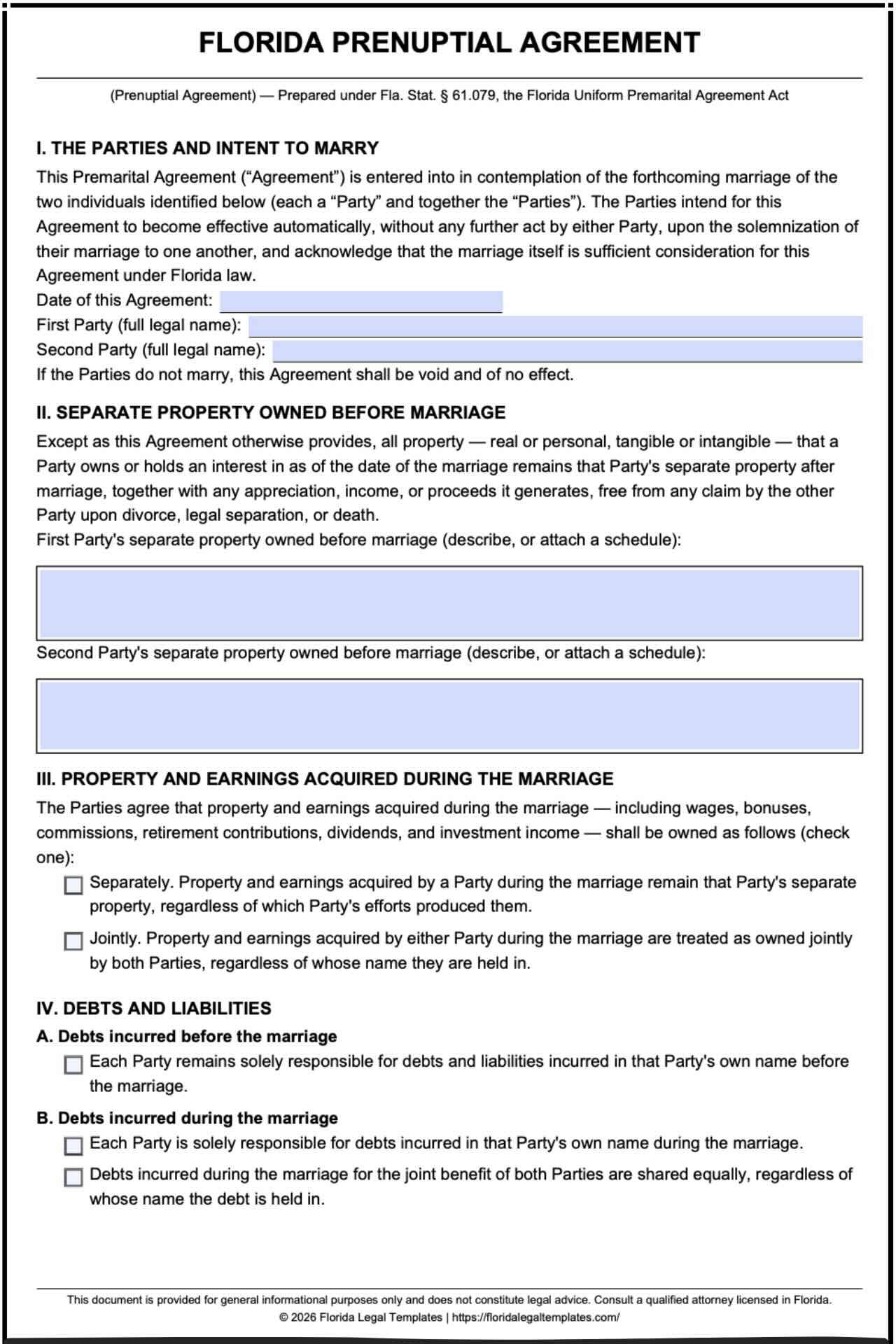
Florida Prenuptial Agreement Template (PDF Fillable Form)
Get PDF
A Florida prenup template can provide a structured starting point for couples who want to document their financial arrangements before marriage.
The template can include:
- Names and identifying information for both parties
- Recitals confirming the agreement is made in contemplation of marriage
- An effective-upon-marriage provision
- Separate and marital property provisions
- Property management and control terms
- Provisions addressing separation, divorce, and death
- Spousal-support provisions
- Estate-planning coordination provisions
- Life-insurance death-benefit provisions
- A child-support protection clause
- Choice-of-law provisions
- Financial disclosure schedules
- An optional written waiver of additional disclosure
- Amendment and revocation provisions
- Signature blocks for both parties
- A separate § 732.702 surviving-spouse-rights waiver rider with a two-witness block when applicable
The template is most useful when both parties have enough information about their assets, debts, income, and financial obligations to make informed decisions.
A template may not be sufficient by itself when the agreement involves complex business interests, substantial property transfers, surviving-spouse rights, complicated estate planning, or significant questions concerning financial disclosure.
What a Florida Prenuptial Agreement Actually Does, and When It Takes Effect
Florida law defines a premarital agreement as an agreement between prospective spouses made in contemplation of marriage and intended to become effective upon marriage under Fla. Stat. § 61.079(2)(a).
In practical terms, the parties can sign the document before the wedding, but the agreement does not become effective merely because it was signed. Marriage is the event that makes the agreement effective. Florida law also provides that the marriage itself is sufficient consideration for the agreement.
The terms prenup, prenuptial agreement, and premarital agreement are commonly used for the same type of document. The statutory term used by Florida law is premarital agreement.
A Florida prenup may address:
- Property rights and obligations
- Management and control of property
- Disposition of property upon separation or divorce
- Disposition of property upon death
- Spousal support
- Estate-planning arrangements
- Life-insurance death benefits
- Choice of law
- Other matters that do not violate Florida public policy or a law imposing a criminal penalty
There is one major statutory boundary: a premarital agreement cannot adversely affect a child’s right to support. And because § 61.079 defines a premarital agreement as one made between prospective spouses, a couple that is already married needs to use a different type of agreement.
Key Florida Laws That Affect a Prenuptial Agreement
Florida Prenup Statute at a Glance: § 61.079 Rules
| Topic / Issue | Florida Legal Rule | Governing Statute |
|---|---|---|
| Writing and both signatures | Must be in writing and signed by both parties. | Fla. Stat. § 61.079(3) |
| Consideration | Marriage itself is sufficient consideration. | Fla. Stat. § 61.079(3) |
| Notary | No statutory notary requirement for an ordinary prenup. | Fla. Stat. § 61.079(3) |
| Witnesses | No general witness requirement for an ordinary prenup; two subscribing witnesses apply to qualifying § 732.702 waivers. | Fla. Stat. §§ 61.079(3), 732.702(1) |
| Effective date | Becomes effective upon marriage. | Fla. Stat. § 61.079(5) |
| Amendment or revocation after marriage | Must be made through a written agreement signed by the parties. | Fla. Stat. § 61.079(6) |
| Filing or recording | § 61.079 does not establish a general filing or recording requirement. | Fla. Stat. § 61.079 |
| Child support | Cannot adversely affect a child’s right to support. | Fla. Stat. § 61.079(4)(b) |
| Enforcement | Challenges can involve voluntariness, fraud, duress, coercion, overreaching, and specified unconscionability/disclosure circumstances. | Fla. Stat. § 61.079(7) |
The primary Florida prenup statute is Fla. Stat. § 61.079.
For an ordinary Florida prenuptial agreement, the statutory starting point is therefore fairly narrow: written agreement, signatures from both parties, and effectiveness upon marriage. The absence of a statutory notary requirement does not mean every provision is automatically enforceable.
The circumstances surrounding execution can matter later. Florida’s enforcement rules specifically address involuntary execution, fraud, duress, coercion, overreaching, and certain unconscionability and disclosure circumstances.
From Statute to Signature Page: How § 61.079 Shapes Your Clauses
The strongest way to complete a Florida prenup is to connect each major clause to the legal purpose it serves.
Signature provisions: Both parties should sign the written agreement because § 61.079(3) expressly requires signatures from both parties.
Effective-date provision: The document should make clear that it is intended to become effective upon marriage, consistent with § 61.079(5).
Property provisions: Separate property, marital property, management, control, and disposition provisions fall within the subjects that § 61.079 permits the parties to address.
Spousal-support provisions: The agreement can establish, modify, waive, or eliminate spousal support, subject to the statutory enforcement rules. If a support provision causes one party to become eligible for public assistance at separation or marital dissolution, § 61.079(7)(b) allows a court to require support to the extent necessary to avoid that eligibility.
Child-support protection: The document should not attempt to adversely affect a child’s right to support.
Financial disclosure: Disclosure schedules can make the parties’ financial positions clearer and provide useful documentation if enforceability is later questioned. Florida’s statute specifically addresses disclosure in the context of an agreement that was unconscionable when executed.
Surviving-spouse rights: If the agreement is intended to waive rights such as an elective share, intestate share, homestead, exempt property, family allowance, or personal-representative preference, the separate requirements of Fla. Stat. § 732.702 must be considered.
A qualifying waiver under § 732.702 requires the waiving party’s written agreement to be signed in the presence of two subscribing witnesses.
What Florida Doesn’t Require for an Ordinary Prenup
Florida’s prenup statute does not prescribe several formalities that are sometimes incorrectly presented as mandatory requirements.
For an ordinary agreement under § 61.079:
- No statutory notary requirement
- No general witness requirement
- No prescribed statutory form
- No required “magic words”
- No general filing or recording requirement
- No statutory minimum signing lead time
- No statutory requirement that each party retain an attorney
- No mandatory financial-disclosure schedule or prescribed disclosure form
The important distinction is between what Florida law requires and what may be prudent drafting or legal practice.
For example, notarization may be used as an additional practice measure, but it should not be described as a statutory requirement under § 61.079. Likewise, allowing adequate time for review can help address practical concerns about voluntariness, but Florida’s prenup statute does not establish a specific number of days that must pass before the wedding.
When a Prenup Fits, and When It’s the Wrong Tool
A Florida premarital agreement can be particularly relevant when the couple wants to establish financial arrangements before marriage.
For example, a person entering a second marriage may want provisions addressing property at death, estate-planning arrangements, or life-insurance benefits. These subjects fall within the matters that § 61.079 permits the parties to address.
A business owner may use a prenup to establish arrangements concerning property management, control, and disposition. A couple with substantially different assets or incomes may also address spousal-support rights.
Financial disclosure becomes particularly significant where one party has substantially greater assets, debts, business interests, or other financial obligations.
There are also situations where a prenup is not the appropriate document. Someone who is already married is no longer entering into a premarital agreement. A couple cannot use a prenup to adversely affect a child’s right to support. And if the sole objective is waiving specified surviving-spouse rights, the requirements of § 732.702 need to be addressed rather than treating the matter as an ordinary prenup provision.
Completing the Florida Prenup Template: A Pre-Wedding Workflow
Step 1: Decide the scope
Identify the subjects the couple wants to address under § 61.079. Determine whether the agreement will cover property, debts, management, spousal support, death, estate planning, insurance, or other permitted matters.
If death-related provisions are included, determine whether the agreement also needs a § 732.702 surviving-spouse-rights waiver.
Step 2: Prepare financial disclosure
Organize information concerning assets, debts, income, and financial obligations.
Florida law does not prescribe a mandatory disclosure attachment for every prenup. However, disclosure becomes particularly relevant to the statutory enforceability analysis when an agreement was unconscionable when executed.
Step 3: Set property and support terms
Clearly identify what each party intends to keep as separate property and how property will be managed or treated during the marriage and upon separation or divorce.
If spousal support is addressed, make the intended treatment clear rather than leaving important financial consequences to ambiguous language.
Step 4: Address death and estate planning
If the agreement includes death-related arrangements, coordinate those provisions with wills, trusts, beneficiary designations, and any statutory surviving-spouse waivers.
A prenup should not be treated as automatically replacing a Florida will or every other estate-planning document.
Step 5: Add safeguards
The document should include the child-support protection required by Florida law and an amendment provision requiring later changes to be made through a signed writing.
Step 6: Allow time for review
Florida does not establish a statutory minimum number of days before the wedding. Nevertheless, leaving meaningful time for review is a practical safeguard because timing and surrounding circumstances can become relevant to a later challenge based on voluntariness, duress, coercion, or overreaching.
Step 7: Sign correctly
Both parties should sign the written agreement.
If the document contains a qualifying § 732.702 waiver, use the separate two-witness execution required by that statute.
Notarization is not a statutory requirement for an ordinary § 61.079 prenup.
Step 8: Keep the executed agreement
The agreement becomes effective upon marriage. A general government filing is not required under § 61.079.
After marriage, any amendment, revocation, or abandonment must be made through a written agreement signed by the parties.
Keep the signed agreement, disclosure schedules, exhibits, and related estate-planning documents together so the final record is clear.
Where a Florida Prenup Stops Working: Limits and Enforcement Risks
A Florida prenuptial agreement cannot override every legal issue.
First, the agreement cannot adversely affect a child’s right to support.
Second, the permitted subject matter is subject to Florida public policy and laws imposing criminal penalties. A clause should not be presented as enforceable merely because both parties agreed to it.
Third, § 61.079 contains specific circumstances under which enforcement can be challenged. These include claims that the agreement was not executed voluntarily or was the product of fraud, duress, coercion, or overreaching. The statute also addresses unconscionability at execution together with specified disclosure, waiver, and knowledge circumstances.
Financial disclosure therefore should not be described as a simple rule that “every prenup is invalid without full disclosure.” The statutory treatment is more specific: disclosure circumstances become relevant to the enforcement analysis where the agreement was unconscionable when executed.
There is also a separate probate boundary. Section 61.079 does not eliminate the formalities applicable to agreements governed by §§ 732.701 or 732.702.
Finally, property transfers, Florida deeds, estate-planning instruments, and similar transactions may have their own legal formalities. A prenup does not automatically replace those requirements.
There are a few additional rules in § 61.079 that are easy to overlook. If a spousal-support provision causes a party to become eligible for public assistance at separation or dissolution, the court may require support to the extent necessary to avoid that eligibility. If a marriage is determined to be void, the premarital agreement remains enforceable only to the extent necessary to avoid an inequitable result. Florida law also tolls applicable statutes of limitations during the marriage, while preserving equitable defenses such as laches and estoppel. Finally, § 61.079 does not change the construction, interpretation, or required formalities applicable to agreements under §§ 732.701 and 732.702.
Execution and Timing Mistakes That Put a Prenup at Risk
Several mistakes can create unnecessary enforcement problems:
- Signing immediately before the wedding. There is no statutory deadline, but rushed execution can become relevant to a voluntariness or duress challenge.
- Incomplete financial information. Poorly documented disclosure can create problems when enforceability is later contested.
- Assuming notarization guarantees enforceability. A notary does not replace the statutory enforcement analysis.
- Treating two witnesses as mandatory for every prenup. The two-witness requirement belongs to qualifying § 732.702 waivers, not ordinary § 61.079 agreements.
- Including a surviving-spouse waiver without the required execution formalities.
- Attempting to affect a child’s support rights.
- Changing the agreement informally after marriage. Section 61.079(6) requires a written agreement signed by the parties.
- Assuming the agreement is effective when signed. The statutory effective event is marriage.
- Assuming the agreement must be recorded with the government. Section 61.079 does not establish a general filing or recording requirement.
The practical problem with these mistakes is not merely technical. If a provision becomes difficult to enforce during a divorce or probate dispute, the parties may end up litigating an issue that careful drafting and documentation could have addressed earlier.
Companion Documents: What a Prenup Doesn’t Replace
A Florida prenuptial agreement may need to work alongside other documents.
Depending on the couple’s circumstances, these can include:
- A § 732.702 surviving-spouse-rights waiver
- A will or revocable living trust implementing the parties’ estate-planning arrangements
- Life-insurance beneficiary designations
- Property-transfer documents
- A written post-marriage amendment or revocation
The connection between these documents matters. For example, a prenup may address life-insurance death benefits, but the parties should ensure that the actual beneficiary arrangements are consistent with what the agreement provides.
Likewise, if the agreement is intended to waive statutory surviving-spouse rights, the separate requirements of § 732.702 should be satisfied. The Florida Legislature’s Fla. Stat. § 732.702 addresses those waivers and their execution requirements.
Frequently Asked Questions (FAQ)
I signed our prenup without a notary or witnesses. Is it still valid in Florida?
An ordinary Florida prenup is required to be in writing and signed by both parties under § 61.079(3). That statute does not impose a general notary or witness requirement.
The answer can change if the agreement contains a waiver of surviving-spouse rights governed by § 732.702. That statute requires the waiving party to sign in the presence of two subscribing witnesses.
The specific provisions contained in the agreement therefore matter.
Can our prenup be thrown out if we signed it a week before the wedding?
There is no statutory minimum lead time for signing a Florida prenup.
However, timing can become relevant if one party later challenges the agreement based on voluntariness, duress, coercion, or overreaching. The surrounding circumstances, including how the agreement was presented and whether the parties had an opportunity to understand the terms, may become relevant to the dispute.
A short timeline should therefore not be described as automatically invalidating a prenup, but it can create practical enforcement concerns.
If my fiancé(e) didn’t fully disclose their finances, is the prenup automatically invalid?
No. Florida’s statute does not establish a standalone rule that every prenup is automatically invalid whenever a particular financial-disclosure schedule is missing.
Instead, § 61.079(7)(a)3 addresses disclosure circumstances when an agreement was unconscionable when executed. The statute refers to fair and reasonable disclosure, a written voluntary express waiver of additional disclosure, and adequate knowledge of the other party’s property or financial obligations.
That makes clear financial documentation valuable from a practical standpoint even though Florida does not prescribe a universal disclosure form.
Will our prenup stop my spouse from claiming my estate if I die?
Not necessarily. The answer depends on the rights the agreement actually addresses and whether any required statutory formalities have been satisfied.
Florida law separately addresses waivers involving rights such as:
- Elective share
- Intestate share
- Pretermitted share
- Homestead
- Exempt property
- Family allowance
- Claims under the Florida Uniform Disposition of Community Property Rights at Death Act
- Preference to serve as personal representative
A qualifying waiver under § 732.702 requires the written agreement to be signed by the waiving party in the presence of two subscribing witnesses. The prenup statute does not eliminate those separate probate formalities.
For that reason, a Florida Prenuptial Agreement should be coordinated with the couple’s estate plan rather than treated as a substitute for every will, trust, beneficiary designation, or probate-related document.
Legal disclaimer: This article provides general educational information about Florida prenuptial agreements and is not legal advice. Laws and individual circumstances can affect how an agreement is drafted or enforced. Consider consulting a qualified Florida attorney for advice about your specific situation.