
Understanding Florida Deeds: Types, Requirements, and Mistakes
A Florida deed isn’t just paperwork filed after a real estate transaction, it’s the legal document that determines what ownership rights are being transferred and what protections, if any, the new owner receives. Choosing the wrong deed can leave a buyer without title warranties, while overlooking Florida’s execution requirements can delay recording or create title problems that don’t surface until years later.
Whether you’re selling a home, transferring property to a family member, funding a living trust, or updating ownership after a divorce, selecting the right deed matters just as much as signing it correctly. Florida recognizes several deed types, each serving a different purpose, and state law imposes strict requirements for witnesses, notarization, recording, and even document formatting.
This article explains the main Florida deed types, the legal requirements every deed must satisfy, and the costly mistakes that commonly lead to rejected recordings, title defects, or even void transfers. By understanding how Florida’s deed laws work before signing, you can avoid problems that often become expensive to fix after the transaction has already closed.
Candice Hayden, Legal Writer
Maria Rosso, Florida Probate, Guardianship and Estate Planning Attorney
The 4 Main Types of Florida Deeds (And When Each Applies)
The biggest difference between Florida deed types isn’t how ownership changes hands—it’s how much protection the grantor gives the new owner regarding the property’s title. Understanding that distinction helps you choose the correct document before signing anything.
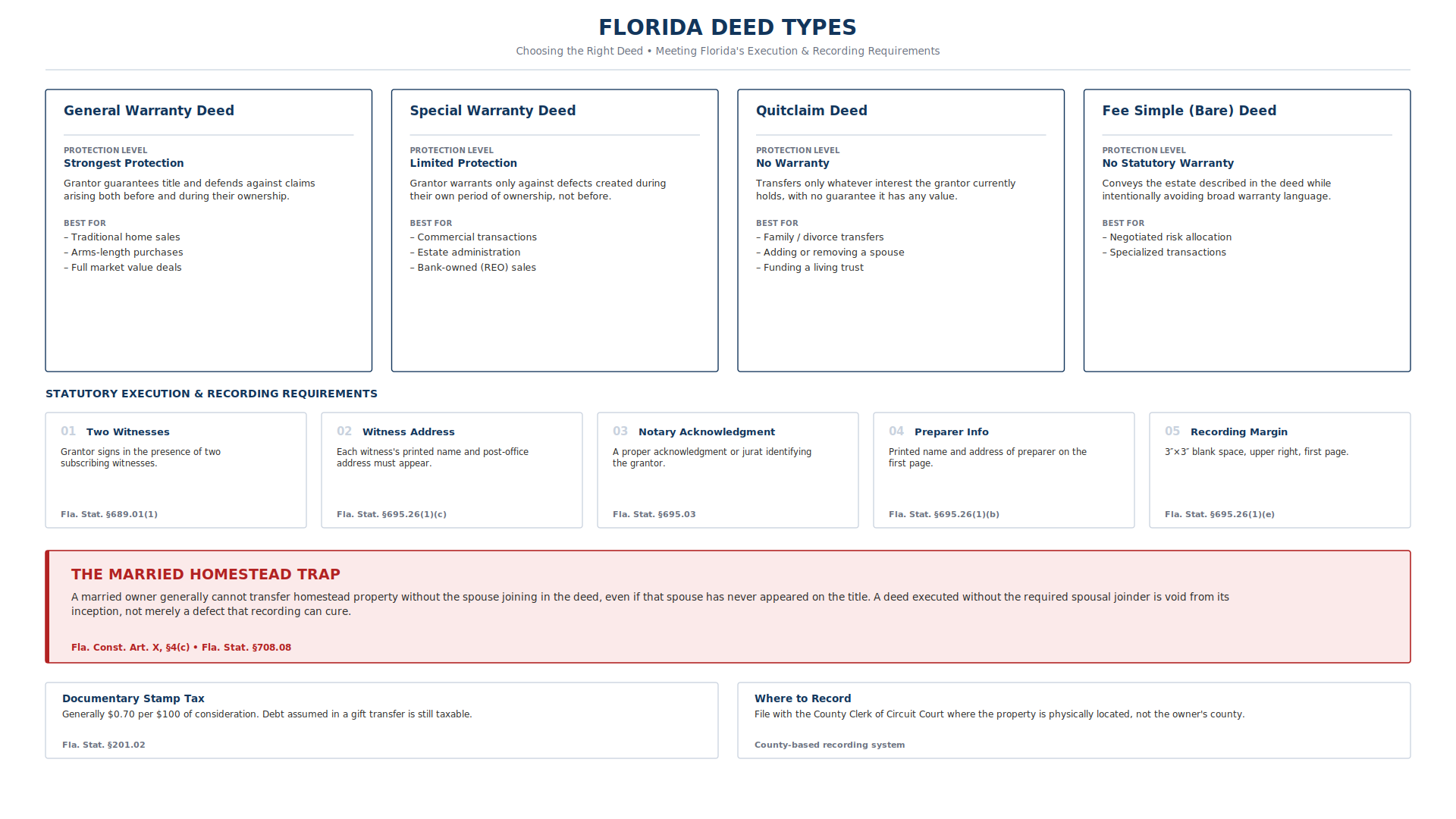
General (Statutory) Warranty Deed
A General Warranty Deed provides the strongest protection available to a buyer. The grantor guarantees that they own the property, have the legal authority to transfer it, and will defend the title against lawful claims arising both before and during their ownership.
Under Florida law, this form of deed traditionally uses statutory words of conveyance such as “granted, bargained, and sold,” together with broad warranty language that protects the grantee against title defects dating back through the property’s ownership history.
Because of these comprehensive warranties, General Warranty Deeds are commonly used for:
- Traditional residential home sales
- Standard real estate purchases
- Arms-length transactions between unrelated parties
- Situations where title insurance and marketable title are expected
For most buyers paying full market value, this remains the preferred Florida real estate deed because it offers the highest contractual protection if title issues later emerge.
Special Warranty Deed
A Special Warranty Deed offers a narrower promise.
Instead of guaranteeing the property’s entire ownership history, the grantor only warrants that they did not create title defects during the time they owned the property. Earlier ownership problems remain outside those warranties.
This type of deed commonly appears in:
- Commercial real estate transactions
- Estate administration
- Bank-owned (REO) properties
- Trustee or fiduciary sales
For example, if an executor transfers property from an estate, they typically cannot guarantee events that occurred decades before the decedent acquired the property. A Special Warranty Deed reflects that practical limitation.
Quitclaim Deed
A Quitclaim Deed is fundamentally different because it contains no warranties whatsoever.
Rather than promising ownership, the grantor simply transfers whatever interest they currently possess—if any.
Florida quitclaim deeds are frequently used for:
- Transfers between family members
- Divorce-related property transfers
- Adding or removing a spouse from title
- Transferring property into a living trust
- Correcting certain title defects
- Clearing potential ownership claims
They are generally not the best choice for a traditional purchase between unrelated buyers and sellers. If an undisclosed title defect later appears, the grantee typically cannot rely on warranty covenants because none were given.
Florida law recognizes this distinction through statutory conveyancing language such as “remise, release, and quitclaim,” which transfers only the grantor’s existing interest without guaranteeing that the interest has any value or is free from competing claims.
Fee Simple (Bare) Deeds
Some Florida deeds transfer ownership without including statutory warranty language at all.
These “bare” conveyances still transfer whatever estate the deed describes but intentionally avoid creating broad contractual warranties regarding title.
Although less common in ordinary residential sales, they may appear in specialized transactions where the parties negotiate different risk allocations.
Brief Note on Fiduciary Deeds
Not every Florida property deed fits neatly into the four primary categories above.
You may also encounter:
- Personal Representative’s Deeds
- Trustee’s Deeds
- Life Estate Deeds
- Lady Bird (Enhanced Life Estate) Deeds
These deeds serve specialized estate-planning or fiduciary purposes and follow different legal considerations. Because each has unique drafting and ownership consequences, they’re best discussed separately rather than treated as interchangeable with ordinary transfer deeds.
Which Deed Should You Use?
The right Florida deed transfer usually depends more on the relationship between the parties than on the property itself.
| Situation | Common Choice |
|---|---|
| Buying a home from a seller | General Warranty Deed |
| Commercial or institutional sale | Special Warranty Deed |
| Transfer between spouses or family | Quitclaim Deed |
| Moving property into a revocable trust | Quitclaim or other estate-planning deed |
| Estate or trustee administration | Fiduciary deed |
A common mistake is choosing a quitclaim deed simply because it’s easy to find online. While it may successfully transfer ownership interests, it doesn’t provide the protections many buyers assume they’re receiving.
What Makes a Deed Legally Valid in Florida?
Many people believe that once a deed is signed, ownership issues are settled forever. Florida law is more nuanced.
A deed must first satisfy Florida’s legal execution requirements before it can effectively convey the ownership interest described in the document. Separately, it must satisfy Florida’s recording requirements before it can be accepted into the county’s official land records.
These are two related but different concepts.
A deed may satisfy the legal requirements for conveying an interest yet still fail to meet the technical standards required for recording. Conversely, recording does not automatically cure execution defects that occurred when the deed was signed.
This distinction explains why title professionals examine both how a deed was executed and whether it complies with Florida’s recording statutes. A document that appears complete at first glance may still contain missing witness information, incomplete acknowledgments, or formatting problems that complicate future title examinations.
For anyone dealing with Florida deeds, execution and recording should be viewed as two separate compliance checkpoints:
- Execution determines whether the deed satisfies Florida’s conveyancing requirements.
- Recording determines whether the deed can be accepted into the public land records and provide notice to future purchasers.
Understanding this difference also helps explain why title companies often reject documents that property owners assumed were perfectly valid. The issue is not always ownership itself it is whether the deed creates clear, insurable title that can withstand future sales, refinancing, or legal scrutiny.
Florida’s Statutory Execution & Recording Requirements
Florida’s deed laws don’t stop at choosing the correct type of deed. Even the right deed can become a problem if it isn’t executed or recorded in compliance with state law. Most title defects seen during closings aren’t caused by disputes over ownership—they’re caused by missing signatures, incomplete witness information, recording deficiencies, or formatting errors that prevent the deed from becoming part of the public record.
This is where many DIY deeds fall short. Generic templates often omit Florida-specific requirements, forcing owners to sign corrective deeds later or delaying a sale while title issues are resolved.
The Statutory Compliance Matrix
The following requirements are drawn directly from Florida’s verified statutory framework governing real estate conveyances.
| Topic / Issue | Florida Legal Rule | Governing Statute |
|---|---|---|
| Execution of a deed | Any deed conveying a freehold interest (ownership) must be signed by the grantor in the physical or authorized remote presence of two subscribing witnesses. (Note: Leases exceeding one year no longer require witnesses) | Fla. Stat. § 689.01(1) |
| Witness information | Each witness’s printed name and post-office address must appear beneath their signature for the deed to be accepted for recording. | Fla. Stat. § 695.26(1)(c) |
| Notary acknowledgment | The deed must include a proper notarial acknowledgment or jurat identifying the grantor before it can be recorded. | Fla. Stat. § 695.03 |
| Preparer information | The first page must identify the person who prepared the deed by printed name and post-office address. | Fla. Stat. § 695.26(1)(b) |
| Grantee information | The deed must state the printed name and post-office address of every grantee receiving the property. | Fla. Stat. § 695.26(1)(f) |
These requirements serve different legal purposes.
The execution rules establish whether the conveyance satisfies Florida’s legal formalities. Recording requirements, on the other hand, allow the county clerk to accept the instrument into the public records so future buyers, lenders, and title companies can rely on it.
A missing witness address might appear insignificant, but it can prevent the clerk from accepting the deed for recording. Likewise, leaving off the preparer’s information or grantee’s mailing address can delay filing until a corrected document is submitted.
For buyers, these aren’t merely paperwork issues. Delayed or rejected recording can complicate refinancing, title insurance, and future sales because the public record no longer accurately reflects ownership.
Why the County Clerk Rejects Deeds (Practical Impact)
Recording a deed in Florida isn’t simply a matter of handing paperwork to the clerk. County recording offices review every submitted document for compliance with Chapter 695 before accepting it into the official land records.
One of the most overlooked technical requirements involves document formatting.
Under Fla. Stat. § 695.26(1)(e), the first page must include a blank 3-inch by 3-inch space in the upper-right corner for the clerk’s recording stamp. Subsequent pages must contain a 1-inch by 3-inch blank space. If those reserved areas are missing, the clerk may reject the document outright.
Another common issue involves incomplete execution blocks.
Many online deed forms include signature lines but omit:
- Printed witness names
- Witness mailing addresses
- Preparer information
- Complete notary acknowledgments
- Return-to recording information
These omissions frequently result in rejected filings because Florida recording statutes require more than signatures alone.
Florida has also implemented an Identity Verification Program framework designed to reduce deed fraud under Fla. Stat. § 28.2225. While many major counties (such as Lee, Palm Beach, and Hillsborough) actively mandate that anyone presenting a deed for recording provide a clear photocopy of a government-issued photographic identification card, this requirement varies depending on individual county clerk policies and localized pilot programs. Property owners should verify their specific county’s ID requirements before submitting.
Understanding why these requirements exist helps explain why professionally prepared deeds tend to encounter fewer recording problems. The witness block, preparer statement, grantee address section, notary acknowledgment, and recording margins are not simply formatting preferences—they exist because Florida law requires them before a deed becomes part of the public record.
The Married Homestead Trap: When a Deed Is Void, Not Just Defective
Few Florida deed rules carry greater consequences than the state’s homestead protection requirements.
Many property owners assume that if only one spouse appears on the title, that spouse can freely transfer the property without anyone else’s signature. That assumption can be disastrously wrong when the property qualifies as the family’s primary residence.
Under Article X, Section 4(c) of the Florida Constitution, together with Fla. Stat. § 708.08, a married owner generally cannot transfer a homestead property without the spouse joining in the deed, even if the spouse has never been listed on the title.
The distinction matters because this isn’t merely a technical defect.
A deed executed without the required spousal joinder is considered void from its inception, not simply voidable or correctable by recording alone.
A Common Real-World Scenario
Imagine a husband purchased a home before marriage, and only his name appears on the deed. Years later, the couple lives there together as their primary residence.
When the property is sold, the husband signs the deed alone because he believes he’s the sole legal owner.
That deed may fail because Florida’s homestead protections require the spouse’s participation in the conveyance—even though she never appeared on the original title.
The problem often isn’t discovered until:
- A buyer’s title company reviews the closing documents.
- A lender examines the property’s ownership history.
- The property is refinanced years later.
- Someone attempts to sell the home again.
Correcting the issue after closing can be expensive and may require additional legal proceedings depending on the circumstances.
Homestead vs. Investment Property
This rule applies specifically to protected homestead property.
If the same owner held an investment property, rental house, vacant lot, or other non-homestead real estate solely in their own name, different considerations apply. The constitutional homestead protections that require spousal joinder generally would not govern those transfers in the same way.
Because title insurers routinely examine homestead compliance during closings, overlooking this requirement can delay a transaction, increase legal costs, and jeopardize the marketability of the property’s title—even when everyone believed the transfer had already been completed.
Required Disclosures and Transfer Taxes at Recording
Signing a deed doesn’t complete a Florida deed transfer. Before the transfer becomes part of the public land records, Florida law requires compliance with certain disclosures, tax obligations, and recording procedures. These requirements are often overlooked in DIY transactions, yet failing to satisfy them can delay recording or create avoidable legal issues.
Mandatory Radon Gas Disclosure
Florida law requires a specific warning about radon gas to appear in real estate sale notification documents, purchase agreements, or lease contracts.
Pursuant to Fla. Stat. § 404.056(5), the notice must use the statutory language:
“RADON GAS: Radon is a naturally occurring radioactive gas that, when it has accumulated in a building in sufficient quantities, may present health risks to persons who are exposed to it over time. Levels of radon that exceed federal and state guidelines have been found in buildings in Florida. Additional information regarding radon and radon testing may be obtained from your county health department.”
Note that this disclosure belongs in the underlying sales contract rather than on the deed itself. County clerks do not require or verify radon text on the face of a deed to accept it for recording, but ensuring it is present in the initial purchase paperwork is required by state law.
Documentary Stamp Tax
Recording a Florida property deed also triggers documentary stamp tax obligations.
Under Fla. Stat. § 201.02, the tax is generally $0.70 for every $100 (or fraction thereof) of the consideration paid for the property.
One detail many property owners miss involves family transfers and gifts.
If no money changes hands but the property is transferred subject to an existing mortgage, documentary stamp tax is generally calculated using the unpaid mortgage balance that the grantee assumes—not the cash purchase price.
For example:
- Parent gifts a home worth $400,000 to a child using a gift affidavit.
- No purchase price is paid.
- The property still has a $150,000 mortgage.
Although the transfer is a gift, documentary stamp tax may still apply because debt is being transferred.
This often surprises families completing estate-planning or intra-family transfers without professional guidance.
Where Is a Florida Deed Recorded?
After execution, the original deed should be submitted to the County Clerk of the Circuit Court (or County Comptroller, depending on the county) where the property is physically located.
Florida follows a county-based recording system. Recording a deed in the wrong county does not establish the public notice intended by Florida’s recording statutes.
Prompt recording also protects the grantee by placing future purchasers and lenders on notice that ownership has changed.
Common Deed Mistakes That Create Title Problems Later
Most title disputes don’t begin with fraud—they begin with small drafting or execution mistakes that nobody noticed at closing.
Here are some of the most common issues professionals encounter.
Using a Quitclaim Deed for a Traditional Home Purchase
Because quitclaim deeds contain no title warranties, they leave buyers with little contractual protection if ownership problems later surface.
For ordinary residential purchases between unrelated parties, buyers generally expect warranty protection. Choosing a quitclaim deed simply because it is easier to prepare can shift significant risk to the purchaser.
Forgetting the Non-Titled Spouse’s Signature
One of Florida’s most expensive mistakes involves homestead property.
Owners frequently assume that only the person listed on the deed needs to sign. If the property qualifies as the family’s homestead, failing to obtain the spouse’s signature can render the conveyance void under Florida law.
Unlike many paperwork mistakes, this isn’t usually corrected by simply re-recording the document after closing.
Improper Witness Blocks
A deed signed without the required witness information may create a title defect that follows the property long after the transaction ends.
Correcting the problem often requires:
- Preparing and recording a corrective deed.
- Obtaining new signatures from the original parties.
- In more complicated situations, pursuing a quiet title action to resolve ownership issues.
These corrective steps can delay future sales and increase legal expenses that could have been avoided during the original transaction.
Using Generic Online Forms
Many downloadable deed forms are written for multiple states.
Florida’s statutory requirements are unusually specific regarding:
- Witnesses
- Witness mailing addresses
- Preparer information
- Recording margins
- Statutory words of conveyance
- Notarial acknowledgments
A form prepared for another jurisdiction may appear complete while failing to satisfy Florida’s recording standards.
Confusing Warranty Language with Title Insurance
Another misconception is that a warranty deed eliminates the need for title insurance.
A warranty deed gives the grantee contractual rights against the grantor.
Title insurance serves a different purpose—it protects against covered title defects regardless of whether the grantor has the financial ability to honor those warranties years later.
For that reason, warranty deeds and title insurance are commonly used together rather than viewed as substitutes.
Frequently Asked Questions
If my deed is missing a witness’s address, is my sale still legal, or do I need to fix it before closing?
Florida requires each subscribing witness’s printed name and post-office address for the deed to satisfy recording requirements under Fla. Stat. § 695.26(1)(c). A missing address can prevent the county clerk from accepting the deed for recording, making it advisable to correct the issue before closing whenever possible.
Can a quitclaim deed be challenged or reversed after it’s recorded?
Recording a quitclaim deed does not prevent legal challenges. Because the grantor makes no warranty regarding ownership, disputes over fraud, lack of authority, forgery, or competing ownership claims may still arise. Recording establishes public notice but does not validate an otherwise defective transfer.
My spouse isn’t on the title. Do they still need to sign the deed if we’re selling our homestead?
Possibly, yes.
If the property qualifies as your Florida homestead, the spouse’s joinder may still be required even when only one spouse appears on the title. Florida’s constitutional homestead protections focus on the property’s status as the family’s primary residence rather than solely on whose name appears in the county records.
What happens if a deed was recorded without the required 3×3 blank space?
The 3-inch by 3-inch reserved space exists for the county clerk’s official recording information. Documents that fail to satisfy Florida’s formatting requirements may be rejected for recording. If the deed has already been accepted and recorded, the underlying transfer and any corrective action depend on the specific circumstances, but meeting the statutory formatting requirements from the outset helps avoid unnecessary delays and recording issues.
Selecting the correct Florida deed is only the first step. The document must also be executed with the required witnesses, include the mandatory recording information, satisfy Florida’s statutory disclosure rules, and be recorded in the proper county. Paying attention to these details from the beginning helps prevent rejected filings, title defects, and costly corrective work when the property is eventually sold, refinanced, or transferred again.