Florida Special Warranty Deed (Free PDF & WORD Form)
A Florida special warranty deed allows a property owner (grantor) to transfer real estate while limiting the promises they make about the property’s title. Instead of guaranteeing the property’s entire ownership history, the grantor generally warrants the title against lawful claims arising by, through, or under the grantor, while excluding claims originating through previous owners. This makes the document a practical middle ground between a General Warranty Deed and a Quitclaim Deed.
A special warranty deed is commonly used when the seller is a bank, trustee, builder, corporation, estate representative, or another party that cannot reasonably guarantee the property’s complete ownership history. Buyers receive more protection than they would under a quitclaim deed, but they do not receive the broad title warranties offered by a general warranty deed.
Our Florida special warranty deed form includes the limited warranty language and execution details commonly used for recording in Florida. Although Florida law prescribes a general warranty deed form under Fla. Stat. § 689.02, the special warranty clause must be drafted to reflect the limited protection the grantor intends to provide. Even with a properly drafted deed, however, compliance with Florida’s execution, witness, notarization, disclosure, and recording requirements remains essential to avoid rejected filings or future title disputes.
Candice Hayden, Legal Writer
Maria Rosso, Florida Probate, Guardianship and Estate Planning Attorney
Florida Special Warranty Deed Form (Free Download)
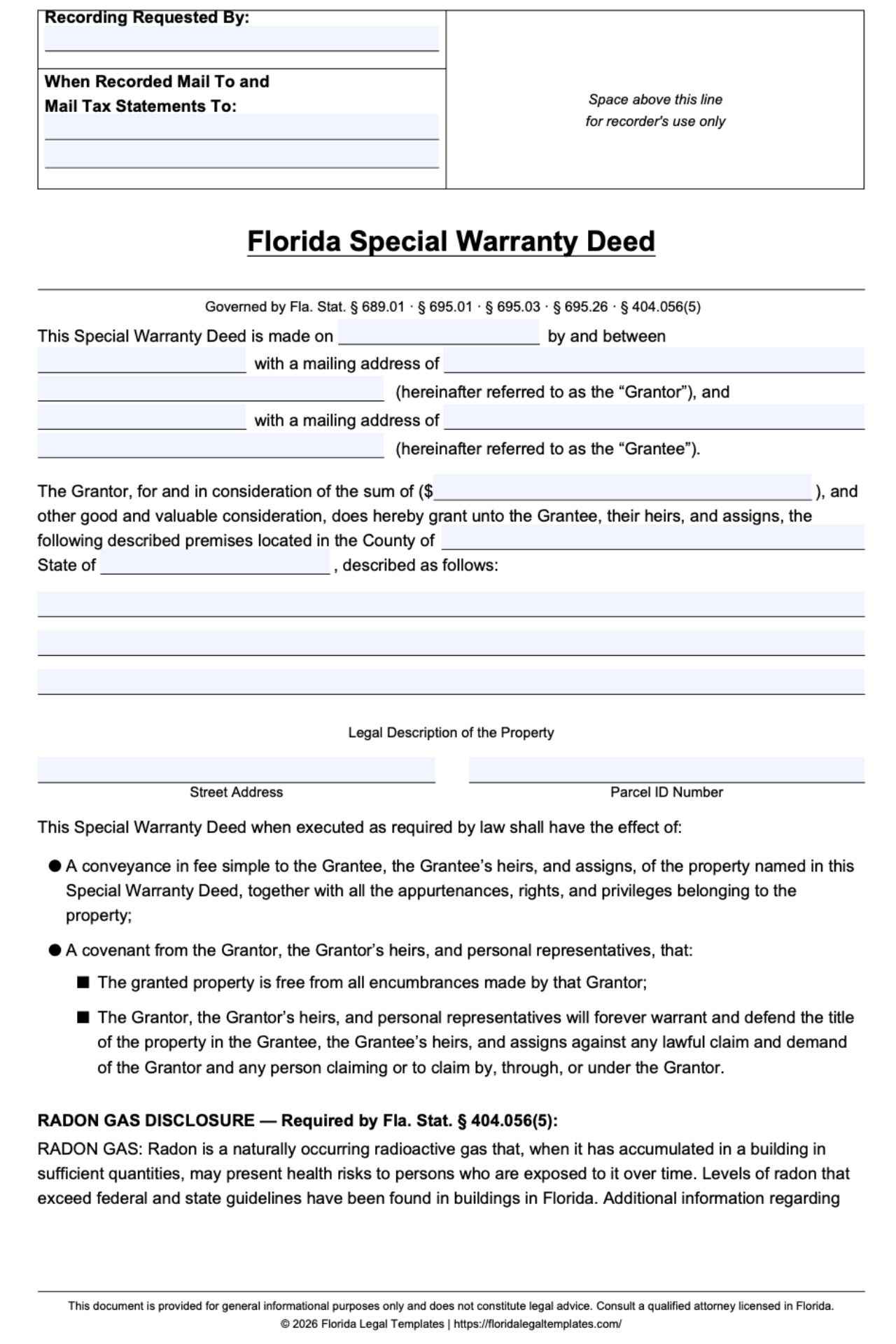
The special warranty deed Florida form is available in both fillable PDF and editable Microsoft Word formats, making it suitable for transactions that require either electronic completion or customized drafting.
A properly prepared template should include:
- Florida statutory granting language
- Limited warranty clause restricting liability to the grantor’s ownership period
- Grantor and grantee information
- Legal property description
- Parcel Identification (Folio) Number field, although the parcel identification number does not replace the legal description and its omission does not by itself affect the deed’s validity or recordability.
- Consideration clause
- Signature block for the grantor
- Two subscribing witness signature blocks
- Witness printed names and mailing addresses
- Notary acknowledgment
- Preparer’s name and mailing address
- Grantee mailing address
- Florida’s statutory radon notification, which is required at or before the contract for sale and purchase or when a rental agreement is executed, rather than as a deed-recording requirement.
-
Grantor’s printed name and post-office address, as required by Fla. Stat. § 695.26(1)(a).
-
Notary public’s printed name beneath the notary’s signature, when applicable, as required by Fla. Stat. § 695.26(1)(d).
-
Reserved space for the clerk’s recording information: 3 inches by 3 inches at the top right of the first page and 1 inch by 3 inches at the top right of subsequent pages, as required by Fla. Stat. § 695.26(1)(e).
Unlike a generic deed template found online, a Florida-compliant form contains numerous statutory fields that recording offices expect to see before accepting the document.
Who Should Use This Form?
A Florida Special Warranty Deed is frequently used by:
- Banks selling foreclosed (REO) properties
- Mortgage lenders disposing of acquired real estate
- Builders transferring newly constructed homes
- Corporate property owners
- Trustees
- Estate personal representatives
- Investment companies selling recently acquired property
These sellers usually have limited firsthand knowledge of the property’s ownership history and therefore restrict their warranty to the period during which they held title.
When This Form May Not Be Enough
A Special Warranty Deed is not appropriate for every transaction.
For example, if a buyer’s lender or title insurance company requires a General Warranty Deed, using a Special Warranty Deed alone may delay or even prevent closing until the seller provides broader warranty language.
Likewise, if the property qualifies as Florida homestead property and the owner is married, additional constitutional requirements apply under Article X, Section 4(c) of the Florida Constitution. Even where only one spouse appears on title, the non-owner spouse generally must join in a conveyance to a third party. A direct conveyance between spouses is treated differently under Fla. Stat. § 689.11.
What Is a Special Warranty Deed in Florida?
A Florida Special Warranty Deed can transfer a fee simple interest in real estate while limiting the grantor’s promises regarding title. The buyer receives only the ownership interest the grantor actually holds and conveys.
Rather than guaranteeing the property’s entire ownership history, the grantor generally limits the warranty to lawful claims arising by, through, or under the grantor. The deed’s actual language determines the promises being made and the extent of the grantor’s responsibility.
This limited warranty is the defining feature of the document.
How It Differs From Other Florida Deeds
Understanding this distinction is often more important than understanding the deed itself.
| Deed Type | Warranty Protection |
|---|---|
| General Warranty Deed | Covers the property’s entire chain of title, including ownership before the grantor acquired it. |
| Special Warranty Deed | Covers only defects arising during the grantor’s ownership. |
| Quitclaim Deed | Provides no warranties whatsoever regarding ownership or title. |
A Special Warranty Deed gives the buyer more protection than a quitclaim deed, but less than a General Warranty Deed. For example, the seller generally remains responsible for claims arising through their own ownership, while older title defects may fall outside the limited warranty.
Why Buyers Should Care
Suppose a title problem surfaces involving an unpaid mortgage recorded twenty years before the current seller ever purchased the property.
Under a General Warranty Deed, the buyer may have a claim against the seller for a breach of the deed’s title warranties, even when the underlying defect originated before the seller acquired the property.
Under a Special Warranty Deed, that same claim generally falls outside the seller’s warranty because the defect existed before the seller owned the property.
This difference explains why buyers frequently obtain title insurance. The insurance policy—not the deed—often becomes the buyer’s primary protection against historical title defects.
Why Banks and Builders Prefer This Deed
Institutional sellers often use a Special Warranty Deed because they cannot verify every transaction in a property’s history. Before accepting one from a bank or builder, buyers should review the title search carefully. The deed limits the seller’s warranty, so an older lien or easement may remain the buyer’s responsibility unless title insurance provides coverage.
Key Florida Statutes Governing This Deed
Execution, Recording & Disclosure Requirements
| Topic / Issue | Precise Legal Rule | Governing Statute / Code |
| Two-Witness Mandate | Requires real property deeds to be signed in the presence of two subscribing witnesses. | Fla. Stat. § 689.01(1) |
| Witness Address Trap | Requires the name and post-office address of each subscribing witness to be legibly printed, typewritten, or stamped on the instrument. | Fla. Stat. § 695.26(1)(c) |
| Limited Warranty Anchor | The deed’s limited warranty generally protects against lawful claims by, through, or under the grantor, rather than claims originating through previous owners. | Florida Common Law Deeds & Case Precedents |
| Grantee Metadata Rule | Requires the name and post-office address of each grantee to be legibly printed, typewritten, or stamped on the instrument before the instrument may be recorded. | Fla. Stat. § 695.26(1)(f) |
| Homestead Joinder Rule | Generally requires a married owner to join with the spouse when conveying protected homestead property to a third party, while permitting a direct conveyance between spouses without requiring the grantee spouse to execute the deed. | Florida Constitution Art. X, § 4(c) & Fla. Stat. § 708.08 |
| Anti-Fraud Verification | Empowers county clerks to demand a valid government-issued photo ID from the party submitting real property conveyances for recordation. | Fla. Stat. § 28.2225 |
| Documentary Stamp Tax | Florida generally imposes documentary stamp tax at $0.70 per $100, or portion thereof, of consideration. Miami-Dade County imposes $0.60 per $100 and an additional $0.45 per $100 surtax on taxable transfers, generally excluding qualifying single-family residences, under Fla. Stat. § 201.031. | Fla. Stat. § 201.02 |
|
Grantor Information Rule |
Requires the name and post-office address of the person executing the instrument to be legibly printed, typewritten, or stamped on the instrument. |
Fla. Stat. § 695.26(1)(a) |
|
Notary Identification Rule |
Requires the printed name of the notary public or other authorized officer whose signature appears on the instrument. |
Fla. Stat. § 695.26(1)(d) |
Florida recording requirements go beyond the signatures themselves. For example, Fla. Stat. § 695.26 requires the names and post-office addresses of the parties, witnesses, and preparer to appear on qualifying instruments, along with the grantee’s name and post-office address. A missing required name or address can create a recording problem even when the deed has otherwise been properly signed.
Before sending the deed to the clerk, review the witness blocks, preparer information, grantee details, and acknowledgment carefully. At the same time, do not treat the parcel identification number as a substitute for the legal description; under Fla. Stat. § 689.02, omission of the parcel number does not by itself affect the deed’s validity or recordability.
Practical Impact & Document Clauses
Every required field on the deed serves a practical legal purpose.
The witness lines establish compliance with Florida’s execution requirements. The preparer block identifies who drafted the instrument. The parcel identification number helps county officials accurately associate the deed with the correct parcel. The grantee’s mailing address ensures future tax notices and ownership records can be maintained correctly.
Perhaps the most important clause is the limited warranty language itself:
“…and the Grantor does hereby warrant the title to said land, and will defend the same against the lawful claims of all persons claiming by, through, or under the Grantor, but against none other.”
Those final words fundamentally distinguish a Special Warranty Deed from a General Warranty Deed. They expressly limit the grantor’s liability to claims arising through the grantor’s own ownership, excluding defects originating earlier in the chain of title.
While Florida law mandates a specific radon gas warning, this consumer notification applies strictly to initial purchase contracts and long-term lease agreements under Fla. Stat. § 404.056(5). Including the radon notice on the deed itself is not required by Fla. Stat. § 404.056(5), which requires the notice on at least one document, form, or application executed at or before the contract for sale and purchase. Because the radon notice is not a deed-recording requirement under § 404.056(5), its absence from the deed itself is not a statutory basis for rejecting the deed under that provision.
When a Special Warranty Deed Fits and When It Doesn’t
A Florida Special Warranty Deed is designed for transactions where the seller is willing to stand behind their own ownership of the property, but not the actions of previous owners. In commercial and institutional real estate transactions, this allocation of risk is common because the seller often lacks firsthand knowledge of the property’s complete history.
Common Situations Where This Deed Makes Sense
A Special Warranty Deed is frequently used by:
- Banks selling foreclosed (REO) properties
- Mortgage lenders disposing of acquired real estate
- Builders conveying newly constructed homes
- Limited liability companies (LLCs) and corporations selling investment properties
- Trustees transferring trust-owned real estate
- Personal representatives administering an estate
In these situations, the seller typically did not occupy the property or investigate decades of prior ownership. Instead of guaranteeing the entire chain of title, they only warrant that they did not create title defects while they owned the property.
For example, a bank that acquires a home through foreclosure cannot reasonably promise that a prior owner did not create an undisclosed easement or leave behind an unreleased lien years earlier. A Special Warranty Deed limits the bank’s responsibility to issues arising during its ownership.
When Buyers May Request Stronger Protection
Some residential transactions require broader warranties.
If the buyer’s lender or title insurance underwriter expects a General Warranty Deed, presenting only a Special Warranty Deed may delay underwriting or require additional negotiations before closing. Although title insurance often protects against historical defects, lenders may still require broader contractual warranties from the seller.
Before preparing closing documents, buyers and sellers should confirm the deed type required by the purchase agreement, lender, and title company.
Situations Where This Deed Is Usually Not Appropriate
A Special Warranty Deed may not be the best choice when:
- The seller has owned and occupied the property for many years.
- The property’s ownership history is well established.
- The buyer expects full title protection.
- The purchase contract specifically requires a General Warranty Deed.
Refusing to provide the deed type required under the sales contract can delay or even jeopardize closing.
Another important consideration involves Florida homestead property. Constitutional protections apply regardless of which deed form is used. A correctly drafted Special Warranty Deed cannot override Florida’s homestead requirements if a required spouse fails to join in the conveyance.
How to Complete and Record the Deed
Preparing a Florida Special Warranty Deed involves much more than filling in names and obtaining signatures. Every section of the document serves a legal purpose, and overlooking a required element can prevent the deed from being recorded.
Step 1: Identify the Grantor and Grantee
Begin by entering the legal names of the grantor (seller) and grantee (buyer). The deed should also include each grantee’s mailing address, as required for recording.
Double-check spelling against government-issued identification and the existing deed. Minor name discrepancies can create unnecessary title questions later.
Step 2: Insert the Property Description
Include:
- The complete legal description from the current deed
- The property’s Parcel Identification Number (Folio Number)
- County where the property is located
Do not rely solely on the street address. The legal description—not the mailing address—is what legally transfers ownership.
Step 3: State the Consideration
The deed should accurately state the consideration exchanged for the transfer.
This amount also affects the documentary stamp tax collected at recording.
Step 4: Evaluate Optional Radon Boilerplate and Mandatory Grantee Details
Under Fla. Stat. § 404.056(5), Florida requires the statutory radon notification on at least one document, form, or application executed at or before a contract for the sale and purchase of a building; the statute does not make the deed itself the required disclosure document. Separately, Fla. Stat. § 695.26 requires the name and post-office address of each grantee to appear on an instrument conveying an interest in real property.
Step 5: Execute the Deed Properly
The grantor must sign the deed in the presence of two subscribing witnesses. Before recording, the execution must also be acknowledged by the grantor or proved by a subscribing witness in a manner permitted by Fla. Stat. § 695.03.
Each witness should sign the deed, and the witness’s printed name and post-office address should appear as required by Fla. Stat. § 695.26. Reviewing those details before recording can help avoid a preventable recording problem.
Step 6: Record the Deed
After execution, the original deed should be submitted to the Clerk of the Circuit Court (or County Comptroller) in the Florida county where the real estate is located.
Recording protects the conveyance against creditors and subsequent purchasers for value without notice as provided by Florida’s recording statute and places the instrument in the county’s public records.
Documentary Stamp Tax
Florida imposes documentary stamp tax when real property is transferred.
The standard rate is:
- $0.70 per $100 (or fraction thereof) of the consideration paid.
Miami-Dade County generally charges $0.60 per $100 of consideration instead of the standard $0.70 rate. An additional $0.45 per $100 surtax generally applies to taxable transfers other than qualifying single-family residences.
Failure to pay the required tax can delay recording.
Identity Verification
Florida clerks also utilize identity verification procedures designed to combat deed fraud.
Florida has also used statutory measures aimed at preventing deed fraud, but the former statewide-sounding language should not be applied to current recording practice. The identity-verification provision cited in earlier versions of this article created a Lee County pilot program under Fla. Stat. § 28.2225, and that statute was repealed effective July 1, 2025. Check the recording requirements of the particular Florida county before assuming that the person presenting a deed must provide government-issued identification.
Practical Tip
Before accepting a Special Warranty Deed, ask the title company to review the property’s ownership history, recorded mortgages, easements, and other title exceptions. This is particularly important when purchasing a foreclosed property, because the seller’s limited warranty may not cover claims originating before the seller acquired title.
Homestead, Spousal Joinder, and Other Limitations
Florida’s constitutional homestead protections create one of the most significant limitations on the use of a Special Warranty Deed.
Homestead Property Requires Spousal Joinder
Under Article X, Section 4(c) of the Florida Constitution, an owner of protected homestead property must generally join with the spouse when conveying or mortgaging the property to a third party. Florida also allows a direct conveyance from one spouse to the other under Fla. Stat. § 689.11; the grantee spouse need not execute that conveyance.
Missing Witnesses Create More Than a Technical Error
Florida requires two subscribing witnesses.
A deed lacking the required witness signatures does not merely create a recording inconvenience—it creates a significant title problem that often requires a corrective deed or, in some situations, quiet title litigation to resolve.
Because the execution itself is defective, simply recording the document later will not cure the problem.
Limited Warranty Means Limited Recovery
Another commonly misunderstood limitation involves historical title defects.
Suppose a buyer later discovers:
- an unreleased mortgage from thirty years ago,
- an undisclosed utility easement,
- a restrictive covenant recorded decades before the current seller purchased the property.
Under a Special Warranty Deed, the buyer generally cannot recover from the seller for claims originating through previous owners when those claims fall outside the limited warranty language in the deed.
In practice, a buyer with title insurance may have coverage for certain historical title defects, depending on the policy’s terms, exclusions, exceptions, and applicable conditions.
Costly Mistakes Sellers and Buyers Make With This Deed
Some deed problems are easy to overlook during closing, particularly when buyers and sellers assume that every warranty deed offers the same protection. In Florida, the wording of the deed matters just as much as the signatures and recording information.
Assuming Every Warranty Deed Provides Full Protection
The word “warranty” often causes confusion.
Some buyers believe every warranty deed guarantees the property’s entire ownership history.
A Special Warranty Deed does not.
Before signing, compare the warranty clause with the protection promised in the purchase agreement. A buyer expecting a General Warranty Deed should not assume that a Special Warranty Deed offers the same protection simply because both documents transfer real estate.
Forgetting Spousal Joinder
Before signing a deed involving Florida homestead property, confirm whether the owner’s spouse must also join in the conveyance. Article X, Section 4(c) of the Florida Constitution generally requires spousal joinder when a married owner conveys homestead property to a third party. Resolving a missing signature before closing is far easier than addressing a title dispute afterward.
Missing Recording Information
Common recording problems include:
- omitted witness addresses,
- missing preparer information,
- incomplete acknowledgment certificates,
- missing or incorrect parcel identification numbers, although § 689.02(2) provides that the omission or an incorrect number does not affect the deed’s validity or recordability.
Before submitting the deed, check the names and addresses of the grantor, grantee, witnesses and preparer against the requirements of Fla. Stat. § 695.26. Include the parcel identification number when available, but remember that § 689.02(2) expressly states that omitting or misstating that number does not affect the deed’s validity or recordability.
Using the Wrong Deed Type
Even a perfectly drafted Special Warranty Deed cannot satisfy a purchase agreement or lender that specifically requires a General Warranty Deed.
Confirming document requirements early in the transaction helps avoid last-minute closing delays.
Frequently Asked Questions (FAQ)
Can a Special Warranty Deed be recorded if a witness’s address is missing?
Generally, no. Florida recording requirements call for each subscribing witness’s post office address to appear on the instrument. Omitting that information may cause the recording clerk to reject the deed until it is corrected.
Does a Special Warranty Deed protect a Florida buyer if a lien from a previous owner surfaces later?
Usually not. The seller’s warranty only covers claims arising through the seller’s ownership. Liens or defects created before the seller acquired the property generally fall outside the warranty. This is why title insurance is so important in Special Warranty Deed transactions.
Is a Special Warranty Deed valid if the seller’s spouse does not sign but the property is not homestead?
The homestead requirement specifically applies to protected homestead property. If the property is not legally homestead, the constitutional spousal joinder requirement generally does not apply under the facts provided. However, other ownership interests or contractual obligations may still require additional signatures.
What happens if a lender requires a General Warranty Deed but the seller only provides a Special Warranty Deed?
The lender or title company may refuse to proceed until the deed satisfies the transaction requirements. In many cases, the parties must renegotiate the deed type or amend the purchase agreement before closing can occur.
Legal Disclaimer: This Florida special warranty deed template is provided for informational purposes and does not constitute legal advice. Recording requirements and the appropriate deed language can depend on the property, transaction, title history, and county-specific procedures. Consider consulting a Florida real estate attorney or title professional before using the form for a specific transaction.