
Florida Small Estate Affidavit [Free Printable PDF Template]
If you’ve been searching for a Florida small estate affidavit the way other states use them, Florida doesn’t have one — and knowing what the state offers instead is the difference between resolving an estate in weeks and spending months in the wrong process. What Florida calls Disposition Without Administration under F.S. §735.301 is a reimbursement mechanism, not a general access tool, meaning only the person who actually paid the funeral expenses or the last 60 days of medical bills qualifies to use it.
I’ve seen families lose weeks to this distinction — a son wanting to close a small bank account while his sister, who paid the funeral bill, was the only one the process actually covered. The template and process breakdown below identify which Florida procedure applies to your situation, what the exempt property rules mean for how the estate gets calculated, and when a Petition for Summary Administration is the more practical path forward.
Candice Hayden, Legal Writer
Maria Rosso, Florida Probate, Guardianship and Estate Planning Attorney
Florida Small Estate Affidavit (PDF, Printable, Fillable)
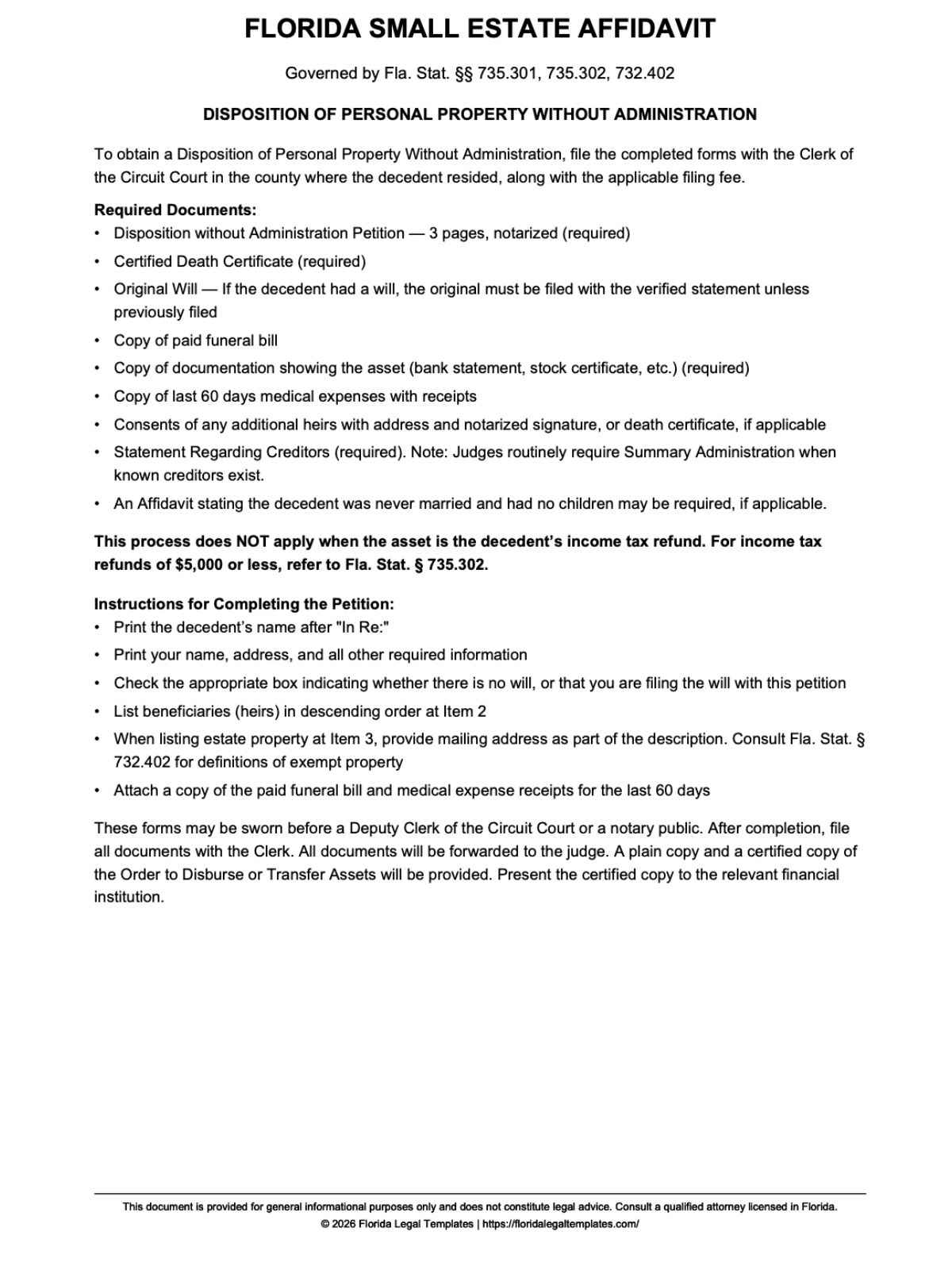
A Florida small estate affidavit form (technically a verified petition) provides a structured format to request reimbursement from a deceased person’s estate through the court.
What the document includes:
- Petitioner identification (person filing the request)
- Decedent details (name, date of death, residence)
- Itemized list of personal property assets
- Exact values (e.g., bank account balances)
- Statement confirming payment of funeral or medical expenses
- Supporting documentation (receipts and proof of payment)
- Sworn affidavit language requiring notarization
Who should use this:
- Individuals who personally paid funeral expenses
- Individuals who paid medical bills from the last 60 days of the decedent’s illness
- Estates with minimal personal property only
- Situations where reimbursement—not distribution—is the goal
Note: If the decedent has a surviving spouse or children, the petition can also include “Exempt Property” under Fla. Stat. § 732.402 (up to $20,000 in furniture/appliances and two vehicles), which is not subject to the funeral/medical reimbursement cap.
When this template may NOT be sufficient:
- The estate includes real estate (automatically disqualified)
- The total value exceeds allowable limits
- There are creditors beyond funeral/medical expenses
- A probate case has already been opened
- Assets need to be distributed to heirs rather than reimbursed
This is where most users get it wrong. The state of Florida small estate affidavit is not a general estate transfer tool—it is a narrow reimbursement mechanism.
What Is a Florida Small Estate Affidavit?
A Florida small estate affidavit is legally known as a Disposition Without Administration under Florida probate law.
Because Florida treats this process as a court-supervised reimbursement procedure rather than a simple transfer affidavit, many families first compare it with other probate-related sworn statements and estate declarations. Readers unfamiliar with Florida probate terminology may also benefit from reviewing broader legal affidavit formats used in Florida courts and situations where an heirship declaration may help establish family relationships during estate administration.
Legal framework:
- Governed by Fla. Stat. § 735.301
Legal nuance:
This is not a standalone affidavit that gives you immediate authority to collect assets. It must be filed with the court, reviewed by a judge, and approved through an official order.
Critical distinction:
- Small Estate Affidavit (Fla. Stat. § 735.301)
→ Limited to reimbursement of final expenses - Summary Administration (Fla. Stat. § 735.201+)
→ Used for larger estates (up to $75,000 or older estates) - Formal Administration
→ Full probate process
Key implication:
Most estates that people assume qualify for a small estate affidavit form Florida actually require Summary Administration instead.
Key Florida Laws That Affect Florida Small Estate Affidavit
Summary of Applicable Laws
| Topic / Issue | Florida Legal Rule | Governing Statute |
|---|---|---|
| Governing Procedure | Disposition Without Administration | Fla. Stat. § 735.301 |
| Max Estate Value | Limited to “Preferred Funeral Expenses” (capped at $6,000 per Fla. Stat. § 733.707) plus reasonable medical expenses from the last 60 days of the last illness. | Fla. Stat. § 735.301(1) |
| Notary Requirement | Must be sworn affidavit or verified petition | Fla. Stat. § 735.301 |
| Asset Restrictions | Personal property only (no real estate) | Fla. Stat. § 735.301(1) |
| Exempt Property | Certain exempt assets excluded from value cap | Fla. Stat. § 732.402 |
The court’s review process depends heavily on documentation accuracy, especially when verifying ownership details, correcting clerical inconsistencies, or validating estate-related records. In situations involving errors in financial or ownership paperwork, a sworn correction statement for inaccurate records may help clarify discrepancies before filing probate-related documents.
Practical Impact & Document Clauses
Florida law tightly controls how this process works—and small mistakes often result in rejection.
The value limitation is the biggest constraint. Under Fla. Stat. § 735.301, the estate must not exceed the amount of funeral and final medical expenses. If assets exceed that amount, the court will deny the request.
The petition must also include a precise itemization of assets. This means listing:
- Exact bank account balances
- Specific property descriptions
- Accurate dollar values
Vague descriptions or estimates are a common reason for rejection.
Additionally, the petitioner must prove they paid the expenses. Receipts are not optional—they are required evidence. Without them, the court will not approve reimbursement.
Finally, this process only applies to personal property. Any presence of real estate automatically disqualifies the estate.
In practical terms:
- Missing receipts → petition denied
- Incorrect asset values → delays or rejection
- Real estate included → forced into probate
- Assets exceeding limits → must use Summary Administration
When to Use Florida Small Estate Affidavit
A Florida small estate affidavit should be used only in very specific situations.
Common use cases:
- Reimbursing funeral expenses
- Recovering small personal property assets
- Closing very small estates quickly
Practical scenarios:
- A family member paid funeral costs and needs reimbursement from a bank account
- A small refund or personal asset needs to be collected
- The estate consists only of minor personal property
When NOT to use:
- The estate includes real estate
- The estate has significant value
- Multiple creditors exist
- Probate has already started
Using this process incorrectly can delay recovery and increase legal costs.
How to Create or Fill Out the Florida Small Estate Affidavit
Filling out a small estate affidavit Florida pdf requires accuracy and supporting documentation.
Step-by-step process:
- Identify the petitioner and decedent
- Confirm eligibility under Florida law
- Itemize all personal property assets
- Assign exact values to each asset
- Confirm payment of funeral or medical expenses
- Attach receipts as proof
- Draft the sworn affidavit or verified petition
- Notarize the document
- File with the Clerk of the Circuit Court (county of residence)
- The judge will issue a “Letter of Authority” or “Order for Payment.” This court-sealed document is the only thing banks and entities are legally required to honor under Fla. Stat. § 735.301(2).
Before You File: Check Whether the Asset Has a Payable-on-Death (POD) Beneficiary
One issue that catches families off guard is that the account they are trying to access may never become part of the probate estate at all. Many Florida checking, savings, and credit union accounts are titled with a Payable-on-Death (POD) or Totten Trust designation. When the account owner dies, the money generally passes directly to the named beneficiary by contract rather than through probate, even if the balance is small. See Fla. Stat. § 655.82.
That distinction matters because a Disposition Without Administration only reaches assets that actually belong to the probate estate. If a bank confirms a valid POD beneficiary is on file, the court’s reimbursement order under Fla. Stat. § 735.301 typically does not override that contractual designation. Instead, the beneficiary usually claims the funds directly from the financial institution by providing identification and a certified death certificate, subject to the bank’s own procedures.
Before preparing this petition, ask each bank whether the account has a POD or other beneficiary designation. Spending five minutes confirming account ownership can prevent filing for an asset that was never probate property in the first place, and it may save both filing fees and several weeks of unnecessary court processing.
Before filing, many petitioners organize supporting estate records alongside other probate planning documents to avoid delays during court review. If the decedent left estate planning instructions or healthcare directives, reviewing a Florida estate planning document or an existing advance medical directive can help confirm how assets and final affairs were intended to be handled.
Practical tips:
- Verify eligibility before preparing the document
- Use exact dollar amounts—no estimates
- Organize receipts clearly for submission
The court does not act on assumptions. Every detail must be supported.
Limitations and Legal Considerations
This is not a general “small estate shortcut.” It is one of the most restricted probate procedures in Florida.
Key limitations:
- Cannot include real estate
- Cannot exceed reimbursement threshold
- Cannot bypass creditor priority rules
Florida-specific constraints:
- Must strictly comply with Fla. Stat. § 735.301
- Requires court approval before assets can be collected
High-risk scenarios:
- Misunderstanding eligibility
- Attempting to transfer assets directly without court order
- Ignoring creditor claims
Edge cases:
- Exempt property under Fla. Stat. § 732.402 may be excluded from value limits
- Estates slightly above the threshold must use Summary Administration
- Pending probate or litigation blocks eligibility
The Homestead Real Estate Disqualification Trap
A widespread mistake among families handling a deceased relative’s affairs is assuming that because Florida protected homestead property is constitutionally excluded from the claims of general creditors under Art. X, § 4 of the Florida Constitution, the family home does not count as “estate property” when evaluating eligibility for Disposition Without Administration. Families frequently attempt to file a Disposition petition to recover a $3,000 bank account while believing they can address the house separately.
This assumption triggers an immediate statutory rejection by the probate court clerk. Under Fla. Stat. § 735.301(1), Disposition Without Administration is strictly limited to estates that leave zero real property. Even if the real estate is 100% exempt homestead, the presence of any real estate title automatically disqualifies the estate from Disposition Without Administration entirely. Attempting to file a Disposition petition in this scenario wastes time and non-refundable court filing fees. Instead, the family must file a Petition for Summary Administration under Fla. Stat. § 735.201 alongside a Petition to Determine Homestead, allowing the probate court to clear title to the real estate and distribute the bank account within a single simplified proceeding
When the estate exceeds Florida’s narrow reimbursement limits, families often need a more formal probate or financial authority process instead of relying on Disposition Without Administration. In some cases, reviewing broader financial decision-making authorization documents may help families understand what authority existed before death and whether additional probate proceedings are necessary.
Common Mistakes to Avoid
Assuming all “small estates” qualify
Consequence: Petition denied and process restarted under probate.
Failing to provide receipts
Consequence: Court rejects reimbursement request.
Listing assets vaguely
Consequence: Delays or outright denial.
Attempting to include real estate
Consequence: Immediate disqualification under Florida law.
Not filing with the court
Consequence: Affidavit has no legal effect.
Frequently Asked Questions (FAQ)
Does Florida allow a small estate affidavit without court involvement?
No. Under Fla. Stat. § 735.301, this is a court-filed process requiring judicial approval.
What is the maximum value allowed for a Florida small estate affidavit?
The estate is limited to the amount of funeral expenses and medical costs from the last 60 days of illness.
Can this be used to transfer real estate?
No. Florida law strictly prohibits using this procedure for real property.
What happens if the estate is too large?
The estate must go through Summary Administration or Formal Administration instead.
A properly prepared Florida small estate affidavit can simplify reimbursement in very limited situations—but only when the strict statutory requirements are fully met.