
Florida Affidavit of Repossession [Free Printable, Fillable PDF]
A Florida affidavit of repossession is the sworn statement used as statutory proof of the lienholder’s ownership and right of possession after a vehicle is repossessed upon default, and most lenders who run into problems with it discover that the physical repossession was the easy part.
Under F.S. §319.28(2)(b), the Florida repossession affidavit stating that the vehicle was repossessed upon default constitutes satisfactory proof of ownership and right of possession — but before the certificate of title can be issued showing no liens, any subsequent lienholder named on the last certificate of title must receive notice at least five days before the vehicle is sold, with a 15-day period for a written protest that triggers a 10-day hold on issuance of the certificate of title.
I’ve worked with lenders who completed a lawful self-help repossession under F.S. §679.609, had the vehicle in their possession, and still couldn’t obtain the repossession title documentation because they skipped the subsequent lienholder notification step required for the title application. The template and process breakdown below cover the affidavit language F.S. §319.28(2)(b) requires, the notification timeline that has to be followed before the title transfer can proceed, and what happens if a subsequent lienholder files a protest before the 15 days are up.
Candice Hayden, Legal Writer
Maria Rosso, Florida Probate, Guardianship and Estate Planning Attorney
Florida Affidavit of Repossession (PDF, Printable, Fillable)
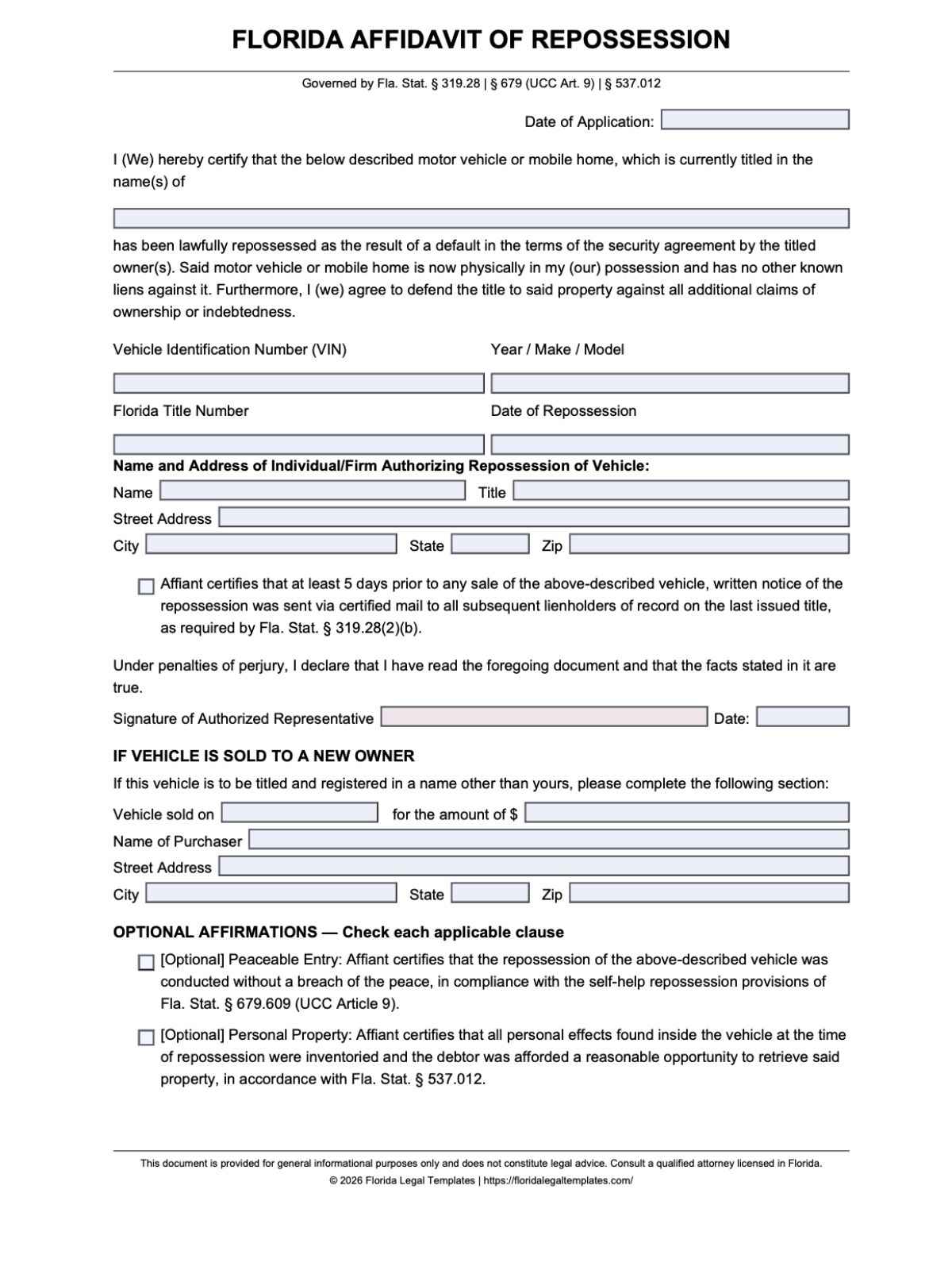
A Florida repossession affidavit template provides a structured format for lenders and agents to comply with state requirements when applying for a new title.
What the document includes:
- Lienholder identification (secured creditor details)
- Debtor information (former owner)
- Vehicle details (VIN, title number, description)
- Statement of repossession
- Mandatory “default” declaration
- Certification of notice to other lienholders
- Notary jurat (sworn oath section)
Who should use this:
- Banks and financial institutions
- Auto lenders and dealerships
- Licensed Class “E” or “EE” Recovery Agents acting on behalf of the lender. Florida generally requires recovery agencies and recovery agents performing repossessions for consideration to hold the licenses required by Chapter 493, including Class R/RR agency and Class E/EE individual licenses.
When this template may NOT be sufficient:
- The repossession involved a breach of the peace
- The repossession is disputed
- Required notices were not sent to lienholders
- Title documents are incomplete or incorrect
Key insight:This affidavit is not just supporting paperwork—it provides the statutory proof used for the repossession title application. Without the affidavit and the other documentation required for the application, FLHSMV may reject the application or require additional documentation before issuing the title.
What Is a Florida Affidavit of Repossession?
A Florida vehicle repossession affidavit is a sworn administrative statement confirming that a vehicle was lawfully repossessed due to default and that the lienholder is entitled to ownership.
Under Florida law, the process is governed by two legal frameworks:
- Title transfer requirements under Chapter 319
- Secured transaction rules under Chapter 679
The affidavit supplies the specific proof required by §319.28(2)(b), while proof of the required notice to subsequent lienholders is submitted with the title application.
Because repossession affidavits function as sworn ownership transfer documents, lenders often compare them with other Florida affidavit formats used for legal verification and administrative filings. Readers unfamiliar with affidavit structure may also benefit from reviewing a broader collection of Florida affidavit templates and related vehicle record correction affidavits commonly used when title information contains errors or inconsistencies.
Legal nuance:
The two documents serve different purposes in the repossession process:
- The security agreement gives the lender the right to repossess
- The affidavit provides the statutory proof the lienholder can use when applying for a certificate of title after repossession.
Critical distinction:
The security agreement supports the creditor’s rights after default, while the repossession affidavit addresses the separate title-application requirement under F.S. §319.28(2)(b). Keeping those two functions separate helps avoid treating the affidavit as a substitute for the underlying security agreement.
Key implication:
Even when the repossession itself was lawful, incomplete or inconsistent title documentation can delay or prevent issuance of the repossessed vehicle’s certificate of title.
Key Florida Laws That Affect Florida Affidavit of Repossession
Summary of Applicable Laws
| Topic / Issue | Florida Legal Rule | Governing Statute |
|---|---|---|
| Title Transfer After Repossession | Affidavit required for issuance of new title | Fla. Stat. § 319.28 |
| Notice to Subsequent Lienholders | Must send certified notice at least 5 days before sale | Fla. Stat. § 319.28(2)(b) |
| Protest & Title Hold Period | 15-day protest window + 10-day hold if protest filed | Fla. Stat. § 319.28(2)(b) |
| Notary Requirement (Jurat) | Must be sworn before a notary public using a Jurat. For 2026 compliance, the notary block must explicitly state whether the affiant appeared via physical presence or remote online notarization (RON). For a Florida notarization, the notarial certificate must state whether the signer appeared by physical presence or by authorized online notarization, as required by Fla. Stat. §117.05 | Fla. Stat. § 117.05(13) |
| Lawful Repossession Requirement | Must occur without breach of the peace | Fla. Stat. § 679.609 |
| Recovery Agent Licensing | Third-party repossession generally requires appropriately licensed recovery agents and agencies, subject to Chapter 493 exemptions | Fla. Stat. §§ 493.6101, 493.6401 |
Under Fla. Stat. § 319.28, Florida strictly regulates how a repossessed vehicle title is transferred. The affidavit must state that the vehicle was repossessed upon default, while proof of the required subsequent-lienholder notice must be submitted separately with the title application.
The law also imposes strict timelines. After the notice is mailed, a subsequent lienholder has 15 days to file a written protest, and the former owner or a subsequent lienholder may file a written protest under oath during that period. If a timely protest is filed, the department may not issue the certificate of title for 10 days thereafter. If the required notice or protest procedure is not followed, the Department may not be able to issue the certificate under the procedure described in §319.28(2)(b).
Additionally, under Fla. Stat. § 679.609, repossession must be conducted without a breach of the peace. If a nonjudicial repossession involves a breach of the peace, the secured party may lose the protection of the self-help procedure under Fla. Stat. §679.609, creating potential liability and title-transfer complications.
Finally, notarization must comply with Fla. Stat. § 117.05. The affidavit must be sworn under oath using a jurat. A simple acknowledgment is legally insufficient.
Real-world risks of non-compliance:
- Title application rejection
- Delay in resale or auction
- Civil liability for wrongful repossession
- A third-degree felony for a person found guilty of violating the requirements of §319.28(2)(b)
Since repossession disputes often arise from financing terms and secured debt obligations, it can help lenders and vehicle dealers to understand how contractual repayment terms are typically documented in a Florida loan agreement. For broader ownership transfer documentation, readers handling post-repossession sales may also need guidance on a Florida vehicle bill of sale once the title is successfully reissued.
When to Use Florida Affidavit of Repossession
A Florida repossession affidavit is used immediately after a lawful repossession and before applying for a new title.
Common use cases:
- Repossessed vehicle due to loan default
- Lender reclaiming collateral
- Dealer repossessing financed vehicle
Practical scenarios:
The practical issue usually appears after the vehicle is already in the lender’s possession: the title record, repossession affidavit, and subsequent-lienholder notice must all support the §319.28 application. For example, FLHSMV Procedure TL-23 specifically requires proof of the notice sent to a subsequent lienholder when one appears on the title record.
When NOT to use:
- The repossession was unlawful
- No valid security agreement exists
- Required lienholder notices were not sent
The affidavit does not cure problems with the underlying repossession or the title record. If the supporting documentation is incomplete, the title application may require additional documentation or further review.
How to Create or Fill Out the Florida Affidavit of Repossession
Completing a Florida vehicle repossession affidavit requires strict adherence to statutory requirements.
Step-by-step process:
- Identify the lienholder (secured creditor)
- Enter debtor (former owner) information
- Provide vehicle details (VIN, title number)
- State that repossession occurred
- Include the mandatory “default” declaration:
- The vehicle “was repossessed upon default in the terms of the security agreement or other instrument”
- Confirm notice was sent to all subsequent lienholders
- Attach proof of certified mail (if applicable)
- Sign by authorized affiant (lender or agent)
- Complete notary jurat (“Sworn to and subscribed…”)
- Submit with:
- Form HSMV 82040 MV (Application for Certificate of Motor Vehicle Title)
- Supporting documentation
- Filing through county tax collector or FLHSMV
Don’t Overlook the Title Reassignment Chain
One issue that catches lenders after a successful repossession is assuming the affidavit alone transfers ownership. It does not. The affidavit establishes the lienholder’s right to obtain a new title under Fla. Stat. § 319.28(2)(b), but FLHSMV still reviews whether the title application contains a complete ownership chain. If the original Florida certificate of title is available, any required reassignment sections should be completed exactly as instructed by FLHSMV. If the title is not available, the lender should follow the documentation requirements in FLHSMV Procedure TL-23, which include an affidavit stating that the certificate of title has been lost or destroyed unless the DMS database reflects an electronic title. Also, If the title record and supporting ownership documents do not establish the applicant’s right to the vehicle, FLHSMV or the tax collector may require additional documentation before issuing the title.
In practice, this usually appears when a lender repossesses a vehicle that has changed hands through a dealer, merger, or loan servicing transfer. The security interest may be valid, but if the paperwork does not clearly connect the current applicant to the lien shown in FLHSMV’s records, the title examiner may request additional supporting documents before issuing a repossession title. Checking that ownership chain before filing can prevent weeks of avoidable delay. (Statutory authority: Fla. Stat. § 319.28; administrative guidelines: FLHSMV Procedure TL-23).
Practical tips:
- Use exact statutory wording for the default clause
- Keep proof of all notices sent
- Verify VIN and lienholder details carefully
Missing the required default statement can prevent the affidavit from supplying the statutory proof required for the repossession title application and may result in rejection or a request for additional documentation.
Affidavit drafting errors are one of the most common reasons FLHSMV rejects title applications after repossession. Users who need additional guidance on sworn statements, notarization language, and supporting declarations may find it useful to review general Florida financial affidavit requirements and other Florida sworn residency affidavit examples that follow similar notarized formatting standards.
Limitations and Legal Considerations
A Florida affidavit of repossession is only valid if the underlying repossession was lawful.
Key limitations:
- Cannot fix an unlawful repossession
- Does not replace the original security agreement
- Does not eliminate debtor rights
Florida-specific constraints:
- Must comply with Chapter 319 (title law)
- Must comply with Chapter 679 (secured transactions)
High-risk scenarios:
- Breach of peace during repossession
- Failure to notify lienholders
- Using unlicensed recovery agents
Edge cases:
- Multiple lienholders on title
- Disputed repossession claims
- Out-of-state repossession involving Florida title
If the repossession violates Florida law, the affidavit becomes ineffective and may expose the lender to liability.
If ownership rights become disputed after repossession — particularly in situations involving deceased owners, inherited vehicles, or competing claims — additional probate-related documentation may be necessary. In those situations, related documents such as a Florida affidavit of heirship can become relevant when establishing successor ownership interests before title transfer can proceed.
The FLHSMV 15-Day “Premature Filing” Rejection Trap
While Fla. Stat. § 319.28(2)(b) requires sending Form HSMV 82048 (Notice to Subsequent Lienholder) by certified mail at least 5 days prior to sale, lenders frequently attempt to file their repossession title application with the County Tax Collector immediately after mailing the notice. Under FLHSMV Procedure TL-23, FLHSMV Procedure TL-23 instructs tax collector offices to reject repossession title applications received during the 15-calendar-day subsequent-lienholder protest period and instructs the lienholder to resubmit after that period. Submitting the paperwork early does not place the application on hold; it forces a mandatory administrative rejection, requiring the lender to re-submit the entire application package after the 15-day period officially expires.
If ownership rights become disputed after repossession particularly in situations involving deceased owners, inherited vehicles, or competing claims additional probate-related documentation may be necessary. In those situations, related documents such as a Florida affidavit of heirship can become relevant when establishing successor ownership interests before title transfer can proceed.
Common Mistakes to Avoid
Missing the “default” declaration
Consequence: Automatic rejection of title application
Not sending certified notice to lienholders
Consequence: The title application may not satisfy the statutory repossession-title requirements and may be rejected or delayed.
Using acknowledgment instead of jurat
Consequence: The document may fail to satisfy the required sworn-affidavit form.
Filing incomplete or incorrect affidavit
Consequence: Delays and additional administrative review
Conducting unlawful repossession
Consequence: Civil lawsuits and potential criminal charges
Under Florida law, violations of repossession and title transfer requirements can lead to serious penalties, including third-degree felony charges.
Additionally, Failing to provide the required vehicle and title information on the Notice to Subsequent Lienholder (Form HSMV 82048) can result in an incomplete notice and may delay or prevent the repossession title application from being processed.
Frequently Asked Questions (FAQ)
Does a Florida repossession affidavit require notarization?
Yes. The affidavit must be sworn before a notary public using a jurat under Fla. Stat. § 117.05.
What happens if I don’t notify other lienholders before sale?
The repossession process becomes defective, and FLHSMV may reject the title application under Fla. Stat. § 319.28.
Can I repossess a vehicle without a court order in Florida?
Yes, but only if it is done without a breach of the peace under Fla. Stat. § 679.609.
How long does FLHSMV take to issue a new title after repossession?
If no protest is filed, the title application can proceed after the applicable 15-calendar-day protest period, subject to the required documentation and FLHSMV processing; Florida law does not set a guaranteed processing time for the completed application. If a protest is filed within 15 days, the Department may not issue the certificate of title for 10 days after the protest is filed.
A properly prepared Florida affidavit of repossession can provide the statutory proof required for a title application after repossession. Before filing, check the affidavit, HSMV 82048 notice, 15-day protest period, HSMV 82040 MV application, and supporting title records together so the package is complete when it reaches the tax collector or FLHSMV.
Legal Disclaimer: This article provides general information about Florida law and is not legal advice. Laws and procedures may change, and you should consult a qualified Florida attorney for advice about your specific situation.