
Florida Loan Agreement (Free Printable PDF Template)
A Florida loan agreement between private parties looks straightforward until you factor in Florida’s usury law, and the consequence of getting it wrong isn’t just losing the excess interest — it can mean losing every dollar you lent. Under Fla. Stat. §§ 687.02 and 687.03, Florida generally treats interest above 18% per year as usurious, subject to statutory exceptions including the separate rule for loans exceeding $500,000. Florida’s spreading rule can require charges that are in the nature of interest to be valued and spread over the stated loan term when determining the effective rate under Fla. Stat. § 687.03(3); whether a particular origination, late, or extension fee is treated as interest depends on its nature and the applicable statutory exceptions.
A charge that causes a loan to cross Florida’s criminal-usury threshold can have consequences far beyond forfeiting interest: Fla. Stat. § 687.071(7) provides that an extension of credit made in violation of that section is not an enforceable debt in Florida courts. The personal loan agreement florida template below is built around Florida’s usury thresholds so the rate, the fees, and the terms stay on the right side of a line that carries consequences most private lenders never see coming.
Candice Hayden, Legal Writer
Carly Johansson, Florida Contract Attorney Last updated: September 27, 2026
Florida Loan Agreement (PDF, Printable, Fillable)
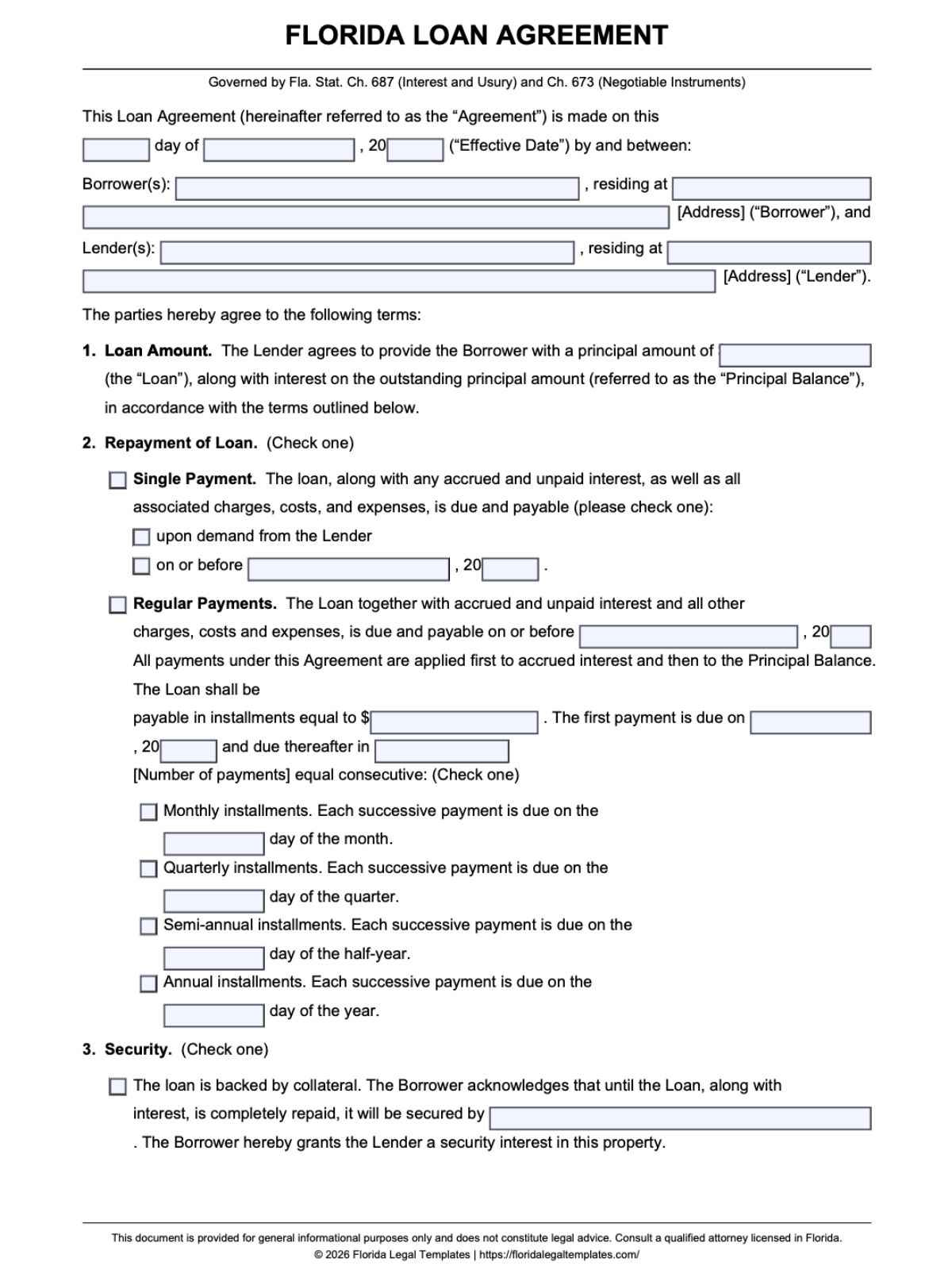
Additionally, a personal loan agreement Florida template provides a ready-to-use structure for documenting the parties, loan terms, repayment obligations, and other provisions commonly included in a private loan.
What the document includes:
- Identification of lender and borrower
- Loan amount and disbursement terms
- Repayment structure (installments or lump sum)
- Interest rate and calculation method
- Default, late fees, and acceleration clause
- Governing law (Florida)
- Signature block
Who should use this:
- Individuals lending money privately
- Family or friend loan arrangements
- Small business or informal financing
- Peer-to-peer lending
When this template may NOT be sufficient:
- Loans secured by real estate (typically require separate mortgage and recording documentation to create and protect the intended lien)
- Loans secured by personal or business assets (may require a UCC financing statement or another perfection method, depending on the collateral)
- Consumer-credit transactions that fall within federal disclosure laws such as the Truth in Lending Act and Regulation Z
- High-value or structured commercial financing
For a straightforward private loan, keep the repayment terms in one place: identify the principal, state the payment dates, and spell out the interest and default terms before the money changes hands. If the loan is secured or involves collateral, the supporting security documents may need to be handled separately.
What Is a Florida Loan Agreement?
A Florida loan agreement puts the repayment bargain in writing: who received the money, how much was advanced, when payments are due, and what happens after a default. For a private loan, the interest and other charges also need to be checked against Florida’s Chapter 687 usury rules.
Private lending arrangements often overlap with broader business or transactional relationships, especially when repayment is tied to services, investments, or asset transfers. In situations involving structured business obligations, parties may also rely on a separate purchase and payment agreement or formal business partnership structure to define rights beyond repayment alone.
Legal framework:
- May be subject to Fla. Stat. Ch. 673 if the repayment instrument qualifies as a negotiable instrument
- Subject to Fla. Stat. Ch. 687 (Interest and Usury)
- Fla. Stat. § 725.01 may require a written and signed agreement when the transaction falls within Florida’s Statute of Frauds
Legal nuance:
Not every loan agreement qualifies as a negotiable instrument. If the parties intend the repayment instrument to qualify under Fla. Stat. § 673.1041, it must satisfy the statute’s requirements, including:
- An unconditional promise to pay
- A fixed amount of money
- Payment on demand or at a definite time
- Payment to bearer or to order
These elements determine whether the repayment instrument qualifies as negotiable under Article 3, which affects how it may be negotiated or transferred.
If the agreement includes conditional language—such as repayment dependent on profits or future events—it may lose its status as a negotiable instrument under Fla. Stat. § 673.1041 and instead be treated as a standard contract, limiting its transferability.
Critical distinction:
- Loan Agreement: broader contract with detailed terms
- Promissory Note: simplified promise focused on repayment
Execution validity:
For an ordinary unsecured loan agreement, Florida law does not impose a general notarization or witness requirement. The important exception is the Statute of Frauds: when § 725.01 applies, the agreement or a sufficient memorandum must be in writing and signed by the party to be charged.
Key implication:
When § 725.01 applies, the agreement or a sufficient memorandum must be in writing and signed by the party to be charged. For a long-term private loan, putting the repayment terms in writing avoids leaving enforceability to an oral arrangement.
Key Florida Laws That Affect This Document
Summary of Applicable Laws
| Topic / Issue | Florida Legal Rule | Governing Statute |
|---|---|---|
| Statute of Limitations | 5 years to enforce written loan | Fla. Stat. § 95.11(2)(b) |
| Statute of Frauds | Must be written if repayment exceeds 1 year | Fla. Stat. § 725.01 |
| Age / Capacity | Florida generally removes the disability of nonage at age 18, although special rules can apply to contracts involving minors. | Fla. Stat. § 743.07 |
| Usury Limits | Loans ≤ $500k: >18% civil; Loans > $500k: >25% civil. Any loan > 25% is criminal usury.** | Fla. Stat. § 687.03 & § 687.071 |
| Negotiable Instrument Rules | Must include unconditional promise to pay | Fla. Stat. § 673.1041 |
Florida courts closely examine repayment terms, fee structures, and default provisions when enforcing private lending agreements. Businesses lending money during ongoing service or consulting relationships may also benefit from written professional service terms to clearly separate compensation obligations from loan repayment obligations.
Practical Impact & Document Clauses
Florida’s lending laws directly shape how a Florida loan agreement must be written to remain enforceable.
Interest rates are strictly regulated. Florida imposes strict usury limits that vary based on the loan amount. For loans of $500,000 or less, interest above 18% per year is generally usurious; for loans exceeding $500,000, § 687.03 applies the separate threshold tied to § 687.071, where criminal usury begins above 25%.
Unless otherwise specifically allowed by law, willfully and knowingly charging interest above 25% can constitute criminal usury under Fla. Stat. § 687.071; willfully and knowingly charging interest above 45% can constitute a third-degree felony under § 687.071.
The consequences are significant. For a willful violation of § 687.03, Fla. Stat. § 687.04 provides for forfeiture of the interest and permits enforcement of the actual principal, while also providing a double-interest remedy in specified circumstances. In criminal cases, the lender may lose the entire debt, including the principal. See Fla. Stat. § 687.02.
For installment-based loans, the limitations period can depend on when the particular claim accrued, including the effect of any acceleration provision. Because Florida case law controls how these timing questions apply to a particular loan, the lender should confirm the applicable limitation rule before relying on a single accrual date.
This makes the interest clause one of the most critical parts of the agreement.
The repayment structure must be clearly defined. Without a specific timeline or demand provision, the agreement may fail to qualify as a negotiable instrument under Fla. Stat. § 673.1041, limiting transferability.
Under Fla. Stat. § 725.01, any loan extending beyond one year must be in writing and signed. Oral agreements in such cases cannot be enforced.
Florida imposes documentary stamp tax on covered promissory notes, nonnegotiable notes, and written obligations to pay money under Fla. Stat. § 201.08; the rate is $0.35 for each $100 or fraction thereof, subject to the statutory maximum.
For covered unsecured notes and written obligations, Fla. Stat. § 201.08(1)(a) imposes tax at $0.35 per $100 or fraction thereof, with the tax on the document capped at $2,450; separate rules apply to mortgages and other recorded security instruments.
Documentary stamp tax may apply to a loan instrument under Fla. Stat. § 201.08, but the enforcement consequences depend on the type of instrument; the statute expressly addresses unenforceability for certain recorded security instruments, so the rule should not be stated as a blanket prohibition on enforcing every loan agreement.
In practical terms:
- Invalid interest terms can make the agreement illegal
- If § 725.01 applies, the agreement generally must be evidenced by a writing signed by the party to be charged before it can be enforced in court.
- Failure to pay documentary stamp tax can create statutory penalties, and particular recorded security instruments may have additional enforcement consequences under § 201.08.
When to Use This Document
For a private Florida loan, the written agreement should identify the principal, repayment terms, interest, default provisions, and any security or guaranty. If the transaction is secured or unusually structured, a standalone loan agreement may not be enough.
Common use cases:
A private loan agreement is most useful when the parties need one document to spell out the principal, repayment schedule, interest, default remedies, and any related guaranty or security arrangement. If the transaction also involves collateral or a separate promissory note, those documents should be reviewed together rather than treated as interchangeable.
Practical scenarios:
For a family loan, put the repayment date and interest rate in writing rather than relying on an informal understanding. For startup or business financing, also identify whether the advance is debt, equity, or payment for services so the documents do not blur different obligations.
When NOT to use:
- Real estate-secured loans (require mortgage documentation)
- Asset-secured loans (require UCC filings)
- Regulated institutional lending
A written agreement gives the lender and borrower a record of the principal, payment dates, interest terms, and default provisions, while also helping identify whether § 725.01 requires a signed writing for the transaction.
Written loan agreements are especially important when funding is provided informally between business owners, investors, or independent professionals. In consulting or startup environments where money is advanced before services are completed, parties often combine lending arrangements with separate project consulting terms to reduce disputes over repayment and deliverables.
How to Create or Fill Out the Florida Loan Agreement
Creating a loan agreement florida template involves more than filling in blanks—it requires legal precision.
Step-by-step process:
- Identify lender and borrower
- Include full legal names
- Specify loan amount
- Clearly state the principal amount
- Define repayment schedule
- Installments, due dates, or demand repayment
- Set interest rate
- Ensure compliance with Florida usury limits
- Include default and late payment terms
- Define penalties and consequences
- Add acceleration clause
- Allow full repayment upon default
- Confirm negotiable instrument elements (if applicable)
- Include unconditional promise and payment terms
- Execute agreement
- Both parties must sign
- Address documentary stamp tax obligations
- Ensure compliance before enforcement
- Store signed copies securely
Don’t Overlook Cross-Default and Guarantor Language
One provision that experienced private lenders often add, but generic templates skip, is a cross-default clause. Imagine two business partners borrow money together. One partner defaults on another major loan or files for bankruptcy, but they continue making payments under your agreement for a few more weeks. Unless your loan agreement defines those events as a default, you may have to wait until an actual payment is missed before exercising remedies.
If a third person guarantees repayment, document the guaranty separately and address extensions or modifications expressly. Fla. Stat. § 673.6051 addresses discharge of indorsers and accommodation parties on instruments, so the effect of a modification on a particular guarantor should be reviewed under the guaranty and applicable Florida law.
This extra drafting takes only a few lines but can determine whether the lender has one source of repayment or several if the borrower’s financial situation deteriorates.
If the loan involves business assets, transferred equipment, or installment-based purchases, the parties may also require separate written ownership transfer documentation to clearly establish what property, if any, is tied to the financing arrangement.
Practical tips:
Before signing, check three Florida-specific points: whether § 725.01 requires a signed writing, whether the interest and charges comply with Chapter 687, and whether documentary stamp tax applies under § 201.08.
An ordinary unsecured loan agreement generally does not require notarization or witnesses merely to be a contract, although particular security instruments can have additional execution requirements; notarization can also provide useful evidence of execution.
Limitations and Legal Considerations
The most important Florida-specific limits are the Chapter 687 usury rules, the Statute of Frauds where § 725.01 applies, and any documentary-stamp-tax obligation under § 201.08.
Key limitations:
Before signing, confirm the actual effective interest rate under Chapter 687 and determine whether § 201.08 applies to the particular note or written obligation. The tax question depends on the instrument, not simply on the fact that money was loaned.
Florida-specific constraints:
The practical question is not simply whether Chapter 687 or § 725.01 exists; it is whether your particular loan falls within those provisions and whether the agreement’s interest, charges, maturity and execution satisfy them.
High-risk scenarios:
The highest-risk drafting mistakes are miscalculating the effective interest rate under § 687.03(3), assuming every oral loan is unenforceable, and overlooking documentary stamp tax when § 201.08 applies.
Edge cases:
- Secured loans requiring additional filings
- Transferable debt instruments
- Loans involving minors (voidable contracts under Fla. Stat. § 743.07)
Review the interest calculation before the loan is signed, especially when the lender is charging an origination, extension, or other fee. Section 687.03 requires amounts that are in the nature of interest to be considered in calculating the effective rate and spread over the stated term.
Attorney’s Fees Clause: Florida generally follows the American Rule, so attorney’s fees ordinarily require a contractual, statutory, or other recognized basis for recovery; a properly drafted fee clause can therefore matter in a loan dispute. Including a clause that awards attorney’s fees to the prevailing party can significantly improve a lender’s ability to recover costs in a dispute.
A loan agreement cannot grant unlimited authority over another person’s finances or legal affairs beyond repayment rights. Where broader financial authority is intended, parties may require a separate durable financial authorization form rather than relying solely on lending language.
Common Mistakes to Avoid
Charging interest above legal limits
Consequence: Contract becomes illegal and may lead to criminal liability.
Using oral agreements for long-term loans
Consequence: Agreement is unenforceable under Fla. Stat. § 725.01.
Failing to include repayment structure
Consequence: Disputes over timing and obligations.
Ignoring documentary stamp tax
Consequence: Unpaid documentary stamp tax can create penalties, and additional enforcement rules may apply depending on the instrument.
Confusing loan agreement with promissory note
Consequence: Missing required elements for enforceability or transferability.
Frequently Asked Questions (FAQ)
Is a Florida loan agreement valid without notarization?
Yes. Florida law does not require notarization for a loan agreement to be legally binding.
What is the maximum legal interest rate in Florida?
Under Fla. Stat. § 687.02 and 687.071, interest above 18% is generally subject to Florida’s civil-usury rules, while willfully and knowingly charging above 25% can constitute criminal usury, subject to statutory exceptions and the special rule for loans exceeding $500,000.
When must a loan agreement be in writing in Florida?
Under Fla. Stat. § 725.01, an agreement that is not to be performed within one year generally must be evidenced by a writing signed by the party to be charged.
Can a loan be enforced without paying documentary stamp tax?
Documentary stamp tax may be due under Fla. Stat. § 201.08, but the enforcement consequences depend on the type of loan instrument; the statute does not establish a blanket rule that every loan agreement is unenforceable until tax is paid.
A written Florida loan agreement records the principal, repayment terms, interest, and default provisions in one place. Its enforceability still depends on the transaction complying with applicable rules, including Chapter 687, § 725.01 when applicable, and any documentary-stamp-tax requirements under § 201.08.
Legal Disclaimer: This article is for general informational purposes only and is not legal advice. Consult a qualified Florida attorney for advice regarding your specific situation.