
Florida Independent Contractor Agreement [Free Fillable PDF]
A Florida independent contractor agreement is not what determines whether someone is actually a contractor — Florida law is, and the distinction between those two things is where a lot of small business owners find themselves in serious trouble. Under F.S. §443.071, intentional misclassification of workers as part of a scheme to avoid paying reemployment tax isn’t a civil penalty issue — it’s a third-degree felony, and the Florida Department of Revenue looks at how the worker was actually treated day to day, not at what the contractor agreement florida paperwork says or whether a 1099 was issued.
I’ve seen business owners with signed agreements, proper invoices, and years of clean 1099 filings walk into a DOR audit and come out facing reclassification because they controlled the worker’s schedule, provided the tools, and directed the work the same way they would with any employee. The independent contractor contract florida template below is built to reflect a genuine contractor relationship on paper — but the breakdown that follows it covers what the actual working arrangement needs to look like for the classification to hold up.
Candice Hayden, Legal Writer
Carly Johansson, Florida Contract Attorney
Florida Independent Contractor Agreement (PDF, Printable, Fillable)
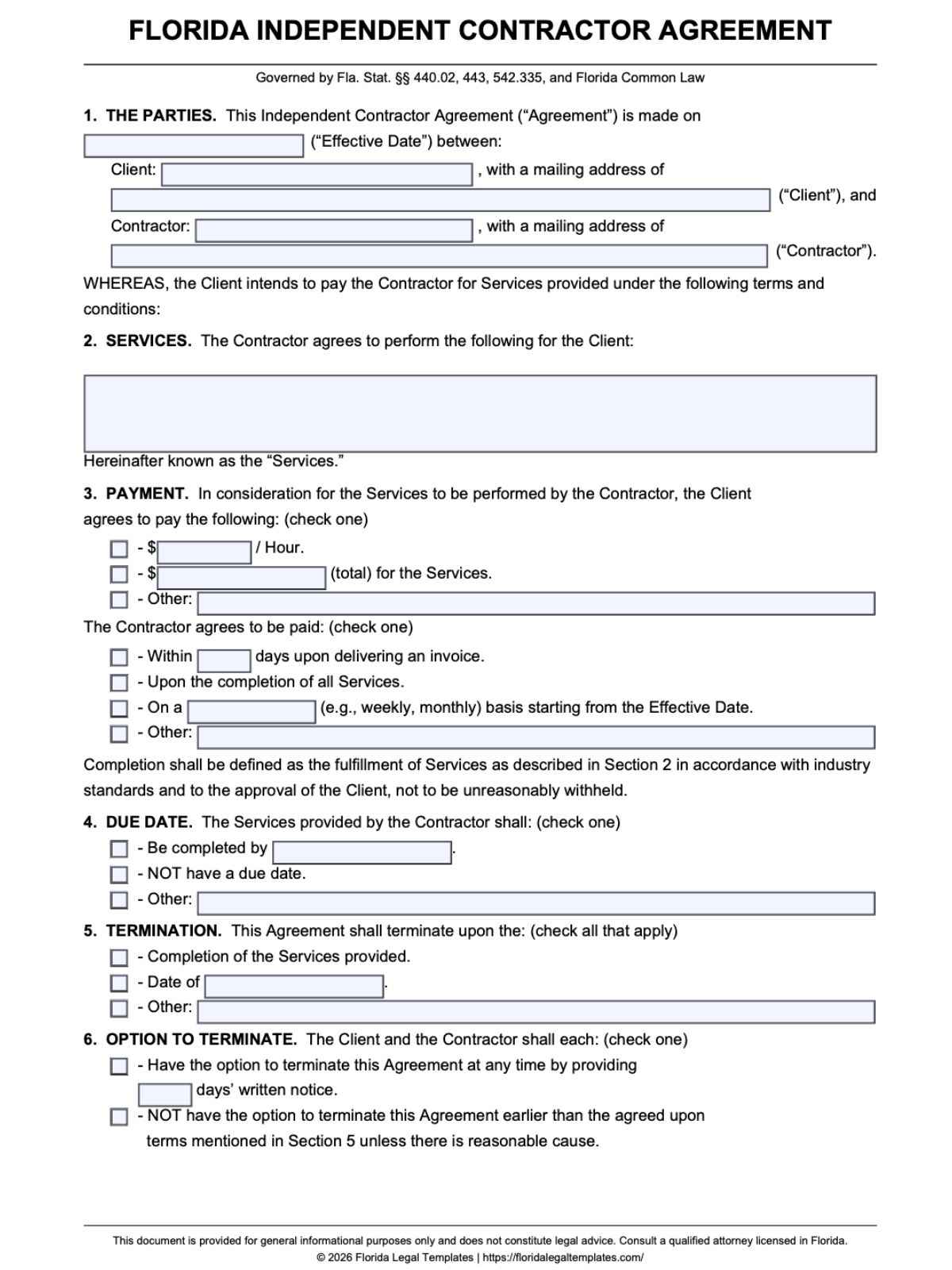
A florida independent contractor agreement template provides a structured, ready-to-use format that includes the key legal protections required under Florida law.
What the document includes:
- Identification of hiring party and contractor
- Scope of services and deliverables
- Compensation and payment terms
- Term and termination provisions
- Independent contractor designation clause
- “Right of control” language (contractor controls means and methods)
- Tax responsibility clause (self-employment taxes)
- No benefits / no workers’ compensation clause
- Confidentiality and intellectual property provisions (if applicable)
- Dispute resolution and governing law
- Reciprocal Attorneys’ Fees clause (pursuant to Fla. Stat. § 57.105(7))
- Forum Selection/Venue clause (specifying the Florida county where disputes will be heard)
Who should use this:
- Businesses hiring freelancers or consultants
- Agencies working with independent contractors
- Individuals offering services independently
- Startups outsourcing work without hiring employees
When this template may NOT be sufficient:
- Situations where the hiring party controls how work is performed (risk of employee reclassification)
- Construction industry engagements. Under Fla. Stat. § 440.02, an independent contractor in construction is legally treated as an employee for Workers’ Comp purposes unless they hold a valid state exemption or meet a specific 12-factor statutory test.
- Agreements including enforceable non-compete clauses (must comply with Florida law)
- Long-term engagements exceeding one year without proper written compliance
- Complex multi-party or hybrid employment arrangements
A freelance contractor agreement Florida works best when the working relationship is genuinely independent—not controlled like employment.
What Is a Florida Independent Contractor Agreement?
A contractor agreement Florida is a private contract establishing a non-employment relationship between a hiring party and a service provider.
Independent contractor relationships are often confused with standard employment arrangements, especially when businesses exercise too much operational control over the worker. Companies comparing classification risks may benefit from reviewing how a formal employee hiring agreement differs from a contractor-based working relationship under Florida law.
Legal framework:
- Governed by Florida contract law
- Subject to the Statute of Frauds under Fla. Stat. § 725.01
- Worker classification governed by Fla. Stat. § 440.02
- Restrictive covenants (if included) governed by Fla. Stat. § 542.335
Legal nuance:
The contract itself does not determine legal classification. Florida applies a “right of control” test, focusing on how the work is actually performed.
Critical distinction:
- Independent contractor: Controls how, when, and how work is completed
- Employee: Works under direction and control of employer
Execution validity:
- No notarization required
- No witnesses required
- Must be signed to be enforceable
Practical implication:
If the hiring party sets strict hours, provides tools, or dictates methods, the worker may be legally reclassified as an employee—regardless of what the contract says.
Key Florida Laws That Affect Florida Independent Contractor Agreement
Summary of Applicable Laws
| Topic / Issue | Florida Legal Rule | Governing Statute |
|---|---|---|
| Statute of Frauds | Any independent contractor agreement that cannot be fully performed within one year from the date it is made must be in writing and signed by the party to be charged. Oral contracts extending beyond one year are unenforceable | Fla. Stat. § 725.01 |
| Statute of Limitations | A civil lawsuit for the breach of a written independent contractor agreement must be filed within five (5) years of the breach | Fla. Stat. § 95.11(2)(b) |
| Age / Capacity | The age of legal majority to enter into a binding commercial contract in Florida is 18 years old. | Fla. Stat. § 743.07 |
| Worker Classification | Determined by “right of control” test | Fla. Stat. § 440.02 |
| Restrictive Covenants | Must protect legitimate business interests | Fla. Stat. § 542.335 |
Many contractor relationships also involve access to proprietary business systems, pricing models, or client information. In those situations, businesses frequently combine contractor agreements with a separate confidential information protection document to strengthen trade secret and data protection obligations during the engagement.
Practical Impact & Document Clauses
These laws directly influence whether a florida independent contractor agreement will be enforceable.
Under Fla. Stat. § 725.01, agreements that cannot be performed within one year must be in writing. This means long-term contractor relationships without a signed agreement are not legally enforceable.
Worker classification is governed by Fla. Stat. § 440.02. The law focuses on whether the hiring party controls the means and methods of work. If control exists, the worker may be reclassified as an employee.
Restrictive covenants must comply with Fla. Stat. § 542.335. Non-compete or non-solicitation clauses must protect legitimate business interests and be reasonable in scope.
Additionally, under Fla. Stat. § 95.11, parties have five years to bring a breach of contract claim for a written agreement.
In real-world terms:
- Misclassification overrides the contract entirely
- Invalid clauses are not enforceable
- Failure to comply can result in back taxes, penalties, and legal disputes
When to Use Florida Independent Contractor Agreement
A florida independent contractor agreement should be used whenever services are performed without creating an employment relationship.
Common use cases:
- Hiring freelancers or consultants
- Outsourcing specialized services
- Project-based or short-term work
Practical scenarios:
- Marketing, IT, design, or consulting services
- Gig-based work arrangements
- Independent professionals working with multiple clients
When NOT to use:
- Hiring full-time employees
- Situations where the business controls how work is performed
- Attempts to avoid tax or employment obligations
Using the correct document ensures legal clarity and reduces the risk of disputes.
Independent contractor agreements are commonly used for project-based professional services where the contractor maintains control over how the work is completed. Businesses outsourcing strategy, branding, or advisory work often pair these arrangements with more detailed consulting service terms to clarify deliverables, timelines, and ownership rights.
How to Create or Fill Out the Florida Independent Contractor Agreement
Creating a florida independent contractor agreement template requires careful alignment with legal standards.
Step-by-step process:
- Identify parties
- Include full legal names and roles
- Define scope of services
- Clearly describe deliverables and expectations
- Set compensation terms
- Specify payment amount, schedule, and method
- Define term and termination
- Include duration and exit conditions
- Insert independent contractor designation
- Explicitly state non-employment relationship
- Add “right of control” language
- Confirm contractor controls means and methods
- Include tax responsibility clause
- Contractor responsible for self-employment taxes
- Add confidentiality and IP clauses (if applicable)
- Protect business information and work product
- Define dispute resolution and governing law
- Specify Florida jurisdiction
- Execute agreement
- Both parties must sign
If the arrangement includes milestone payments, equipment transfers, or staged deliverables, parties may also need separate written project payment and transfer provisions to properly document obligations beyond the contractor relationship itself.
Practical tips:
- Focus on deliverables, not work instructions
- Avoid controlling schedule or methods
- Ensure the contract reflects the real working relationship
Keep Records That Support Independent Contractor Status
A signed agreement is only one piece of evidence if the Florida Department of Revenue later reviews the relationship for reemployment tax purposes. In an audit, the agency can request records showing how the work functioned in practice, not just what the contract says. See Fla. Stat. § 443.1216 (worker status for reemployment assistance purposes).
If you genuinely intend to hire an independent contractor, keep documents that match that arrangement. Examples include invoices submitted by the contractor, proof they set their own work schedule, communications showing they chose the method of performing the work, evidence they supplied their own equipment where appropriate, and documentation that they provide similar services to other clients if that is true. Those records often become more persuasive than the contract itself when an auditor evaluates whether the worker operated an independent business.
Many disputes arise years after the relationship begins, when day-to-day practices have drifted away from the written agreement. Reviewing the working relationship periodically and correcting any increase in employer-style control can significantly reduce the risk of reclassification during a Florida Department of Revenue audit.
Limitations and Legal Considerations
A florida independent contractor agreement has clear legal limits.
Key limitations:
- Cannot override worker classification laws
- Cannot eliminate tax or employment obligations
Florida-specific constraints:
- Must satisfy the “right of control” test under Fla. Stat. § 440.02
- Restrictive covenants must meet statutory requirements
High-risk scenarios:
- Misclassifying employees as contractors
- Including overly broad non-compete clauses
Edge cases:
- Construction industry (stricter compliance requirements)
- Long-term contractor relationships
- Contractors working exclusively for one client
Understanding these limitations prevents legal exposure and contract failure.
The 4-of-6 Statutory Safe Harbor Trap
While business owners often rely on the broad common law “right of control” test, Florida enforces a strict statutory safe harbor for non-construction independent contractors under Fla. Stat. § 440.02(15)(d)1.a. To legally qualify as an independent contractor for workers’ compensation and administrative audit purposes, the worker must satisfy at least four of the six primary statutory criteria:
- Maintaining a separate business with their own facility, equipment, or materials;
- Holding or applying for a Federal Employer Identification Number (FEIN);
- Receiving compensation paid directly to a business entity rather than an individual;
- Operating dedicated business bank accounts to handle operational expenses;
- Performing or offering work to other entities at their own election without an employment application;
- Receiving compensation on a competitive-bid or per-job basis.
If a contractor is a solo freelancer working under their personal Social Security Number and receiving payments directly to a personal bank account, they automatically fail three of these primary statutory tests on day one. In an administrative audit or injury claim, failing to satisfy at least four criteria shifts the burden of proof heavily onto the hiring entity, exposing the business to immediate reclassification, back-assessed workers’ compensation premiums, and statutory fines under Chapter 440—regardless of what the signed contractor agreement states.
A contractor agreement cannot be used to override statutory employment protections or delegate legal authority unrelated to the service relationship. Where financial or operational decision-making authority is involved, businesses may require a separate legal authorization document rather than relying solely on contractor language.
Common Mistakes to Avoid
Misclassifying employees as contractors
Consequence: Back taxes, penalties, and workers’ compensation liability.
Controlling contractor’s schedule or methods
Consequence: Worker may be legally reclassified as an employee.
Using vague scope of work
Consequence: Disputes over deliverables and payment.
Omitting tax responsibility clause
Consequence: Confusion over tax obligations and potential liability.
Including unenforceable non-compete clauses
Consequence: Clause becomes void under Fla. Stat. § 542.335.
Frequently Asked Questions (FAQ)
Is a Florida independent contractor agreement valid without notarization?
Yes. Florida law does not require notarization for a contractor agreement to be legally binding.
How does Florida determine if someone is a contractor or employee?
Florida uses the “Right of Control” test (Common Law). Courts look at whether the hiring party controls the *results* of the work (Contractor) or the *details and methods* of how the work is done (Employee). For Workers’ Comp and Unemployment, Florida relies heavily on Fla. Stat. § 440.02 and § 443.121.
When must a contractor agreement be in writing in Florida?
Under Fla. Stat. § 725.01, agreements exceeding one year must be in writing.
Can a Florida independent contractor agreement include a non-compete clause?
Yes, but only if it complies with Fla. Stat. § 542.335 and protects legitimate business interests.
A well-drafted Florida independent contractor agreement does more than define services—it ensures compliance, reduces risk, and protects both parties in a legally enforceable way.