
Florida Lady Bird Deed (Free Form PDF & WORD)
A Florida Lady Bird Deed, also known as an Enhanced Life Estate Deed, allows a property owner to transfer real estate automatically to designated beneficiaries after death while keeping complete control over the property during their lifetime. Unlike a traditional life estate deed, the owner can continue to sell, refinance, mortgage, lease, or even revoke the deed without obtaining the beneficiaries’ permission—provided the deed contains the necessary enhanced powers language recognized under Florida common law.
Many Florida homeowners use this estate planning tool to avoid probate while preserving their homestead benefits and maintaining full ownership rights. However, because Florida has not adopted Transfer-on-Death (TOD) deeds for real estate, a Lady Bird Deed must be drafted carefully. Missing mandatory language, overlooking homestead restrictions, or failing to satisfy execution requirements can defeat the purpose of the deed or even convert it into a traditional life estate with far more restrictive legal consequences.
Candice Hayden, Legal Writer
Maria Rosso, Florida Probate, Guardianship and Estate Planning Attorney
Florida Lady Bird Deed Template (Free PDF & Fillable Form)
A professionally drafted Florida Lady Bird Deed form should contain far more than blank fields for names and property information. Because Florida recognizes this deed through common law rather than statute, the wording of the document plays a critical role in determining whether it functions as intended.
Our Florida Lady Bird Deed template is designed to include the provisions commonly expected during title examination and county recording.
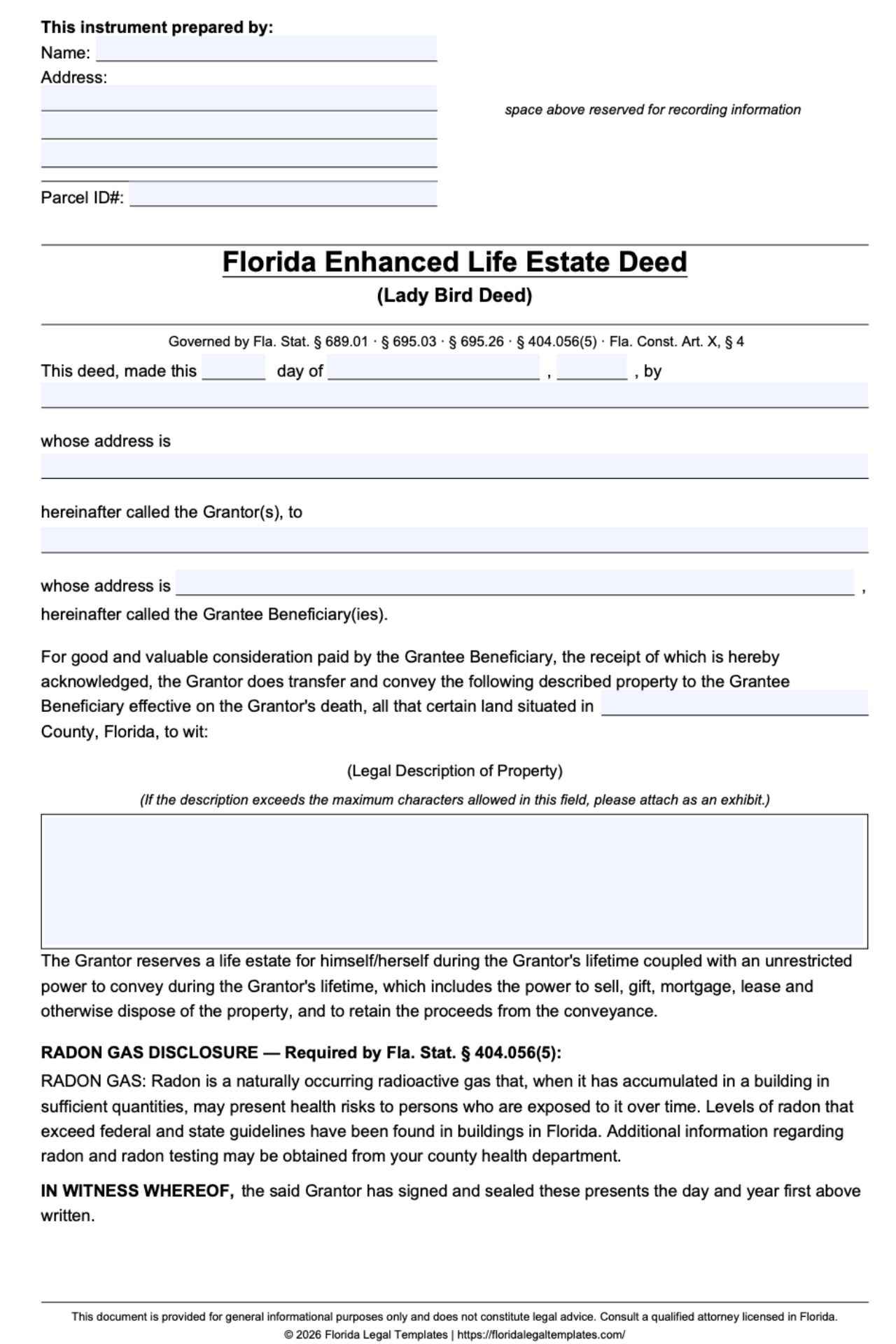
The template includes:
- Enhanced Life Estate reservation clause containing the required retained powers
- Mandatory Florida Radon Gas Disclosure
- Property legal description section
- Grantor and remainder beneficiary information
- Preparer’s name and mailing address block
- Signature lines for grantor(s)
- Two witness signature blocks
- Florida notary acknowledgment
- Recording information section
Unlike generic deed forms found online, a properly drafted Lady Bird Deed Florida PDF should already incorporate the operational language necessary to preserve the grantor’s unrestricted authority over the property.
What the template already includes
Enhanced Life Estate Reservation Clause
The defining feature of an Enhanced Life Estate Deed Florida is the reservation of broad ownership powers.
The deed should expressly reserve the grantor’s right to:
- sell the property
- mortgage it
- lease it
- convey it
- revoke the deed
- retain all sale proceeds
- eliminate remainder beneficiaries without their consent
These are commonly referred to as the deed’s “enhanced powers.” If they are omitted or vaguely drafted, the instrument may function only as a traditional life estate.
The Radon Gas Boilerplate Myth
While Florida law requires a specific radon gas notice under Fla. Stat. § 404.056(5), this mandate applies strictly to initial sales contracts and lease agreements—not the final executed deed. Including this text block on a Lady Bird deed is a legacy drafting habit rather than a statutory recording requirement. County clerks do not verify deeds for radon clauses, and omitting it will never cause a recording rejection.
Recording Compliance Features
A recording-ready template should also include:
- preparer’s printed name and address
- printed names beneath every signature
- witness blocks
- notary acknowledgment
- recording margin space
These seemingly minor details frequently determine whether the county clerk accepts or rejects the document for recording.
When a Fillable Template Is Not Enough
A fillable Florida Lady Bird Deed form works well for many straightforward situations, but certain ownership structures usually require individualized drafting.
Examples include:
- property owned by a trust
- property titled in an LLC
- married homestead owners with unique family circumstances
- multiple remainder beneficiaries receiving unequal shares
- contingent beneficiaries
- out-of-state grantors
- unresolved title defects
- boundary disputes
- probate title issues
In these situations, relying solely on a generic template can create expensive title problems later.
What Is a Lady Bird Deed Under Florida Law?
A Lady Bird Deed is Florida’s name for an Enhanced Life Estate Deed—a deed that transfers ownership automatically upon the owner’s death while allowing the owner to retain virtually complete control during life.
Unlike many other states, Florida does not authorize Transfer-on-Death Deeds through legislation. Instead, the validity of a Lady Bird Deed arises from Florida common law together with the state’s general real property conveyance rules under Chapter 689.
This distinction matters because there is no statute describing exactly what language creates a valid Lady Bird Deed. The deed succeeds only if its wording clearly reserves enhanced ownership rights.
How It Differs from a Traditional Life Estate
Many homeowners mistakenly assume the two deeds accomplish the same objective.
They do not.
With a traditional life estate:
- the remainder beneficiaries receive a vested future interest immediately
- selling the property usually requires beneficiary participation
- refinancing often becomes significantly more difficult
- revoking the deed may be impossible without beneficiary consent
A properly drafted Florida Lady Bird Deed, however, allows the owner to continue acting as though the deed had never been signed.
The owner may:
- sell the property
- refinance it
- mortgage it
- lease it
- revoke the deed entirely
- replace beneficiaries
without obtaining permission from the remainder beneficiaries.
That retained flexibility explains why Lady Bird Deeds have become popular estate planning tools in Florida.
Homestead Considerations
Even though the deed provides broad retained powers, Florida’s constitutional homestead protections still apply.
If the property qualifies as the owner’s constitutional homestead, the ability to transfer the remainder interest may be restricted by Article X, Section 4 of the Florida Constitution. These protections exist to safeguard surviving spouses and minor children and can override the owner’s intended distribution if constitutional requirements are not satisfied.
Florida Laws That Govern the Lady Bird Deed
Although Florida has no statute specifically creating Lady Bird Deeds, several statutes and constitutional provisions govern how the deed must be executed, recorded, and enforced.
Execution, Recording & Homestead Compliance Table
| Topic / Issue | Florida Legal Rule | Governing Statute |
|---|---|---|
| Witness requirement | Grantor must sign before two subscribing witnesses. | Fla. Stat. § 689.01(1) |
| Notary acknowledgment | Proper notarization is required for recordation. | Fla. Stat. § 695.03 |
| Spousal joinder | A married titleholder cannot alienate a primary homestead to a third-party remainder beneficiary without spousal joinder; however, under Fla. Stat. § 708.08(1), an owner can freely execute a Lady Bird deed directly to their spouse without the non-titled spouse’s signature. | Florida Constitution Art. X, § 4(c) & Fla. Stat. § 708.08 |
| Documentary stamp tax | Only the minimum documentary stamp tax generally applies because beneficial ownership does not presently transfer. | Fla. Stat. § 201.02 |
| Homestead exemption | Executing the deed does not itself trigger reassessment or loss of Save Our Homes benefits. | Fla. Stat. § 196.031 |
How These Rules Shape the Deed’s Clauses
Because Florida recognizes Lady Bird Deeds through judicial precedent rather than legislation, the enhanced powers clause becomes the heart of the document. If the deed merely reserves a “life estate” without expressly allowing the owner to sell, mortgage, revoke, or otherwise dispose of the property independently, title companies may treat it as an ordinary life estate. That dramatically limits the owner’s ability to deal with the property later.
The mandatory Radon Gas Disclosure is another provision that often surprises homeowners. Florida requires the statutory disclosure language to appear in instruments transferring interests in real property. Omitting it may create unnecessary recording or compliance issues, even though it has nothing to do with estate planning itself.
Homestead rules deserve equal attention. Many people assume only the titled owner must sign the deed. In reality, constitutional homestead protections can require a spouse’s participation even when that spouse does not appear on the existing deed. Ignoring this requirement can render the intended remainder transfer ineffective.
Finally, homeowners often worry that recording a Lady Bird Deed will trigger property tax reassessment or eliminate Save Our Homes protections. Under Florida law, because no present beneficial ownership transfers during the grantor’s lifetime, executing the deed generally does not reset the property’s assessed value or affect the owner’s homestead exemption.
Recording the Deed: Filing Requirements That Trip Up Homeowners
Preparing a legally sound Florida Lady Bird Deed is only half the process. The deed must also be recorded correctly. Recording places the document in the property’s chain of title and allows the remainder interest to pass automatically upon the grantor’s death without opening a probate case.
Even a carefully drafted deed can be rejected by the recording office if it does not satisfy Florida’s recording requirements. Many recording delays result from technical omissions rather than substantive legal issues.
Where to File
A completed Florida Lady Bird Deed must be recorded with the County Clerk of the Circuit Court (or County Comptroller, depending on the county) where the real estate is physically located.
Florida’s recording laws are intended to provide public notice of interests affecting real property. Recording the deed helps establish the future transfer within the property’s chain of title.
Under Florida law, recording should occur in the county where the property is located.
Recording Checklist
Before submitting the deed, verify that it includes:
- Complete legal description copied exactly from the current deed
- Grantor’s full legal name
- Remainder beneficiary’s full legal name
- Enhanced life estate reservation clause
- Mandatory Radon Gas Disclosure
- Two witness signatures
- Proper notary acknowledgment
- Printed names beneath every signature
- Preparer’s printed name and mailing address
- Appropriate recording fees
Missing any of these items may delay recording or require preparation of a corrective deed.
Printed Names Matter More Than Many Owners Realize
One of the most common reasons deeds are rejected involves something surprisingly simple—missing printed names.
Florida recording requirements call for the names of signing parties to be printed legibly beneath their signatures. Although the signatures themselves establish execution, printed names allow recording officials, title examiners, and future purchasers to identify each party accurately.
Illegible signatures frequently create unnecessary title questions years later.
Don’t Forget the Preparer Information
Another detail frequently overlooked is the preparer’s identification block.
The first page of the deed should clearly display:
- preparer’s name
- mailing address
County recording offices routinely review this information before accepting documents for recording.
Leaving this section blank often results in avoidable rejection and delays.
Identity Verification During Recording
Florida has implemented deed fraud prevention measures designed to reduce fraudulent real estate transfers.
Under Fla. Stat. § 28.2225, the individual presenting the deed—or the electronic recording provider acting on that person’s behalf—must comply with identity verification requirements, including providing a copy of a government-issued photo identification as part of applicable county recording procedures.
This requirement helps reduce fraudulent recordings involving forged deeds.
Using Electronic Recording Services
Many Florida counties now accept electronic recording through approved vendors.
For homeowners, e-recording often provides several advantages:
- faster submission
- reduced paperwork
- electronic confirmation of recording
- integrated identity verification procedures
- fewer clerical errors
Even when using an electronic service, every execution requirement remains the same. The deed must still contain proper witnesses, notarization, mandatory disclosures, and complete recording information.
Practical Tip: Before recording, compare your completed deed line-by-line with your current recorded deed. The legal description, parcel identification, and owner names should match exactly unless you are intentionally changing ownership information.
After the Owner Dies: The Deed Doesn’t Automatically Update Public Records
A Lady Bird Deed avoids probate, but it does not automatically change the county’s land records when the grantor dies. The public record will still show the deceased owner until someone records additional documents.
In practice, the remainder beneficiary will usually need to record a certified copy of the grantor’s death certificate in the county where the property is located before selling or refinancing. Many title companies also request an affidavit confirming that the beneficiary identified in the deed survived the grantor and that no later deed revoked or replaced the original Lady Bird Deed. This is not a statewide statutory filing requirement, but it is a common underwriting requirement during Florida real estate closings and title examinations.
If the property was the grantor’s homestead, the beneficiary should also consider updating the county property appraiser’s records and, if eligible, filing for any applicable homestead exemption or portability benefits within the required deadlines. Those tax benefits do not transfer automatically simply because the property passed outside probate. County procedures vary, so the local Property Appraiser’s office should be contacted after ownership changes. (Florida property tax procedures: Fla. Stat. Ch. 196; specific filing deadlines and forms are administered by each county Property Appraiser.)
Real-World Scenarios: Who Actually Uses a Lady Bird Deed (and Who Shouldn’t)
A Florida Lady Bird Deed is designed for a specific purpose: allowing real estate to pass outside probate while preserving the owner’s complete lifetime control. It is not a one-size-fits-all estate planning tool, and understanding when it works—and when it does not—can prevent costly mistakes.
Scenario 1: An Aging Parent Wants to Avoid Probate
A widowed homeowner wishes to leave their homestead to an adult child but does not want to give up control of the property.
A Lady Bird Deed often works well because the parent may continue to:
- live in the home
- refinance if needed
- sell the property
- change beneficiaries later
- revoke the deed entirely
The adult child receives no present ownership rights, reducing many of the practical complications associated with traditional life estates.
Scenario 2: Married Homeowners Planning for the Future
Married couples sometimes use a Lady Bird Deed Florida as part of a broader estate plan.
However, Florida’s constitutional homestead protections require special attention.
If the property is protected homestead, transferring the remainder interest without proper spousal participation may invalidate the intended transfer. Even when only one spouse appears on the current deed, constitutional restrictions may still apply.
Ignoring these requirements can send the property through probate despite the existence of the deed.
Scenario 3: Blended Families
Second marriages often create competing estate planning goals.
A homeowner may wish to:
- continue living with a spouse,
- preserve lifetime control,
- ensure children from a previous marriage ultimately inherit the property.
A carefully drafted Lady Bird Deed can sometimes help accomplish those objectives while avoiding probate. However, Florida’s homestead restrictions still govern what may legally occur if the grantor is survived by a spouse or minor child.
This is one of the situations where individualized legal review is often worthwhile because constitutional protections can override the grantor’s intended distribution.
Scenario 4: Medicaid Planning
Many people hear that Lady Bird Deeds are “good for Medicaid.”
That statement requires context.
A Lady Bird Deed primarily functions as a probate avoidance tool. It does not provide blanket protection from creditors or automatically shield property from every Medicaid-related issue.
If property is non-homestead, or later loses its homestead status, judgment liens, IRS tax liens, and certain Medicaid estate recovery issues may still affect the property because the grantor retains complete ownership and control during life.
Using the deed solely as an asset protection strategy is a common misunderstanding.
When a Lady Bird Deed May Not Be the Best Choice
This deed may not be appropriate when:
- the grantor wants protection from existing creditors
- the property has significant judgment liens
- ownership interests are disputed
- multiple owners disagree about future disposition
- beneficiaries require irrevocable ownership certainty
- property is held in a business entity or trust requiring different planning strategies
Estate planning should always reflect the owner’s objectives rather than forcing every situation into the same document.
How to Fill Out and Execute the Deed Correctly
Completing a Florida Lady Bird Deed form involves much more than filling in names. Small drafting mistakes can affect marketable title years later, particularly when beneficiaries attempt to sell the property after the owner’s death.
Following a structured process helps reduce that risk.
Step 1: Copy the Legal Description Exactly
Never rely on the property’s mailing address alone.
Instead, obtain the legal description from the most recently recorded deed and reproduce it exactly, including:
- lot and block descriptions
- subdivision names
- metes-and-bounds descriptions
- condominium unit information
- parcel references where applicable
Even minor transcription errors may require a corrective deed before title insurance can be issued.
Practical Tip: Consider ordering a title search before preparing the deed. It can reveal existing mortgages, judgment liens, easements, or ownership issues that may complicate future transfers.
Step 2: Identify Every Grantor and Beneficiary Correctly
Use each party’s full legal name exactly as it appears on official identification or the current deed.
Avoid:
- nicknames
- initials in place of legal names
- inconsistent spelling
- outdated marital names
If multiple remainder beneficiaries are named, clearly specify how they will receive ownership. Ambiguous beneficiary designations frequently create title questions after the grantor’s death.
Step 3: Insert the Enhanced Powers Clause in Full
This is the most important provision in the document.
The deed should clearly reserve the grantor’s unrestricted authority to:
- sell the property
- mortgage it
- lease it
- convey it
- revoke the deed
- retain sale proceeds
- remove beneficiaries without notice or consent
Paraphrasing or shortening this language creates unnecessary risk. If the reservation is unclear, the deed may be interpreted as creating only a traditional life estate, significantly limiting the owner’s future control.
Step 4: Omit Redundant Radon Text and Verify Witness/Grantee Data
Because Fla. Stat. § 404.056(5) targets real estate contracts rather than conveyances, you can freely omit the radon text block from the deed. Instead, use this space to verify that the full legal name and complete post office address of every remainder beneficiary are clearly printed to comply with Fla. Stat. § 695.26(1)(f), and that both subscribing witnesses have their full mailing addresses legibly typed beneath their signatures per § 695.26(1)(c).
Step 5: Sign Before Two Witnesses and a Notary
Florida execution formalities are strict.
The grantor must sign the deed:
- in the presence of two subscribing witnesses; and
- before a notary so the deed can be recorded.
Skipping either requirement can prevent the deed from functioning as intended.
Step 6: Complete Every Signature Block
Before leaving the signing appointment, confirm that:
- every signature is complete;
- each printed name appears beneath its corresponding signature;
- the notary acknowledgment is fully completed;
- the preparer’s name and mailing address appear on the first page.
Many corrective deeds result from overlooking these seemingly routine details.
Step 7: Record the Deed Promptly
After execution, record the original deed with the appropriate County Clerk for the county where the property is located.
Bring any required recording fees and comply with applicable identity verification procedures, including providing a government-issued photo ID where required for recording.
Waiting months—or years—to record a properly executed deed increases the possibility of title complications, competing conveyances, or lost original documents.
Limitations, Homestead Restrictions & When the Deed Can Fail
A Florida Lady Bird Deed is an effective probate-avoidance tool when drafted and executed correctly, but it is not immune from legal limitations. Constitutional homestead protections, drafting errors, and creditor issues can all prevent the deed from producing the intended result.
Understanding these limitations before signing the deed is often far less expensive than correcting title problems after the owner’s death.
Constitutional Homestead Restrictions Can Override the Deed
One of the most misunderstood aspects of a Lady Bird Deed Florida involves Florida’s constitutional homestead protections.
If a grantor owns Florida homestead property and is survived by:
- a spouse who has not waived homestead rights, or
- a minor child,
the owner cannot simply transfer the remainder interest to another person if doing so violates Florida Constitution Article X, Section 4(c).
For example, suppose a widowed homeowner executes a Lady Bird Deed naming an adult child as the remainder beneficiary. If the homeowner later remarries and dies while survived by that spouse without a valid waiver of homestead rights, the constitutional protections may override the intended transfer.
Likewise, if the grantor dies leaving a surviving minor child, constitutional restrictions may prevent the remainder interest from passing as drafted.
In these circumstances, the property may instead pass under Florida’s constitutional and intestate succession rules rather than according to the deed.
Omitting the Enhanced Powers Language Can Change the Entire Deed
The most significant drafting mistake is failing to reserve the grantor’s enhanced ownership powers.
Because Florida has no statute creating Lady Bird Deeds, the deed depends entirely on clear drafting.
If the deed merely states that the grantor reserves a “life estate,” but does not expressly retain the unrestricted authority to:
- sell,
- mortgage,
- lease,
- convey,
- revoke, or
- otherwise dispose of the property without beneficiary consent,
the document may operate as a traditional life estate rather than an enhanced one.
The practical consequences are substantial.
Instead of maintaining complete control, the owner may suddenly need every remainder beneficiary to:
- approve a sale,
- sign refinancing documents,
- consent to a mortgage,
- participate in future transfers.
What was intended as a flexible estate-planning tool can become a significant obstacle to managing the property.
Practical Example: A homeowner signs what they believe is a Lady Bird Deed using a generic online form. Five years later, they decide to sell the home. During closing, the title company determines the deed lacks the enhanced reservation clause, requiring every remainder beneficiary to join the sale. One uncooperative beneficiary can delay—or even prevent—the transaction.
A Lady Bird Deed Does Not Shield Property from Current Creditors
Another common misconception is that a Lady Bird Deed provides asset protection.
It generally does not.
Because the grantor keeps unrestricted ownership and control during life, the property remains subject to the grantor’s financial obligations.
For non-homestead property, the deed does not prevent:
- judgment liens,
- IRS tax liens,
- creditor claims,
- other valid encumbrances
from attaching to the property.
The deed changes how ownership transfers after death, not who owns the property during life.
Homestead Status Can Change Over Time
Many homeowners execute a Lady Bird Deed while living in the property as their primary residence.
Years later, circumstances change.
The owner may:
- move into assisted living,
- relocate permanently,
- convert the property into a rental,
- establish residency elsewhere.
If the property loses its homestead status, legal protections available to homestead property may no longer apply in the same manner.
That change can increase creditor exposure and affect future estate planning decisions.
For this reason, homeowners should periodically review their estate planning documents whenever the property’s use changes significantly.
Common Drafting Mistakes That Cause Recording Rejection or Probate Anyway
Most Lady Bird Deeds do not fail because Florida law is complicated—they fail because relatively small drafting or execution mistakes create larger legal problems later.
Below are some of the issues most frequently encountered during title examination and probate administration.
1. Missing or Weak Enhanced Powers Language
This is the most serious drafting error.
If the deed does not clearly reserve the grantor’s unrestricted right to revoke, sell, mortgage, or otherwise dispose of the property independently, the document may be treated as a traditional life estate.
Potential consequences include:
- inability to sell without beneficiary signatures;
- refinancing delays;
- title objections;
- corrective deeds;
- increased closing costs.
This mistake often goes unnoticed until years later when the property is sold.
2. Omitting a Required Spouse on Homestead Property
Many homeowners assume only the person listed on the current deed must sign.
That assumption can create serious problems.
Florida’s constitutional homestead protections may require both spouses to execute the deed even if one spouse never appeared on the original title.
Ignoring this requirement may invalidate the intended remainder transfer and ultimately send the property through probate.
3. Leaving Out the Preparer’s Information
The first page of the deed should identify:
- the person who prepared the document;
- that person’s mailing address.
Without this information, the County Clerk may reject the document for recording.
Fortunately, this is one of the easiest mistakes to avoid.
4. Forgetting to Update Beneficiaries
Estate plans should evolve as families change.
Suppose the named remainder beneficiary dies before the grantor.
If the deed is never updated:
- ownership may not transfer as intended;
- substitute beneficiaries may not exist;
- probate could become necessary to resolve ownership.
Reviewing estate planning documents every few years—or after major life events—helps reduce these risks.
5. Assuming the Deed Eliminates Medicaid Recovery
Another frequent misunderstanding is believing a Lady Bird Deed automatically prevents Medicaid estate recovery.
The deed should not be viewed as a universal Medicaid planning strategy.
Its primary purpose is probate avoidance.
Where non-homestead property is involved, creditor rights and certain Medicaid recovery issues may still affect the property because the grantor retains full ownership during life.
6. Recording Errors
Even a perfectly drafted deed can encounter recording problems if execution formalities are overlooked.
Examples include:
- missing witness signatures;
- incomplete notary acknowledgment;
- omitted printed names beneath signatures;
- missing preparer block;
- incomplete legal description.
These errors frequently result in:
- clerk rejection;
- recording delays;
- corrective deeds;
- additional filing costs.
A careful review before recording is almost always less expensive than correcting the public record afterward.
Frequently Asked Questions (FAQ)
Does a Lady Bird Deed still work if my named beneficiary dies before me and I never updated the deed?
Possibly not, If the deed does not identify alternate or contingent beneficiaries and the named remainder beneficiary dies before the grantor, ownership may not pass as originally intended. Depending on the deed’s language and the surrounding circumstances, additional probate proceedings or corrective planning may become necessary.
Reviewing beneficiary designations after major life events is a practical way to avoid this issue.
Can my spouse challenge the deed after my death if they weren’t listed as a remainderman on our homestead?
Potentially, yes. Florida’s constitutional homestead protections may limit the owner’s ability to transfer homestead property away from a surviving spouse or minor child. If the deed conflicts with those constitutional protections, the intended remainder transfer may be ineffective regardless of the owner’s wishes.
If I forget the enhanced language, can the deed be fixed later without preparing a new deed?
Usually, no. If the deed has already been executed and recorded without clearly reserving the enhanced ownership powers, correcting the problem generally requires executing and recording a properly drafted replacement or corrective deed while the grantor still has legal capacity.
Waiting until after the grantor’s death or loss of capacity typically removes that opportunity
Will recording a Lady Bird Deed trigger a property tax reassessment or affect my Save Our Homes cap?
Generally, no. Because the grantor retains complete ownership and beneficial control during life, executing and recording a properly drafted Lady Bird Deed generally does not constitute a present change of ownership for Florida homestead tax purposes.
Accordingly, the grantor ordinarily continues to receive:
- the Florida homestead exemption; and
- Save Our Homes assessment protections,
provided all other eligibility requirements continue to be satisfied.