
Florida LLC Operating Agreement (Free Template, PDF)
Starting a Florida LLC is easy. Running it without internal disputes, ownership confusion, or management problems is where things usually go wrong. A properly drafted florida LLC operating agreement gives the company its internal rulebook: who owns what, who controls decisions, how profits are distributed, and what happens when members leave, die, or disagree.
This article is built for Florida LLC owners, founders, and investors who want two things: a usable operating agreement template and a practical understanding of how Florida law under Chapter 605 actually affects the way the business operates. Whether you are forming a single-member LLC or structuring a multi-member company with investors, this article explains the legal and operational decisions that matter most.
Candice Hayden, Legal Writer
Carly Johansson, Florida Contract Attorney
Free Florida LLC Operating Agreement Template
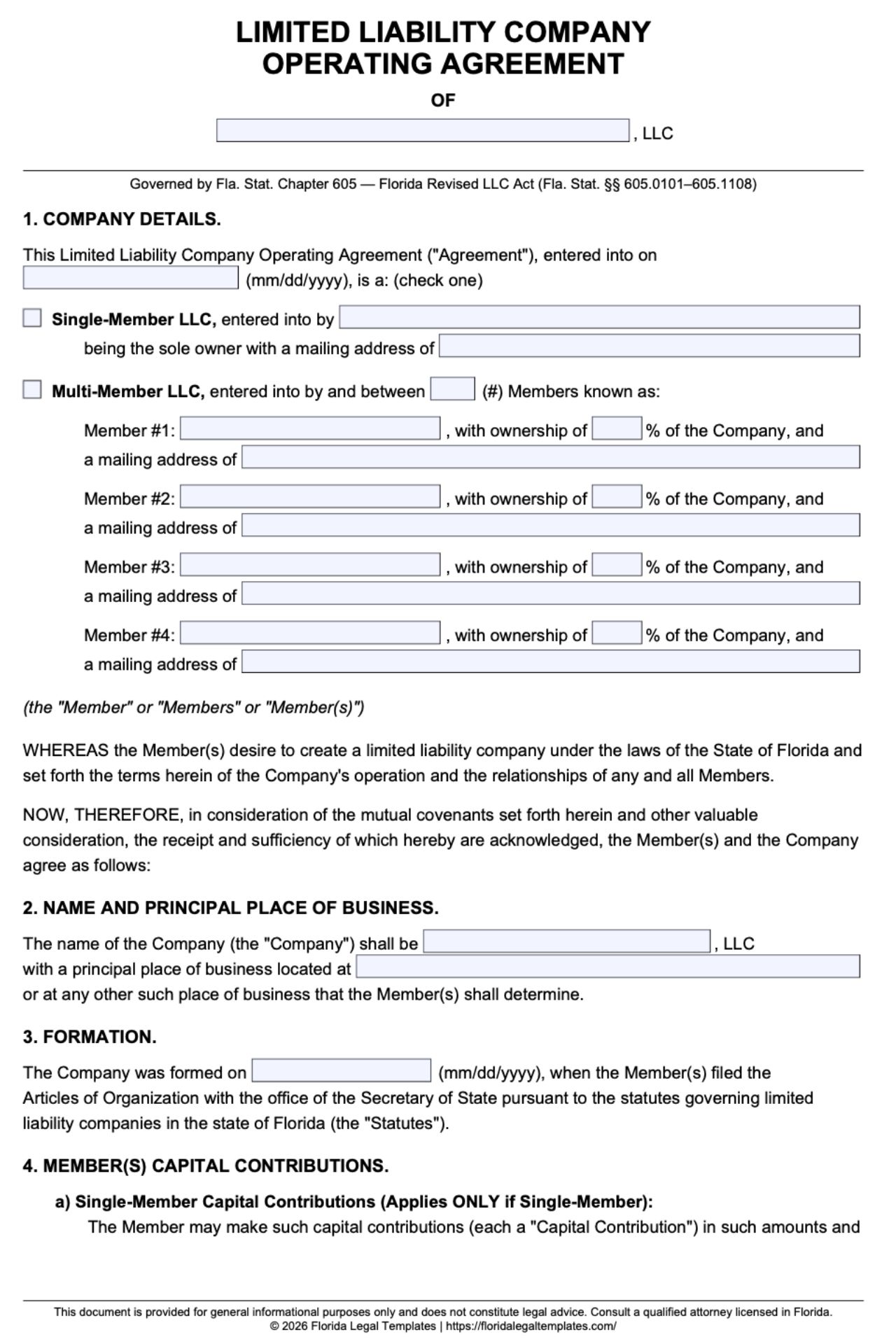
A Florida LLC operating agreement template typically includes:
- LLC identification details
- Ownership percentages
- Capital contributions
- Profit and loss allocations
- Voting rights
- Member or manager authority
- Transfer restrictions
- Dissolution procedures
- Amendment rules
Most templates can be adapted for both:
- Single-member LLCs
- Multi-member LLCs
You should also decide early whether the agreement will use:
- A member-managed structure
- A manager-managed structure
That distinction changes who has authority to legally bind the company.
When a Basic Template Is Not Enough
A standard template may not adequately protect the business if your LLC involves:
- Unequal ownership contributions
- Custom profit-sharing formulas
- Silent investors or outside funding
If that outside funding comes as debt rather than equity, a standalone loan agreement for outside LLC funding should document repayment terms separately — never embed debt obligations inside the operating agreement itself.
- Professional LLCs (PLLCs)
- Real estate holdings
- Multi-state operations
Those situations usually require custom drafting because Florida default rules under Chapter 605 may not match the arrangement members actually intended.
The Brand-New Florida Protected Series LLC Framework (Fla. Stat. §§ 605.2101–605.2802)
A major structural change took effect on July 1, 2026, when Florida’s new Uniform Protected Series Provisions became effective under Chapter 605. Under the newly enactedFlorida Protected Series LLC legislation (Senate Bill 316), a single “parent” or “umbrella” LLC can now establish one or more protected series under Chapter 605, but each protected series requires a protected-series designation to be delivered to the Department of State for filing. Each individual series can hold its own distinct assets, enter into independent vendor contracts, and feature completely separate membership shares.
Most importantly, Chapter 605 generally treats the debts and liabilities of a protected series as separate from those of the series LLC and other protected series, subject to the statute’s rules governing claims that seek to disregard the liability limitation and enforcement against non-associated assets. The protected-series liability framework depends on satisfying Chapter 605’s statutory requirements, including proper establishment and asset records; the operating agreement should also address protected-series governance, associated assets, and the separation of each series’s activities and records.
What a Florida LLC Operating Agreement Actually Does
The most common misunderstanding is confusing the operating agreement with the Articles of Organization.
The Articles of Organization are the public filing submitted to the Florida Division of Corporations (Sunbiz) to legally create the LLC. The operating agreement is completely different. It is a private internal contract governing how the LLC functions after formation.
Florida law does not require a separate written operating agreement. Under Fla. Stat. § 605.0102(45), an operating agreement may be oral, implied, in a record, or any combination of those forms. However, unwritten agreements create immense risk, leaving internal terms nearly impossible to prove during court disputes.
That flexibility sounds convenient until a dispute happens.
If two members later disagree about ownership percentages, distributions, or voting authority, an oral understanding becomes extremely difficult to prove. Courts are then forced to reconstruct the arrangement from emails, bank records, conduct, and testimony. That is expensive and unpredictable.
Without a written agreement, Florida’s default rules under Chapter 605 automatically control the company. Those defaults are designed for a generic LLC — not your specific business structure, investor relationship, or management expectations.
In practice, the operating agreement functions more like a constitution for the business relationship than a formation document.
If you are still deciding onentity structure,understanding the distinctions inaflorida LLC vs partnership agreement matters beforedrafting any internal governancedocument.
Florida Laws That Govern Your Operating Agreement
The Statutory Framework Under Chapter 605
| Topic / Issue | Florida Legal Rule | Governing Statute |
|---|---|---|
| Required adoption | Not legally required to form or maintain an LLC | No statutory mandate |
| Permissible form | Can be oral, implied, written, or any combination | Fla. Stat. § 605.0102(45) |
| Single-member validity | Fully enforceable even with only one party | Fla. Stat. § 605.0106(5) |
| Default management structure | Member-managed unless otherwise stated | Fla. Stat. § 605.0407(1) |
| Recordkeeping obligation | LLC must maintain a copy of the agreement | Fla. Stat. § 605.0410 |
Florida gives LLC owners substantial contractual freedom, but Chapter 605 also creates default governance rules that automatically apply whenever the agreement is silent.
The practical problem is not simply having a verbal agreement; it is leaving important terms undefined. When the operating agreement does not provide for a matter governed by §605.0105, Chapter 605 supplies the rule, which may produce a result the members never discussed when they started the LLC.
Recordkeeping requirements are specific under Fla. Stat. § 605.0410(1)(b), the company must keep a copy of its then-effective operating agreement and recorded amendments at its principal office or another location if the agreement was made in a record.
What These Laws Mean for Your Agreement in Practice
Florida’s recognition of oral operating agreements creates what many business attorneys consider an enforcement trap. Technically valid does not mean practically enforceable.
The management default rule creates another major risk. Under Fla. Stat. § 605.0407: an LLC is automatically member-managed unless the agreement or Articles explicitly state otherwise. That means each member generally acts as an agent of the LLC for its ordinary-course activities and may bind the company unless the member lacked authority for the particular matter and the other party knew or had notice of that lack of authority.
For passive investors, that can become a serious liability problem if the agreement is poorly drafted.
Clauses the Operating Agreement Cannot Legally Include
Florida allows broad contractual flexibility, but Chapter 605 imposes hard statutory limits.
Under Fla. Stat. § 605.0105, certain provisions are automatically void even if every member agrees to them.
Key Statutory Limits on an Operating Agreement
1. Cannot exonerate intentional misconduct
An operating agreement cannot protect a member or manager from liability arising from:
- Bad faith
- Intentional misconduct
- Knowing violations of law
Poorly drafted indemnification clauses frequently fail here. If the language attempts to broadly shield misconduct without carve-outs, courts may refuse to enforce portions of the clause.
2. Cannot eliminate good faith and fair dealing
Florida law does not allow an operating agreement to eliminate the obligation of good faith and fair dealing, although the agreement may set performance standards if those standards are not manifestly unreasonable.
The agreement can define reasonable performance standards, but it cannot authorize dishonest or abusive conduct between members.
3. Cannot unreasonably restrict member inspection rights
Members have statutory information and inspection rights under Fla. Stat. § 605.0410, and an operating agreement cannot unreasonably restrict those rights.
DIY agreements sometimes create burdensome access procedures that conflict with Chapter 605. Those restrictions can be invalidated during litigation.
4. Cannot change the LLC’s legal capacity
An operating agreement cannot vary the LLC’s statutory capacity to sue or be sued in its own name.
That capacity exists by statute and cannot be altered privately.
The Manager-Managed Election — A Drafting Decision With Real Legal Consequences
This is one of the most important structural decisions in a Florida LLC agreement.
Under Florida’s default rule, an LLC is member-managed unless its operating agreement or Articles of Organization expressly provide for manager-managed status or equivalent manager-control language.
That means:
- Any member may potentially bind the LLC
- Passive investors may unintentionally gain agency authority
- Third parties may reasonably rely on a member’s apparent authority
For LLCs with silent investors, outside funding, or multiple owners, that creates operational risk.
A manager-managed structure changes that authority model: management is vested in the managers, and a member is not an agent of the LLC solely because the person is a member.
To override Florida’s default rule, the agreement must explicitly state the LLC is “manager-managed” or clearly assign authority exclusively to managers.
Without that language, courts and third parties generally apply the statutory default.
This issue becomes especially important with:
-
Commercial lease authority for the LLC — landlords routinely request the operating agreement specifically to confirm who is authorized to execute the lease.
- Vendor contracts
- Real estate acquisitions
- Business banking authority
Banks and counterparties routinely ask for operating agreements specifically to verify who can legally sign on behalf of the LLC.
When Your Operating Agreement and Sunbiz Filing Do Not Match
One mistake that often delays financing or property closings is a mismatch between an LLC’s operating agreement and its public filings on Sunbiz. For example, your operating agreement may state the company is manager-managed, while your Articles of Organization on file with the state still show a member-managed structure.
Under Fla. Stat. § 605.0407, an LLC is default member-managed unless the operating agreement or Articles explicitly state otherwise. When internal documents conflict with public filings, Fla. Stat. § 605.0107(4) creates a sharp legal distinction:
-
Internal Governance: The operating agreement controls between members and managers.
-
Third-Party Transactions: A filed record generally prevails over a conflicting operating-agreement provision as to outside parties to the extent they reasonably rely on that record.
Because third parties are protected when relying on public records, title officers will pause a deal if Sunbiz contradicts your operating agreement. They will routinely demand an official state amendment, a member resolution, or a recorded Statement of Authority (Fla. Stat. § 605.0302) before allowing a closing to move forward.
How to Fix It: If you change the LLC’s management structure or authority, update the operating agreement and determine whether the filed Articles of Organization also need to be amended under Fla. Stat. § 605.0202; an Articles amendment is necessary when the filed record itself must be changed. The Florida Division of Corporations currently lists a $25 fee for an LLC’s “Any Other Amendment.” You can also update the management information required on the LLC’s Annual Report under Fla. Stat. § 605.0212, including the name, title or capacity, and address of at least one person authorized to manage the company. Keeping your public filings aligned with internal governance prevents costly transaction delays and signature challenges later.
What a Complete Florida LLC Operating Agreement Should Include
Foundational Identity Provisions
The agreement should identify:
- LLC legal name
- Formation date
- Principal business address
- Registered agent
- Business purpose
Even though the registered agent already appears publicly through Sunbiz filings, including it internally helps maintain consistent governance records.
Membership Structure and Capital Contributions
This section should clearly document:
- Each member’s ownership interest
- Initial contributions
- Whether contributions were cash, services, or property
When a member contributes ongoing services rather than a one-time capital input, documenting that as a consulting arrangement separate from ownership interest prevents compensation disputes from bleeding into membership rights later.
- Valuation methods
Many future disputes start here.
If unequal contributions are poorly documented, members often later disagree about ownership percentages and profit rights.
Profit, Loss, and Distribution Allocations
The agreement should define:
- Allocation methods
- Distribution timing
- Tax distribution rules
- Guaranteed payments, if applicable
Members performing services for the LLC are different from hired workers — those external working relationships should be covered under a separate independent contractor agreement in Florida to keep ownership and labor obligations legally distinct.
Florida law allows flexible allocation structures, but ambiguity creates accounting and tax complications quickly.
Management Structure and Voting Rights
This section should address:
- Member-managed vs. manager-managed status
- Voting thresholds
- Major-decision approval requirements
- Manager appointment and removal
Two-member 50/50 LLCs especially benefit from deadlock provisions because Florida law recognizes unresolved management deadlock as a potential ground for judicial dissolution when the statutory requirements are met.
Member Admission, Transfer, and Exit Provisions
Strong agreements control:
- Admission of new members
- Ownership transfers
- Withdrawal procedures
- Buyout rights
- Death or disability scenarios
These provisions become especially important when an owner wants to transfer an interest, withdraw, or dies. Chapter 605 contains default rules for membership and transferable interests, so the agreement should state the company’s intended admission, transfer, and buyout process rather than leaving those decisions entirely to the statute.
Fiduciary Duties — Default Rules and Permissible Modifications
In member-managed LLCs, members owe duties of loyalty and care.
In manager-managed LLCs, managers generally owe those duties instead.
Florida permits certain modifications to fiduciary duties under § 605.0105(4)(c), including identifying specific activities that do not violate the duty of loyalty, so long as the provision is not manifestly unreasonable. For stronger post-exit restrictions, non-compete restrictions for departing LLC members require a separate enforceable agreement — fiduciary duty language inside the operating agreement alone is not sufficient.
But the agreement cannot completely eliminate fiduciary duties or excuse intentional misconduct.
Dissolution and Winding-Up Procedures
The agreement should define:
- Dissolution triggers
- Required approval thresholds
- Asset distribution priorities
Physical asset transfers during winding-up need their own documentation — a bill of sale during LLC asset transfers creates the written record required for tax and liability purposes after dissolution.
- Liquidation procedures
Dissolution planning matters because Florida law recognizes specific dissolution events, including an event stated in the operating agreement, unanimous member consent, judicial dissolution, and administrative dissolution under §605.0701. A well-drafted agreement can therefore address the exit process before the company reaches that point.
Amendment and Dispute Resolution
A strong agreement includes:
- Amendment procedures
- Voting thresholds
- Mediation requirements
- Florida governing law language
Without amendment procedures, unanimous consent may be required for changes under default rules.
Single-Member LLC Operating Agreements — Why You Still Need One
Florida expressly provides that a single-member operating agreement is not unenforceable simply because only one person is a party under Fla. Stat. § 605.0106(5).
Many single-member owners assume an agreement is unnecessary because there are no co-owners. In practice, lenders, banks, courts, and counterparties often disagree.
A written agreement helps reinforce the LLC’s separate legal identity.
When creditors attempt to “pierce the corporate veil,” they often argue the LLC was operated like a personal alter ego rather than a separate business entity. Formal governance documents help counter that argument.
Banks also routinely request operating agreements before:
- Opening business accounts
- Issuing loans
- Approving merchant processing
Even a single-member agreement should address:
- Management authority
- Distributions
- Succession planning
A power of attorney for single-member incapacity addresses the gap period between incapacity and formal succession — and the operating agreement should acknowledge that authority consistently to avoid management conflicts.
- Future admission of members
A single-member agreement can also plan for a later ownership change. That matters because Florida expressly recognizes a one-member operating agreement under §605.0106(5), while the agreement can separately establish the process for admitting a future member or investor.
Drafting Mistakes That Void or Weaken Florida LLC Operating Agreements
Mistake 1: Using a Generic National Template
Many online templates reference laws from other states or include unnecessary execution formalities.
Florida does not require notarization or witnesses for validity.
Mistake 2: Failing to Explicitly Elect Manager-Managed Status
Without explicit language, passive investors may unintentionally gain authority to bind the LLC.
Mistake 3: Overbroad Indemnification Clauses
Clauses attempting to shield intentional misconduct violate § 605.0105(3) and may become partially unenforceable.
Mistake 4: Not Documenting Capital Contributions
Poor contribution records create ownership disputes that become difficult to resolve later.
Mistake 5: Relying on an Oral Agreement
Florida permits oral agreements, but proving their terms during litigation is extremely difficult.
Mistake 6: Never Updating the Agreement
LLCs evolve. Ownership changes, managers change, and capital structures change.
An outdated operating agreement eventually stops reflecting operational reality, which creates governance confusion during disputes or transactions.
Frequently Asked Questions
Q1: If Florida doesn’t require an operating agreement, can my LLC be sued for not having one?
No. Florida does not require an operating agreement to form or maintain an LLC.
The risk is operational rather than regulatory. Without an agreement, Chapter 605 default rules govern disputes, management authority, and distributions.
Q2: Does our Florida LLC operating agreement need to be notarized to be legally valid?
No. Florida imposes no notarization or witness requirement on operating agreements. Validity is governed by ordinary contract principles.
That said, signed and notarized agreements create stronger evidence if execution is later disputed.
Q3: Can one member unilaterally change the operating agreement?
Usually no. Unless the agreement expressly authorizes unilateral amendments, member approval is required. If the agreement is silent, unanimous consent may apply under default rules.
Q4: We have a verbal agreement about how our Florida LLC is run. Is that legally binding?
Technically yes. Florida recognizes oral and implied operating agreements under Fla. Stat. § 605.0102(45). Practically, though, verbal agreements are extremely difficult to enforce once members disagree.
When an oral LLC arrangement does not establish a term clearly, Chapter 605 supplies rules for matters the operating agreement does not otherwise address, which can make the parties’ intended arrangement harder to establish in a later dispute.
Legal Disclaimer: This article provides general legal information about Florida LLC operating agreements and is not legal advice. Laws can change, and your situation may require advice from a qualified Florida attorney. Review your specific circumstances with an attorney before relying on this information or using any template.