
Florida Golf Cart Bill of Sale Template (Printable PDF & Word)
A Florida golf cart bill of sale can be an especially important ownership record in a private golf cart transaction because standard golf carts are generally exempt from Florida’s vehicle registration and license-plate requirements. Unlike a car transfer, there is usually no Florida title certificate proving ownership history, lien status, or transfer records. That leaves the bill of sale functioning as the primary written evidence showing who sold the cart, who purchased it, when the transfer occurred, and what condition the cart was in at the time of sale.
That distinction matters more than many buyers realize. Battery disputes, speed modifications, brake problems, missing serial numbers, and roadway-use misunderstandings commonly surface after the sale — especially in retirement communities, campgrounds, resort properties, and neighborhood transportation setups where golf carts are used daily rather than recreationally.
Florida law also draws a sharp legal line between a standard golf cart and a converted low-speed vehicle (LSV). Florida defines a golf cart as a vehicle that is not capable of exceeding 20 MPH. Once modified so that its top speed is greater than 20 MPH but not greater than 25 MPH, the vehicle may qualify as a low-speed vehicle and become subject to Florida’s titling, registration, insurance, equipment, and inspection requirements. A basic bill of sale alone may no longer be sufficient for the transfer.
Candice Hayden, Legal Writer
Carly Johansson, Florida Contract Attorney
Florida Golf Cart Bill of Sale Template
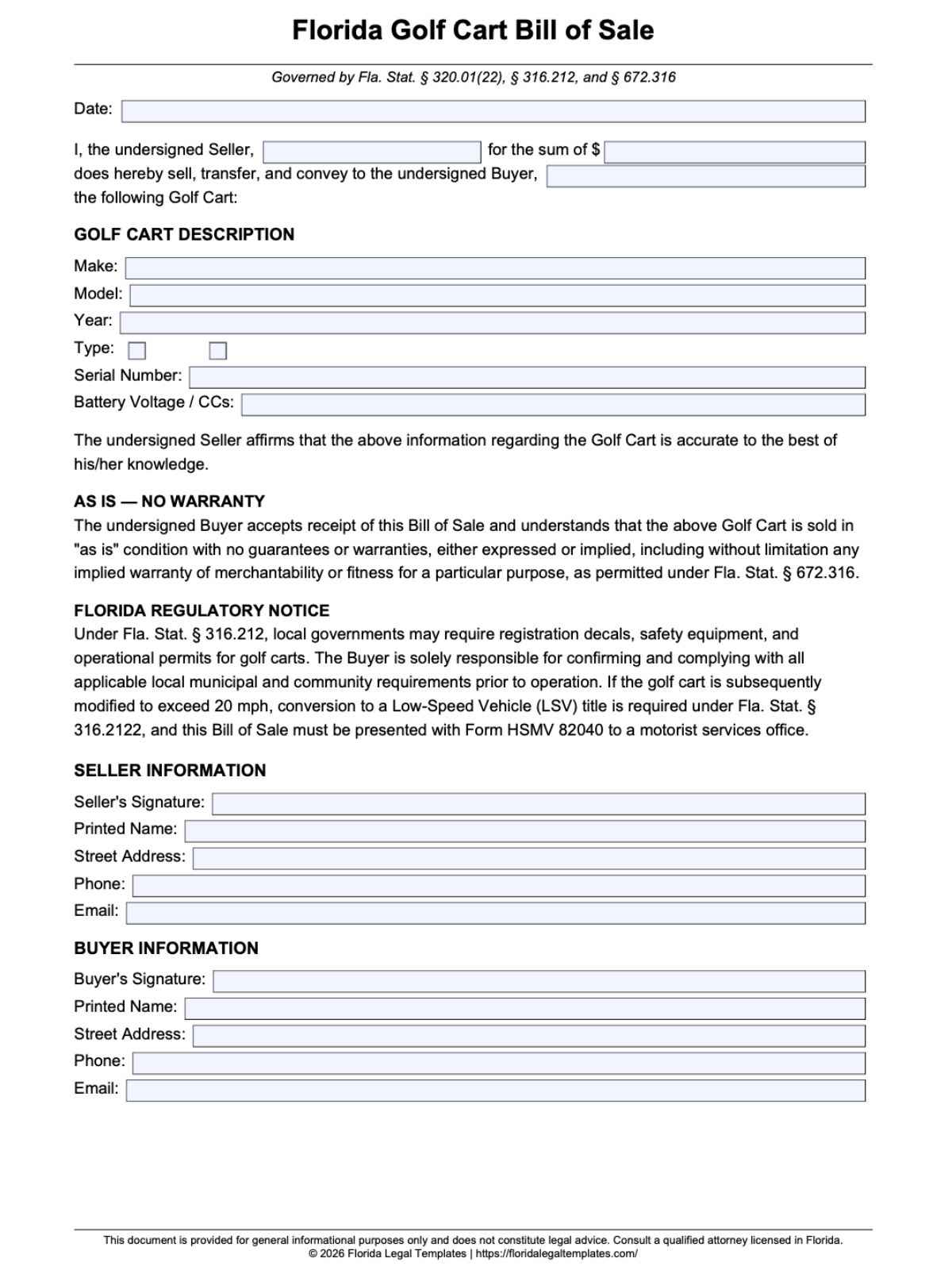
A properly drafted Florida golf cart bill of sale should contain far more than a handwritten receipt. The document should clearly identify the parties, the cart itself, the payment terms, and the legal condition of the sale.
Most reliable templates include:
- Buyer and seller legal names and addresses
- Manufacturer, model, and year
- Golf cart serial number
- Purchase price and payment method
- Delivery or possession date
- “AS IS” warranty disclaimer language
- Signature lines for both parties
Most users prefer formats that are:
- Printable
- Fillable online
- PDF-ready for storage and sharing
The document is commonly used for:
- Private-party neighborhood sales
- Retirement-community transfers
- Resort and campground ownership changes
- Casual transportation-cart purchases
- Facebook Marketplace or Craigslist sales
A simple template may not be enough in higher-risk situations. Problems commonly arise when:
- The cart exceeds 20 MPH
- Financing or installment payments are involved
- The cart was heavily customized
- Ownership history is unclear
- The cart may legally qualify as an LSV rather than a golf cart
When buyers agree to staggered payments instead of paying the full purchase price upfront, the parties often need additional documentation beyond the bill of sale itself. In more expensive transactions involving upgraded batteries or customized carts, sellers sometimes use separate agreements covering repayment obligations, defaults, and late-payment terms associated with financing terms for a private golf cart transaction.
Those situations often require additional documentation beyond a standard bill of sale.
What Makes a Florida Golf Cart Bill of Sale Different From a Vehicle Bill of Sale?
Florida treats standard golf carts differently from titled motor vehicles. Under Florida law, traditional golf carts are exempt from standard state titling and registration requirements.
That changes the purpose of the document entirely.
A normal vehicle bill of sale usually supplements an official state title transfer. A golf cart bill of sale often becomes the primary ownership record itself.
That creates several practical differences:
- No state-issued title usually exists
- No standard 17-digit VIN system applies
- No odometer disclosure requirement applies
- Ownership disputes rely heavily on private documentation
Because Florida does not treat a standard golf cart like an ordinarily titled motor vehicle, the manufacturer’s serial number is an important identifier to record in the bill of sale. Buyers should photograph the serial plate and keep that photograph with the signed document, especially if they may later resell the cart or need to establish which cart they purchased.
This also explains why users frequently confuse golf carts with low-speed vehicles. Once a cart is modified to exceed 20 MPH, the legal classification can change entirely. At that point, the transaction may require title paperwork, inspection records, and registration procedures instead of a simple private bill of sale.
Key Florida Laws That Affect a Golf Cart Bill of Sale
Florida Statutes Governing Golf Cart Transfers
| Topic / Issue | Florida Legal Rule | Governing Statute |
|---|---|---|
| Statute of Frauds | Golf cart transactions for $500 or more generally require a record sufficient to indicate that a sale contract was made and signed by the party against whom enforcement is sought. | Fla. Stat. § 672.201(1) |
| Warranty disclaimer rules | “AS IS” disclaimers must properly exclude implied warranties, including merchantability | Fla. Stat. § 672.316 |
| Road-operation equipment | Golf carts operated on public roads must have efficient brakes, reliable steering, safe tires, a rearview mirror, and red reflectorized warning devices in the front and rear. | Fla. Stat. § 316.212(6) |
| Legal age to contract | Florida generally removes the disability of nonage at age 18, while ordinary contract-capacity rules also apply. | Fla. Stat. § 743.07 |
| LSV conversion rules | Modified carts exceeding golf-cart speed limits may require VIN assignment, title, and registration | Fla. Stat. § 316.2122 and § 320.01(41) |
Under Florida’s Uniform Commercial Code, golf cart sales exceeding $500 become difficult to enforce without written documentation signed by the party being sued. That is one reason informal cash transactions often create evidentiary problems later. Buyers may claim additional promises were made verbally, while sellers may deny agreeing to repairs, battery replacement, or delivery obligations.
Sellers face substantial exposure if expensive battery banks fail post-sale. To exclude the implied warranty of merchantability in a written agreement, Florida law requires the disclaimer to mention merchantability and be conspicuous; the statute does not require a particular font, capitalization, or bolding format.
Speed modifications create another common legal trap. A cart capable of exceeding 20 MPH may no longer legally qualify as a golf cart under Florida law. Buyers sometimes discover after purchase that the cart should have been titled and registered as an LSV, exposing them to roadway violations and insurance problems.
Practical Impact of These Laws on the Bill of Sale
The bill of sale is not just a payment receipt. In practice, it becomes the document that allocates risk between buyer and seller.
Serial numbers matter because standard golf carts do not use traditional state VIN tracking systems. If the serial number is missing or inaccurate, proving lawful ownership later becomes significantly harder.
Poorly drafted “AS IS” clauses also create litigation exposure. Sellers frequently assume a simple handwritten statement like “sold as seen” automatically protects them. Under Florida law, that assumption can fail if the disclaimer language is incomplete or not visually conspicuous.
Florida law also addresses contractual limitation periods directly: a provision that shortens the applicable statutory period is void under Fla. Stat. § 95.03.
Documentation problems become even more serious when handwritten records contain incorrect serial numbers, buyer names, or model details. In disputed transactions, parties sometimes prepare additional paperwork focused on fixing mistakes in ownership transfer paperwork tied to the original sale documents.
When You Should — And Should Not — Use a Florida Golf Cart Bill of Sale
A golf cart bill of sale is strongly recommended for:
- Private residential sales
- Retirement-community transactions
- Campground and resort transfers
- Family sales involving payment
- Online marketplace transactions
Additional paperwork may be necessary when:
- The cart qualifies as an LSV
- A dealer participates in the sale
- Financing is involved
- The cart belongs to a commercial fleet
- The cart has extensive modifications
Relying only on a bill of sale can become risky if:
- The serial number is missing
- Ownership history is disputed
- The cart was homemade
- The cart contains undocumented modifications
- Major battery replacements were never documented
Battery-condition disputes are especially common because replacement battery systems can cost thousands of dollars. Buyers should document battery age, replacement history, and charging-system condition whenever possible.
Information That Should Always Appear in the Golf Cart Bill of Sale
The document should clearly identify both the parties and the cart itself.
Key information usually includes:
- Buyer and seller names and addresses
- Manufacturer
- Model
- Year
- Color
- Serial number
- Tire condition disclosures
- Brake condition disclosures
- Battery replacement history
- Speed capability disclosures
- Purchase price
- Payment method
- Possession-transfer date
The warranty disclaimer language deserves special attention. Under Florida law, Sellers using a written warranty disclaimer should make the exclusion conspicuous and, when excluding the implied warranty of merchantability, expressly mention merchantability; Florida law also recognizes “AS IS” and “WITH ALL FAULTS” language as warranty exclusions in appropriate circumstances.
A strong clause often appears in bold capital letters rather than buried in normal text.
Although notarization is not legally required for standard golf cart sales, some parties still notarize the document to reduce future signature-fraud disputes. That added evidentiary value can become useful if ownership litigation later occurs.
How to Fill Out a Florida Golf Cart Bill of Sale Properly
Identify the Golf Cart Correctly
Serial numbers are commonly located:
- Under the passenger-side glove box
- Near the steering column
- On the frame
- Beneath the seat assembly
Vague descriptions create major ownership problems later. A document stating only “used golf cart” provides little evidentiary protection if the parties later disagree about the exact vehicle sold.
Verify the Manufacturer Serial Plate Has Not Been Altered
Recording the serial number is only the first step. Before handing over payment, compare the serial plate with the cart itself. On Club Car, E-Z-GO, and Yamaha carts, the factory serial plate is normally riveted or permanently affixed in a specific location for that manufacturer. Fresh rivets, scratched paint around the plate, mismatched fonts, or adhesive residue can indicate the original identification plate was removed or replaced.
That matters because many private buyers assume a bill of sale proves ownership. It does not cure a cart with a questionable identity. If law enforcement later determines the serial plate was altered or belongs to a different vehicle, the buyer may have difficulty proving lawful ownership even with a signed bill of sale.
As a practical safeguard, photograph the serial plate before completing the sale and attach that photo to your records along with the bill of sale. If the serial number is unreadable, missing, or appears tampered with, postpone the transaction until the seller can satisfactorily explain the discrepancy. Walking away from a cart with an altered identification plate is usually far less expensive than trying to resolve an ownership dispute after the purchase.
Verify Whether the Cart Is Still Legally a “Golf Cart”
Florida’s 20 MPH threshold matters enormously.
Once a cart exceeds that limit, it may legally become an LSV requiring:
- Inspection
- Registration
- Titling
- VIN assignment
Undisclosed speed modifications create some of the most serious post-sale disputes because buyers may unknowingly operate an unlawfully unregistered vehicle on public roads.
The Component Serial Number Swap Trap
A high-risk issue unique to the secondary golf cart market is the “component swap trap,” which commonly surfaces in transactions involving heavily customized or refurbished carts. While a standard vehicle bill of sale relies on a single frame-stamped VIN, a custom golf cart is a hybrid machine. It features an initial factory frame serial number, but its most expensive individual parts—such as a high-capacity lithium battery pack, an upgraded high-torque AC motor, or a heavy-duty aftermarket controller each carry separate manufacturer serial numbers.
If a customized cart includes expensive replacement components, buyers should document the identifying information and receipts for those components in addition to the cart’s frame serial number. That extra record can make it easier to identify what the buyer actually purchased if a later dispute arises. Furthermore, if a dishonest seller installs an old or degraded battery pack right before the physical exchange, a general frame description makes it incredibly difficult to prove asset manipulation in court. To protect both parties, the bill of sale must feature individual serial number line items for the frame plus the active battery system and motor assembly.
Include Proper Warranty Disclaimer Language
A proper disclaimer should prominently include phrases such as:
- “AS IS”
- “WITH ALL FAULTS”
- “MERCHANTABILITY”
Under Florida UCC rules, weak disclaimer wording may fail to eliminate implied warranty claims. Sellers attempting to avoid future battery or mechanical disputes should avoid vague language.
Document Payment and Possession Transfer
The agreement should clearly state:
- Whether payment was made in full
- Whether installments remain due
- The exact possession-transfer date
Ownership disputes sometimes arise when buyers take possession before payment fully clears.
Retain Supporting Documents
Helpful supporting records include:
- Repair invoices
- Battery replacement receipts
- Prior purchase documents
- Conversion-part receipts
- Maintenance records
These records frequently become important when proving ownership history or disputing undisclosed modifications.
Golf Cart vs. Low-Speed Vehicle (LSV) in Florida
Many Florida buyers mistakenly assume every golf cart is legally treated the same way. That is incorrect.
The operational threshold changes everything:
- Standard golf cart = below 20 MPH
- LSV = 20–25 MPH
Once converted into an LSV, the vehicle may require:
- State inspection
- VIN assignment
- Registration
- Titling
- Insurance compliance
A bill of sale alone does not complete the title process for a converted LSV. FLHSMV’s conversion procedure can require Form HSMV 82040, Form HSMV 86064, Form HSMV 84490, supporting conversion records, a certified weight slip, proof of Florida insurance, and the required inspection and fees.
Florida Roadway Rules Buyers Commonly Misunderstand
Many buyers incorrectly believe golf carts can automatically operate on public roads throughout Florida.
Under Florida law, roadway use is heavily restricted. Florida generally prohibits golf-cart operation on public roads unless the road falls within the types of roads designated for golf-cart use under § 316.212, and local governments may impose stricter rules.
Under Fla. Stat. § 316.212(7), street operation requires strict age and identification verification. Operators under 18 must have a valid learner’s driver license or driver license, while operators 18 or older must have a valid government-issued photographic identification. Localities can pass more restrictive ordinances under subsection (8), but these baseline identity checks are mandatory statewide.
Public-road operation also requires certain safety equipment, including:
- Efficient brakes
- Reliable steering
- Safe tires
- Rearview mirror
- Reflectorized warning devices
Buyers should independently verify local ordinances before purchasing a golf cart for neighborhood transportation use. A cart that is perfectly lawful inside one retirement community may be prohibited on nearby public roads.
Common Golf Cart Bill of Sale Mistakes That Create Legal Problems
Several recurring drafting mistakes create avoidable disputes:
- Using a motor-vehicle template referencing nonexistent VINs
- Omitting the serial number
- Failing to disclose speed modifications
- Using weak “AS IS” language
- Confusing golf carts with LSVs
- Assuming registration is never required
- Accepting vague handwritten descriptions
- Ignoring battery-condition disclosures
- Relying entirely on verbal agreements
- Failing to keep signed copies
One overlooked problem involves undisclosed modifications that push the cart beyond the legal golf-cart classification. Buyers sometimes discover only after purchase that the cart cannot legally operate without registration.
Many buyers mistakenly reuse generic automobile forms that fail to address serial numbers, battery disclosures, or speed-related compliance issues unique to golf carts. Those drafting problems frequently appear in disputes centered around proving ownership when no Florida title exists.
Legal Limitations and Liability Considerations
A golf cart bill of sale does not automatically legalize roadway use.
Even with a properly signed document, buyers may still face compliance problems involving:
- Illegal roadway operation
- Improper LSV conversion
- Missing registration requirements
- Local ordinance violations
Ownership disputes can also arise if the parties fail to preserve supporting evidence such as repair invoices or prior purchase records.
Private warranty disclaimers have limitations as well. Fraudulent concealment, intentional misrepresentation, or materially false statements may still create liability exposure despite “AS IS” language.
Florida contract claims involving golf cart sales are subject to the applicable limitation periods in Chapter 95, which generally provide five years for an action founded on a written instrument and four years for an action not founded on a written instrument, including an action for the sale and delivery of goods.
Frequently Asked Questions About Florida Golf Cart Bills of Sale
Can I legally sell a golf cart in Florida without a title?
Yes. Standard golf carts are generally exempt from Florida motor-vehicle titling requirements. Because no state title usually exists, the bill of sale often becomes the primary ownership document proving the transfer.
What happens if a golf cart I purchased can actually exceed 20 MPH?
The vehicle may legally qualify as a low-speed vehicle rather than a standard golf cart. That can trigger registration, titling, VIN assignment, and inspection obligations under Florida law. Buyers who unknowingly operate improperly converted carts on public roads may face compliance and insurance issues.
Does a Florida golf cart bill of sale need to be notarized to hold up in court?
No statutory notarization requirement generally applies to standard golf cart transfers. However, notarization can strengthen the document’s evidentiary value and help reduce future signature-authenticity disputes.
Can a buyer sue me after a private golf cart sale for battery or mechanical problems?
Possibly. Properly drafted “AS IS” language may reduce implied warranty exposure, but poorly written disclaimers often fail. Sellers using incomplete warranty language sometimes discover they remain exposed to claims involving merchantability or undisclosed defects.
What if the golf cart does not have a visible serial number?
That creates significant transaction risk. Without a serial number, ownership verification becomes harder, resale complications increase, and theft-related disputes become more difficult to resolve. Buyers should proceed cautiously before purchasing any cart lacking identifiable manufacturer information.
Legal Disclaimer:This article provides general information about Florida golf cart bills of sale and is not legal advice. Florida laws and local requirements may change, and individual transactions may involve different legal issues. Consider consulting a qualified Florida attorney for advice about your specific situation.