
Florida As Is Bill of Sale Template (Free PDF & Word)
A Florida As Is Bill of Sale is often used when a seller wants to transfer personal property without making promises about its condition, but many people don’t realise that simply adding the words “AS IS” isn’t always enough to avoid later disputes. Under Florida’s Uniform Commercial Code, warranty exclusions must be clear and conspicuous, which is why a generic as is bill of sale florida template can sometimes create problems instead of preventing them.
I’ve seen county court disputes arise after a seller relied on a vague no warranty bill of sale florida form that failed to properly address warranty language or clearly identify the property being transferred. Another common misconception is that an “AS IS” clause eliminates every seller obligation, even though Florida law treats warranties about an item’s condition differently from warranties of title and ownership. The article explains what belongs in the document, how Florida handles warranty disclaimers, and the mistakes that most often lead to disagreements after a sale.
Candice Hayden, Legal Writer
Carly Johansson, Florida Contract Attorney
Florida As Is Bill of Sale Template
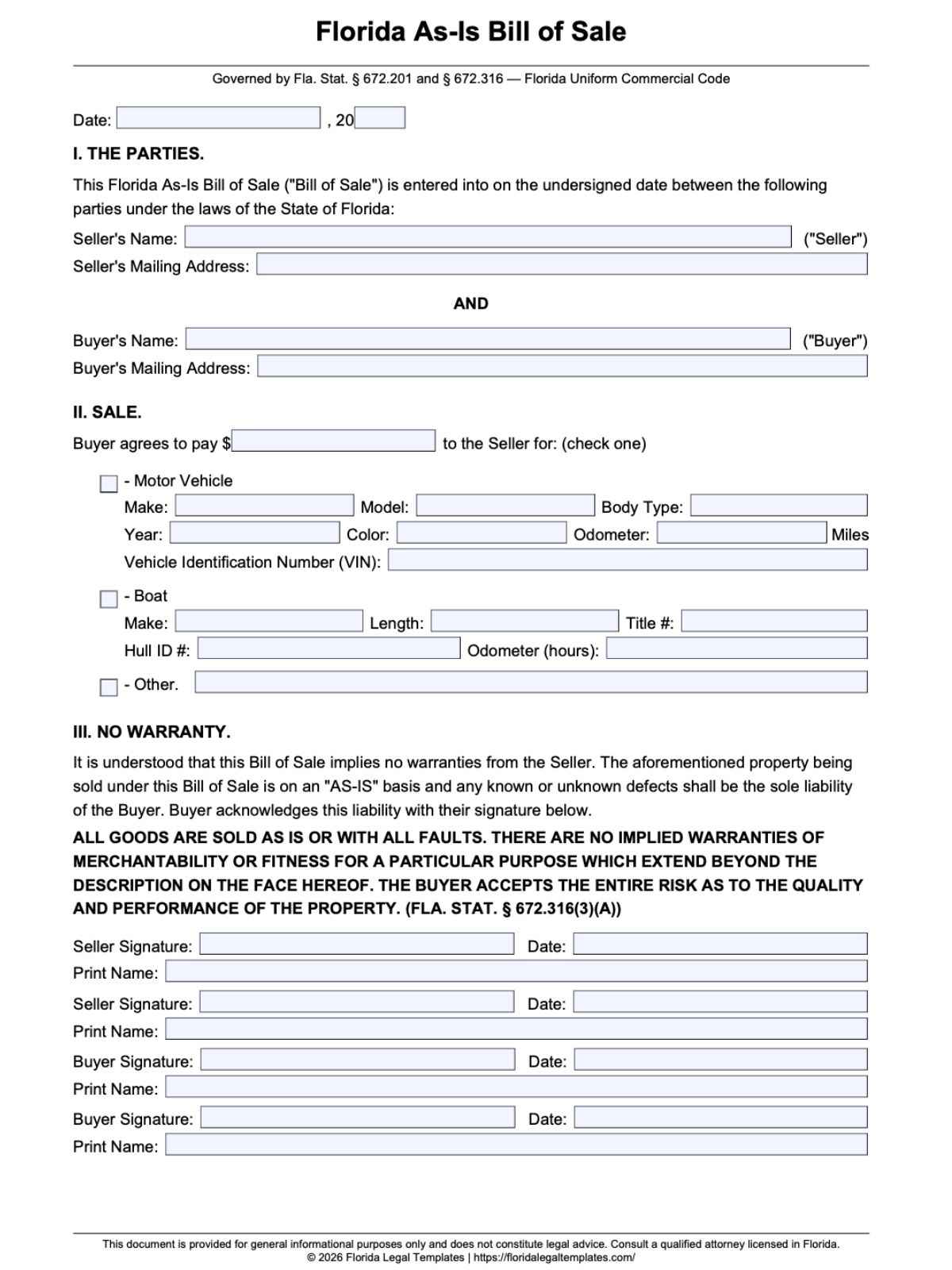
A Florida As Is Bill of Sale template typically includes:
- Buyer and seller information
- Date of sale
- Property description
- Purchase price
- Payment details
- Warranty disclaimer language
- Signatures of both parties
The template can be downloaded as a PDF or Word document and completed electronically or printed for signing.
This type of form is commonly used for:
- Electronics
- Furniture
- Tools
- Appliances
- Other personal property
The document is designed primarily for private sales of goods between individuals.
However, the template may not be sufficient for:
- Motor vehicles
- Boats and vessels
- Assets requiring state title transfer
- Transactions involving financing
- Installment-payment arrangements
Those transactions often require additional state-specific paperwork beyond a standard bill of sale.
What Is a Florida As Is Bill of Sale?
A Florida As Is Bill of Sale is a private contract and receipt documenting the transfer of ownership of personal property from a seller to a buyer.
The phrase “as is” does not merely describe the condition of the item. It has legal significance because it communicates that the buyer accepts the property with its existing defects, whether known or discoverable through reasonable inspection.
The document performs two separate functions:
- Transfer of ownership — establishes that the seller transferred the item to the buyer.
- Disclaimer of warranties — limits certain promises regarding the property’s condition.
Many private sellers use this form to reduce the risk of future claims involving used property. Buyers often accept an as-is transaction when purchasing secondhand goods at a reduced price.
Unlike a standard bill of sale that may contain express warranties or guarantees, an as-is bill of sale is specifically designed to disclaim certain warranty obligations.
Why the “As Is” Clause Matters Under Florida Law
What “AS IS” Legally Means
Florida’s Uniform Commercial Code recognizes “AS IS” and “WITH ALL FAULTS” language as ways to exclude implied warranties when the disclaimer also satisfies the specific requirements of Fla. Stat. § 672.316.
Pursuant to Florida Statutes § 672.316(3)(a), language that clearly alerts the buyer that no implied warranties are being provided can eliminate those implied protections. See Fla. Stat. § 672.316.
In practical terms, the buyer assumes the risk that the item may contain defects, wear, or performance issues that become apparent after purchase.
The Conspicuous Disclaimer Requirement
Florida law does not favor hidden disclaimers.
To effectively exclude the implied warranty of merchantability, a written disclaimer must be conspicuous and must specifically mention merchantability.
Common methods include:
- ALL CAPITAL LETTERS
- Bold formatting
- Separate disclaimer boxes
- Placement directly above signature lines
Burying warranty language in dense fine print can create enforceability concerns because a buyer may argue that the disclaimer was not reasonably noticeable.
Condition Warranties vs. Title Warranties
A common misconception is that an as-is clause eliminates every legal warranty associated with a sale.
In practice, an as-is provision is generally directed at implied warranties concerning the condition or fitness of goods, while title warranties are addressed separately under Fla. Stat. § 672.312.
It does not automatically eliminate warranty-of-title protections. Under Fla. Stat. § 672.312(2), the warranty of title and rightful transfer is excluded or modified only by specific language or by circumstances that give the buyer reason to know the seller does not claim title or is transferring only whatever title the seller or another person may have.
This distinction becomes particularly important when expensive equipment, collectibles, or business assets are involved.
Key Florida Laws That Affect Florida As Is Bill of Sale
Florida Legal Requirements at a Glance
| Topic / Issue | Florida Legal Rule | Governing Statute |
|---|---|---|
| UCC Property Scope | The Uniform Commercial Code governs sales of goods, generally meaning movable things identified to the contract for sale. | Fla. Stat. § 672.105 |
| Statute of Frauds | A contract for the sale of goods priced at $500 or more generally requires a signed record sufficient to indicate that a contract was made, subject to the exceptions in Fla. Stat. § 672.201. | Fla. Stat. § 672.201(1) |
| Title Warranty Limits | An “As Is” clause generally affects condition warranties and does not automatically disclaim warranties of title, rightful transfer, or freedom from liens. | Fla. Stat. § 672.312 |
| Conspicuous Standard | Any disclaimer of the implied warranty of merchantability must be conspicuous and reasonably noticeable to the buyer. | Fla. Stat. § 672.316(2) |
| Implied Warranty Disclaimer | Expressions such as “AS IS” or “WITH ALL FAULTS” effectively exclude implied warranties when properly presented. | Fla. Stat. § 672.316(3)(a) |
| Sales Tax Considerations | Private sales of tangible personal property may be subject to Florida’s state sales tax and applicable local surtaxes unless a specific exemption applies. | Fla. Stat. § 212.05 |
A practical takeaway from these rules is that documentation becomes increasingly important as transaction value rises. A verbal agreement may create significant proof problems, especially once a sale exceeds the $500 threshold addressed by Florida’s statute of frauds provisions.
The warranty language also matters as much as the property description. A poorly drafted disclaimer may undermine one of the primary reasons parties use an as-is bill of sale in the first place.
Additionally, inaccurate sale prices or incomplete records can create tax issues if the transaction is later reviewed by state authorities.
When a Florida As Is Bill of Sale Is the Right Choice
This document is commonly used for:
- Private sales of used personal property
- One-time transactions between individuals
- Household liquidation sales
- Estate cleanouts
- Marketplace and classified-ad sales
Situations where it may not be appropriate include:
- Sales involving guarantees or warranties
- Complex commercial transactions
- Installment-payment arrangements
- Property with disputed ownership
- State-regulated titled assets
If ownership is unclear or financing is involved, a more comprehensive purchase agreement is often the better choice.
How to Complete a Florida As Is Bill of Sale
Identify the Parties
Include:
- Full legal name of the seller
- Full legal name of the buyer
- Addresses if desired for recordkeeping
Using the parties’ full legal names makes the signed record easier to connect to the transaction if a dispute later arises over the property or payment.
Describe the Property
The property description should be specific.
Include:
- Make and model
- Serial numbers
- Identification numbers
- Unique characteristics
- Known condition details
A detailed description is especially useful for goods with serial or identification numbers because it helps distinguish the property sold from similar equipment or other items owned by the seller.
State the Purchase Terms
Document:
- Sale price
- Payment date
- Payment method
- Any immediate transfer terms
Accurate pricing is important because, when a transaction is taxable, Florida sales tax is generally calculated from the taxable sales price, while qualifying occasional or isolated sales may be exempt under Rule 12A-1.037.
Insert Proper Warranty Disclaimer Language
The disclaimer should be highly visible.
A common approach is:
THE PROPERTY IS SOLD “AS IS” AND “WITH ALL FAULTS.” THE SELLER MAKES NO WARRANTIES, EXPRESS OR IMPLIED, REGARDING THE CONDITION OF THE PROPERTY.
The purpose of conspicuous language is to ensure the buyer understands the risk allocation before signing.
Execute the Document
For general personal property sales:
- Buyer signs
- Seller signs
- Date the document
Florida generally does not require witnesses or notarization for a standard personal property as-is bill of sale.
Each party should retain a signed copy for future reference.
Sales Tax and Transaction Reporting Considerations
Under Florida Administrative Code Rule 12A-1.037, occasional or isolated sales of tangible personal property may be exempt when the transaction satisfies the rule’s requirements. For an individual seller, the occasional-sale exemption generally applies to no more than two sales or series of sales during a 12-month period, subject to additional conditions and exclusions.
Because tax obligations may depend on the reported transaction value:
- Do not understate the purchase price.
- Do not leave price fields blank.
- Maintain complete transaction records.
Accurate documentation protects both parties if questions arise regarding ownership history, valuation, or tax compliance.
Legal Limits of an As Is Bill of Sale
Fraud and Concealment Cannot Be Waived
An AS IS clause does not by itself make a false statement about the property true or eliminate every claim that may arise from the seller’s conduct.
If a seller actively conceals a defect, intentionally misrepresents the condition of the property, or hides a material problem that a buyer could not reasonably discover, the as-is protection may become ineffective.
Whether an AS IS clause bars a fraud claim depends on the contract language and the circumstances surrounding the transaction, including whether the alleged fraud is contradicted or negated by the agreement.
The Express Warranty Override Trap (§ 672.316(1))
A widespread drafting error occurs when a seller writes an “AS IS” disclaimer but also includes specific descriptive promises about the item’s condition or performance (e.g., writing “brand new battery installed” or “engine completely rebuilt”). Under Fla. Stat. § 672.313, an affirmation of fact or promise that becomes part of the basis of the bargain can create an express warranty, even if the seller does not use words such as “warrant” or “guarantee.”
Under Fla. Stat. § 672.316(1), an AS IS disclaimer and an express warranty should be construed consistently where reasonable, but the disclaimer is inoperative to the extent that the two provisions cannot reasonably be read together. If a dispute reaches court, Florida judges will enforce the seller’s specific affirmative representation over a general “AS IS” clause. To maintain true “AS IS” protection, sellers must avoid making specific performance or repair guarantees within the document or advertisement.
Consumer Protection Limitations
Commercial sellers face additional limitations.
Businesses cannot rely on an AS IS provision to make deceptive or unfair trade practices lawful, and other statutory consumer-protection obligations may still apply depending on the transaction.
Florida’s consumer protection laws may limit the effectiveness of disclaimer language when deceptive conduct is involved.
Illegal Uses of the Document
Potentially unlawful practices include:
- Leaving buyer information blank
- Omitting the purchase price
- Open-ended transfer arrangements
- Tax-avoidance schemes
- Ownership-skipping transactions
These practices can create audit exposure, penalties, and evidentiary problems for both parties.
Common Mistakes That Create Liability for Buyers and Sellers
The problems usually start with a few preventable drafting mistakes:
- Using vague or generic as-is language
- Failing to identify the property clearly
- Omitting serial numbers
- Assuming an as-is clause eliminates all legal duties
- Failing to document known defects
- Leaving key fields blank
- Relying on verbal agreements for transactions exceeding statutory thresholds
- Failing to keep signed copies
These mistakes often become significant only after a dispute arises, making prevention far easier than litigation.
Documents Often Confused With a Florida As Is Bill of Sale
Standard Bill of Sale with Warranties
Includes representations or guarantees about condition or performance.
Vehicle Bill of Sale
Used alongside motor vehicle title-transfer requirements.
Vessel Bill of Sale
Designed for boat transactions and may accompany vessel title and registration procedures.
Purchase Agreement
Contains broader contractual terms, contingencies, and obligations.
Sales Receipt
Primarily confirms payment but may not contain ownership-transfer or warranty-disclaimer provisions.
The right document depends on what is being sold and whether the transaction also involves title, registration, financing, or additional contractual promises.
Frequently Asked Questions
Is a Florida As Is Bill of Sale legally valid without a notary?
Yes. For general personal property transactions, Florida law does not require notarization for a standard as-is bill of sale. Mutual signatures are generally sufficient.
Can a buyer sue after signing an as-is bill of sale in Florida?
Potentially. An as-is clause may limit warranty-based claims, but it does not automatically prevent claims involving fraud, intentional concealment, or other legally recognized causes of action.
Does an as-is clause protect a seller who knew about a hidden defect?
Not necessarily. Active concealment or intentional misrepresentation may undermine the protection normally provided by an as-is clause.
Do I need a written Florida As Is Bill of Sale if the property is worth more than $500?
Florida’s Uniform Commercial Code Statute of Frauds requires a written record to enforce a contract for the sale of goods valued at $500 or more. See Fla. Stat. § 672.201(1).
Can an as-is bill of sale be used for a vehicle or boat in Florida?
A general as-is bill of sale may document the transaction, but vehicles and vessels typically require additional title-transfer procedures and state-specific paperwork. A specialized vehicle or vessel bill of sale is usually the more appropriate document.
Legal Disclaimer:This article provides general information about Florida law and is not legal advice. Laws and legal requirements can change, and the effect of an as-is clause depends on the specific transaction and contract language. For advice about your situation, consult a qualified Florida attorney.