
Florida Vessel Bill of Sale [Free Template, Fillable PDF]
A florida vessel bill of sale carries documentation requirements that a generic bill of sale template consistently misses — and a buyer who completes a boat purchase with the wrong form discovers that problem at the tax collector’s office, not at the dock, when the registration cannot be processed because the document does not satisfy Florida’s vessel title transfer requirements. Florida titles all motorized vessels and sailboats over 16 feet under F.S. §328.03, and the vessel bill of sale florida that supports that title transfer must include the hull identification number, vessel make, model, year, and length as required by the title application standards of F.S. § 328.01 — details that a standard bill of sale form built for vehicle or personal property transfers does not prompt for and often omits entirely.
Lien documentation matters just as much as vessel identification: under the strict lien enforceability framework of F.S. § 328.15, any existing lien on the vessel must be satisfied and released before clear title can transfer, which means a buyer who skips lien verification is taking on the risk that a creditor’s interest in the boat travels with the purchase regardless of what the seller represents at closing. I’ve worked with buyers who showed up at the tax collector’s window with a handwritten bill of sale that had every dollar amount correct but no hull identification number, and had to spend weeks tracking down a seller who had already moved on to execute a corrected document before the vessel could be registered.
The florida vessel bill of sale template and breakdown below cover the required identification fields, the lien release documentation Florida expects, and the physical documentation requirement that applies during the 30-day temporary registration window after purchase.
Candice Hayden, Legal Writer
Carly Johansson, Florida Contract Attorney
Florida Vessel Bill of Sale Template
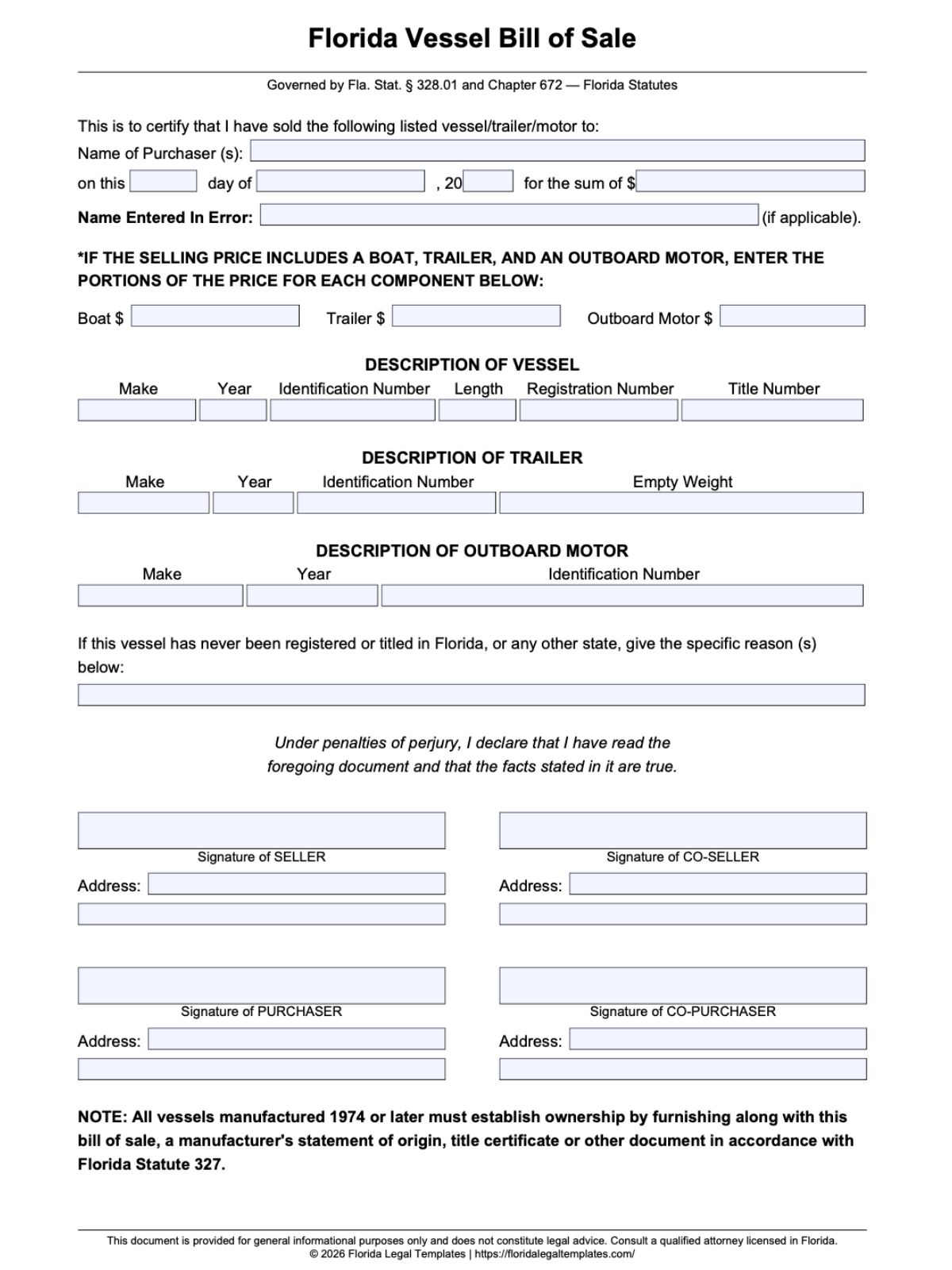
A Florida vessel bill of sale template typically includes:
- Buyer and seller names and addresses
- Vessel description and specifications
- Hull Identification Number (HIN)
- Year, make, and model
- Purchase date
- Purchase price breakdown
- Trailer and outboard motor details
- Signature lines for both parties
- Odometer or engine-hours information when applicable
Many templates are available in:
- PDF format
- Word format
- Printable forms
- Fillable digital versions
This document is commonly used for:
- Private boat sales
- Casual sales involving trailers and outboard motors
- Transactions requiring proof of purchase price for Florida sales tax purposes
- Family or acquaintance transfers
A Florida watercraft bill of sale becomes particularly valuable when the purchase involves separate components. Florida’s casual-sales tax structure may treat the hull, trailer, and outboard motor differently if the prices are separately itemized.
The template may not be sufficient for:
- Federally documented USCG vessels
- Commercial vessel transactions
- Probate or estate transfers
- Situations involving missing titles or unresolved liens
It is also critical to distinguish between several related documents:
| Document | Primary Purpose |
|---|---|
| Vessel Bill of Sale | Proof of transaction and tax-basis support |
| Florida Certificate of Title | Official ownership transfer instrument |
| Registration Application | State operating authorization process |
Even with a properly completed bill of sale, Florida buyers must still complete title and registration transfer within the statutory deadlines imposed under Chapter 328.
What Is a Florida Vessel Bill of Sale?
A Florida vessel bill of sale is a private transfer document used to record the sale of a boat or watercraft between parties. It serves as evidence of the transaction and supports the buyer’s title and registration application.
In more complex private transactions involving payment schedules, contingencies, or negotiated warranties, parties may also use a Florida sales agreement alongside the bill of sale to document broader contractual terms beyond the vessel transfer itself.
The document helps:
- Record the agreed sale terms
- Verify the purchase date
- Establish the tax basis
- Support title-transfer paperwork
- Provide temporary onboard proof of purchase
Under Florida law, the document is not a substitute for a certificate of title. Pursuant to Florida Statutes § 328.03, the title itself remains the legally controlling ownership document for titled vessels.
A vessel bill of sale differs from several similar documents:
- A general bill of sale may lack vessel-specific compliance fields
- A registration certificate only authorizes operation
- A trailer bill of sale addresses the trailer separately
-
A jet ski bill of sale may apply more specifically to personal watercraft (PWC) transactions
- USCG transfer documentation follows federal maritime procedures
Vessel transactions create unique compliance issues because Florida combines tax reporting, title transfer, registration deadlines, and vessel-identification requirements into a single operational workflow. That makes accuracy more important than in many ordinary personal-property sales. Unlike off-road recreational transfers handled with documents such as a Florida ATV bill of sale, vessel transfers under Chapter 328 involve separate maritime identification standards tied to Hull Identification Numbers (HINs) and watercraft registration rules.
Key Florida Laws That Affect Florida Vessel Bill of Sale
| Topic / Issue | Florida Legal Rule | Governing Statute |
|---|---|---|
| Vessel title transfer | A private bill of sale tracks transaction intent but cannot replace the official certificate of title. | Fla. Stat. § 328.03(1) |
| Registration deadline | The complete title application must be submitted within 30 days or face a $10 late penalty. ¹ | Fla. Stat. § 328.46(1) & § 328.03(4) |
| Sales tax cap | Discretionary state sales/use tax and local surtaxes are capped at a maximum of $18,000. | Fla. Stat. § 212.05(1)(c) |
| Perjury declaration | Attestation text required to authenticate corrected values or structural documentation changes. | Fla. Stat. § 92.525 |
| Federal Maritime Rules | Documented vessel transfers exceeding 5 net tons are subject to USCG bill of sale notarization codes. | 46 C.F.R. § 67.200 |
[¹] Enforcement Note: Operating a vessel past the 30-day window without completing the registration transfer violates Chapter 328 and triggers second-degree misdemeanor exposure under Fla. Stat. § 328.21(4).
Florida’s vessel-transfer system is heavily documentation-driven. A missing purchase date, blank buyer field, altered sale amount, or inaccurate HIN can delay registration or trigger additional review by the County Tax Collector or Florida Department of Revenue.
The separate itemization of the boat, trailer, and outboard motor is especially important in casual sales. When the values are properly separated, Florida’s tax treatment may exempt the outboard motor from certain casual-sales tax calculations while still taxing the hull and trailer components.
The statutory perjury clause also serves a practical purpose. It discourages post-sale alterations and provides enforcement leverage during audits or tax investigations involving underreported purchase prices or open transfers.
Practical Impact & Document Clauses
A compliant vessel bill of sale should include:
- Exact purchase date
- Full buyer identity
- Complete vessel description
- HIN matching the title exactly
- Separate pricing for:
- Boat/hull
- Trailer
- Outboard motor
The document should also contain the following statutory declaration exactly as written:
“Under penalties of perjury, I declare that I have read the foregoing document and that the facts stated in it are true.”
This language becomes especially important when corrections, cross-outs, or tax-itemization issues exist. In more complex ownership or verification disputes, parties sometimes supplement the transaction file with a Florida affidavit template to formally document disputed facts or supporting statements.
Although notarization is not generally required for ordinary private transfers, it becomes practically important when dealing with corrected documents or federally documented vessels governed by 46 C.F.R. § 67.200.
Florida also treats open or blank bills of sale as potential tax-evasion tools. Leaving the buyer name, sale amount, or transfer date incomplete can invalidate the transaction’s legal protections and create audit exposure under Chapter 212.
Information Required in a Florida Watercraft Bill of Sale
A properly drafted Florida watercraft bill of sale should contain detailed vessel-identification information, including:
- 12-character Hull Identification Number (HIN)
- Year
- Make or builder
- Model
- Vessel length
- Hull material
- Propulsion type
- Fuel type
The transaction section should also include:
- Sale price
- Date of transfer
- Included equipment
- Trailer information
- Outboard motor details
Both the seller and buyer should sign the document.
Accurate vessel identification is critical because the HIN connects the transaction to the title record, registration system, and theft databases. Even minor discrepancies between the title and bill of sale can delay transfer processing or raise ownership concerns.
Florida authorities also use vessel details to verify tax calculations and investigate suspiciously undervalued transfers.
When to Use Florida Vessel Bill of Sale
A Florida vessel bill of sale is commonly used for:
- Private sales of motorized vessels
- Transactions involving separate trailers or outboard motors
- Proof of purchase during the 30-day grace period
- Tax documentation during registration
- Family or acquaintance transfers
The document should not be used as a substitute for:
- Missing-title procedures
- Dealer-issued paperwork packages
- Maritime lien resolution
- Federal Coast Guard transfer documentation
Separate documents may still be required, including:
- Certificate of title
- Form HSMV 82040
- Trailer-transfer paperwork
When a vessel title is unavailable or the seller is not the titled owner, the transaction becomes substantially riskier. A bill of sale alone does not cure title defects.
How to Create or Fill Out the Florida Vessel Bill of Sale
Step 1: Identify the buyer and seller accurately
Use full legal names and addresses. Avoid nicknames or incomplete identities.
Step 2: Enter complete vessel specifications
List the year, make, model, propulsion type, hull material, fuel type, and vessel length.
Step 3: Add the HIN exactly as shown on the vessel/title
The HIN should match the title character-for-character. Transposed digits can delay registration or create ownership disputes.
Step 4: Break down the purchase price
Separate the values for:
- Boat/hull
- Trailer
- Outboard motor
This structure affects Florida casual-sales tax treatment.
Step 5: Include the statutory perjury statement
Insert the exact declaration required under Fla. Stat. § 92.525.
Step 6: Verify title information matches the vessel
Review the title assignment carefully before signing.
Step 7: Sign and exchange copies
Both parties should retain signed copies before submission.
Step 8: Submit supporting documents
The buyer should bring the bill of sale, endorsed title, and Form HSMV 82040 to the County Tax Collector’s Office.
Practical tips:
- Avoid handwritten corrections
- Keep scanned copies
- Match dates across all documents
- Carry the bill of sale onboard during the 30-day grace period
Avoid handwritten corrections whenever possible. If material errors or alterations affect ownership details, HIN information, or transaction values, parties may need a Florida affidavit of correction to help resolve title-processing issues with the tax collector.
Sales Tax Rules for Florida Vessel Transfers
Florida applies special tax rules to casual vessel sales.
When a private-sale bill of sale separately itemizes the:
- Hull
- Trailer
- Outboard motor
the outboard motor may receive different tax treatment from the hull and trailer under Florida’s casual-sales framework.
Improper allocation can increase tax liability or trigger audit review. Extremely low reported sale prices may also prompt additional scrutiny from tax authorities.
Florida additionally caps the combined state sales/use tax and local discretionary surtax on a single vessel transaction at $18,000 under Fla. Stat. § 212.05.
County surtaxes still interact with the state system, which is why accurate purchase-price reporting matters during registration processing.
Title Transfer and Registration Workflow After the Sale
After purchase, the buyer generally completes the following workflow:
- Obtain signed bill of sale
- Receive endorsed certificate of title
- Complete Form HSMV 82040
- Pay taxes and fees
- Receive registration and updated title processing
These documents are typically submitted through the local County Tax Collector’s Office. When a buyer or seller cannot appear personally to complete the transfer, a Florida DMV power of attorney may allow an authorized representative to handle certain title and registration paperwork on their behalf.
Pursuant to Fla. Stat. § 328.46(1), Florida permits operation of the newly purchased vessel for up to 30 days after purchase if the bill of sale is kept onboard as a valid temporary certificate of number.
After that period, operating without completing the title-transfer process may expose the buyer to second-degree misdemeanor liability under Fla. Stat. § 328.21.
The bill of sale alone does not authorize indefinite operation on Florida waters.
Limitations and Legal Considerations
A vessel bill of sale documents the transaction, but it does not independently transfer legal title.
Problems commonly arise when:
- The title is missing
- The seller is not the titled owner
- Existing liens remain attached
- The vessel is federally documented
In situations involving lender recovery or default-related ownership disputes, a FL affidavit of repossession may become part of the supporting title documentation before the vessel can be legally transferred again.
Cash-only informal transactions also create additional risk because they often lack traceable payment evidence. When vessel purchases involve private financing, installment payments, or deferred balances, parties sometimes use a Florida loan agreement alongside the vessel bill of sale to separately document repayment obligations and default terms.
Florida vessel transfers differ from ordinary vehicle transfers in several operational ways, especially regarding tax itemization, vessel identification, and federal documentation overlap.
Before purchasing a vessel, buyers should verify:
- Existing liens
- Registration status
- HIN accuracy
- Title ownership consistency
Common Mistakes to Avoid
Common errors include:
- Leaving the buyer name blank
- Failing to separate trailer and outboard motor values
- Using an incorrect HIN
- Omitting the sale date
- Using heavily altered forms
- Assuming the bill of sale replaces the title
- Delaying registration beyond 30 days
- Underreporting the purchase price
- Using signatures inconsistent with title assignment
These mistakes can lead to:
- Tax penalties
- Registration rejection
- Audit exposure
- Ownership disputes
- Criminal liability risks
Open or incomplete bills of sale are particularly dangerous because Florida may treat them as evidence of tax evasion or unlawful title skipping.
Frequently Asked Questions
Can I register a boat in Florida with only a bill of sale?
Generally, no. A bill of sale proves the transaction occurred, but Florida still requires the endorsed certificate of title and supporting registration paperwork for titled vessels.
Does a Florida vessel bill of sale need to be notarized?
Most ordinary private transfers do not require notarization under Florida law. However, notarization may become necessary for federally documented vessel transfers governed by 46 C.F.R. § 67.200 or when corrected documents are submitted.
How long can I operate a boat in Florida after purchase without registration?
Florida generally allows operation for up to 30 days after purchase if the bill of sale is onboard as proof of purchase date. After that period, failure to complete title and registration transfer may create misdemeanor exposure under Fla. Stat. § 328.21.
Why should the outboard motor price be listed separately on a Florida vessel bill of sale?
Florida’s casual-sales tax structure may treat separately itemized outboard motors differently from the hull and trailer. Proper allocation can affect tax calculations and reduce audit disputes.