
Florida Boat Bill of Sale [Free Printable, Fillable PDF]
A Florida boat bill of sale has two jobs that most generic templates only do one of — it documents the ownership transfer for title purposes and it serves as your legal proof of temporary registration on the water during the 30-day window Florida law gives you to complete the titling process. Under Fla. Stat. § 328.46, the physical bill of sale must be aboard the vessel and available for law enforcement inspection during that entire 30-day window. It acts as your temporary certificate of number; an FWC officer who stops you without it on the water can issue a non-criminal citation for operating an unnumbered vessel, regardless of how recently you bought it.
I’ve seen buyers show up at the tax collector’s office with a boat bill of sale florida template they printed from a generic site, only to be turned away because it was missing the hull identification number, hull material, propulsion type, or vessel length that Florida requires for title transfer. The vessel bill of sale florida template below is built to satisfy both requirements — the description details FLHSMV needs for the title application and the on-board documentation FWC expects if you’re stopped on the water.
Candice Hayden, Legal Writer
Carly Johansson, Florida Contract Attorney
What Is a Florida Boat Bill of Sale?
A Florida boat bill of sale is a regulated transaction document used to support vessel ownership transfer and registration.
Legal framework:
- Governed by Chapter 328 of the Florida Statutes
- Administered through FLHSMV and County Tax Collectors
Legal nuance:
This document is not just proof of sale—it is part of the official title and registration process.
Critical distinction:
- Bill of sale: Evidence of transaction
- Certificate of title: Legal ownership
Under Florida law, the title has priority. A bill of sale cannot replace a valid title if one exists.
Because vessel transfers are treated differently from standard vehicle transactions, buyers often benefit from reviewing how Florida handles broader ownership documentation requirements through a general Florida proof of sale document. If the transaction involves a personal watercraft instead of a traditional vessel, the registration process and transfer structure are also similar to a personal watercraft ownership transfer form.
Execution validity:
- Must be signed by both buyer and seller
- Notarization is only required in specific situations (e.g., vessels from non-titling states or when used as proof of ownership)
Practical implication:
If the document is not submitted properly with required forms, ownership is not legally updated—even if both parties signed the agreement.
Florida Boat Bill of Sale (PDF, Printable, Fillable)
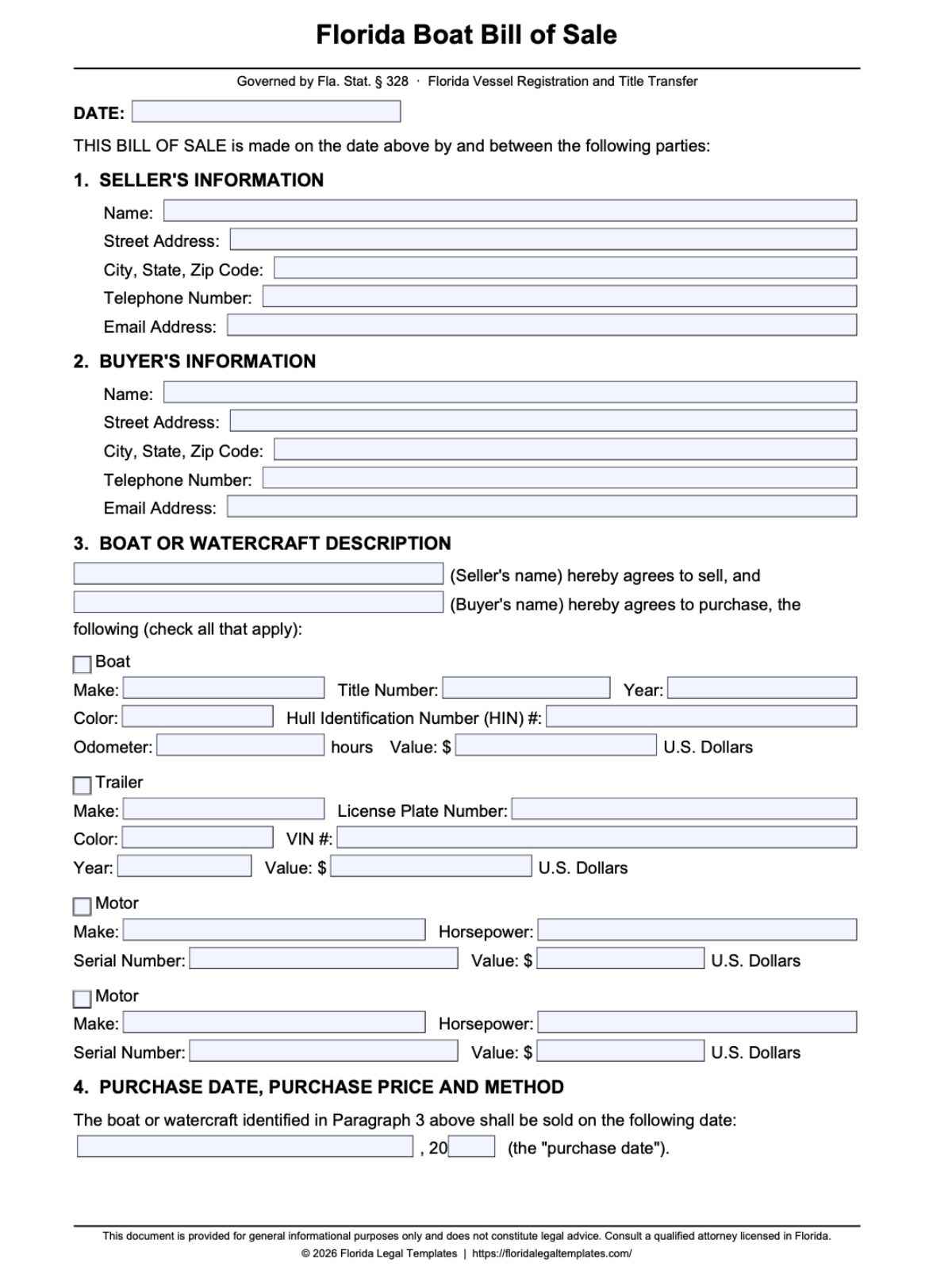
A Florida boat bill of sale pdf or fillable template provides a structured format that aligns with state requirements for vessel transfers.
What the document includes:
- Buyer and seller identification
- Vessel details:
- Hull Identification Number (HIN)
- Year, make, and length
- Type of propulsion
- Purchase price and payment terms
- Required statutory clauses, including the temporary authority notice
- Signatures of both parties
Who should use this:
- Private buyers and sellers of boats
- Individuals transferring vessel ownership
- Buyers preparing documentation for title and registration
When this template may NOT be sufficient:
- When a vessel already has a Florida title (title must be properly transferred)
- Homemade vessels without inspection and assigned HIN
- Transactions with missing or invalid ownership documentation
Even a complete boat bill of sale Florida will be rejected if it does not align with FLHSMV submission requirements.
Key Florida Laws That Affect Florida Boat Bill of Sale
Summary of Applicable Laws
| Topic / Issue | Florida Legal Rule | Governing Statute |
|---|---|---|
| Governing Law | Vessel titling and registration required | Chapter 328, Fla. Stat. |
| Execution & Proof | Signatures from both parties are mandatory; if the vessel is arriving from a non-titling state, the bill of sale must be formally notarized to serve as valid proof of ownership. | Fla. Stat. § 328.01 |
| Registration Timeline | The buyer must title and register the vessel within 30 days of purchase or face a mandatory $10.00 late fee penalty. | Fla. Stat. § 328.46(1) & § 328.03(4) |
| Identification Requirement | Valid government ID required | § 328.01(7) |
| Title Priority Rule | Bill of sale cannot replace title | § 328.01 & § 328.07 |
Practical Impact & Document Clauses
These laws directly control whether a Florida boat bill of sale will be accepted for registration and title transfer.
First, the document must include specific statutory language. The most critical requirement under Fla. Stat. § 328.46 is the temporary authority notice. The operator must keep the bill of sale on board, and it serves as a temporary certificate of number for exactly 30 days from the date of sale. Operating after day 30 without a permanent registration is a non-criminal infraction.
The document must also include:
- A statement declaring Florida as the state of principal use
- Complete vessel identification details (HIN, year, make, length, propulsion type)
Second, filing requirements are strict. The bill of sale must be submitted with an Application for Certificate of Title (Form HSMV 82040) to the County Tax Collector. Without this step, ownership is not officially transferred.
Third, both parties must meet identification requirements under Fla. Stat. § 328.01, meaning valid government-issued ID is required for processing.
Finally, the title-priority rule is critical. If a vessel has an existing Florida title, that title must be signed and transferred. A bill of sale alone will be rejected.
Failure to follow these requirements can result in:
- Rejected title applications
- Delayed registration
- Continued liability for the seller
- Exposure to fraud-related penalties
Florida’s filing rules become even more important when the vessel sale is financed privately or paid in installments. In those situations, parties sometimes also document repayment obligations separately using a written payment agreement to avoid disputes over unpaid balances after the title transfer is submitted.
When to Use Florida Boat Bill of Sale
A Florida vessel bill of sale should be used whenever a boat is sold or transferred between private parties.
Common use cases:
- Private sale of a boat or watercraft
- Transfer of ownership between individuals
- Supporting documentation for vessel registration
Practical scenarios:
- Cash transactions
- Purchasing vessels from out-of-state sellers
- Providing proof of ownership to tax collector offices
When NOT to use:
- As a substitute for a vessel title
- For vessels with incomplete or invalid ownership records
- Without required statutory clauses
Using the correct document at the right stage ensures a smooth transfer process.
Many private sellers handling multiple recreational vehicle transfers use similar ownership documentation across different asset types. For example, transactions involving campers or towable recreational units often require a Florida RV transfer document, while utility towing equipment sales generally rely on a trailer ownership sale form.
Boat Included? That Does Not Automatically Include the Trailer
One mistake I see regularly is buyers assuming the boat bill of sale also transfers the trailer sitting underneath it. In Florida, the boat and the trailer are separate pieces of property with separate ownership records. A vessel is titled and registered under Chapter 328, while most boat trailers are titled and registered through Florida’s motor vehicle system under Chapter 319 and Chapter 320, depending on the trailer’s weight and title status. Buying one does not legally transfer the other.
If the seller is including the trailer, make sure the paperwork clearly identifies it with its own vehicle identification number (VIN), year, make, and purchase price, or states that the trailer is included in the total sale price. If the trailer requires a Florida title, the seller must also properly assign that title to the buyer. Showing up with only a boat bill of sale is a common reason buyers leave the tax collector’s office with the vessel paperwork completed but the trailer still legally belonging to the previous owner. Handling both transfers at the same time avoids a second trip and prevents registration problems if you plan to tow the boat home immediately.
How to Create or Fill Out the Florida Boat Bill of Sale
Creating a compliant Florida boat bill of sale requires attention to statutory detail.
Step-by-step process:
- Identify the parties
- Full legal names
- Valid government-issued identification
- Describe the vessel
- Hull Identification Number (HIN)
- Year, make, and length
- Type of propulsion
- State purchase price
- Include amount and payment method
- Insert required statutory clauses
- Temporary authority notice (exact wording required)
- Statement of principal use (Florida)
- Add additional disclosures
- Vessel condition
- Any liens or encumbrances
- Sign the document
- Both buyer and seller must sign
- Submit for title transfer
- File with County Tax Collector using Form HSMV 82040
- File Notice of Sale (seller)
- Submit Form HSMV 82050 to limit liability
Practical tips:
- Double-check HIN accuracy—errors can delay registration
- Do not modify statutory language—use exact wording
- Keep copies for both parties
Accuracy in vessel identification details is critical because Florida title offices reject incomplete ownership records across nearly all motorized property transfers. Sellers familiar with highway vehicle transfers often recognize similar documentation standards from the motor vehicle sale paperwork process, especially regarding serial numbers, ownership disclosures, and transfer timelines.
Limitations and Legal Considerations
A Florida boat bill of sale is not a standalone ownership document.
Key limitations:
- Cannot replace a valid vessel title
- Must meet statutory requirements to be accepted
Legal constraints:
- Must comply with FLHSMV documentation rules
- Must include complete vessel identification
High-risk scenarios:
- Selling a vessel without proper title
- Using a bill of sale from a non-titling state without notarization or perjury clause
Edge cases:
- Antique vessels
- Homemade vessels requiring inspection and HIN assignment
- Out-of-state purchases
Florida law treats vessel ownership transfers as regulated transactions, not informal exchanges.
If ownership records contain errors, missing signatures, or incorrect vessel details, parties may need supplemental corrective documentation before the transfer can be processed. In some situations, a Florida correction affidavit may help clarify clerical mistakes submitted with title paperwork.
Common Mistakes to Avoid
Using a bill of sale instead of transferring title
A bill of sale does not override title requirements.
Consequence: Title application will be rejected.
Omitting the temporary authority clause
This is a statutory requirement.
Consequence: Buyer cannot legally operate the vessel during the initial 30-day period.
Missing vessel identification details
Incomplete HIN or specifications.
Consequence: Registration delays or rejection.
Not filing within the 30-day deadline
Both buyer and seller have statutory timelines.
Consequence: Continued liability. If the buyer abandons the boat and it becomes a “derelict vessel,” the seller of record (you) can be held liable for thousands of dollars in removal costs if a Notice of Sale (HSMV 82050) was not filed.
Using a non-compliant document
Missing required language or structure.
Consequence: Rejection by FLHSMV.
Attempting to sell a vessel with invalid ownership
Fraudulent or incomplete documentation.
Consequence: Potential third-degree felony under Florida law.
Frequently Asked Questions (FAQ)
Does a Florida boat bill of sale transfer ownership by itself?
No. Ownership transfers only when the title and registration are properly processed through the tax collector.
What is the 30-day rule for vessel registration in Florida?
The buyer must register and title the vessel within 30 days of purchase, and the seller should notify the state within the same timeframe.
Can I use a bill of sale if the boat has no title?
Only in limited situations. Additional requirements such as notarization or a perjury clause may apply, and acceptance depends on FLHSMV rules.
What happens if I don’t include the required statutory notice?
The document may be rejected, and the buyer may not have legal authority to operate the vessel during the initial period.
A properly structured Florida boat bill of sale ensures the transaction complies with state law and supports a valid ownership transfer. When combined with correct filing and title procedures, it protects both parties and prevents costly legal issues.