
When Is a Florida Bill of Sale Legally Binding? (Court Rules)
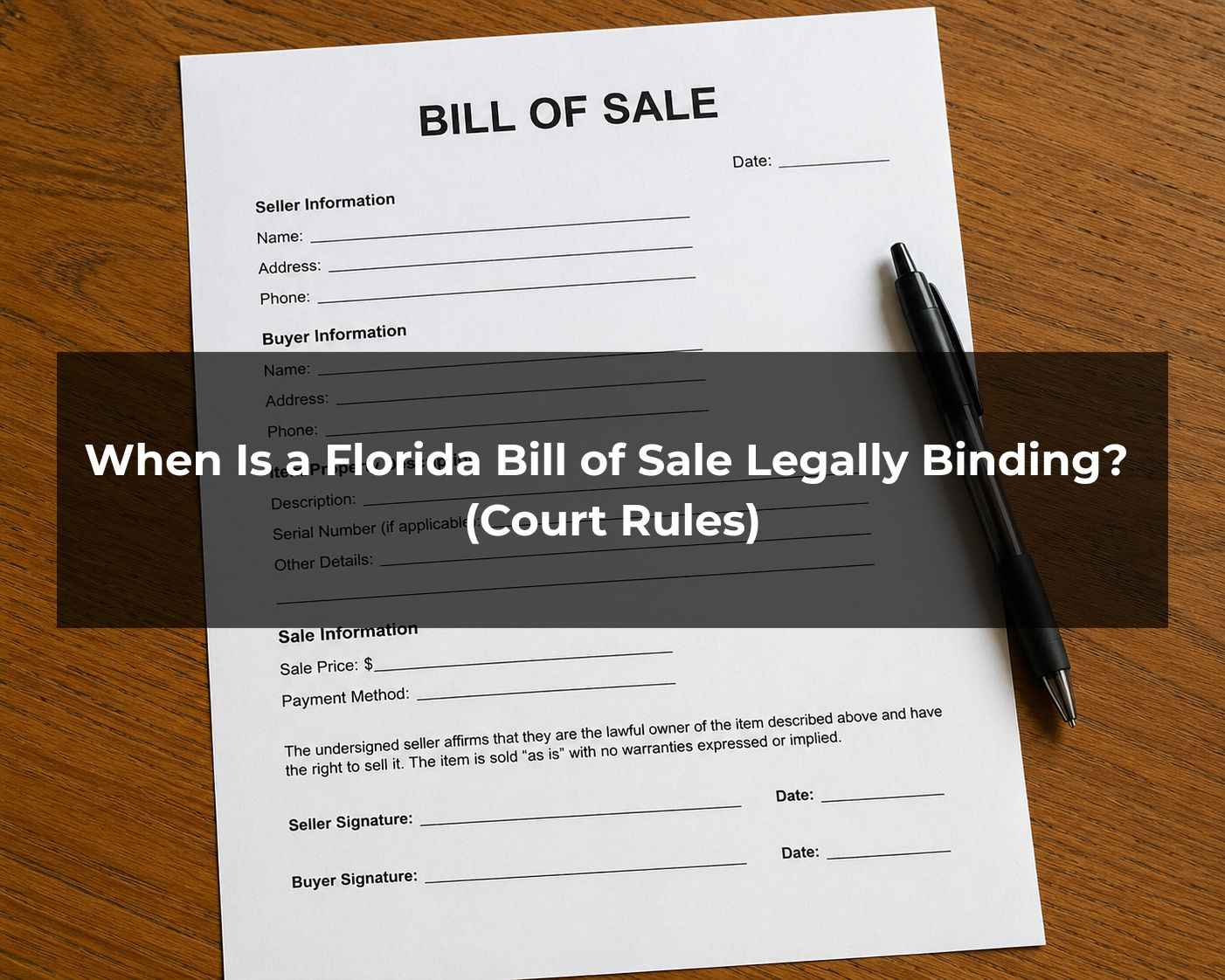
A bill of sale usually receives little attention until something goes wrong. The buyer discovers the title was never transferred, the seller receives toll notices months after handing over the keys, or both parties remember the deal differently. That is when the bill of sale matters most: it gives the parties a written record of what they agreed to, even though it does not replace Florida’s separate title requirements for titled property.
If you’re asking is a bill of sale legally binding in Florida, the answer is yes but only within its legal purpose. A properly drafted bill of sale can create an enforceable contract between the buyer and seller. What it cannot always do is prove legal ownership, particularly for property that Florida requires to be titled, such as motor vehicles and vessels.
The signed bill of sale is important, but it is not necessarily the end of the ownership question. In a Florida vehicle dispute, the court may also look at payment records, possession, the signed title, required disclosures, and what the parties actually did after the sale. Those details can matter when the paperwork and the parties’ version of events do not line up.
Understanding what courts evaluate and where a bill of sale falls short can help both buyers and sellers avoid disputes that are expensive to resolve after the transaction is complete.
Candice Hayden, Legal Writer
Carly Johansson, Florida Contract Attorney
Is a Bill of Sale Legally Binding in Florida? The Direct Answer
Yes, a bill of sale can be legally binding in Florida when it accurately records an enforceable agreement between the buyer and seller. Whether it can be enforced depends on the transaction, the parties’ agreement, and any legal requirements that apply to the property being sold.
That answer, however, only addresses the relationship between the buyer and seller.
Many people mistakenly assume that if a contract is legally binding, ownership has automatically transferred. Florida law treats those as two separate questions.
For General Personal Property
When selling ordinary personal property such as furniture, tools, equipment, electronics, or machinery—the bill of sale usually functions as the primary contract documenting the transaction. These sales fall under Florida’s Uniform Commercial Code governing the sale of goods.
If the document clearly identifies:
- the buyer and seller,
- the property being transferred,
- the agreed purchase price, and is signed when a signed writing is required by law or by the parties
it will generally serve as strong evidence that an enforceable agreement exists.
In most disputes involving untitled personal property, the court focuses less on the document’s appearance and more on whether it accurately reflects what the parties actually agreed to.
Vehicles and Vessels Are Different
This is where many private sales go wrong.
A person may purchase a vehicle, pay the full purchase price, receive the keys, and walk away with a signed bill of sale believing they are now the legal owner.
Not necessarily.
For motor vehicles, mobile homes, and vessels, Florida law separates the contract from the transfer of title.
The bill of sale documents the parties’ transaction and may also be evidence of the ownership interest transferred. Florida law requires the parties to complete the applicable title-transfer process, but failure to finish that paperwork does not necessarily mean ownership never transferred. In a dispute, the court may look at delivery, payment, possession, the signed title, the bill of sale, and the surrounding circumstances to determine what ownership interest was transferred.
That distinction rarely matters while everything goes smoothly.
It becomes extremely important when something doesn’t.
Imagine a vehicle is stolen before the title transfer is completed. Or suppose the seller attempts to sell the same vehicle again. The bill of sale helps establish that an agreement existed, but ownership will often depend on whether the statutory title procedures were completed correctly.
Why Florida Courts Separate Contract Rights from Ownership
When a bill of sale is challenged, judges are often answering two different questions.
First: Did these parties actually enter into a valid agreement?
Second: Did that agreement legally transfer ownership under Florida law?
For ordinary household goods, the answers are often identical.
For titled property, they frequently are not.
This explains why buyers sometimes succeed in proving they purchased a vehicle yet still encounter legal problems involving title, insurance, financing, or subsequent purchasers.
The bill of sale may establish contractual rights against the seller without resolving every ownership issue involving third parties.
What This Means in Practice
Consider two different sales completed on the same afternoon.
A homeowner sells a riding lawn mower to a neighbor using a handwritten bill of sale. Both parties sign it, exchange payment, and the buyer immediately takes possession.
Across town, another seller privately sells a pickup truck. The parties also sign a bill of sale, exchange payment, and the buyer drives away. Neither party completes the title paperwork.
Although both transactions appear identical, Florida law treats them very differently.
The lawn mower dispute will usually focus on whether the parties made a valid contract.
The truck dispute involves an additional question—whether ownership transferred through the statutory title process.
The difference matters because a bill of sale may provide strong evidence of a sale of ordinary personal property, while a Florida-titled vehicle also requires compliance with the applicable title rules.
Key takeaway: A bill of sale is generally binding between the buyer and seller, but for vehicles and other titled property, it should never be confused with the Certificate of Title.
What Makes a Bill of Sale Valid and What Makes It Invalid in Florida
People often assume Florida requires lengthy legal forms, witnesses, or notarization before a bill of sale becomes enforceable.
In reality, courts are usually far more interested in whether the document accurately records a genuine agreement than whether it looks formal.
A handwritten bill of sale on a single sheet of paper can carry significant legal weight. A professionally prepared document downloaded from the internet may carry very little if it contains inaccurate information or fails to reflect what actually happened.
The Essential Elements Courts Expect to See
While Florida law does not prescribe one mandatory format for every bill of sale, a strong document should clearly identify the parties, the property, the price, the sale date, and the terms the parties actually agreed to.
- Who sold the property?
- Who bought it?
- What exactly was transferred?
- How much was paid?
- When did the sale occur?
- Did both parties agree to these terms?
The more precisely those questions are answered, the less room exists for later disagreement.
One of the most common weaknesses in private bills of sale isn’t missing legal language—it’s vague drafting.
For example, describing the property simply as “used trailer” creates uncertainty if the seller owned multiple trailers. Including the manufacturer, model year, serial number, color, or other identifying information dramatically reduces the chance of future disputes.
Judges generally prefer documents that leave little to interpretation.
Does Florida Require a Bill of Sale to Be Notarized?
No general Florida rule requires an ordinary bill of sale to be notarized or witnessed merely to make the agreement enforceable, although particular vehicle or title transactions can impose additional documentation requirements.
That said, many people confuse legal validity with evidentiary strength.
Those are different concepts.
Notarization doesn’t transform an otherwise defective agreement into an enforceable one. A notary confirms the identity of the signer—not the truth of the information contained in the document.
If the purchase price is incorrect, the VIN contains errors, or the seller intentionally misrepresents the property’s condition, notarization does nothing to fix those problems.
Where notarization can help is in reducing later disputes over authenticity. If a seller later claims they never signed the document, a notarized acknowledgment makes that argument considerably harder to prove.
For that reason, HSMV 82050 uses a certification under penalties of perjury rather than requiring a general notarial acknowledgment on the form.
Is a Handwritten Bill of Sale Legal in Florida?
Yes. Another common misconception is that handwritten bills of sale are somehow less enforceable than typed documents.
Florida law makes no such distinction. A handwritten bill of sale can carry exactly the same legal effect as a professionally prepared document if it accurately identifies the parties, clearly describes the property, records the agreed terms, and bears authentic signatures.
In fact, courts are often less interested in how a document was created than in whether it reliably reflects the parties’ actual agreement.
A typed document containing incorrect information may receive less evidentiary weight than a handwritten agreement supported by payment records, text messages, or witness testimony.
What matters more is whether the document accurately identifies the transaction and is consistent with the other evidence, such as payment records and title documents.
Are Digital and Text-Message Bills of Sale Valid in Florida?
With the prevalence of peer-to-peer marketplaces, buyers and sellers frequently execute transactions via electronic signatures, PDF exchanges, or text message confirmations. Under Florida’s electronic-signature laws, including Fla. Stat. § 668.004 and the Uniform Electronic Transaction Act in § 668.50, electronic signatures and records can have legal effect when the applicable requirements are satisfied.
Electronic records and signatures can have legal effect in Florida when the applicable law permits electronic contracting and the parties have agreed to transact electronically. A text-message exchange may provide evidence of an agreement, but it should not automatically be treated as a substitute for the formal title-transfer documents required for a titled vehicle or vessel.
What Makes a Bill of Sale Invalid in Florida?
People frequently search for what makes a bill of sale invalid in Florida, expecting a simple checklist.
A missing or defective provision does not automatically make the entire transaction void.
Most challenged bills of sale are not declared automatically void. Instead, they become difficult—or sometimes impossible—to enforce because they fail to establish what actually happened.
Common problems include:
- Missing signatures.
- Vague or incorrect property descriptions.
- Contradictory purchase prices.
- False statements.
- Missing statutory disclosures where required.
- Failure to satisfy the Statute of Frauds for qualifying transactions.
Notice that most of these issues have one thing in common: they create uncertainty.
Courts resolve disputes by evaluating evidence. A bill of sale that introduces confusion instead of reducing it loses much of the value it was intended to provide.
Key takeaway: Florida courts rarely reject a bill of sale because it was handwritten or not notarized. They reject—or give less weight to—documents that fail to prove the parties’ actual agreement.
The Statute of Frauds Trap: When a Bill of Sale Must Be in Writing
Most people assume a bill of sale becomes important only after someone questions ownership. In reality, one of the biggest legal problems occurs much earlier—when the parties never create a written agreement in the first place.
Imagine agreeing to sell a $9,000 commercial lawn mower to a neighbor. The buyer pays a deposit, promises to return with the balance, and both of you shake hands. Weeks later, the buyer refuses to complete the purchase, claiming there was never a final agreement.
At that point, the dispute isn’t about who is telling the truth. It’s about whether the agreement is one a Florida court can enforce.
For sales of goods priced at $500 or more, Florida’s Statute of Frauds generally requires a sufficient signed record before the contract can be enforced, although §672.201 contains exceptions, including certain situations involving payment, acceptance, or an admission in court.
That rule isn’t designed to make legitimate transactions more difficult. Its purpose is to prevent expensive disputes based solely on conflicting memories.
Fla. Stat. § 672.201 and the $500 Threshold
The following statutory rules commonly determine whether a Florida bill of sale withstands legal scrutiny.
| Topic / Issue | Florida Legal Rule | Governing Statute |
|---|---|---|
| Statute of Frauds (Goods ≥ $500) | Contracts for the sale of goods priced at $500 or more generally require a signed writing to be enforceable. | Fla. Stat. § 672.201 |
| Notice of Sale (Vehicles) | Sellers who make a bona fide sale and deliver possession should notify the department within 30 days in the form prescribed by the department; that notice satisfies the statutory notice requirement used to limit the seller’s civil liability for the vehicle’s subsequent operation. | Fla. Stat. § 319.22(2) |
| Vessel title application | A vessel owner generally must deliver an application for a certificate of title within 30 days after the later of the transfer of ownership or the date Florida becomes the state of principal use. | Fla. Stat. § 328.03 |
| Age & Capacity | Adults generally have full contractual capacity at 18, while the enforceability of agreements involving minors can depend on Florida’s rules governing minors and contractual capacity. | Fla. Stat. § 743.07 |
The $500 threshold in §672.201 is one reason a written record matters. For a qualifying sale, the record can be what allows a party to enforce the agreement when the other side later disputes what was purchased, for how much, or on what terms.
The same principle applies to vehicle sales. A signed bill of sale may establish that a sale occurred, but failing to complete the additional statutory steps—such as filing the Notice of Sale—can leave the seller dealing with problems long after the buyer has driven away.
Practical Impact & Document Clauses
When judges review disputed contracts, they usually aren’t looking for sophisticated legal language. They’re looking for certainty.
A strong bill of sale should leave very few unanswered questions.
At a minimum, it should identify:
- the buyer and seller,
- the property being transferred,
- the agreed purchase price,
- the sale date,
- and the signatures of both parties.
Adding identifying information—such as a VIN, serial number, or hull identification number where applicable—can eliminate arguments about whether the document refers to the correct property.
One practical lesson appears repeatedly in litigation: people rarely regret including too much information in a bill of sale. They often regret leaving out details they assumed everyone would remember.
What Judges Actually Weigh When a Bill of Sale Is Disputed
A signed bill of sale is important evidence, but it is not necessarily the only evidence before the court. Payment records, title documents, communications, and witness testimony may also matter.
A signed bill of sale is evidence, not a shortcut around the rest of the transaction. If ownership is disputed, the court can compare the document with payment records, possession, title paperwork, communications, and the parties’ conduct.
The judge’s objective is straightforward:
Does this document accurately reflect what actually happened?
That question influences almost every dispute involving a challenged bill of sale.
A Bill of Sale Is Evidence Not the Entire Case
Suppose two parties appear in court over the sale of a fishing boat.
The buyer presents a signed bill of sale and insists ownership transferred on the day payment was made.
The seller responds that the buyer never paid the remaining balance and therefore ownership never fully transferred.
Neither side is necessarily proven correct simply because they possess—or dispute—the document.
The court may also examine:
- bank transfers,
- cancelled checks,
- text messages,
- emails,
- inspection reports,
- photographs,
- repair invoices,
- title documents,
- witness testimony,
- and even the parties’ conduct after the sale.
A signed bill of sale is important evidence, but its value depends on whether the payment records, title documents, communications, and other transaction records tell the same story.
What a Judge Typically Wants to See
When authenticity isn’t disputed, judges often focus on practical questions like these:
| Court’s Question | Why It Matters |
|---|---|
| Can the property be identified with certainty? | Prevents disputes over what was sold. |
| Does the purchase price match other evidence? | Confirms the document reflects the actual transaction. |
| Were both parties legally capable of contracting? | Determines whether the agreement is enforceable. |
| Are statutory requirements satisfied? | Certain transactions require additional disclosures or procedures. |
| Does other evidence support the document? | Increases confidence that the bill of sale is reliable. |
The document’s appearance is rarely the deciding issue. What matters more is whether the property, price, parties, signatures, and other transaction records consistently support what the bill of sale says.
Handwritten vs. Typed Bills of Sale
Many buyers worry that a handwritten bill of sale will automatically lose against a typed contract.
Florida law doesn’t support that assumption.
Imagine these two scenarios.
Document A is downloaded from the internet. It contains an incorrect VIN, lists the wrong purchase price, and omits information both parties verbally agreed upon.
Document B is handwritten on notebook paper. It correctly identifies the vehicle, accurately records the agreed price, includes both signatures, and matches every payment record.
If those two documents were introduced into evidence, most judges would likely find the handwritten document far more persuasive.
The practical lesson is simple: a correctly completed document that matches the transaction is more useful than a polished form containing incorrect or conflicting information.
The Biggest Mistake Buyers Make
One misunderstanding appears repeatedly in private vehicle sales.
The buyer believes:
“I have the bill of sale, so I own the vehicle.”
Legally, the answer is more complicated.
For titled property, the bill of sale proves the transaction occurred.
The Certificate of Title is important evidence of ownership, but it is not necessarily the only evidence a court may consider when determining who owns a vehicle.
Until both documents align, disputes can arise involving insurers, lenders, creditors, or subsequent purchasers.
That’s why experienced practitioners rarely treat the bill of sale as the final step in a vehicle transaction.
They treat it as the beginning of the ownership transfer process—not the end.
Key takeaway: When Florida courts evaluate a challenged bill of sale, they rarely ask whether the document exists. They ask whether the document is supported by the surrounding evidence.
Fraud, Misrepresentation, and Disclosure Failures That Can Undo a Sale
Not every challenged bill of sale involves an honest disagreement.
Sometimes the dispute centers on information that should have been disclosed before the buyer agreed to complete the purchase.
Those cases often become far more serious because they extend beyond contract law into allegations of fraud or statutory non-compliance.
Odometer Disclosures Are More Than Paperwork
A surprisingly common mistake in private vehicle sales is treating the odometer disclosure as another blank to fill in.
Florida law views it differently.
Mileage directly affects market value.
A buyer paying market price for a vehicle with 42,000 actual miles is purchasing something very different from one that has traveled 142,000 miles.
That’s why many used-vehicle title transfers require a written mileage disclosure acknowledged by both parties, subject to the exemptions in Fla. Stat. §319.225.
Knowingly providing false mileage information isn’t simply poor drafting—it can expose the seller to criminal liability.
More importantly from a litigation perspective, inaccurate mileage immediately damages the seller’s credibility.
If one required disclosure proves false, courts often scrutinize every other representation made during the transaction.
Salvage History Is Not Something a Seller Can Ignore
A rebuilt or flood vehicle is subject to specific Florida title and disclosure rules. Before the sale of a vehicle covered by Fla. Stat. §319.14, the seller must make the required written disclosure to the purchaser.
Trying to hide a branded title often creates a much bigger problem than the vehicle’s condition itself.
A buyer who later discovers the undisclosed history may argue they paid a price they never would have agreed to had the information been disclosed.
That transforms an ordinary ownership dispute into a dispute about misrepresentation.
In many cases, disclosure failures become more significant than minor drafting errors elsewhere in the bill of sale.
Why “AS IS” Doesn’t End Every Lawsuit
Few phrases are misunderstood more than “AS IS.”
Some private sellers believe those two words eliminate every future claim.
They don’t.
An effective “AS IS” clause may help disclaim certain implied warranties for general goods, but it does not excuse fraud.
If a seller knowingly conceals important information, falsifies required disclosures, or intentionally misrepresents the property, adding “AS IS” to the document is unlikely to prevent the dispute from reaching court.
Think of the clause this way:
It shifts the risk of unknown defects to the buyer.
It does not turn an otherwise actionable misrepresentation or other unlawful conduct into permissible conduct.
That distinction explains why some “AS IS” sales are quickly upheld while others become lengthy and expensive lawsuits.
How to Draft a Bill of Sale That Holds Up If Challenged
Most bill of sale disputes don’t happen because someone forgot to sign the document. They happen because the document leaves too many questions unanswered.
Think about it from a judge’s perspective. Years after the sale, neither party may remember every conversation they had. The bill of sale becomes the closest thing to a snapshot of the transaction. The more complete that snapshot is, the less room there is for conflicting interpretations.
A good bill of sale doesn’t try to impress with legal jargon. It simply records the transaction so clearly that someone with no prior knowledge can understand exactly what changed hands.
1. Clearly Identify the Parties
Start with the basics.
Include each party’s full legal name and current address. Avoid initials, nicknames, or abbreviated names that could create confusion later.
This seems like a small detail until two people with similar names become involved in a dispute. Courts prefer documents that remove uncertainty rather than create it.
2. Describe the Property So It Cannot Be Confused
One of the fastest ways to weaken a bill of sale is using a vague description.
Compare these two examples.
Poor description
Used trailer
Strong description
2022 Big Tex 70PI utility trailer, black, VIN 16V1D2025N1234567.
The second description leaves almost no doubt about what was sold.
Whenever possible, include:
- Make and model
- Year
- VIN or serial number
- Hull Identification Number (for vessels)
- Color
- Any unique identifying characteristics
The goal is simple: if someone reads the document five years later, they should know exactly which property changed hands.
3. Record the Financial Terms
Many disputes have nothing to do with ownership. They’re about money.
Did the buyer pay everything?
Was part of the purchase price still outstanding?
Was there a trade-in?
Did the parties agree to installments?
Those answers belong in the bill of sale—not in text messages or someone’s memory.
A well-drafted document should include:
- Purchase price
- Date of payment
- Payment method
- Any balance still owed
- Any special payment arrangements
When those details are missing, courts often have to reconstruct the agreement using outside evidence.
4. Include Required Vehicle Disclosures
Vehicle transactions deserve extra attention because Florida law imposes additional disclosure obligations.
Where applicable, the bill of sale should include:
- The required odometer disclosure.
- Any required rebuilt, salvage, flood-damaged, police vehicle, or taxicab disclosures.
These aren’t optional drafting improvements.
They’re statutory requirements designed to protect buyers from purchasing a vehicle without understanding its history.
Ignoring them doesn’t simply create incomplete paperwork—it increases the likelihood that the buyer will later challenge the transaction.
5. Use “AS IS” Carefully
An “AS IS” clause is often appropriate for private sales of used property.
But it should never become a substitute for honesty.
The purpose of the clause is to tell the buyer they are accepting the property’s present condition rather than relying on implied warranties.
It is not permission to:
- hide known defects,
- falsify mileage,
- conceal a branded title,
- or make misleading statements about the property.
Courts routinely distinguish between accepting ordinary wear and tear and being misled into purchasing something fundamentally different from what was represented.
6. Finish the Transaction—Don’t Stop at the Bill of Sale
One mistake appears repeatedly in private vehicle sales.
The parties sign the paperwork…
…exchange payment…
…hand over the keys…
…and assume they’re finished.
For titled property, they’re usually not.
The buyer should promptly complete the title transfer, while the seller should submit the required Notice of Sale within the applicable timeframe. Those final administrative steps often determine whether future parking tickets, toll violations, or ownership questions continue following the seller after the vehicle has left their possession.
Practical tip: Think of the bill of sale as the foundation of the transaction—not the final step. For vehicles and vessels, the paperwork surrounding the bill of sale is just as important as the document itself.
Common Mistakes That Lead to a Bill of Sale Being Challenged in Court
Most bill-of-sale problems are easier to prevent than to fix. In Florida vehicle transactions, the biggest risks usually involve inaccurate identifying information, missing required disclosures, or stopping after the bill of sale without completing the applicable title paperwork.
| Mistake | Why It Creates Problems |
|---|---|
| Vague property description | Makes it difficult to identify what was actually sold. |
| Incorrect VIN or serial number | Creates uncertainty about whether the document matches the property. |
| Missing purchase price or payment terms | Leads to disputes over the parties’ actual agreement. |
| Missing required vehicle disclosures | Can expose the seller to statutory consequences and increase fraud allegations. |
| Assuming notarization solves everything | Notarization confirms identity—not the accuracy of the document. |
| Failing to complete title transfer | Creates ownership disputes despite a valid bill of sale. |
| Seller never files the Notice of Sale | Can leave the seller connected to the vehicle after the transaction. |
Notice that very few of these mistakes involve complicated legal drafting.
Most arise because the parties rushed through what seemed like a straightforward private sale.
Taking an extra ten minutes to verify the details often prevents months—or even years—of future problems.
Frequently Asked Questions
Can a bill of sale be thrown out because it wasn’t notarized?
Generally, no. Florida law does not ordinarily require notarization for a bill of sale to be legally binding between the parties. A court is more concerned with whether the document accurately reflects the agreement than whether a notary acknowledged the signatures.
What happens if the buyer and seller disagree about the purchase price?
The court will consider the bill of sale alongside other evidence, including payment records, bank transfers, receipts, emails, and text messages. If the written price conflicts with the surrounding evidence, the court evaluates the entire transaction rather than relying on a single document.
Can a handwritten bill of sale be as strong as a typed one?
Yes. Florida law does not favor typed documents over handwritten ones. A handwritten bill of sale that accurately identifies the parties, property, and terms may carry the same legal weight as a professionally prepared form.
If the seller never files the Notice of Sale, can they still have problems later?
Potentially, yes. Failing to file the Notice of Sale can leave the seller without the statutory notice protection provided by §319.22 and can create continuing administrative or liability problems after the sale. That can result in toll notices, parking citations, or other issues being directed to the former owner even after the sale has taken place.
Legal Disclaimer: This article provides general information about Florida bill of sale laws and is not legal advice. Laws and individual circumstances vary. For advice about your specific situation, consult a qualified Florida attorney.