
Florida Non-Compete Agreement (Free PDF Template)
A Florida non-compete agreement sits in a very different legal environment than most other states. Florida law is comparatively employer-friendly, but only when the agreement is drafted correctly and tied to a legally recognized business interest. Employers often assume a broad restriction is automatically enforceable because Florida permits restrictive covenants under state law. In practice, most litigation turns on drafting mistakes, vague business-interest language, overbroad activity restrictions, or failure to comply with Florida’s statutory framework under Chapter 542.
For employees reviewing a noncompete agreement florida document, the risk is equally real. Florida courts can issue injunctions quickly, and under Fla. Stat. § 542.335, employers receive significant procedural advantages during enforcement proceedings. At the same time, the newer Florida CHOICE Act created a separate enforcement track for certain high-earning employees, allowing restrictions lasting up to four years if strict disclosure requirements are satisfied. Understanding which framework applies — standard restrictive covenant florida law or the CHOICE Act structure — matters before anyone signs the agreement.
Candice Hayden, Legal Writer
Carly Johansson, Florida Contract Attorney
Florida Non-Compete Agreement Template
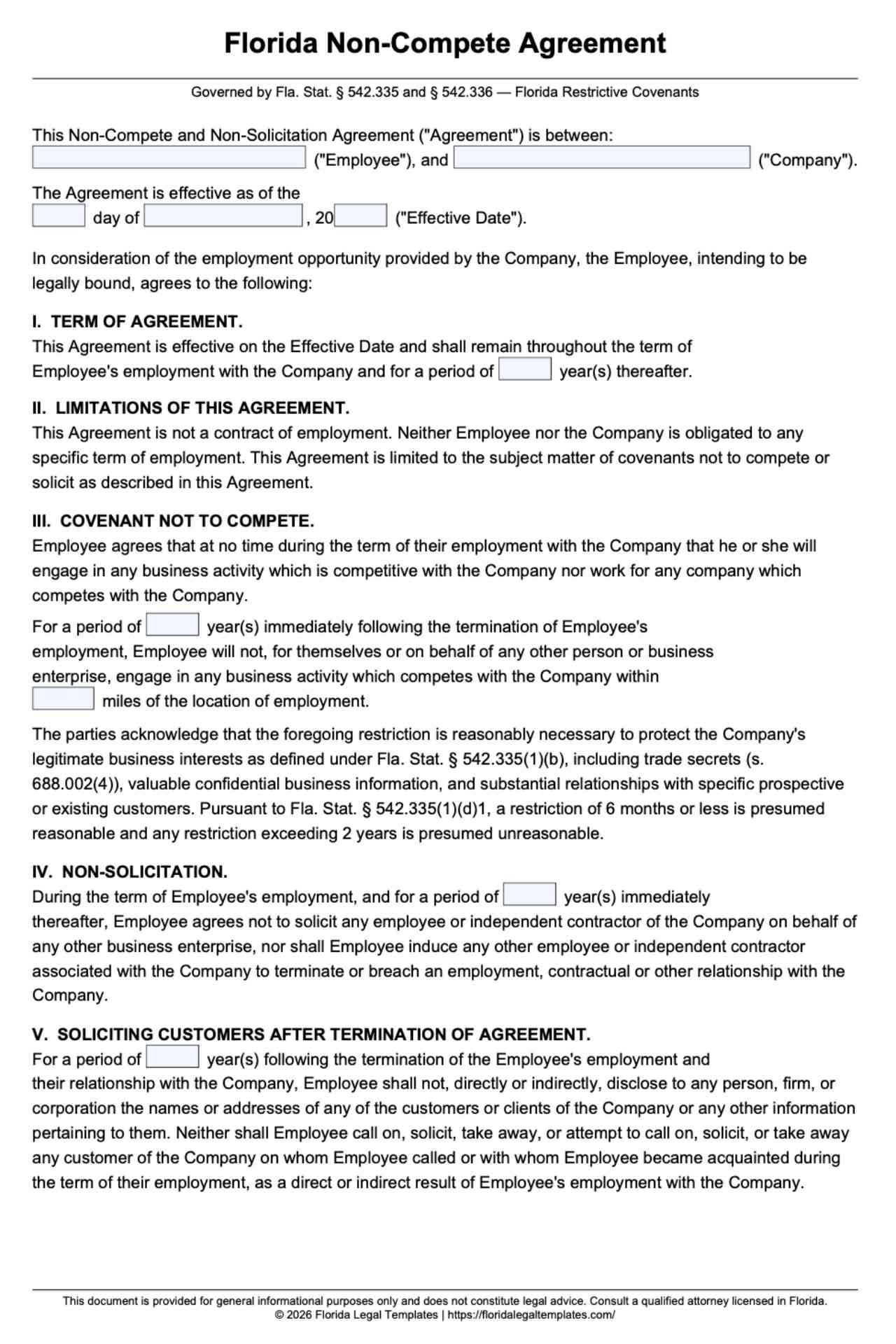
A properly drafted florida non compete agreement template should include far more than a simple promise not to work for a competitor. Florida courts evaluate the actual structure of the agreement and whether each restriction connects to a protectable business interest recognized under state law.
A strong template typically includes:
- Parties identification block
- Legitimate business interest declaration clause
- Geographic restriction language
- Duration and temporal restriction terms
- Activity restriction clause
- Confidentiality and trade secret references
- Governing law and venue clause
- Signature block
- CHOICE Act disclosure section where applicable
In most hiring scenarios, a standalone non-compete is executed alongside the initial hiring documentation — though Florida courts treat a non-compete as a distinct enforceable instrument even when it appears as a standalone document separate from the primary employment terms.
This type of agreement is commonly used by:
- Employers hiring workers with access to confidential information
- Businesses protecting customer relationships
- Healthcare practices protecting patient goodwill
- SaaS and technology companies protecting proprietary systems
- Buyers acquiring a business and restricting the seller post-sale
- Employers using the CHOICE Act framework for high-earning personnel
A generic national template often fails in Florida because Florida law requires the agreement to identify a legitimate business interest with specificity. Many out-of-state forms never address this requirement directly.
There are also situations where a template may not be legally sufficient at all:
- The employee is a Florida-licensed attorney
- No identifiable legitimate business interest exists
- The employer cannot satisfy CHOICE Act disclosure requirements
- The restriction is designed merely to suppress ordinary competition
What Is a Non-Compete Agreement Under Florida Law?
Under Florida law, a non compete florida agreement is a restrictive covenant governed primarily by Chapter 542 of the Florida Statutes. Florida technically begins from a general prohibition against restraints of trade, but Fla. Stat. § 542.335 creates a statutory exception allowing certain restrictive covenants when specific conditions are satisfied.
That distinction matters operationally. A Florida non-compete is not presumed valid simply because both parties signed it. The employer must still prove the agreement protects a recognized business interest and remains reasonable in scope.
Florida law separates restrictive covenants into two major tracks:
- Standard employee covenants under § 542.335
- CHOICE Act agreements under Fla. Stat. §§ 542.41–542.45 for qualifying high earners
Non-competes also differ from related agreements:
- Non-solicitation agreements restrict solicitation of customers or employees
- Confidentiality agreements protect information
MostFlorida employers use multipleagreements together rather thanrelying on one document alone. Aconfidentiality agreement handles informationprotection, while the non-competehandles competitive activity — both aretypically executed at the sametime.
- Non-competes restrict competitive activity itself
Non-competes applied to contractors carry additional legal complexity around worker classification issues in contractor relationships — misclassification can undermine the enforceability of any attached restrictive covenant regardless of how carefully the non-compete itself is drafted.
Most Florida employers use multiple agreements together rather than relying on one document alone.
Florida’s Statutory Requirements — What the Law Actually Demands
The Non-Negotiate Rules at a Glance
| Topic / Issue | Florida Legal Rule | Governing Statute |
|---|---|---|
| Writing Requirement | Must be in clear writing and signed by the bound party | Fla. Stat. § 542.335(1)(a) |
| Standard Duration (Presumed Reasonable) | 6 months or less | Fla. Stat. § 542.335(1)(d)1 |
| Standard Duration (Presumed Unreasonable) | More than 2 years | Fla. Stat. § 542.335(1)(d)1 |
| CHOICE Act Duration Exception | Up to 4 years for qualifying high earners | Fla. Stat. § 542.43 & § 542.45 |
| Irreparable Harm Presumption | Violation creates presumption of irreparable harm | Fla. Stat. § 542.335(1)(j) |
| Notarization / Witnesses | Not legally required | General contract law |
The writing requirement is absolute. An oral promise not to compete has no legal effect under Florida law. Courts routinely scrutinize whether the agreement was actually signed by the employee against whom enforcement is sought.
The six-month and two-year thresholds are not automatic validity limits. They operate as presumptions. Restrictions under six months receive favorable treatment for employers, while restrictions exceeding two years shift the burden heavily onto the employer to justify the duration.
The irreparable harm presumption is one of the most powerful enforcement tools available to employers. During injunction proceedings, the employer does not initially need to prove actual business damage once a valid covenant violation is shown under Fla. Stat. § 542.335.
What These Rules Mean in Practice
In real disputes, duration alone rarely decides the case. Courts usually focus first on whether the employer can identify a legitimate business interest and whether the restriction actually matches the employee’s role.
A two-year nationwide restriction for a regional sales employee may face significant scrutiny even though Florida law allows courts to modify overbroad provisions instead of voiding the agreement outright.
CHOICE Act agreements create additional compliance risk because the enhanced protections disappear if mandatory disclosures are missing from the contract itself.
The “Legitimate Business Interest” Requirement — Florida’s Core Enforceability Test
The single most important concept in restrictive covenant florida litigation is the legitimate business interest requirement.
Florida law does not allow employers to restrict ordinary market competition simply because an employee leaves for a competitor. The agreement must protect a specific statutory interest identified in the contract itself.
Under Fla. Stat. § 542.335(1)(b), courts evaluate whether the employer is protecting an actual business interest rather than attempting to suppress competition generally.
The Five Recognized Legitimate Business Interests
Trade Secrets
Florida references trade secrets as defined under Fla. Stat. § 688.002(4). Merely labeling information “confidential” is not enough. Employers must show the information genuinely derives value from secrecy.
Valuable Confidential Business Information
This category often includes:
- Internal pricing structures
- Proprietary methodologies
- Non-public business strategies
- Specialized operational systems
The information may still qualify even if it does not rise to the level of a statutory trade secret.
Substantial Customer Relationships
Florida courts look for identifiable relationships, not general exposure to customers. A salesperson with direct client management authority creates a stronger case than an employee with minimal customer interaction.
Customer Goodwill
This frequently appears in healthcare, professional services, and relationship-based businesses where the employee effectively becomes the face of the company to clients or patients.
Extraordinary or Specialized Training
Routine onboarding usually does not qualify. Employers must demonstrate unusual investment in training that creates a competitive advantage transferable to competitors.
Drafting Implication — What Must Appear in Your Agreement
The agreement should specifically identify which business interests are being protected and how the employee’s role connects to those interests.
Generic language such as “to protect company business” creates substantial enforcement risk. Courts do not rewrite missing legitimate-interest language for employers.
If the employer cannot identify a protectable interest during drafting, enforcement problems typically surface later during injunction proceedings.
The Florida CHOICE Act — The 2026 High-Earner Non-Compete Track
The Florida CHOICE Act created a separate enforcement framework for certain highly compensated employees.
Employees earning more than twice the annual mean wage in their county may fall under this enhanced framework, which permits restrictions lasting up to four years under Fla. Stat. §§ 542.43–542.45.
The CHOICE Act also authorizes “garden leave” arrangements where employees remain compensated during restricted periods.
CHOICE Act Mandatory Disclosure Checklist (Fla. Stat. § 542.43)
To qualify for the CHOICE Act’s 4-year enforcement framework under Fla. Stat. § 542.43, the agreement must strictly satisfy all four mandatory statutory prerequisites prior to execution:
-
Salary Threshold Verification: Confirm the worker earns a base salary exceeding twice the annual mean wage of the applicable Florida county.
-
Right-to-Counsel Advisory: Deliver written notice advising the worker of their right to consult an attorney at least 7 calendar days before the offer or agreement window expires.
-
7-Day Review Period: Provide the complete proposed non-compete or garden leave agreement to the worker at least 7 days prior to execution.
-
Signed Acknowledgment: Obtain an explicit, signed written acknowledgment from the worker confirming receipt of, or access to, the employer’s confidential business information or substantial customer relationships.
Missing one disclosure can destroy the enhanced protections entirely.
CHOICE Act vs. Standard § 542.335 — When Each Track Applies
| Feature | Standard Track (§ 542.335) | CHOICE Act Track (§§ 542.41–542.45) |
|---|---|---|
| Employee Eligibility | All employees | High-earning qualifying employees |
| Typical Duration Framework | 6 months favored; over 2 years presumed unreasonable | Up to 4 years permitted |
| Mandatory Disclosures | No special disclosure checklist | Mandatory statutory disclosures required |
| Garden Leave | Not specifically structured | Specifically contemplated |
Geographic Scope, Activity Restrictions, and What “Reasonable” Actually Means in Florida Courts
Florida courts frequently modify overbroad agreements instead of invalidating them entirely. That process is commonly called “blue-penciling.”
Still, employers should not rely on courts to repair poor drafting. A narrowed injunction may fail to protect the relationships or territories the employer actually intended to safeguard.
Standard track contracts must strictly limit geographic reach to an employer’s actual market footprint. Conversely, high-earner covenants executing under the CHOICE Act (Fla. Stat. § 542.43) are explicitly exempt from geographic reasonableness limits and are strictly enforced as written.
Activity restrictions create some of the most heavily litigated disputes. Courts examine whether the restriction actually matches the employee’s role.
A software sales representative restricted from all “technology employment” may face an overbreadth challenge because the restriction exceeds the employee’s actual function.
Florida also rejects the normal rule interpreting ambiguities against the drafter. Under Fla. Stat. § 542.335(1)(h), courts construe restrictive covenants broadly in favor of protecting legitimate business interests.
Three Situations Where a Florida Non-Compete Is Legally Unenforceable
1. No Legitimate Business Interest Can Be Proven
Even a signed agreement fails if the employer cannot establish a recognized business interest under Fla. Stat. § 542.335(1)(b).
General experience, industry knowledge, and ordinary skill are not protectable interests.
2. The Employee Is a Florida-Licensed Attorney
Under Florida Bar Rule 4-5.6, non-competes restricting attorneys from practicing law are void as a matter of public policy.
The prohibition applies regardless of compensation level or CHOICE Act eligibility.
3. The Agreement Is Oral, Unsigned, or Ambiguously Signed
Under Fla. Stat. § 542.335(1)(a), the agreement must be in writing and signed by the employee against whom enforcement is sought.
Handshake agreements, email discussions, and unsigned offer letters are major enforcement failures in litigation.
What Happens When a Florida Non-Compete Is Violated
A Florida non-compete agreement is not filed with Sunbiz, county clerks, or any state agency. It remains a private contract unless litigation begins.
Most enforcement cases follow this sequence:
- Employer identifies suspected breach
- Employer files a lawsuit in Florida Circuit Court
- Agreement is attached as an exhibit
- Employer requests temporary injunction
- Court evaluates enforceability and scope
The injunction phase is the decisive hurdle. Standard track actions deploy a basic rebuttable presumption of harm, but CHOICE Act claims under Fla. Stat. § 542.43 compel judges to issue automatic injunctions unless the worker clears a steep ‘clear and convincing’ evidentiary hurdle.
Florida law also prevents judges from considering employee hardship during enforcement analysis under Fla. Stat. § 542.335(1)(g)1. Loss of income or difficulty finding work generally does not defeat enforcement.
Industry-Specific Enforcement Realities in Florida
Healthcare and Medical Practices
Patient goodwill is commonly recognized as a legitimate business interest. Florida generally permits physician non-competes, unlike states such as California.
Technology and SaaS Companies
Trade secrets and confidential systems dominate most disputes. Courts distinguish between proprietary systems and general programming knowledge.
Sales and Business Development Roles
Customer goodwill and direct client relationships drive most enforcement disputes. Courts evaluate whether the employee genuinely managed customer relationships or merely had incidental exposure.
Businesses engaging senior advisors in business development roles often need to address post-engagement restrictions for senior advisors separately from any employment-style non-compete — the scope of permissible restrictions differs depending on how the relationship is structured at the outset.
Post-Sale Business Restrictions
Florida courts often enforce broader restrictions when tied to the sale of a business. Sellers usually receive less judicial protection than ordinary employees.
In partnership contexts, non-compete obligations arising from a partner exit are often governed by partner exits where restrictions are built into the governing business document — and Florida courts analyze those provisions under a different standard than standard post-employment covenants.
Common Drafting Mistakes That Make Florida Non-Competes Unenforceable
1st Mistake: No legitimate business interest language
Consequence: Agreement may fail entirely during enforcement.
2nd Mistake: Restriction exceeds two years without justification
Consequence: Employer faces presumption of unreasonableness.
3rd Mistake: Geographic scope exceeds actual operations
Consequence: Court may narrow the restriction substantially.
4th Mistake: Activity restriction is broader than employee’s role
Consequence: Increased litigation risk and judicial modification.
5th Mistake: CHOICE Act disclosures omitted
Consequence: Enhanced four-year protections may be voided.
6th Mistake: Reliance on unsigned agreements or email references
Consequence: Unenforceable under Fla. Stat. § 542.335(1)(a).
7th Mistake: Using generic national templates
Consequence: Florida-specific statutory requirements are often missing.
This problem extends beyond non-competes — broader commercial relationships requiring Florida-specific drafting face the same enforceability risk when parties rely on out-of-state or generic forms that fail to account for Florida’s statutory framework.
Frequently Asked Questions About Florida Non-Compete Agreements
Q1: My employer’s non-compete says I can’t work anywhere in the United States for 3 years. Can they actually enforce that in Florida?
Possibly, but the employer faces a significant burden. Restrictions exceeding two years are presumed unreasonable under Fla. Stat. § 542.335(1)(d)1, and nationwide restrictions require substantial justification tied to legitimate business interests.
Florida courts may narrow the restriction rather than invalidate it entirely.
Q2: I signed a non-compete, but my employer never gave me anything in return for signing it. Is it still binding?
At initial hiring, employment itself may constitute consideration under Florida law. Mid-employment non-competes create greater enforceability risk if no additional benefit or compensation was provided.
Employers frequently encounter litigation problems when adding non-competes after employment has already begun.
Q3: My new job is in a different state. Can my Florida employer still sue me?
Yes. Florida courts may still issue injunctions if the agreement contains Florida governing-law and jurisdiction provisions.
The employer must still prove an actual breach within the agreement’s geographic and activity restrictions.
Q4: Can a Florida employer fire me for refusing to sign a non-compete agreement?
Generally yes, because Florida follows at-will employment principles. CHOICE Act agreements, however, require a seven-day review period for qualifying employees before execution.
Q5: If my company was acquired, does the buyer inherit the non-compete agreement?
Often yes, particularly where the agreement contains assignment or successor language. Courts still evaluate whether the legitimate business interest continues under the new ownership structure.
Hidden Assignment Trap: Asset Sales Can Break Enforcement Rights
Many employers assume a non-compete automatically transfers when the business changes hands. That is not always true. Florida law specifically addresses enforcement by a successor, but the agreement itself matters. Under Fla. Stat. § 542.335(1)(f), a restrictive covenant may be enforced by a successor or assignee only if the contract expressly authorizes enforcement by a party’s assignee or successor. If that language is missing, an employer that acquires the business through an asset purchase may find it much harder to enforce existing employee non-competes.
This issue often appears months after closing, when a key employee resigns and joins a competitor. The buyer assumes it inherited every employment restriction, only to discover the agreement names only the original employer and contains no successor or assignment clause. Fixing the problem after the acquisition may require negotiating new restrictive covenant agreements with affected employees rather than relying on the old ones.
For employers buying a Florida business, reviewing every existing non-compete for successor-enforcement language should be part of due diligence, not an afterthought. It is a small drafting point that can determine whether the restrictive covenant survives the transaction or effectively stays behind with the seller.