
Florida Freelance Contract Template (Free PDF & Laws)
A Florida freelance contract is the written agreement that defines exactly what a freelancer is being hired to do, how they get paid, who owns the finished work, and what happens if the project falls apart halfway through. For designers, developers, writers, consultants, photographers, marketers, and other independent contractors, this document is usually the only thing standing between a smooth project and a payment or ownership dispute.
The problem is that many Florida freelancers rely on short emails, DMs, or recycled templates that never address the issues that actually trigger disputes: scope creep, revision abuse, intellectual property ownership, cancellation fees, or contractor misclassification. Under Florida law, the wording inside the agreement matters far more than most freelancers realize — especially when restrictive covenants, long-term projects, or creative deliverables are involved.
Candice Hayden, Legal Writer
Carly Johansson, Florida Contract Attorney
Fillable Florida Freelance Contract Template
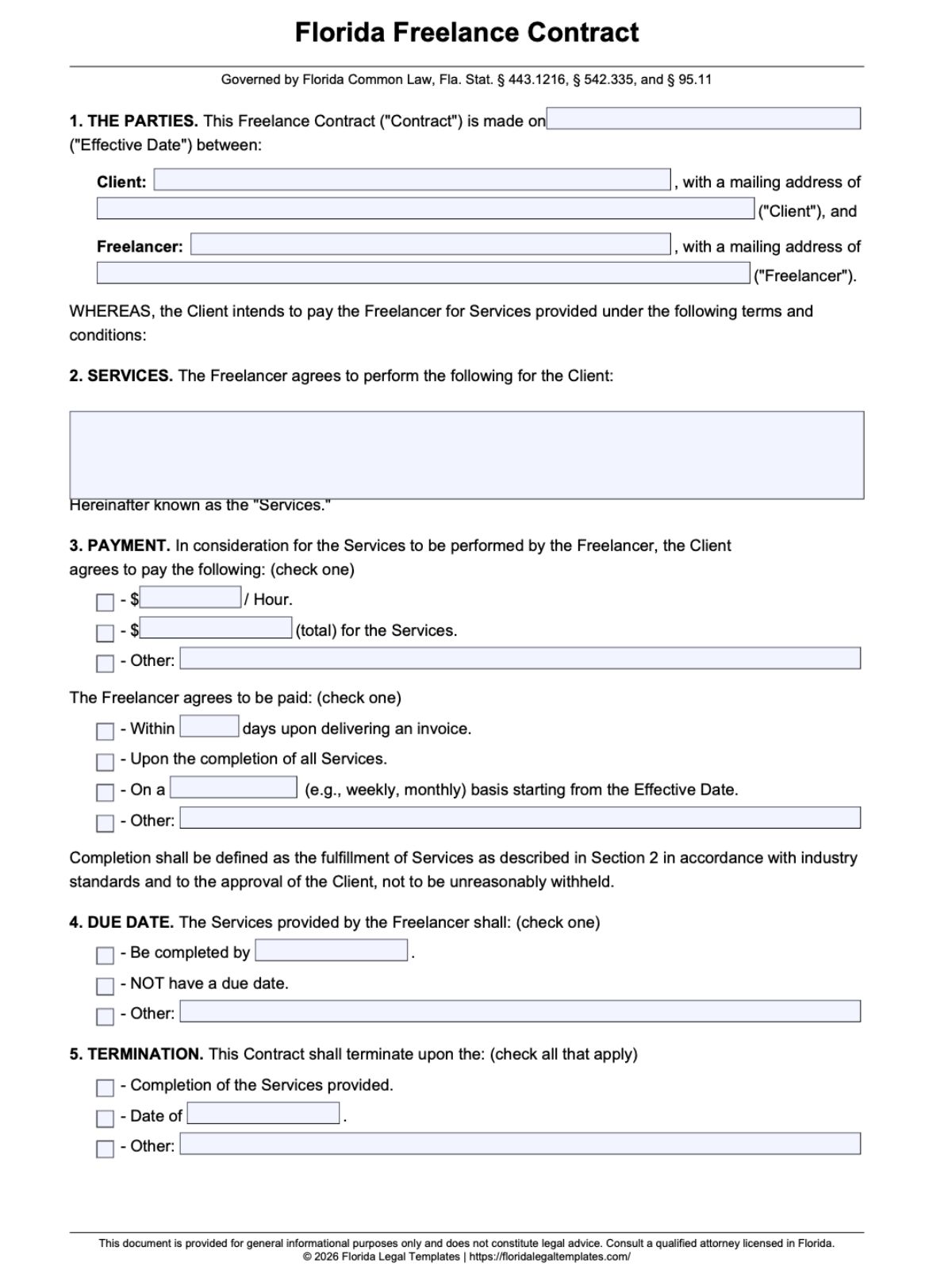
A properly drafted florida freelance contract template should include far more than a basic payment promise. The operational clauses are what determine whether the agreement actually protects either party when a project becomes contentious.
A strong template typically includes:
- Project scope and deliverables section
- Payment schedule and milestone structure
- Intellectual property and “work made for hire” clause
- Revision limits and scope creep protections
- Termination, kill fee, and cancellation terms
- Florida governing law and dispute resolution clause
- Optional confidentiality, non-disclosure, and non-compete provisions
This type of freelance agreement florida businesses use is commonly built for:
- Freelance designers
- Writers and copywriters
- Software developers
- Marketing consultants
Marketing and strategy professionals operating under defined project scopes may also benefit from reviewing a Florida Consulting Agreement, which covers similar ground but is structured around advisory and consulting engagements specifically.
- Videographers and photographers
- Creative agencies using subcontractors
- Florida businesses hiring independent contractors
- Out-of-state clients hiring Florida-based freelancers
A standard template is not always enough. Certain projects require customized drafting, especially when:
- The project involves substantial copyright or licensing structures
- The contract contains non-compete restrictions
- The freelancer works in Florida construction trades
- The engagement extends beyond one year and triggers written contract requirements under Florida law
What a Florida Freelance Contract Actually Does (And Doesn’t Do)
A florida freelance contract is a project-based agreement between an independent contractor and a client for defined work output. It is built around deliverables, deadlines, payment terms, and ownership rights.
That differs from several related documents people often confuse with it.
An Independent Contractor Agreement focuses more heavily on worker classification and the ongoing relationship between the parties. A freelance services agreement florida businesses use is usually narrower and tied to a specific project cycle.
A Service Agreement is broader and often governs recurring business services over time.
A Statement of Work (SOW) is usually just a project attachment. By itself, it may not contain the legal terms needed to operate as a standalone enforceable contract.
Florida also does not have a dedicated freelancer protection statute similar to New York’s Freelance Isn’t Free Act. That means freelancers in Florida depend heavily on general contract law and the quality of their written agreement.
In practice, the contract establishes four core things:
- The scope of the work
- The payment trigger
- Ownership of the deliverables
- Exit rights if the project breaks down
Without clear drafting, each of those areas becomes a litigation problem later.
Florida Laws That Govern Freelance Agreements
Florida Statutory Compliance Matrix
| Topic / Issue | Florida Legal Rule | Governing Statute |
|---|---|---|
| Writing Requirement | Under Fla. Stat. § 725.01, the one-year Statute of Frauds clock runs from the exact day a contract is made, not when work begins. If a project cannot be completed within one year of that initial verbal or digital agreement, it is entirely unenforceable without a signed, written contract. | Fla. Stat. § 725.01 |
| Worker Classification Test | For state tax audits under Fla. Stat. § 443.1216(1)(a)2, Florida applies the Cantor v. Cochran right-of-control test. Day-to-day operational control dictates worker status, entirely overriding any contract labels. | Fla. Stat. § 443.1216(1)(a)2 |
| Restrictive Covenant Writing Rule | Non-compete and non-solicitation clauses are entirely unenforceable unless set forth in a clear writing and signed by the freelancer | Fla. Stat. § 542.335(1)(a) |
| Legitimate Business Interest Requirement | Any restrictive covenant must explicitly name the protected business interest (trade secrets, client relationships, etc.) or it is void on its face | Fla. Stat. § 542.335(1)(b) |
| Non-Compete Duration Ceiling | Covenants exceeding 2 years against an independent contractor are presumed overbroad and subject to judicial modification | Fla. Stat. § 542.335(1)(d)1 |
| Workers’ Comp Construction Exception | Construction contractors are treated as employees unless exempted | Fla. Stat. § 440.05 |
| Misclassification Felony | Intentional contractor misclassification may constitute a felony | Fla. Stat. § 443.071 |
Florida does not require witnesses or notarization for a standard freelancer contract florida businesses use. General contract principles control enforceability instead.
Operationally, the biggest risk is assuming labels control classification. They do not. A contract calling someone an “independent contractor” carries very little weight if the client controls hours, supervises daily activity, mandates training, and supplies work tools.
Another common mistake is inserting a non-compete copied from an employee agreement into a freelance agreement florida project. Florida courts regularly scrutinize these clauses for overbreadth, missing business-interest language, or excessive duration.
Federal IP Law Intersection (Critical for Florida Freelancers)
The most financially significant clause in many freelance projects is the intellectual property ownership section.
Under federal copyright law, specifically 17 U.S.C. §§ 101 and 201, copyright ownership defaults to the creator unless the agreement explicitly states the work is a “work made for hire” or includes a written assignment clause.
That means a client can fully pay for a logo, website, article series, or software build and still not legally own the copyright.
This catches businesses off guard constantly. Many assume payment automatically transfers ownership. It does not.
For creative freelancers, this clause often determines the single most valuable right in the contract.
What Florida Does NOT Require (Misconceptions to Clear)
Florida freelance agreements do not require:
- Notarization
- Witness signatures
- Filing with Sunbiz
- Recording with a county clerk
- Registration with a state agency
Florida law also does not impose mandatory “magic words” for standard service contracts.
The main exception involves restrictive covenants and construction-industry worker exemptions. Construction contractors seeking exemption from workers’ compensation classification rules must file Form DFS-F2-DWC-250 with the Florida Division of Workers’ Compensation.
The Clauses That Actually Protect You in a Florida Freelance Contract
Scope of Work and Deliverable Definition
Vague scope language causes more freelance disputes than nonpayment itself.
A usable scope clause should define:
- Exact deliverables
- File formats
- Delivery deadlines
- Acceptance criteria
- Included revision rounds
The strongest agreements also define what is excluded. That prevents scope creep later.
For example, a website design project might include homepage and contact-page mockups but specifically exclude SEO optimization, copywriting, and post-launch edits.
A change-order clause is critical. Without one, clients often treat new requests as part of the original fee.
Payment Structure, Milestones, and Late Fees
Payment structures vary depending on the project:
- Hourly billing
- Flat-fee projects
- Milestone-based payments
- Retainer arrangements
Most Florida freelancers require an upfront deposit before work begins. Creative projects commonly use 30%–50% deposits because substantial work often occurs before final delivery.
Late fee provisions should clearly state:
- When payment becomes overdue
- The fee percentage or flat amount
- Whether work pauses during nonpayment
Expense reimbursement must also be expressly stated. Courts generally will not infer reimbursement obligations.
Kill Fee and Early Termination
A kill fee compensates the freelancer when the client terminates the project midstream.
Without one, a freelancer who completed most of the work may recover far less than expected.
A proper termination clause should address:
- Required notice period
- Payment owed upon cancellation
- Ownership of unfinished work
- Delivery obligations after termination
Most commercial freelance agreements use 14–30 day notice periods.
Intellectual Property Transfer and “Work Made for Hire”
This clause determines who owns the work after payment.
Without explicit transfer language, ownership stays with the freelancer by default.
Sellers and clients frequently stumble into a federal intellectual property trap here. Under 17 U.S.C. § 101, an independent contractor’s commissioned work only qualifies as a ‘work made for hire’ if it falls within nine narrow statutory buckets (such as compilations or instructional texts). Because custom software, standalone branding logos, and marketing layouts rarely fit these definitions, a comprehensive contract must contain an explicit, written copyright assignment clause to legally clear the title.
Not every client needs full ownership. Some only require a license to use the work.
Freelancers should also reserve portfolio-display rights unless confidentiality restrictions prohibit disclosure.
Revision Limits and Scope Lock
Unlimited revisions are one of the fastest ways for a profitable project to become financially unworkable.
Good contracts define revisions numerically:
- Two revision rounds included
- Additional revisions billed hourly
- New concepts treated as separate work
That creates objective boundaries instead of open-ended obligations.
Confidentiality (NDA Within the Contract)
Embedded confidentiality clauses work well for smaller projects involving customer lists, marketing plans, pricing structures, or proprietary workflows.
Larger projects sometimes justify standalone NDAs instead.
For projects where sensitive business information warrants a fully separate document, a dedicated Florida Non-Disclosure Agreement provides stronger, standalone confidentiality protections beyond what an embedded clause can offer.
The agreement should define:
- What information is confidential
- What exclusions apply
- How long confidentiality obligations last
Overbroad confidentiality clauses are harder to enforce because they often attempt to classify publicly known information as confidential.
Non-Compete and Non-Solicitation (When Applicable)
Not every freelancer contract florida businesses use should contain restrictive covenants.
These clauses are more common when freelancers gain access to:
- Trade secrets
- Customer relationships
- Proprietary systems
- Confidential operational data
Under Florida law, valid restrictive covenants must:
- Be written
- Be signed
- Identify a legitimate business interest
- Remain reasonable in scope and duration
Florida courts may modify overbroad restrictions rather than voiding them entirely.
Limitation of Liability
A limitation-of-liability clause caps financial exposure if something goes wrong.
Many agreements limit liability to:
- Total project fees paid
- A fixed dollar amount
Florida public policy does not allow parties to waive liability for gross negligence, intentional misconduct, or criminal acts.
Overreaching language can make the entire clause unenforceable.
Dispute Resolution and Governing Law
A governing-law clause matters enormously when parties operate in different states.
Without it, jurisdiction fights can become expensive before the underlying dispute even begins.
Many Florida contracts use:
- Florida governing law
- Florida venue selection
- Mediation-first procedures
- Attorney’s fees provisions
Florida follows the American Rule, meaning each side pays its own legal fees unless the contract states otherwise.
Tax Compliance Obligations When Using a Florida Freelance Contract
The contract itself remains private. It does not get filed with Florida agencies.
The hiring party still has compliance obligations, including:
- Collecting a signed IRS Form W-9
- Issuing Form 1099-NEC for payments of $600 or more
Florida has no state income tax, but freelancers still owe federal self-employment taxes.
Misclassification remains a major enforcement risk. A company cannot avoid payroll obligations simply by labeling workers as contractors in the agreement.
How to Draft and Execute a Florida Freelance Contract Step by Step
- Identify the parties using full legal names and entity types
- Define the project scope precisely
- Establish payment structure and late-fee terms
- Address IP ownership using “work made for hire” or assignment language
- Add termination and kill-fee provisions
- Insert confidentiality clauses if needed
- Specify Florida governing law and dispute procedures
- Add restrictive covenants only if legally justified
- Sign and date the agreement
- Retain signed copies electronically or physically
Electronic signatures are valid under Florida law.
For projects exceeding one year, written contracts are mandatory under Fla. Stat. § 725.01.
The Mistakes That Invalidate or Weaken a Florida Freelance Contract
Labeling Someone a Contractor When the Work Relationship Says Otherwise
Florida applies a control-based classification analysis.
If the client controls schedules, training, supervision, and tools, the contractor label may collapse entirely.
That can trigger tax liability, penalties, and statutory exposure.
When the actual working arrangement more closely resembles employment than independent contracting, a Florida Employment Contract is the legally appropriate document — and using the wrong agreement type can expose both parties to serious compliance risk.
Skipping the “Work Made for Hire” Language
This is one of the costliest drafting failures in creative freelance work.
Without ownership-transfer language, the freelancer may legally retain copyright ownership.
Inserting a Non-Compete Without Naming the Protected Interest
Under Fla. Stat. § 542.335(1)(b), restrictive covenants must identify a legitimate business interest.
Generic boilerplate often fails this requirement.
No Kill Fee Clause on a Creative Project
Courts will not invent cancellation compensation.
If the contract does not provide for a kill fee, recovery becomes much harder.
Writing a Liability Waiver That Voids the Whole Limitation
Trying to waive liability for fraud, gross negligence, or intentional misconduct can invalidate the clause entirely.
Oral Agreements and Informal Modifications
Oral freelance agreements are difficult to prove in court.
Scope changes handled casually through Slack or text messages often create evidentiary disputes later.
Frequently Asked Questions About Florida Freelance Contracts
Q1: If my Florida freelance contract doesn’t say who owns the copyright, who legally holds it?
The freelancer retains copyright ownership by default under federal copyright law unless the agreement includes “work made for hire” language or a written assignment clause. Payment alone does not transfer ownership rights.
Q2: Can a Florida client enforce a non-compete clause in a freelance contract if I’m an independent contractor, not an employee?
Yes. Florida permits enforcement of restrictive covenants against independent contractors if the agreement satisfies Fla. Stat. § 542.335 requirements. The restriction must be written, signed, tied to a legitimate business interest, and reasonable in scope.
Q3: Does a Florida freelance contract need to be notarized or witnessed to be legally valid?
No. Florida does not require notarization or witnesses for standard freelance agreements. Electronic signatures are generally enforceable as well.
Q4: What happens to payment if a client cancels my Florida freelance project halfway through?
That depends almost entirely on the termination language inside the contract. Without milestone billing or a kill-fee clause, compensation may be limited to work already invoiced or delivered. Clear written payment triggers are what protect freelancers when projects end early.