
Florida Buyer Broker Agreement (Free Fillable PDF Form)
Buying a home in Florida now involves more paperwork than many buyers expect, and one of the first documents you’ll likely encounter is a Florida Buyer Broker Agreement. Before a real estate licensee can tour residential properties with you, current industry rules require a written buyer agreement. That requirement often leads buyers to ask whether the agreement is legally mandatory, whether a simple PDF template is sufficient, and what rights they’re actually signing away.
The short answer is that a written agreement has become a practical requirement before property tours, but Florida’s legal authority governing buyer representation, commissions, and brokerage relationships comes from Chapter 475 of the Florida Statutes rather than a standalone statute saying every buyer must sign a buyer broker agreement. Understanding that distinction is important because the agreement determines who represents you, how compensation is handled, and what happens if a dispute arises later.
Whether you’re looking for a Florida buyer broker agreement PDF, comparing an exclusive buyer broker agreement Florida form with a non-exclusive arrangement, or wondering is a buyer broker agreement required in Florida, knowing how the document works before signing it can help you avoid unexpected obligations.
Florida Buyer Broker Agreement (PDF & Fillable)
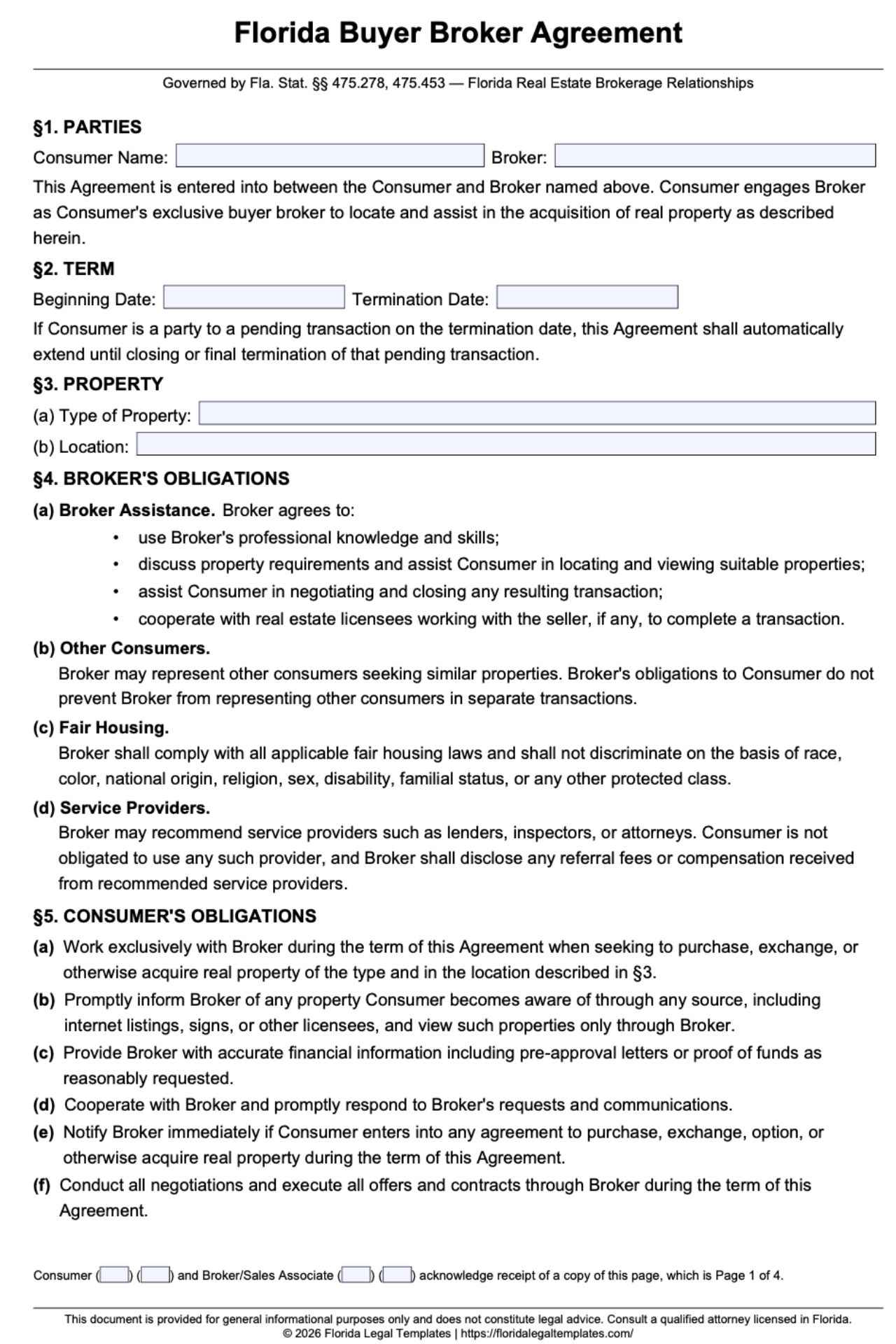
If you’re searching for a Florida buyer broker agreement PDF, a fillable template can provide a useful starting point for understanding how buyer representation works. These agreements are commonly used when a buyer wants to formally retain a licensed brokerage before beginning a property search.
A typical template allows the parties to complete information such as:
- buyer and brokerage details;
- representation type;
- agreement term;
- geographic search area;
- property type;
- compensation provisions;
- termination rights; and
- required signatures.
For many straightforward residential purchases, a properly completed template helps both parties clearly understand their respective obligations before negotiations begin.
Who Should Use This Template?
A Florida buyer broker agreement is commonly appropriate for:
- homebuyers working exclusively with one brokerage;
- first-time buyers who want professional representation throughout the purchase process;
- buyers relocating from another state;
- investors purchasing standard residential property; and
- licensed brokerages onboarding new buyer clients.
Using a written agreement early helps reduce misunderstandings about compensation, communication expectations, and the services the brokerage has agreed to provide.
When a Generic PDF May Not Be Enough
A downloadable template works well for many ordinary residential transactions, but certain situations require additional attention because Florida law imposes different rules or mandatory disclosures.
For example, buyers should avoid relying solely on a generic form when the transaction involves:
- commercial real estate, where buyer brokers may have statutory lien rights securing unpaid commissions;
- a Single Agent relationship, which carries fiduciary duties and requires specific statutory disclosures if the relationship later transitions to Transaction Broker status;
- agricultural property or larger multi-unit residential property that falls outside Florida’s residential agency disclosure definitions; or
- unusually complex compensation arrangements.
In those situations, brokerages often use standardized forms prepared by professional organizations such as Florida Realtors® because those forms are regularly updated to reflect current statutory and regulatory requirements.
Even when using a fillable PDF, buyers should carefully review every compensation provision, exclusivity clause, expiration date, and representation disclosure before signing. Most disputes involving buyer broker agreements arise not because the document is missing, but because one party misunderstood the obligations contained within it.
Is a Buyer Broker Agreement Required in Florida?
For most residential buyers, yes—in practice, you’ll need to sign one before a real estate licensee begins showing homes. Current industry rules require a written buyer agreement before touring properties with a prospective buyer.
That practical requirement, however, should not be confused with the legal framework governing brokerage relationships. Florida’s enforceable rules regarding agency relationships, broker duties, and commission disputes stem from Chapter 475 of the Florida Statutes, which regulates licensed real estate professionals. The agreement itself establishes the contractual relationship between you and the brokerage while documenting compensation, representation, and the scope of services.
The Difference Between Industry Practice and Florida Law
Many buyers assume Florida enacted a statute requiring every homebuyer to execute a buyer representation agreement. The legal reality is more nuanced.
Current industry practice requires a written agreement before home tours begin, while Florida law governs:
- brokerage relationships;
- commission enforceability;
- agency disclosures;
- licensing requirements; and
- professional conduct for real estate licensees.
Those legal rights and obligations arise under Florida’s real estate licensing laws rather than from a single statute stating that every buyer must execute a buyer broker agreement before purchasing property.
Understanding this distinction becomes important if disagreements later arise over commissions, representation duties, or disclosure obligations.
Does the Agreement Need a Notary or Witnesses?
No, Florida law does not require a buyer broker agreement to be notarized or signed before witnesses in order to be legally enforceable. Instead, the agreement is governed by ordinary Florida contract principles regarding offer, acceptance, consideration, and mutual assent.
This surprises many buyers because deeds, mortgages, and certain estate planning documents often require additional execution formalities. A buyer broker agreement does not.
As long as both parties properly enter into the agreement and the contract otherwise satisfies Florida contract law, the absence of a notary or subscribing witnesses does not invalidate it.
What About Verbal Agreements?
Although buyers and agents may discuss representation verbally, relying on an unwritten arrangement creates unnecessary risk.
Without a written agreement:
- the parties may disagree over compensation;
- the scope of representation becomes difficult to prove;
- important disclosures may never be documented; and
- disputes often become credibility contests if litigation occurs.
Florida law is particularly strict when commissions involve unlicensed individuals.
Under Florida law, any agreement promising compensation for real estate brokerage services performed by someone who is not actively licensed is void and legally unenforceable. Even if both parties verbally agreed to pay a commission, Florida courts will not enforce that promise if the recipient lacked the required license.
For buyers, the practical takeaway is straightforward: always confirm that the brokerage and the individual licensee are properly licensed before signing any representation agreement.
Exclusive vs. Non-Exclusive Buyer Broker Agreements in Florida
One of the most important decisions you’ll make before signing a Florida Buyer Broker Agreement is whether the relationship should be exclusive or non-exclusive. The choice affects who represents you, when compensation may be owed, and how much flexibility you retain while searching for a property.
Many buyers focus on the commission percentage but overlook the exclusivity clause. In practice, that provision often determines whether a commission remains payable even if you locate a property yourself or purchase through another brokerage during the agreement’s term.
Exclusive Buyer Broker Agreement
An exclusive buyer broker agreement means you appoint one brokerage as your sole representative for the duration of the contract. In exchange for providing search assistance, negotiations, market advice, and transaction support, the brokerage receives the exclusive right to earn the agreed compensation if you purchase qualifying property during the contract period.
This doesn’t necessarily mean the buyer always writes the commission check. Compensation may still come from the seller, be credited at closing, or be paid directly by the buyer depending on how the transaction is structured. The agreement simply establishes who has earned that compensation.
For buyers, the benefits include:
- consistent representation throughout the transaction;
- one point of contact for negotiations;
- fewer disputes over procuring cause;
- clearer fiduciary or brokerage obligations; and
- better continuity when searching over several months.
The trade-off is reduced flexibility. If you independently find a property, purchase directly from a builder, or work with another agent while the agreement remains active, you may still owe compensation under the contract if the exclusivity clause applies.
Non-Exclusive (Open) Buyer Representation
A non-exclusive arrangement gives the buyer considerably more flexibility.
Instead of committing to one brokerage, the buyer may work with multiple agents or brokerages simultaneously. Generally, only the brokerage that successfully completes the transaction earns compensation.
Although this approach offers freedom, it also creates practical disadvantages.
Agents may be less willing to spend significant time arranging showings, researching off-market opportunities, or negotiating aggressively if there is no assurance they’ll ultimately represent the buyer through closing.
For that reason, non-exclusive agreements are more common when:
- buyers are still deciding which brokerage to hire;
- investors pursue multiple opportunities simultaneously;
- buyers are relocating and interviewing several agents; or
- the expected search period is relatively short.
Pay Close Attention to the Agreement’s Scope
Regardless of whether the agreement is exclusive or non-exclusive, buyers should carefully review how broadly the contract defines the broker’s representation.
Several provisions deserve particular attention:
Term Length
Many agreements remain effective for several months. A longer term can provide continuity, but it also delays your ability to switch brokerages if the relationship isn’t working.
Geographic Area
Some agreements cover an entire county or region, while others apply only to specific neighborhoods or cities. Defining the search area too broadly may unintentionally expand your obligations.
Property Type
A buyer searching for a primary residence may not intend the agreement to cover vacant land, investment property, or commercial real estate. Those categories should be identified clearly whenever possible.
Don’t Overlook the Protection Period
One of the most misunderstood provisions is the protection period, sometimes called a holdover clause.
This provision allows the brokerage to claim compensation if the buyer purchases a property introduced during the agreement, even after the contract itself expires.
For example, suppose an agent shows you a home in May. Your agreement expires in June, but you purchase that same property through another brokerage in July. Depending on how the protection clause is drafted, the original brokerage may still claim it earned the agreed compensation.
Protection periods exist to prevent buyers from waiting until an agreement expires solely to avoid paying the brokerage that performed the work.
Before signing, buyers should understand:
- how long the protection period lasts;
- which properties it applies to;
- whether written notice is required from the brokerage; and
- what events trigger compensation after expiration.
A carefully negotiated agreement balances the brokerage’s legitimate interest in protecting its work without creating obligations that continue far longer than the buyer reasonably expected.
How Florida Law Shapes Your Buyer Broker Agreement
Florida buyer broker agreements are more than ordinary service contracts. They operate within a detailed regulatory framework governing licensed real estate professionals, brokerage relationships, commissions, and mandatory disclosures.
Although the agreement itself is negotiated between the buyer and brokerage, several provisions are heavily influenced by Florida law. Understanding those rules helps buyers recognize which clauses are legally significant and which are simply contractual business terms.
Florida Statutory Matrix
| Topic / Issue | Florida Legal Rule | Governing Statute |
|---|---|---|
| Presumption of Transaction Brokerage | Licensees are presumed to act as Transaction Brokers unless another relationship is established in writing. | Fla. Stat. § 475.278(1)(b) |
| Dual Agency | Dual Agency is prohibited in Florida. | Same statute (§ 475.278(1)(a)) |
| Residential Scope Limitation | Residential definitions under Fla. Stat. § 475.278(5)(a) apply strictly to improved property of four or fewer units, unimproved residential lots, or agricultural land of 10 or fewer acres. Under § 475.278(1)(b), written relationship disclosure forms are completely exempt for default transaction brokers, mandating paperwork only for single agent or no-brokerage relationships. | Fla. Stat. § 475.278 (specifically subsections (1)(b) and (5)(a)) |
| Commission to Unlicensed Person | Agreements promising brokerage compensation to an unlicensed person are void and unenforceable. | Fla. Stat. § 475.41 |
| Commercial Buyer-Broker Liens | A licensed broker can place a statutory lien on a commercial property transaction to secure unpaid commissions. This right depends entirely on the existence of a signed, written brokerage agreement | Fla. Stat. § 475.703 |
| Execution Formalities | No witness or notary is required; general Florida contract principles govern execution. | Common-law contract formation |
Florida’s brokerage statutes do more than regulate licensing—they determine how representation is created, when commissions can be enforced, and what disclosures must appear in the agreement. Failing to comply with these requirements can affect both regulatory compliance and a brokerage’s ability to enforce contractual rights.
From a buyer’s perspective, these rules also provide important consumer protections. They restrict who may legally earn brokerage compensation, prohibit dual agency, and require brokerage relationships to be clearly identified rather than left to assumption.
Practical Impact & Mandated Clauses
A well-drafted Florida Buyer Broker Agreement should clearly identify the type of brokerage relationship being created. Under Fla. Stat. § 475.278, a real estate licensee is presumed to act as a Transaction Broker unless a Single Agent or No Brokerage Relationship is established in writing.. Leaving this section incomplete can create expectations that differ from the legal relationship that actually exists.
Compensation provisions deserve equal attention. Any agreement addressing broker compensation should prominently disclose that the broker’s fee is fully negotiable and is not established by law, antitrust regulation, or any Multiple Listing Service. This disclosure helps promote transparency while reducing the risk of deceptive trade or antitrust concerns.
If the parties establish a Single Agent relationship but later need to transition to a Transaction Broker relationship, Florida law requires prior written consent using specific statutory language presented in uppercase. Omitting or altering that required disclosure may create compliance issues and complicate the brokerage relationship later in the transaction.
These clauses are not merely administrative paperwork. They define the legal duties owed by the brokerage, clarify how compensation is earned, and reduce the likelihood of disputes after a purchase contract has already been negotiated.
How to Fill Out and Execute the Agreement
A Florida Buyer Broker Agreement allocates responsibilities between the buyer and the brokerage before the property search begins. Completing it carefully helps avoid commission disputes, misunderstandings about representation, and compliance issues later in the transaction.
Step 1: Identify the Parties and Confirm Licensure
Begin by entering the full legal names of:
- The buyer(s)
- The licensed real estate brokerage
- The individual sales associate or broker, if applicable
Before signing, verify that the brokerage and licensee are actively licensed in Florida. This is more than a formality.
Under Florida law, any agreement promising a commission to someone performing brokerage services without an active Florida real estate license is void and unenforceable. A buyer who unknowingly signs with an unlicensed individual may later discover that the agreement cannot legally support a commission claim.
Step 2: Select the Brokerage Relationship
One of the most significant sections of the agreement identifies how the brokerage will represent you.
Florida recognizes several brokerage relationships, but unless another relationship is established in writing, a licensee is presumed to act as a Transaction Broker.
Your agreement should clearly state whether the brokerage will act as:
- Transaction Broker
- Single Agent
- No Brokerage Relationship (where applicable)
This section directly affects the duties owed to you during the transaction.
If a Single Agent relationship is chosen and later changes to a Transaction Broker relationship, Florida law requires prior written consent using the exact statutory disclosure language in uppercase.
The required disclosure reads:
FLORIDA LAW ALLOWS REAL ESTATE LICENSEES WHO REPRESENT A BUYER OR SELLER AS A SINGLE AGENT TO CHANGE FROM A SINGLE AGENT RELATIONSHIP TO A TRANSACTION BROKERAGE RELATIONSHIP IN ORDER FOR THE LICENSEE TO ASSIST BOTH PARTIES IN A REAL ESTATE TRANSACTION BY PROVIDING A LIMITED FORM OF REPRESENTATION. THE LAW REQUIRES THE LICENSEE TO OBTAIN THE PRIOR WRITTEN CONSENT OF THE BUYER OR SELLER BEFORE CHANGING THE RELATIONSHIP.
Using different wording or omitting this disclosure may create regulatory compliance issues if the brokerage relationship changes during the transaction.
Step 3: Clearly Define the Scope of Representation
The agreement should describe exactly what properties the brokerage is authorized to help you purchase.
Typical limitations include:
- cities or counties;
- neighborhoods;
- property type;
- price range; and
- intended use (primary residence, investment, vacant land, etc.).
Defining the scope carefully reduces future disagreements over whether a particular purchase falls within the agreement.
If the transaction involves commercial real estate or property outside Florida’s residential agency definitions, additional contractual considerations may apply beyond a standard residential template.
Step 4: Establish the Agreement Term
Every buyer broker agreement should specify:
- the effective date;
- expiration date;
- any renewal provisions; and
- any protection (holdover) period.
Avoid leaving the term open-ended.
A clearly defined expiration date allows both parties to know when representation ends, while the protection period identifies circumstances where compensation may still be owed after expiration for properties introduced during the agreement.
Before signing, buyers should understand exactly how long those post-expiration obligations remain in effect.
Step 5: Complete the Compensation Section
The compensation provision deserves careful review because it explains when, how, and by whom the brokerage is paid.
Depending on the transaction, compensation may be structured as:
- a percentage of the purchase price;
- a flat fee;
- an hourly arrangement; or
- another mutually negotiated payment method.
The agreement should also explain whether compensation is expected from:
- the seller;
- the buyer;
- closing credits or concessions; or
- a combination of these sources.
Florida compliance standards also require the agreement to clearly disclose that:
Broker’s compensation is fully negotiable and is not set by law, antitrust regulation, or any Multiple Listing Service (MLS).
That statement promotes transparency and helps prevent misunderstandings about how commissions are determined.
Step 6: Execute the Agreement
Once every material provision has been reviewed, both parties should sign the agreement.
Unlike deeds and certain estate planning documents, a Florida Buyer Broker Agreement does not require witnesses or notarization to be legally enforceable under Florida’s general contract principles.
Each party should receive a complete copy immediately after execution.
That copy becomes the primary evidence of:
- the brokerage relationship;
- compensation terms;
- exclusivity;
- expiration date; and
- any negotiated modifications.
Compensation, Who Pays, and the “Negotiable” Rule
One of the biggest misconceptions surrounding buyer broker agreements is that the buyer always pays the broker directly.
In reality, Florida buyer broker agreements establish who is legally responsible for compensation, while the actual source of payment often depends on the purchase contract and negotiations between the parties.
How Buyer Broker Compensation Works
Compensation may take several forms, including:
- percentage-based commission;
- flat-fee representation;
- hourly consulting arrangements; or
- another mutually negotiated structure.
Depending on the transaction, payment may come from:
- the seller through the closing process;
- the buyer directly;
- negotiated seller concessions; or
- another contractually agreed arrangement.
The buyer broker agreement should explain these responsibilities clearly so neither party is surprised at closing.
Why the “Negotiable” Disclosure Matters
Florida administrative rules require agreements addressing broker compensation to clearly disclose that compensation is fully negotiable.
This disclosure reminds consumers that commissions are:
- not established by Florida law;
- not fixed by any Multiple Listing Service; and
- not standardized across brokerages.
Every brokerage remains free to negotiate compensation with its clients.
Removing or obscuring this disclosure can create unnecessary compliance concerns while reducing transparency during the representation process.
Hidden Fees Are Not Allowed
Compensation should never include undisclosed payments from third parties.
A buyer’s broker cannot secretly accept:
- referral fees;
- rebates;
- commission splits;
- title company incentives; or
- similar financial benefits
without the buyer’s prior written knowledge and consent.
Undisclosed compensation arrangements may constitute fraudulent dealing under Florida law and expose the licensee to disciplinary action, including suspension or revocation of their real estate license.
For buyers, this rule provides an important safeguard by ensuring the broker’s financial interests remain transparent throughout the transaction.
Commercial Transactions Follow Different Rules
Residential buyers rarely encounter statutory lien rights.
Commercial transactions, however, operate differently.
Where a written commercial buyer broker agreement expressly creates a commission obligation, Florida law allows the broker to assert certain lien rights against the buyer’s interest or net proceeds to secure unpaid compensation.
That distinction highlights why commercial purchases often require carefully drafted agreements rather than relying on generic residential templates.
Common Mistakes That Void or Weaken the Agreement
Most buyer broker agreement disputes don’t arise because the contract is missing. They happen because key provisions were overlooked, misunderstood, or drafted improperly. Knowing the most common mistakes can help buyers avoid unexpected commission claims and ensure the agreement accurately reflects the intended relationship.
Signing with an Unlicensed Individual or Brokerage
Before signing any agreement, verify that the brokerage and the individual agent hold an active Florida real estate license.
Any agreement promising compensation to an unlicensed individual is void under Fla. Stat. § 475.41. This protects consumers from paying commissions to individuals who are not legally authorized to provide brokerage services.
If you are unsure whether your agent is properly licensed, ask for their license information before executing the agreement.
Leaving the Representation Type Blank
Many buyers assume their agent automatically owes them full fiduciary duties.
That assumption can be incorrect.
Florida law presumes that a real estate licensee acts as a Transaction Broker unless another brokerage relationship is established in writing. If the agreement fails to identify the intended relationship, buyers may later discover that their expectations regarding confidentiality, loyalty, and representation differ from the legal duties actually owed.
Taking a few minutes to review this section before signing can prevent significant misunderstandings later in the transaction.
Including Liability Waivers That Go Too Far
Some agreements attempt to limit a brokerage’s legal responsibility through broad liability waivers.
While reasonable contractual limitations may be enforceable in some circumstances, Florida public policy does not allow a brokerage to avoid responsibility for:
- fraud;
- intentional misrepresentation;
- concealment; or
- culpable negligence.
Florida courts have consistently refused to enforce contractual provisions that attempt to shield a brokerage from liability for serious professional misconduct.
If a clause appears to excuse dishonest conduct or eliminate all accountability regardless of the circumstances, it deserves careful review before signing.
Attempting Dual Agency
Dual Agency often causes confusion for buyers moving from states where it is permitted.
Florida follows a different approach.
A single licensee cannot simultaneously represent both the buyer and seller as full fiduciaries in the same transaction.
Instead, if both parties are represented in the transaction, Florida law generally requires the brokerage relationship to operate as a Transaction Broker, providing limited representation to each side rather than undivided loyalty to both.
An agreement attempting to establish prohibited Dual Agency would conflict with Florida law and create immediate compliance issues.
Missing the Required Transition Disclosure
If the agreement begins as a Single Agent relationship but later changes to a Transaction Broker relationship, Florida requires prior written consent using specific statutory language presented in uppercase.
Failing to include that disclosure—or modifying the required wording—may create regulatory concerns and complicate the brokerage relationship if questions arise later.
Brokerages typically rely on standardized forms to reduce the risk of accidentally omitting this mandatory language.
Ignoring Broad Exclusivity or Protection Clauses
Many buyers skim past the exclusivity section because they’re eager to begin touring homes.
That can become expensive.
An overly broad agreement may:
- cover a larger geographic area than intended;
- apply to additional property types;
- remain effective longer than expected; or
- include a lengthy protection period after expiration.
Understanding these provisions before signing helps avoid post-closing disputes over whether compensation is still owed.
Recordkeeping, Privacy, and What Happens to the Signed Form
A common misconception is that a Florida Buyer Broker Agreement is filed with a government office after execution.
It isn’t.
The agreement remains a private contract between the buyer and the licensed brokerage.
It is not recorded with:
- the Florida Department of Business and Professional Regulation (DBPR);
- the Florida Real Estate Commission (FREC); or
- the county clerk of court.
Unlike deeds, mortgages, or certain other real estate documents, buyer broker agreements generally remain in the brokerage’s internal records.
Broker Record Retention Requirements
While kept completely private, brokerages must systematically retain all written buyer agreements, disclosures, and performance logs for at least five years under Fla. Stat. § 475.5015. If a document becomes part of an active court dispute, the storage timeline extends to two years past final resolution.
If the agreement later becomes evidence in litigation or a disciplinary proceeding, the retention period extends until two years after the matter has concluded.
This recordkeeping requirement helps ensure that regulators and courts can review the original agreement if questions arise regarding:
- agency disclosures;
- compensation;
- brokerage duties;
- commission disputes; or
- professional conduct.
Why Buyers Should Keep Their Own Copy
Do not rely solely on the brokerage to maintain the agreement.
Request a complete, fully executed copy immediately after signing and keep it with your closing documents.
Your copy serves as the primary evidence of:
- the agreed commission structure;
- the brokerage relationship selected;
- exclusivity terms;
- expiration date;
- protection period; and
- any negotiated revisions made before execution.
If a disagreement arises months later, that signed agreement will usually be the first document reviewed.
Frequently Asked Questions
If I sign an exclusive buyer broker agreement, do I owe a commission if I find the house myself?
Possibly, An exclusive agreement generally gives the brokerage the exclusive right to earn the agreed compensation during the contract term. Even if you locate the property independently or purchase through another brokerage, compensation may still be owed depending on the agreement’s wording and whether the purchase falls within the contract period or any applicable protection period.
Always review the exclusivity and holdover provisions before signing.
Is my buyer broker agreement valid in Florida without a witness or notary?
Yes, Florida law does not require a buyer broker agreement to be witnessed or notarized. Like most service contracts, it is governed by general contract formation principles rather than special execution formalities.
What happens if my agent never had me sign the brokerage relationship disclosure?
Florida presumes that a licensee acts as a Transaction Broker unless another relationship is established in writing.
If the agreement fails to properly document a different relationship, disputes may arise over the duties the brokerage owed during the transaction. While the enforceability of compensation depends on the specific facts and contract language, failing to complete required disclosures can create both contractual and regulatory issues.
Can I cancel or get out of a buyer broker agreement early in Florida?
That depends on the agreement.
Most buyer broker agreements specify an expiration date, but some also permit early termination by mutual written agreement. Others require the parties to continue performing until the stated expiration unless another contractual provision allows termination.
Even if the agreement ends early, certain obligations—such as a negotiated protection period covering properties previously introduced by the brokerage—may survive termination.
Before requesting cancellation, review the agreement carefully to determine what rights and obligations continue after the representation relationship ends.