Florida Hold Harmless Agreement (Free PDF & WORD Form)
A Florida hold harmless agreement is used when one party agrees to assume certain legal or financial risks so another party is protected if a claim, injury, or loss arises from a defined activity. Whether you’re hiring a contractor, selling property, renting equipment, organizing an event, or entering a business relationship, this document helps clarify who is responsible if something goes wrong. A well-drafted agreement reduces disputes by allocating risk before work begins rather than after an accident or lawsuit.
This articles provides a free Florida hold harmless agreement form, explains when it can be used, and highlights the Florida-specific rules that determine whether the agreement is likely to be enforceable. While many people search for a sample hold harmless agreement Florida, the wording matters far more than the title. Florida courts closely examine how liability is described, especially when a party attempts to shift responsibility for negligence. Understanding those requirements before signing can prevent an otherwise useful agreement from becoming unenforceable.
Candice Hayden, Legal Writer
Carly Johansson, Florida Contract Attorney Last Updated: October 28, 2026
Free Florida Hold Harmless Agreement (PDF & Word)
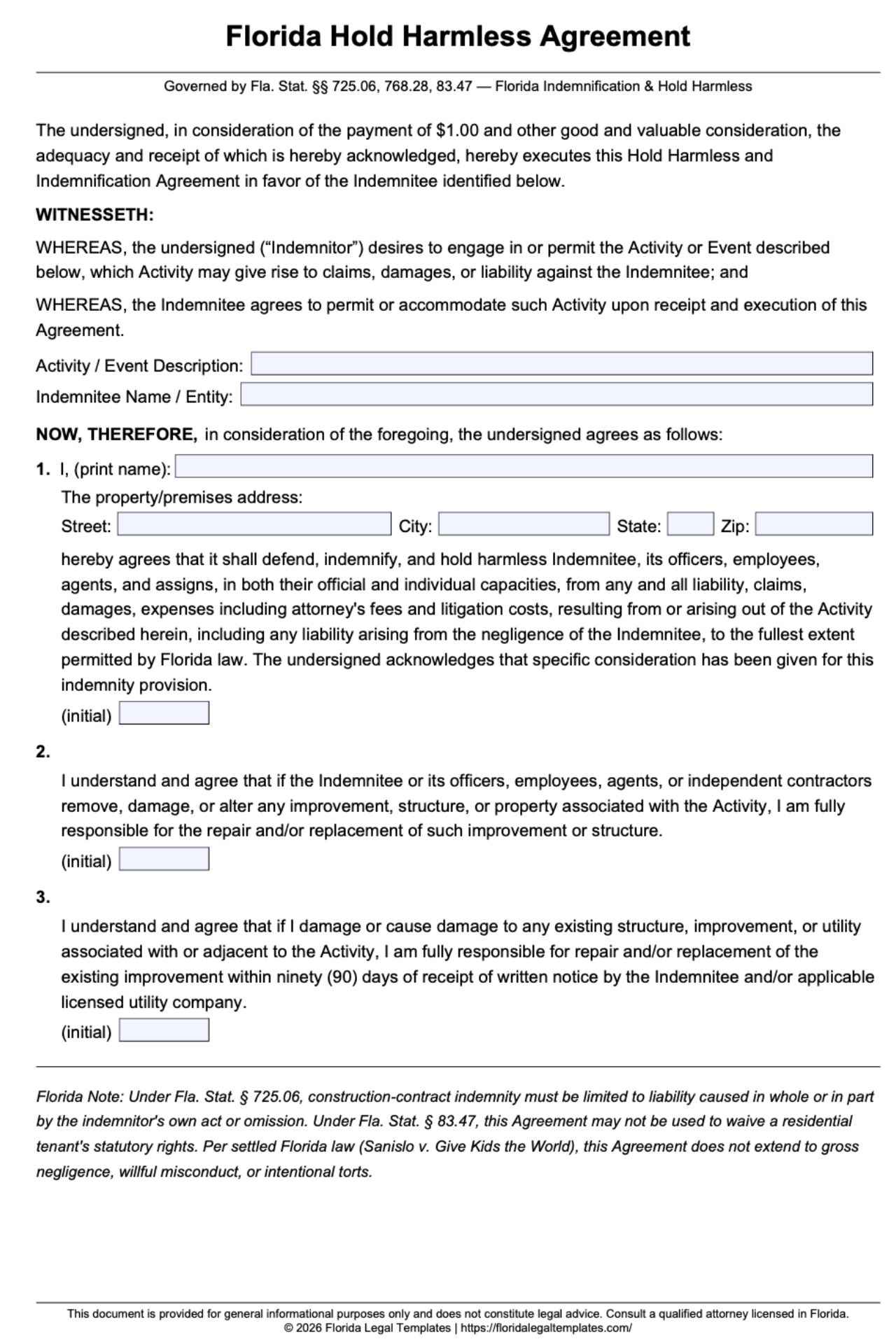
A free hold harmless agreement Florida template gives you a practical starting point for allocating risk between two parties. The document is commonly provided in both editable Word and fillable PDF formats so it can be customized for different situations without drafting a contract from scratch.
A well-prepared template typically includes:
- Identification of the indemnitor (the party assuming the risk)
- Identification of the indemnitee (the protected party)
- A detailed indemnification clause
- Scope of covered activities
- Defense obligations where applicable
- Duration of the agreement
- Signature blocks
- A monetary limitation field for qualifying construction agreements
- Optional witness and notary sections for stronger evidentiary value
Which version should you choose?
Different situations call for different language.
General or personal use
Suitable for:
- Equipment rentals
- Volunteer activities
- Recreational events
- Private property use
- Small business transactions
Real estate version
A hold harmless agreement Florida real estate template is often used when a buyer, seller, landlord, tenant, inspector, or contractor needs to allocate responsibility during property access, inspections, maintenance, or other property-related activities.
Construction version
A hold harmless agreement Florida construction template requires extra care because Florida law imposes special statutory restrictions on certain construction indemnity provisions. A generic agreement copied from another state may not satisfy those requirements.
Who commonly uses Florida Hold Harmless Agreement?
Florida hold harmless agreements are most useful when the parties need to decide in advance who will bear the financial consequences of a particular activity. For example, a property owner hiring a contractor may want the agreement to address claims arising from the contractor’s work, while an event organizer may need different language for risks associated with the event itself. The wording should match the activity rather than assume one form will cover every situation.
When this template is not enough
Even the best template has limits.
You should not rely solely on a standard form when:
- The agreement involves a public agency construction contract.
- The agreement attempts to waive liability for gross negligence or intentional misconduct.
- A large private construction project requires statutory monetary limitation language.
- The transaction involves significant financial exposure requiring customized risk allocation.
In those situations, project-specific drafting is usually far safer than relying on a generic template.
What a Hold Harmless Agreement Actually Does in Florida
Many people assume a hold harmless agreement eliminates liability altogether. That is not how it works.
Instead, the agreement reallocates responsibility between the parties. One party—the indemnitor—agrees to absorb specified legal or financial losses so the other party—the indemnitee—is protected from those claims.
Imagine a landscaping company performing work on private property. The property owner may require the contractor to assume responsibility for claims arising from the contractor’s work. If an employee damages neighboring property while performing the job, the agreement may determine which party bears that financial responsibility.
The agreement does not prevent accidents. It determines who is contractually responsible afterward.
One document, several legal functions
Under Florida law, similar language may operate as:
- a hold harmless agreement,
- an indemnity agreement,
- a release,
- or an exculpatory clause.
The document’s title is less important than the actual wording inside it. Courts examine the operative language to determine what obligations the parties intended to create.
For that reason, simply downloading a sample hold harmless agreement Florida is only the first step. The clauses must accurately reflect the specific transaction and clearly describe the intended allocation of risk.
Three common allocation structures
In practice, the allocation usually depends on who is taking the risk and whose conduct the agreement covers. Three structures appear most often: unilateral, mutual, and intermediate.
Unilateral
Only one party agrees to indemnify the other.
This is the most common arrangement in contractor relationships, equipment rentals, and vendor agreements.
Mutual (Reciprocal)
Each party agrees to protect the other against liabilities arising from its own conduct.
This approach is more common where both businesses perform services and both assume operational risks.
Intermediate
One party accepts broader responsibility than a simple unilateral agreement but not unlimited responsibility.
Construction projects often involve carefully negotiated intermediate indemnity language because multiple contractors may contribute to a loss.
Selecting the wrong structure can unintentionally shift far more liability than either party expected.
A hold harmless agreement is not insurance
One of the biggest misunderstandings is treating the agreement as a replacement for insurance coverage.
They serve completely different purposes.
A hold harmless agreement reallocates legal responsibility between the contracting parties.
Insurance, on the other hand, provides the financial resources to pay covered claims.
If the indemnitor has no assets or insufficient insurance, the contractual promise to indemnify may have little practical value even if the agreement itself is enforceable.
For that reason, experienced businesses often require both:
- a properly drafted hold harmless agreement, and
- proof of current liability insurance through a certificate of insurance.
Using both together provides significantly stronger risk management than relying on either one alone.
Defense obligations are not automatic unless the contract says so
Many Florida hold harmless agreements use the words “indemnify, defend, and hold harmless” together, but those are three different obligations. The duty to defend can require the indemnitor to provide or pay for a legal defense as soon as a covered claim is made, even before a court decides who was actually at fault. If your agreement only says the party will “indemnify” another for losses, you may end up arguing over whether attorney’s fees and defense costs are covered during the lawsuit or only after liability has been established.
This becomes especially important when a lawsuit names both parties. A property owner who waits until the case is nearly over before demanding a defense may face an argument that unnecessary legal expenses were incurred without giving the indemnitor a fair opportunity to assume the defense. For that reason, well-drafted Florida agreements often include a notice procedure requiring the protected party to promptly tender the claim, along with language explaining who controls the defense, whether the indemnitor may choose counsel, and whether settlement requires the other party’s consent. Those procedural details frequently determine the real-world value of the agreement far more than the indemnity clause itself.
Florida Laws That Decide Whether Your Agreement Holds Up
Signing a hold harmless agreement does not automatically make every clause enforceable. Under Florida law, courts look beyond the document’s title and examine whether its provisions comply with statutory requirements and established contract principles. Certain agreements—particularly those involving construction projects or public agencies—are subject to specific legal restrictions that generic templates often overlook.
For most private agreements, Florida follows common law contract principles. However, Chapter 725 and Chapter 768 contain important rules that affect indemnity provisions, negligence claims, and liability allocation. Missing one required clause can mean a carefully negotiated indemnity provision is unenforceable when you need it most.
Statutory Matrix — Rules That Control Enforceability
| Topic / Issue | Florida Legal Rule | Governing Statute |
|---|---|---|
| Execution Formalities (Witnesses) | No witnesses are required to execute a standalone hold harmless agreement. Governed by common law contract principles. | Common law contract principles |
| Notary Requirements | A notary acknowledgment is not required for a private hold harmless agreement to be legally binding. | Common law contract principles |
| Construction Monetary Limit | For qualifying Florida construction contracts, Fla. Stat. § 725.06(1) requires a monetary limitation that bears a reasonable commercial relationship to the contract. When a party in privity with the owner indemnifies the owner, the statute generally requires a limitation of at least $1 million per occurrence unless the parties otherwise agree, so the clause should be checked against the statute and the specific project documents. | Fla. Stat. § 725.06(1) |
| Public Agency Construction Projects | Public-agency construction contracts generally may require indemnity only to the extent liability is caused by the negligence, recklessness, or intentional wrongful misconduct of the indemnifying party and persons it employs or uses to perform the contract. | Fla. Stat. § 725.06(2)–(3) |
| Design Professional Public Contracts | Public-agency professional-services contracts may require a design professional to indemnify the agency only to the extent caused by the negligence, recklessness, or intentionally wrongful conduct of the design professional and persons employed or utilized by the design professional. | Fla. Stat. § 725.08 |
These rules illustrate why copying a generic indemnity clause from another state’s contract can create serious problems. Florida has adopted specific statutory limitations in areas where indemnity provisions have historically shifted excessive liability, particularly in the construction industry.
From a practical standpoint, the agreement should always be drafted with the underlying transaction in mind. A hold harmless clause suitable for a private equipment rental may be entirely inappropriate for a multimillion-dollar commercial construction project or a public works contract.
Practical Impact & Which Clauses These Laws Dictate
Florida courts distinguish a direct release from an indemnity agreement. In Sanislo v. Give Kids the World, Inc. (2015), the Florida Supreme Court held that a release is not automatically ineffective because it omits the word negligence; University Plaza Shopping Center, Inc. v. Stewart (1973), however, requires clear and unequivocal language when an indemnity agreement is intended to cover the indemnitee’s own negligence. Under University Plaza, general language such as ‘any and all claims’ does not by itself establish an agreement to indemnify an indemnitee for the indemnitee’s own negligence; the intent to cover that negligence must be expressed in clear and unequivocal terms.
Construction agreements deserve additional attention. Under Fla. Stat. § 725.06(1), a qualifying private construction indemnity provision must include a separate monetary limitation that bears a reasonable commercial relationship to the contract. Without that language, the indemnity clause may be challenged or declared unenforceable.
A commonly used statutory-style clause is:
“The Indemnitor’s liability under this provision shall be limited to the monetary sum of $1,000,000 per occurrence, which the parties agree bears a reasonable commercial relationship to the contract.”
The actual dollar amount may differ if the parties agree otherwise, but omitting the monetary limitation entirely is a common drafting mistake that can undermine the indemnity provision.
Florida law also draws a firm line when public agencies are involved. Florida law restricts indemnity and defense provisions in public-agency construction contracts under Fla. Stat. § 725.06(2)–(3), so the enforceability of a clause depends on the contract’s wording and the statutory limits on the indemnifying party’s responsibility. Any attempt to create that type of broad-form public indemnity is void under Florida law and cannot be enforced.
Finally, a hold harmless agreement does not automatically protect a party from every form of misconduct. In particular, Florida’s construction-indemnity statute excludes certain claims involving gross negligence or willful, wanton, or intentional misconduct, while the enforceability of other provisions depends on the language of the agreement and the type of claim involved. Those protections simply cannot be created by private agreement, even if both parties sign willingly.
This distinction often surprises business owners. A well-written agreement can effectively allocate many ordinary business risks, but there are legal boundaries that contract language cannot cross. Understanding those boundaries before signing is far less expensive than discovering them during litigation.
How Florida Use Shapes the Agreement: Construction vs. Real Estate vs. General
The same hold harmless clause does not work equally well in every transaction. Florida law and the nature of the activity determine how the agreement should be drafted.
Construction
A hold harmless agreement Florida construction is commonly used between owners, general contractors, and subcontractors. For private projects, an indemnity clause covering the owner’s negligence must include the monetary limitation required by Fla. Stat. § 725.06(1). Public construction contracts follow different statutory rules, and broad-form indemnity in favor of a public agency is not enforceable.
Real Estate
A hold harmless agreement Florida real estate is often used during property inspections, repair work, “as-is” sales, or landlord maintenance activities. It helps allocate responsibility for specific risks, but it does not automatically eliminate future claims. Ambiguous language or attempts to waive liability beyond what Florida law permits may still be challenged.
General and Personal Use
Outside construction and real estate, these agreements are frequently used for:
- Equipment rentals
- Event venues
- Volunteer activities
- Temporary property use
- Small business service contracts
In each case, the agreement should clearly define the activity being covered instead of using broad, catch-all language.
The Parental Pre-Injury Waiver Trap for Minors (§ 744.301)
A massive trap in event management, youth sports, and recreational facilities involves holding a business harmless for injuries to a minor child. Florida law now permits natural guardians, under Fla. Stat. § 744.301(3), to waive certain claims arising from a minor child’s participation in a commercial activity when the claim results from an inherent risk and the statutory requirements are satisfied.
To enforce a minor’s hold harmless agreement or liability waiver in Florida, the document must strictly comply with Fla. Stat. § 744.301. The statute requires a specific notice in uppercase type that is at least 5 points larger than, and clearly distinguishable from, the rest of the waiver or release. The notice explains that the parent is allowing the minor to participate in a potentially dangerous activity and is waiving specified claims arising from inherent risks. If an event organizer uses a generic hold harmless agreement without this exact statutory warning, the waiver is void on its face as to the minor child.
A hold harmless agreement should never be treated as a substitute for liability insurance or used to avoid responsibility for gross negligence or intentional misconduct.
How to Fill Out a Florida Hold Harmless Agreement
Completing the agreement correctly is just as important as using the right template.
- Identify the indemnitor and indemnitee using their full legal names rather than trade names alone.
- Describe the activity or project with enough detail that the scope of the indemnity is clear.
- Specify whether the agreement is unilateral, mutual, or intermediate.
- State the negligence language clearly and unequivocally so the parties understand exactly which risks are being allocated.
- For qualifying private construction contracts, include the required monetary limitation clause.
- Both parties should sign and date the agreement. Although Florida does not require witnesses or notarization for validity, either can strengthen proof of execution if a dispute later arises.
- Keep the signed agreement with your contract records and obtain a certificate of insurance whenever appropriate.
Filing, Recording & Record-Keeping
Keep the signed Florida hold harmless agreement with the contract or transaction it relates to, along with any insurance certificates and related notices. If the agreement forms part of a larger real estate or construction transaction, check whether that transaction has separate execution, filing, or recording requirements before assuming that retaining a private copy is sufficient.
Limitations That Void or Weaken the Agreement
Even a carefully drafted Florida hold harmless agreement has limits. A clause that shifts responsibility for a claim must still comply with the law governing that transaction, and signing the document does not automatically make every waiver enforceable. Before relying on a clause involving serious misconduct or a party’s own negligence, have a Florida attorney review the specific wording and the type of claim it is intended to cover.
Construction agreements that omit the required monetary limitation under Fla. Stat. § 725.06(1) risk having the indemnity provision declared unenforceable. Public-agency contracts are subject to additional limits: under Fla. Stat. § 725.08, a design professional may be required to indemnify a public agency only to the extent specified by the statute, and broader defense or indemnity provisions are generally void.
Governmental-agency agreements that attempt to hold a vessel or terminal facility harmless from liability for a prohibited pollutant discharge are prohibited by Fla. Stat. § 376.165.
Finally, risk allocation boilerplate should be read alongside Florida’s comparative-fault statute, Fla. Stat. § 768.81. The statute generally bars recovery in a negligence action when a party is found more than 50% at fault for their own harm, subject to the statutory exceptions; it does not, by itself, determine a contractual duty to defend or indemnify.
Costly Drafting Mistakes Florida Parties Make
Some of the most expensive disputes arise from avoidable drafting errors, including:
- Leaving out the required monetary limitation in a qualifying construction contract.
- Using vague phrases like “all claims” without clearly addressing negligence.
- Copying an out-of-state template that ignores Florida’s statutory requirements.
- Attempting to require a contractor to indemnify a public agency for the agency’s own negligence.
- Assuming notarization determines enforceability while overlooking the clarity of the indemnity language.
- Treating a hold harmless agreement as a replacement for liability insurance instead of using both together.
Frequently Asked Questions
Is a Florida hold harmless agreement valid without a notary or witnesses?
Yes. Florida law does not require witnesses or notarization for a standalone private hold harmless agreement to be legally binding, although either may strengthen the document’s evidentiary value.
Does my construction hold harmless clause have to state a dollar amount to be enforceable?
For qualifying private construction agreements covered by Fla. Stat. § 725.06(1), yes. The indemnity provision must include a monetary limitation that bears a reasonable commercial relationship to the contract.
Can a hold harmless agreement protect me if I was grossly negligent in Florida?
No. Florida public policy does not permit agreements that attempt to waive liability for gross negligence, intentional misconduct, criminal acts, or similar conduct.
Will a hold harmless agreement signed in a real estate “as-is” sale stop a buyer from suing later?
Not necessarily. The agreement may allocate certain risks, but it does not automatically bar every future claim. Its effectiveness depends on the language used, the circumstances of the dispute, and whether the provision complies with Florida law.
Legal Disclaimer: This article provides general information about Florida hold harmless agreements and is not legal advice. Laws and their application can change, and the appropriate language depends on the specific circumstances of your transaction. Consider consulting a qualified Florida attorney before using or signing a hold harmless agreement.