
Florida Eviction Notice [Free Printable, Fillable PDF Template]
A florida eviction notice is not just the first step in removing a nonpaying or noncompliant tenant it is also where timing and notice requirements can determine whether an eviction case can move forward. Florida’s eviction statute under F.S. §83.56 requires different notice periods depending on why the eviction is being initiated: three days for nonpayment of rent, seven days for a curable lease violation, and seven days to vacate for violations serious enough that no cure is required, and those distinctions are not interchangeable.
The florida 3 day eviction notice that most landlords reach for first comes with its own procedural trap: F.S. § 83.56(3) excludes Saturdays, Sundays, and court-observed legal holidays from the three-day count, so those days are simply left out when calculating the deadline. Delivery method matters just as much as notice period Furthermore, under F.S. § 83.56(4), if the tenant is absent from the premises, the landlord may deliver the notice by leaving a copy at the residence. A follow-up mailing is not required when another authorized delivery method has been properly used, and landlords should not assume that mailing a pre-suit notice automatically changes the statutory three-day period to an eight-day period.
I’ve watched landlords with airtight nonpayment cases get dismissed at their first hearing because the notice period miscounted a holiday or the certificate of mailing was missing sending them back to day one while the tenant stayed in possession. The florida eviction notice form and breakdown below cover the notice type, the correct counting method, and the delivery requirements Florida courts actually enforce.
Candice Hayden, Legal Writer
Ross Bridger, Florida, Real Estate Attorney
Florida Eviction Notice Forms (3-Day & 7-Day Notices)
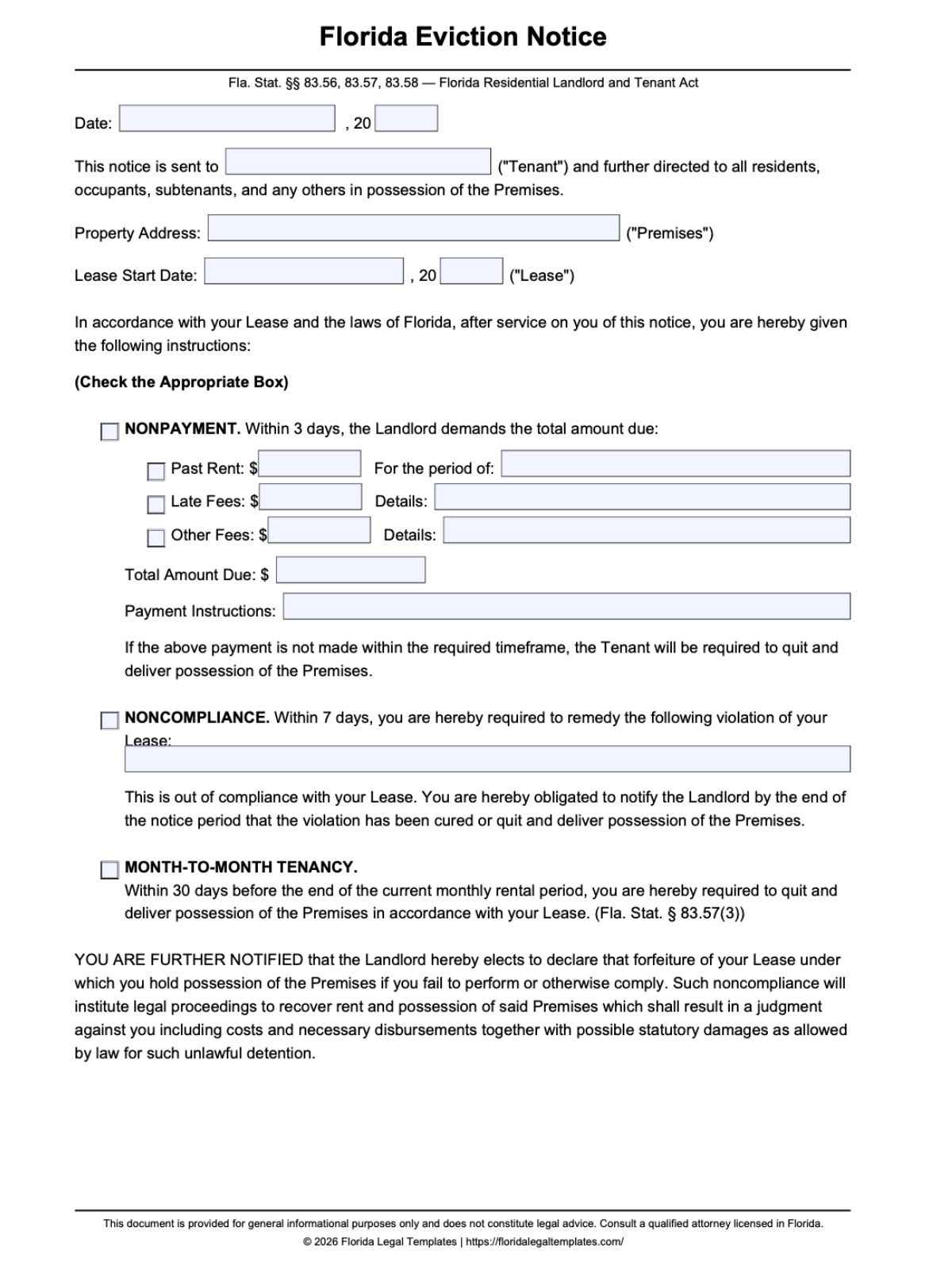
Florida landlords commonly use three eviction notice forms depending on the reason for terminating the tenancy.
3-Day Notice to Pay Rent or Vacate
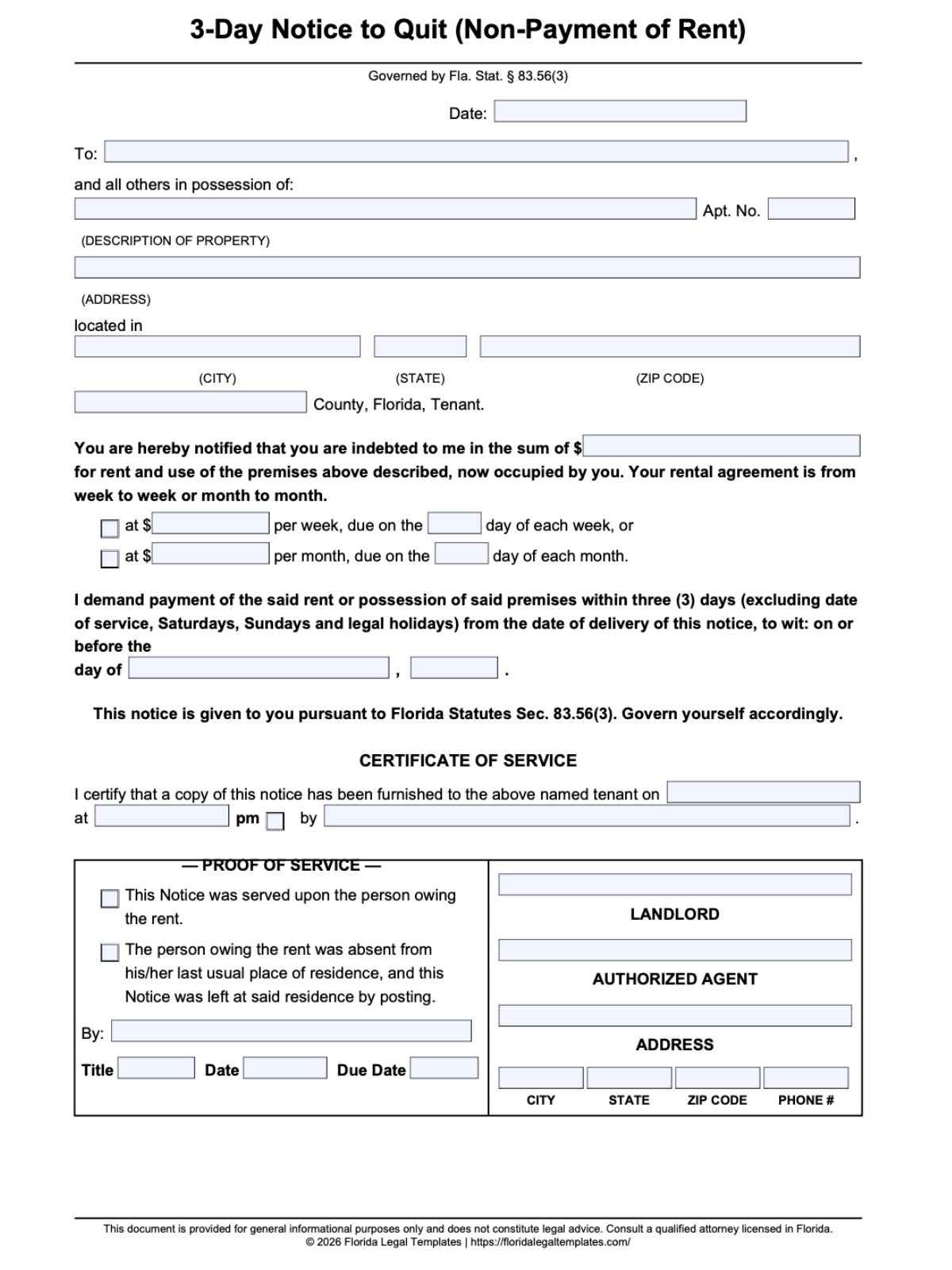
This notice is used when a tenant fails to pay rent. Under Florida law, the tenant must either pay the overdue rent or surrender possession of the property within the statutory notice period.
Before serving a notice, landlords should confirm the tenancy structure and rental terms in the original lease paperwork. Reviewing the underlying residential tenancy agreement or an existing month-to-month rental arrangement can help determine whether the tenant’s conduct actually violates the lease terms referenced in the notice.
7-Day Notice to Cure Noncompliance
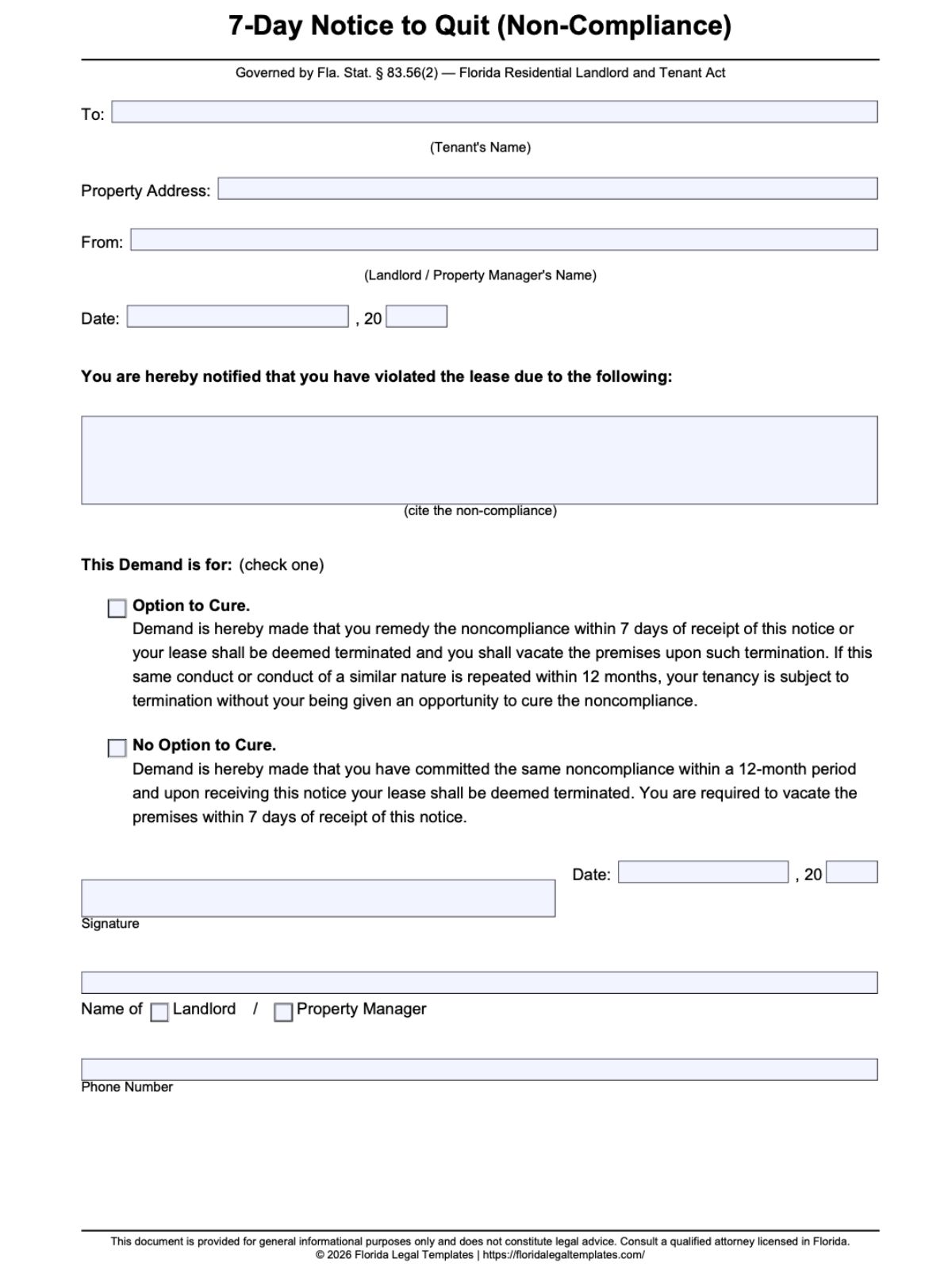
This form applies to lease violations that can be corrected, such as:
- Unauthorized pets
- Unauthorized occupants
- Repeated disturbances
- Failure to follow lease obligations
The tenant receives an opportunity to fix the violation within seven days.
7-Day Notice to Vacate for Incurable Violations
This notice applies to severe misconduct that does not require a cure opportunity, including:
- Intentional property destruction
- Violent behavior
- Serious criminal activity
These forms are commonly available as:
- PDF downloads
- Printable notices
- Fillable digital templates
A valid Florida eviction notice typically includes:
- Tenant names
- Rental property address
- County information
- Description of the violation
- Statutory deadline language
- Landlord or authorized agent signature
Landlords should avoid copying generic internet templates without reviewing Florida statutory requirements. Florida courts require strict compliance with statutory wording, especially for a 3-day notice to quit.
What Is a Florida Eviction Notice?
A Florida eviction notice is a mandatory pre-suit legal notice governed by Florida residential landlord-tenant law. It serves as the formal warning a landlord must provide before initiating an eviction lawsuit under Chapter 83 of the Florida Statutes.
Under Florida law, the notice itself does not evict the tenant. A landlord cannot legally remove a tenant without obtaining a court order.
Eviction notices differ from related rental notices because they are tied directly to statutory eviction procedures. They are not the same as:
- Lease termination letters
- Month-to-month non-renewal notices
- General demand letters
- Informal warnings
They are also fundamentally different from unlawful “self-help” measures, such as changing locks or shutting off utilities.
The purpose of the notice is procedural. It gives the tenant a legally required opportunity to either:
- Pay rent
- Cure a lease violation
- Vacate the premises before the landlord files an eviction action in court.
Florida eviction notices are closely tied to the broader landlord-tenant documentation process. In many disputes involving unpaid rent, landlords also rely on supporting records such as a written rent payment record or the tenant’s original rental screening documentation when preparing for court proceedings.
Types of Florida Eviction Notices
3-Day Notice to Quit for Nonpayment of Rent
A 3-day notice to quit is used when a tenant fails to pay rent owed under the lease agreement.
Pursuant to Florida Statutes § 83.56(3), landlords must provide three days for payment or surrender of the property, excluding Saturdays, Sundays, legal holidays, and the date of delivery from the calculation.
One of the most common legal mistakes involves including non-rent charges in the notice. A Florida 3-day notice should state the rent actually claimed as due, and landlords should be cautious about adding fees or other charges unless the lease and applicable law support treating those amounts as rent.
Improperly including:
- Late fees
- Utility charges
- Administrative fees
- Property damage costs
may invalidate the notice and result in dismissal of the eviction case.
Florida requires the 3-day notice to substantially comply with the statutory wording set out in Fla. Stat. § 83.56(3).
7-Day Notice to Cure Lease Violations
A 7-day notice to cure is used for lease violations the tenant can correct within the notice period.
Common examples include:
- Unauthorized pets
- Excessive noise complaints
- Improper parking
- Unauthorized occupants
Under Florida law, the notice must identify the noncompliance and give the tenant seven days from delivery to correct it.
Florida law also allows termination without another cure opportunity when the same or similar conduct recurs within 12 months after notice.
7-Day Notice to Vacate for Incurable Violations
Some lease violations are considered so serious that Florida law does not require the landlord to provide a cure period.
Examples may include intentional destruction, damage, or misuse of property, fraudulent entry of a residential dwelling, or a subsequent or continuing unreasonable disturbance, depending on the facts.
Under Fla. Stat. § 83.56(2)(a), the rental agreement is terminated while the tenant receives seven days from delivery of the notice to vacate.
Because these notices can lead directly to litigation, detailed violation descriptions are important.
Key Florida Laws That Affect Eviction Notices
| Topic / Issue | Florida Legal Rule | Governing Statute |
|---|---|---|
| 3-Day Notice Deadline | Excludes weekends, holidays, and delivery date | Fla. Stat. § 83.56(3) |
| 7-Day Notice Requirements | Tenant receives 7 full calendar days | Fla. Stat. § 83.56(2) |
| Delivery Methods | Notice may be mailed, hand-delivered, emailed, or posted | Fla. Stat. § 83.56(4) |
| Self-Help Evictions | Lockouts and utility shutoffs are prohibited | Fla. Stat. § 83.67 |
| Mandatory Statutory Language | Notices must substantially comply with statutory wording | Fla. Stat. § 83.56 |
| Non-Waivable Tenant Rights | Tenant notice rights cannot be waived by lease | Fla. Stat. § 83.56(6) |
| Court Filing Requirement | The landlord must satisfy the applicable notice requirement before filing an eviction action | Fla. Stat. § 83.59 and applicable Florida case law |
Florida’s eviction process is highly procedural. Courts frequently dismiss eviction actions when landlords fail to follow statutory notice requirements precisely.
The timing rules are especially important. A landlord who incorrectly counts weekends in a 3-day notice may accidentally shorten the statutory period, making the notice defective.
Florida also prohibits self-help evictions under Fla. Stat. § 83.67. A landlord who changes locks or disconnects utilities without a court order may face liability for damages, attorney’s fees, and additional financial penalties.
The governing eviction notice rules appear primarily in Fla. Stat. § 83.56.
Practical Impact & Document Clauses
Florida eviction notices are not casual warning letters. Each notice contains clauses that directly affect whether a court will allow the eviction case to proceed.
Critical statutory clauses include:
- Rent demand wording
- Cure language
- Vacate language
- Service-related requirements
A landlord who serves the wrong notice type or uses incorrect statutory wording risks restarting the process from the beginning.
Mandatory “Magic Words” Required Under Florida Law
Required Language for a 3-Day Notice
Florida law requires substantial compliance with the statutory wording in Fla. Stat. § 83.56(3).
A valid 3-day notice generally includes:
- Exact rent amount owed
- Property address and county
- Deadline for payment
- Demand for possession if unpaid
- Landlord contact information
Missing these elements may create a fatal defect in the eviction process.
Required Language for a 7-Day Notice to Cure
A 7-day cure notice must identify the specific lease violation and demand correction within seven days.
Florida law also requires warning language explaining that repeated conduct within 12 months may lead to termination without another cure opportunity.
Required Language for a 7-Day Unconditional Notice
For incurable violations, the notice must clearly state that the lease is terminated immediately and explain the conduct justifying termination.
Vague accusations can create evidentiary problems if the case proceeds to court.
When to Use a Florida Eviction Notice
Florida eviction notices are commonly used for:
- Nonpayment of rent
- Unauthorized occupants
- Lease violations
- Excessive noise complaints
- Illegal activity
- Property damage
- Failure to comply with lease terms
They should not be used for:
- Informal roommate disputes
- Non-eviction disagreements
- Illegal lockout attempts
- Utility shutoff threats
Landlords dealing with holdover tenants after lease expiration may require different notices depending on the tenancy structure.
How to Fill Out a Florida Eviction Notice
Identify the Correct Notice Type
Match the notice to the violation. Using a 3-day notice for a non-rent lease violation can invalidate the eviction process.
Enter Tenant and Property Information
Include:
- Full tenant names
- Rental property address
- County location
Accurate tenant and property information also makes the notice easier to match to the lease and proof of delivery if the matter later reaches county court.
Describe the Violation Properly
For rent notices, state the exact unpaid rent amount.
For lease violations, clearly explain the conduct involved instead of using vague accusations.
Calculate the Deadline Correctly
For a 3-day notice to quit:
- Exclude Saturdays
- Exclude Sundays
- Exclude legal holidays
- Exclude the delivery date
For 7-day notices, Florida generally requires seven full calendar days from delivery.
Sign and Deliver the Notice
The notice should be signed by:
- The landlord
- Property manager
- Authorized agent
Keep copies of the notice and proof of service for court purposes.
Lease violations often arise from terms added after the original lease was signed. If the dispute involves pets, parking, maintenance obligations, or occupancy rules, landlords should review any applicable supplemental lease addendum provisions before drafting the notice to ensure the violation language matches the enforceable lease terms.
Proper Service Methods for a Florida Eviction Notice
Under Fla. Stat. § 83.56(4), acceptable delivery methods include:
- Hand delivery
- Mailing a copy
- Posting the notice at the residence if the tenant is absent
- Electronic delivery under limited circumstances governed by Fla. Stat. § 83.505
Proof of service is important because the notice becomes a required exhibit if the landlord files an eviction lawsuit under Fla.Stat. § 83.59.
Note on Mailing: While mailing a notice is an authorized method under subsection (4), doing so triggers Florida’s procedural timeline extensions. If a landlord mails a 3-Day Notice, they must add 5 additional days for postage transmission, transforming a brief 3-day window into an 8-day delay before a lawsuit can be filed.
Electronic Notice Delivery (§ 83.505) Requirements
Under Fla. Stat. § 83.505, landlords may electronically deliver notices by email when the landlord and tenant have signed the required addendum to the rental agreement agreeing to electronic delivery and have provided valid email addresses for that purpose.
Attempting to email an eviction notice without a fully executed § 83.505 addendum—or emailing a notice after a party has submitted a written revocation of electronic consent—fails the statutory service test under § 83.56(4). Furthermore, if an emailed notice bounces as undeliverable, the landlord must immediately fall back on physical delivery (hand delivery or posting) to preserve legal standing in court.
What Happens After Serving the Notice?
If the Tenant Pays or Cures the Violation
The tenant complies within the notice period, the tenancy generally continues and the issue is resolved.
If the Tenant Fails to Comply
If the tenant fails to pay rent, cure the violation, or vacate the property, the landlord may file an eviction lawsuit seeking possession of the premises.
The eviction notice and proof of service become part of the court filing.
Accepting Partial Rent After Serving a 3-Day Notice Can Reset the Eviction Timeline
One mistake that catches many first-time landlords off guard happens after the notice is served: accepting partial rent without strictly adhering to statutory procedures. Under general Florida contract principles, taking money after serving a 3-Day Notice can be interpreted as a waiver of the default, potentially forcing you to start the eviction process over.
However, Florida law provides an explicit statutory mechanism underFla. Stat. § 83.56(5)(a) that allows a landlord to accept partial rent without waiving the right to evict for the remaining balance. TTo preserve the landlord’s ability to proceed after accepting partial rent following a posted nonpayment notice, §83.56(5)(a) provides three statutory options:
-
Provide a Formal Receipt: Give the tenant a written receipt detailing the date, the amount received, and the agreed-upon due date for the remaining balancebefore filing the eviction complaint;
-
Deposit into the Court Registry: Place the entire accepted partial payment into the court registry at the time you file the eviction lawsuit; or
-
Issue a New 3-Day Notice: Serve a fresh 3-Day Notice reflecting the reduced balance, which restarts the three-business-day waiting period.
If partial rent is accepted after posting the nonpayment notice, the landlord should follow one of the procedures in Fla. Stat. § 83.56(5)(a) to avoid waiving the right to proceed on the existing noncompliance.
Because following these steps requires precise timing and accounting, many eviction attorneys advise landlords to simply decline partial payments during an active default. However, if accepting cash in hand is necessary, strictly utilizing the receipt or court registry rules under Chapter 83 will prevent your eviction case from being delayed or dismissed.
What Landlords Cannot Legally Do
Florida law prohibits landlords from:
- Changing locks
- Removing doors
- Disconnecting utilities
- Removing tenant property
- Harassing tenants into leaving
A violation of Fla. Stat. § 83.67 can expose a landlord to actual and consequential damages or three months’ rent, whichever is greater, plus costs and attorney’s fees.
Limitations and Legal Considerations
A Florida eviction notice does not automatically remove a tenant. Only a court can authorize physical removal through the formal eviction process.
Landlords should also understand several important limitations:
- Incorrect notices may invalidate the case
- Tenant notice rights cannot be waived by lease provisions
- Commercial leases follow different legal rules
- Retaliatory conduct may create legal defenses
County court procedures may also vary after the lawsuit is filed.
Not every tenancy dispute requires an eviction notice. In some situations, landlords may instead need updated tenancy terms through a lease renewal arrangement or a separate occupancy agreement such as a shared room rental contract, particularly when the issue involves informal living arrangements rather than statutory eviction grounds.
Common Mistakes to Avoid
The most costly mistakes are usually procedural: using the wrong notice, miscalculating the statutory period, failing to use an authorized delivery method, or filing before the applicable notice period has expired. Because Florida’s notice rules vary by the reason for termination, the form should be checked against the applicable subsection of §83.56 before filing.
One of the most overlooked mistakes in Florida eviction cases is relying on verbal understandings instead of written agreements. Property owners who hire outside maintenance personnel, leasing agents, or independent property managers should also maintain clear written service terms through documents like a property service contract to reduce disputes over authority, notice handling, and tenant communications.
Florida Eviction Notice vs Related Rental Notices
Eviction Notice vs Lease Termination Notice
An eviction notice addresses lease default or statutory noncompliance. Also, A lease termination notice may simply end a tenancy relationship without alleging wrongdoing.
Eviction Notice vs Notice to Vacate
A notice to vacate is not necessarily an eviction notice. Florida landlords may use move-out or nonrenewal notices in situations where the tenancy is ending without an allegation that the tenant breached the lease.
Residential vs Commercial Eviction Notices
Residential eviction notices are governed by Florida’s residential landlord-tenant statutes in Chapter 83, Part II. Commercial lease disputes may involve different statutory rules and notice standards.
Frequently Asked Questions
Can a Florida landlord email an eviction notice?
Florida law allows electronic delivery only under limited circumstances governed by Fla. Stat. § 83.505. Many landlords still use physical delivery methods to reduce service disputes.
Does a Florida 3-day notice include weekends?
No. Saturdays, Sundays, legal holidays, and the date of delivery are excluded from the 3-day calculation under Fla. Stat. § 83.56(3).
Can late fees be included in a Florida eviction notice?
Generally, a 3-day notice should demand only unpaid rent unless the lease explicitly defines additional charges as rent or additional rent.