
Florida Lease Renewal Agreement [Free Printable, Fillable PDF]
A florida lease renewal agreement is what prevents a fixed-term tenancy from quietly converting to month-to-month the moment a lease expires — and most Florida landlords do not realize that conversion happens automatically whether they intend it or not. Under F.S. §83.57, when a fixed-term lease ends and a tenant remains in possession with the landlord’s knowledge and acceptance of rent, Florida law treats the arrangement as a month-to-month tenancy from that point forward regardless of what either party assumed about the relationship continuing.
A lease renewal agreement florida signed before the original term expires resets the fixed term, preserves the lease conditions both parties agreed to, and keeps the landlord in a position to enforce those terms — rather than starting over under month-to-month rules that now require 30 days written notice to terminate under the 2023 update to F.S. §83.57(3).
I’ve worked with landlords who believed a verbal agreement or a text exchange confirming another year was enough to lock in a new term, only to discover two months later that their tenant could walk with 30 days notice and they had no fixed-term lease to point to. The florida lease renewal template below covers what the agreement needs to include to create a genuine fixed-term tenancy rather than an arrangement Florida courts will treat as month-to-month.
Candice Hayden, Legal Writer
Ross Bridger, Florida, Real Estate Attorney
Florida Lease Renewal Agreement Template
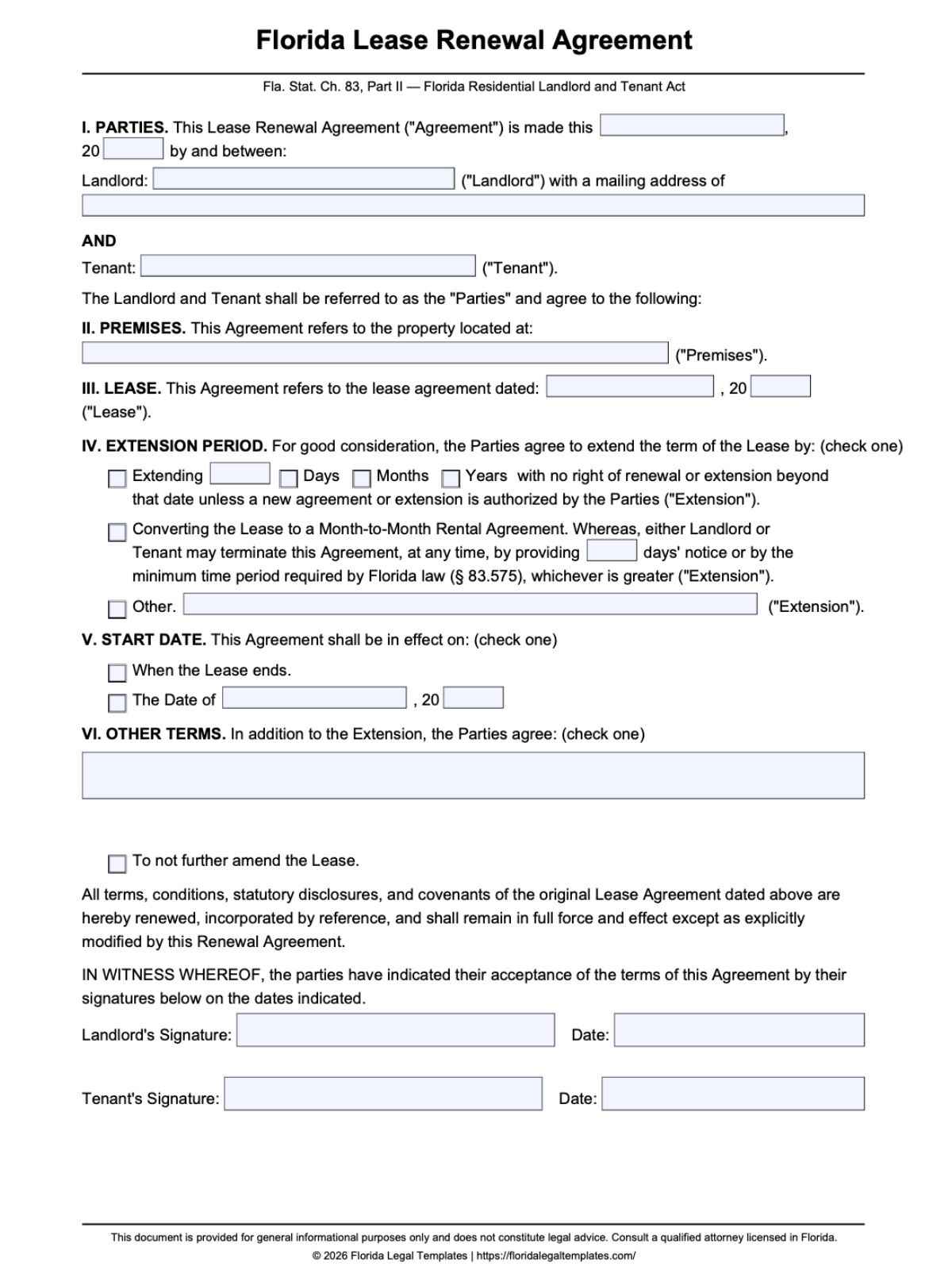
A standard renewal lease agreement florida template typically contains the following sections:
- Names of the landlord and tenant
- Property address
- Reference to the original lease
- Renewal start and end dates
- Updated monthly rent
- Renewal notice requirements
- Signature section
- Optional amended lease clauses
Most templates are available in:
- Printable PDF format
- Editable Word documents
- Fillable electronic versions
This document is commonly used by:
- Residential landlords
- Property management companies
- Tenants extending an existing lease
- Owners renewing annual tenancy arrangements
A renewal template works best when the parties want to preserve most of the original lease terms while adjusting limited provisions such as rent, renewal dates, or notice obligations.
However, a simple extend lease florida form may not be appropriate for:
- Commercial properties
- Large-scale lease restructuring
- Mid-term modifications imposed without mutual agreement
- Tenancy disputes or pending eviction matters
To avoid ambiguity, the renewal should clearly reference the original lease execution date and state that all unchanged provisions remain in effect.
What Is a Florida Lease Renewal Agreement?
A Florida lease renewal agreement is a written contract that extends or renews an existing residential tenancy for a new lease term. Rather than replacing the original lease entirely, the renewal incorporates the prior agreement while updating specific terms.
Several related tenancy concepts are often confused:
- Lease renewal: Creates a new fixed term under the original lease framework
- Lease extension: Lengthens the current lease period, sometimes without major modifications
- Lease modification: Changes specific lease terms during an active tenancy
- Month-to-month tenancy: A periodic tenancy created when occupancy continues without a new fixed-term agreement
Under Florida law, these distinctions have practical consequences. If a fixed-term lease expires and the landlord continues accepting unconditional rent payments without a signed renewal agreement, the arrangement converts into a periodic tenancy without a specific duration under Fla. Stat. § 83.46(2). Because the duration is determined by the monthly rent payment interval, it becomes a month-to-month tenancy at will, which then requires a strict 30-day notice to terminate under § 83.57(3).
That conversion can significantly reduce a landlord’s control over lease duration and termination timelines. Instead of relying on fixed-term protections, the landlord may need to provide statutory notice before changing rent or terminating occupancy.
Florida also treats residential lease renewals as private contractual records. There is generally no requirement to record or register the agreement with state agencies or county offices.
A lease renewal only works properly when the underlying tenancy terms are already legally structured. If the original rental contract was incomplete or outdated, landlords often transition to a fully updated residential rental agreement form instead of relying on a short renewal addendum. For flexible occupancy arrangements that no longer need a fixed annual term, a periodic month-to-month rental contract may also be more appropriate.
Key Florida Laws That Affect Florida Lease Renewal Agreement
| Topic / Issue | Florida Legal Rule | Governing Statute |
|---|---|---|
| Execution Formalities | No witnesses required for residential lease renewal agreements | Fla. Stat. § 689.01(1) |
| Notice Window Limits | Renewal notice periods cannot be shorter than 30 days or longer than 60 days | Fla. Stat. § 83.575(1) |
| Liquidated Damages Reminder | Separate reminder notice required before penalty enforcement | Fla. Stat. § 83.575(2) |
| Electronic Signatures | E-signatures carry the same legal validity as handwritten signatures | Fla. Stat. § 668.50 (Uniform Electronic Transactions Act) |
| Holdover Conversion | Unconditional rent acceptance sets the duration based on payment periods. | Fla. Stat. § 83.46(2) & § 83.57(3) |
| Radon Gas Disclosure | Standalone renewal agreements may require statutory radon disclosure language | Fla. Stat. § 404.056(5) |
Under Florida residential tenancy law, landlords cannot freely create renewal procedures that conflict with statutory notice requirements. If a lease renewal clause attempts to impose notice windows outside the legally permitted 30-to-60-day range, those provisions may become unenforceable.
Florida also imposes procedural safeguards before landlords can collect liquidated damages tied to renewal notice failures. Pursuant to Fla. Stat. § 83.575, landlords must issue a separate reminder notice within a narrow statutory window before penalties can apply.
Electronic execution is also fully recognized under Florida law. Under Fla. Stat. § 668.50, electronic signatures executed through platforms like DocuSign generally carry the same enforceability as traditional signatures.
Practical Impact & Document Clauses
Florida no longer requires subscribing witnesses for residential lease renewal agreements, even when the renewed term exceeds one year. This simplifies execution compared to older Florida conveyance practices.
Notarization is also generally unnecessary because Florida law does not impose a blanket acknowledgment requirement for residential lease renewals.
Landlords should pay close attention to renewal notice clauses. If the lease imposes tenant notice obligations tied to penalties or liquidated damages, the agreement must specifically identify all applicable fees and charges. Failure to do so can weaken enforcement efforts.
Standalone renewal agreements may also require radon disclosure language under Fla. Stat. § 404.056(5) when the renewal creates a continuing tenancy exceeding 45 days.
Another overlooked issue involves litigation. If a landlord later files an eviction action tied to the renewal period, both the original lease and signed renewal agreement may need to be attached to the court complaint pursuant to Florida Rule of Civil Procedure 1.130. Missing exhibits can create dismissal risks during litigation.
When to Use Florida Lease Renewal Agreement
A florida lease renewal agreement is commonly used when:
- Renewing a fixed-term residential lease
- Extending tenancy with updated rent terms
- Keeping most original lease provisions intact
- Avoiding accidental month-to-month tenancy conversion
- Standardizing annual renewals for multiple units
- Negotiating small updates to occupancy terms
This document is especially useful when the landlord wants to preserve fixed-term protections while continuing the tenancy relationship.
Lease renewals are commonly used when the parties want to preserve an existing tenancy without renegotiating every lease provision from scratch. However, situations involving additional occupants, shared housing responsibilities, or subtenants may require supporting documents such as a shared housing responsibility agreement or a Florida sublease arrangement depending on how the property will be occupied during the renewal term.
Situations Where This Document May Not Be Appropriate
A simple renewal agreement may not work well for:
- Commercial lease renewals
- Oral tenancy arrangements
- Major lease restructuring
- Mid-term rent increases lacking contractual authority
- Ongoing eviction disputes
- Significant occupancy or property-use changes
Florida law also prevents landlords from unilaterally imposing new lease terms during an active fixed term unless the original lease already authorizes those modifications.
How to Create or Fill Out the Florida Lease Renewal Agreement
Identify the Original Lease
The renewal should clearly identify:
- Original lease execution date
- Property address
- Names of all parties
- Original lease term
The agreement should also confirm that all unchanged lease provisions remain incorporated into the renewed tenancy.
State the New Renewal Term
Specify:
- Renewal commencement date
- Renewal expiration date
- Whether the tenancy remains fixed-term
Avoid vague wording that could unintentionally create a periodic tenancy.
Add Updated Financial Terms
If rent or fees are changing, clearly state:
- New monthly rent amount
- Payment due dates
- Security deposit handling
- Fee-in-lieu arrangements if applicable
Florida law requires additional disclosure language when fee-in-lieu programs replace traditional security deposits.
If the renewal changes rent amounts, payment schedules, or recurring fees, landlords should maintain updated payment records throughout the new lease term. Using a standardized rental payment receipt form can help document compliance if disputes later arise regarding unpaid rent, partial payments, or renewal-related fee obligations.
Include Required Florida Disclosures
Certain renewal agreements require mandatory statutory language.
For example, standalone renewals exceeding 45 days may need the following radon disclosure:
“RADON GAS: Radon is a naturally occurring radioactive gas that, when it has accumulated in a building in sufficient quantities, may present health risks to persons who are exposed to it over time.”
If the agreement introduces a fee-in-lieu deposit arrangement, Florida law also requires the following disclosure statement:
“THIS DISCLOSURE IS BASIC. PLEASE REFER TO PART II OF CHAPTER 83, FLORIDA STATUTES, TO DETERMINE YOUR LEGAL RIGHTS AND OBLIGATIONS.”
Define Renewal Notice Obligations
If the renewal requires advance notice before termination or non-renewal:
- The notice period must remain within the statutory 30-to-60-day range
- Penalties and liquidated damages must be specifically listed
- Separate reminder notices may be required before enforcement
Execute the Agreement Properly
Florida generally allows:
- Handwritten signatures
- Electronic signatures
- Remote execution methods
Because the agreement functions as a legal contract, both parties should retain signed copies for future disputes or litigation.
Before drafting renewal terms, landlords often review the tenant’s original screening information to confirm employment, occupancy, and rental history details remain accurate. Many property managers keep the original tenant screening application alongside the renewal paperwork to maintain a complete leasing file, especially when rent terms or occupants are changing during the extension.
Required Florida Disclosure Language
Florida residential lease renewals sometimes require statutory disclosures depending on how the renewal is structured.
Radon Gas Disclosure
Standalone renewal agreements extending occupancy beyond 45 days may require radon disclosure language under Florida law.
The disclosure informs tenants about potential radon exposure risks and directs them toward additional public health resources.
Fee-In-Lieu Disclosure
If the renewal introduces a recurring fee alternative instead of a traditional security deposit, Florida law requires specific statutory disclaimer language.
Failing to include mandatory disclosures can create enforceability problems and increase litigation risk during future disputes.
Lease Renewal vs. Month-to-Month Tenancy in Florida
One of the biggest operational mistakes landlords make is allowing tenants to remain after lease expiration without a signed renewal agreement.
Under Fla. Stat. § 83.57(3), continued occupancy combined with unconditional rent acceptance may automatically create a month-to-month tenancy.
That change affects several important rights:
| Issue | Fixed-Term Renewal | Month-to-Month Tenancy |
|---|---|---|
| Lease Duration | Locked until expiration | Continues monthly |
| Rent Stability | Protected by contract | Easier to modify |
| Termination Rights | Limited during term | Requires statutory notice |
| Long-Term Predictability | Higher | Lower |
For landlords, failing to secure signed renewals can weaken occupancy control and increase termination complexity.
Limitations and Legal Considerations
A renewal agreement cannot be used to force unilateral lease changes before the current lease expires.
Florida law generally requires mutual written agreement when modifying tenancy terms. Landlords also cannot rely on local ordinances that conflict with statewide residential tenancy regulation because Florida preempts many local residential tenancy rules under state law.
Residential lease renewals also remain private contractual records. There is no requirement to file the agreement with:
- Sunbiz
- Florida Department of Revenue
- County Clerk recording offices
However, renewal agreements become critically important during litigation because courts may require signed copies when disputes arise.
A lease renewal agreement is designed to extend an existing tenancy — not rewrite the entire landlord-tenant relationship. When parties need to introduce major rule changes, pet policies, occupancy restrictions, or property-use provisions, landlords often use a separate lease amendment or addendum document rather than overloading the renewal agreement itself. In mixed-use or business occupancy situations, a commercial leasing contract may be required instead.
Electronic Signatures and Digital Lease Renewals
Florida recognizes electronic lease execution through the Florida Uniform Electronic Transactions Act.
Digital platforms commonly used for renewals include:
- DocuSign
- Adobe Sign
- PandaDoc
Landlords should maintain organized electronic records, including timestamps and signed PDF copies, to support future enforcement if disputes occur.
Common Mistakes to Avoid
Landlords and tenants frequently create legal problems by:
- Allowing occupancy without a signed renewal
- Using notice periods shorter than 30 days
- Forgetting required disclosure language
- Omitting liquidated damages details
- Attempting unauthorized mid-term rent increases
- Failing to attach renewal agreements during eviction lawsuits
- Assuming notarization or witnesses are mandatory
- Using generic out-of-state forms that conflict with Florida law
Many of these errors become expensive only after disputes arise. For example, landlords attempting to enforce invalid notice provisions may lose penalty claims entirely.
Frequently Asked Questions
Does a Florida lease renewal agreement need to be notarized?
No. Florida law generally does not require notarization for residential lease renewal agreements. The agreement is usually enforceable once properly signed by the parties.
What happens if a Florida lease expires without a renewal agreement?
If the landlord continues accepting rent after lease expiration, the tenancy may automatically convert into a month-to-month arrangement under Fla. Stat. § 83.57.
Can a landlord change rent terms during a lease renewal in Florida?
Yes, but the changes generally must take effect during the renewal period rather than during the active lease term unless a prior modification clause authorizes earlier adjustments.
Are electronic signatures valid for Florida lease renewals?
Yes. Florida recognizes electronic signatures under Fla. Stat. § 668.50, giving digitally executed lease renewal agreements the same legal enforceability as traditional paper contracts.